
An overnight gap can look like a strong directional message before the regular session even begins. A large gap up feels bullish because price has already traveled far above the prior close, while a large gap down feels bearish for the opposite reason. That interpretation is understandable, but it skips the most important question. The gap tells you that price changed; it does not tell you whether the cash-session market will accept that change.
This is where traders often confuse movement with agreement. Overnight trade can reflect genuine repricing, a major catalyst, thin-session positioning, or a temporary imbalance that changes once the full U.S. cash session opens. The market may continue from the new area, rotate back toward the prior range, or spend the first hour negotiating between the two. The trader’s job is to evaluate which behavior is developing rather than label the day from the gap alone.
What an Overnight Gap Means in Futures
For stocks, a classic gap is often described as an opening jump from the previous close with no trading between the two prices. Equity-index futures such as ES, NQ, and YM require a more careful definition because they trade through most of the overnight period. For intraday futures analysis, the useful comparison is usually the 9:30 a.m. ET regular-session opening price relative to the prior regular-session close or prior regular-session range. That creates an opening displacement even though futures may have traded continuously through the overnight move.
This makes the subject part of The Market first: the gap describes the environment before it describes an opportunity. That distinction matters because different gap definitions answer different questions. A trader measuring from the prior regular-session close is asking how far the cash session is opening from where the previous cash session ended, while a trader comparing the open with the prior day’s high or low is asking whether the market is opening outside the previous range. Neither definition is automatically superior, but the chosen definition must remain consistent.
A gap statistic becomes almost meaningless if the reference point changes whenever the chart story changes. The trader should define the reference before the open and preserve it during review. That keeps the gap measurement objective enough to compare across sessions. It also prevents hindsight from changing what counted as a meaningful displacement.
Measure Gap Size in Context
Raw points are the simplest way to describe a gap, but they are often the weakest way to compare one period with another. A 50-point NQ gap can be meaningful in one volatility regime and ordinary in another, while the same number of points means something entirely different in ES or YM. Percentage displacement improves comparability across price levels, and measuring the gap relative to recent average daily range or Average True Range (ATR) adds volatility context. The goal is not to discover one perfect measurement but to understand how unusual the opening displacement actually is.
The same principle applies when traders use labels such as small, medium, or large gap. Those categories should come from a defined historical or volatility-relative framework rather than intuition after the open. If recent sessions have been unusually wide, what looks dramatic on a fixed-point scale may be normal for the current environment. Context keeps the gap measurement descriptive instead of turning it into a prediction.
Why Big Gaps Feel Like Trend Days
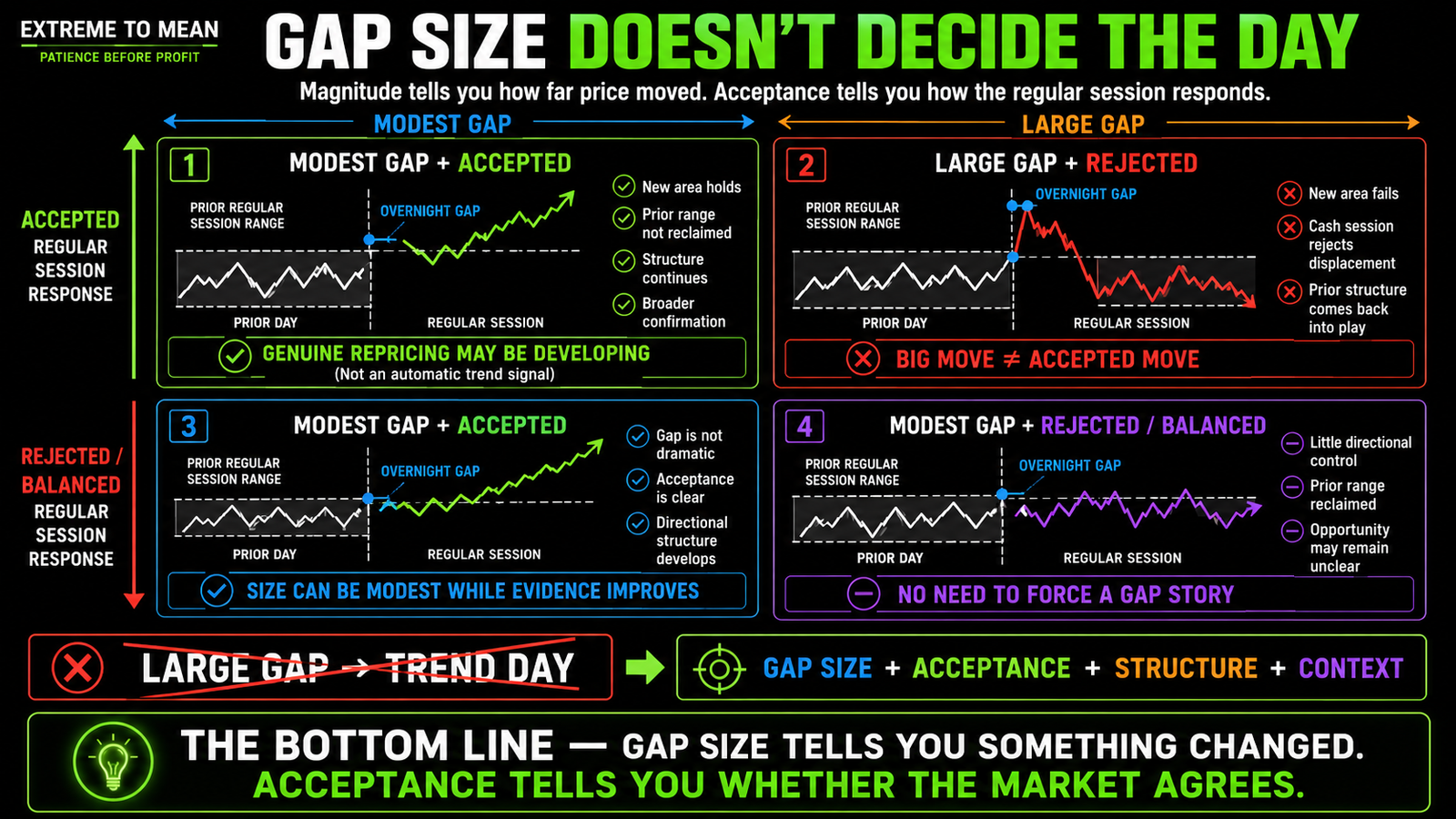
A large gap creates a compelling narrative because it appears to show conviction before the bell. If price is far above yesterday’s close, buying continuation can feel like joining obvious strength; if price is far below, selling can feel like following obvious weakness. The larger the displacement, the more psychologically difficult it becomes to imagine the market doing anything else. That is exactly why gap size can become a shortcut instead of evidence.
The opposite shortcut is just as common: assuming every gap must fill. The prior close is an important reference, but it is not a magnet with a schedule. Some gaps retrace quickly, some partially retrace, some remain open for the session, and some continue farther before revisiting the old area later. A gap-fill tendency in a dataset is not the same thing as a guaranteed intraday destination.
What Research Actually Says
Research on overnight and opening behavior supports a more cautious conclusion than either slogan. Studies have found that overnight returns can have measurable relationships with early-session behavior, and recent MNQ research has found that overnight gap magnitude can help identify statistically different intraday regimes. At the same time, trading rules built from those patterns have not automatically survived stricter tests for costs, sample size, and consistency. A market tendency can be real without being a complete trading system.
That distinction is central to the three market states. A gap can occur before a trend session, a rotational session, or a transition that begins one way and changes character later. The gap is one piece of pre-open context, not the day’s final classification. Treating it that way protects the trader from forcing every large opening displacement into the same playbook.
Acceptance Is More Important Than Magnitude
The strongest continuation case is not simply a large gap; it is a gap followed by evidence that the new area is being accepted. On a gap up, price may open above the prior range, hold above the important reference area, resist meaningful attempts to return inside, and continue building structure at higher prices. On a gap down, the same logic applies in reverse. The important observation is that the regular session is confirming rather than rejecting the overnight repricing.
A large gap that fails produces very different information. Price may open well outside the prior range, attract continuation traders, and then quickly lose the opening area as the cash session begins to trade back toward yesterday’s structure. The gap was still large, but the market’s response changed what that size meant. This is why context comes before the candle: the opening move needs to be interpreted through what happens next.
There is also a middle outcome that traders often overlook. Price can open outside the prior range, hold the gap without extending much farther, and spend time building a new balance rather than producing a clean trend or immediate fill. That behavior is neither a failed gap nor strong continuation. Acceptance can exist without creating an attractive entry at the current location.
Build a Context Stack Around the Gap
Gap direction is the beginning of the context stack, not the end. A gap up after a clean overnight trend may carry different information from a gap up produced by one abrupt premarket reaction, while a gap that opens directly into major prior structure may have less room than the same displacement into open space. The quality and timing of the catalyst also matter because markets respond differently to scheduled economic data, earnings-related index effects, geopolitical headlines, and moves with no obvious fresh trigger. The point is not to rank catalysts perfectly but to recognize what may have produced the repricing.
Cross-market behavior can add another layer for index-futures traders. If ES, NQ, and YM are all opening with compatible directional displacement and then accepting outside comparable reference areas, the continuation case has broader participation than an isolated move in one contract. Divergence does not automatically invalidate the leading market, but it should reduce the temptation to call the move universal strength or weakness. Confirmation adds evidence; it does not eliminate uncertainty.
The first hour is where the overnight story meets full cash-session participation. Instead of deciding at 9:29 that a large gap means trend, watch whether the open holds, whether failed attempts are reclaimed, whether price accepts inside or outside the prior range, and whether the developing structure supports continuation. This is the natural bridge between pre-open context and the market-state evaluation taught throughout Extreme to Mean. The more the first hour contradicts the overnight story, the less useful the original gap narrative becomes.
A Cleaner Gap Evaluation Process
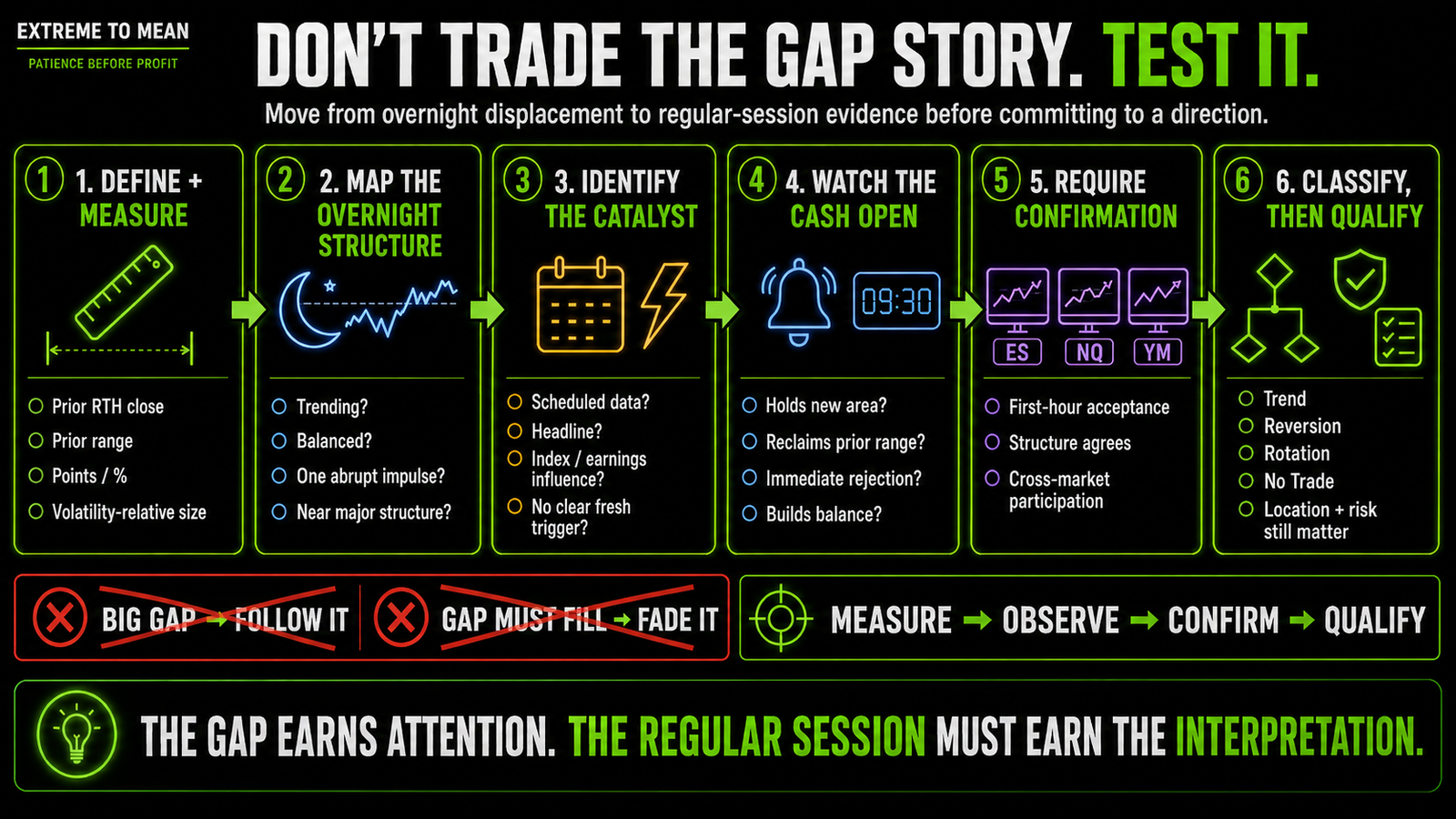
A cleaner process begins before the open by defining the gap consistently and measuring its size relative to current conditions. Then identify where the market is opening relative to the prior close, prior high or low, overnight structure, and other meaningful locations. After the bell, let the market show whether the displacement is being accepted, rejected, or simply balanced. Only then should the gap influence whether the developing environment deserves a Trend, Reversion, rotation, or No Trade classification.
This is another application of the principle that the market comes first. The trader does not need to ignore a large gap or pretend that it carries no information. The better process is to give the gap the correct job: identify that something meaningful changed before the open, then require current-session evidence before acting on that change. Gap size can earn attention without earning risk.
Better Questions Before You Follow or Fade
Before treating an overnight gap as continuation or a fade, ask questions that force the market to provide more than one piece of evidence. The best questions separate what happened overnight from what the regular session is confirming now. They also make post-trade review more useful because the decision can be reconstructed from observations rather than from hindsight. If several answers remain unclear, waiting is a valid classification rather than a failure to act.
- How am I defining and measuring this gap?
- How large is it relative to recent volatility or daily range?
- Is the cash session opening inside or outside the prior regular-session range?
- What did the overnight structure look like before the open?
- Was there a meaningful catalyst behind the displacement?
- Is the regular session accepting or rejecting the new price area?
- Are ES, NQ, and YM broadly confirming the move?
- What has the first hour added to or contradicted about the overnight story?
- Is the environment becoming Trend, Reversion, rotation, or No Trade?
- What evidence would invalidate my current interpretation?
The practical takeaway is not that large gaps should be faded or followed. It is that size should be recorded, normalized, and then placed beside acceptance, structure, catalyst context, first-hour behavior, and related-market confirmation. That produces a more complete decision record than simply writing “big gap” in a journal. Better context can improve consistency of evaluation without promising a particular market outcome.
Final Thought
Large overnight gaps matter because they tell you the market arrived at the regular session somewhere meaningfully different from where the prior session ended. They can precede strong trend days, sharp reversals, partial fills, or new areas of balance. The mistake is asking the magnitude of the gap to decide among those outcomes before the market has provided enough evidence. Gap size is information, not a verdict.
The better question is not, “Is this gap large enough to trend?” but, “Is the regular session accepting the repricing that happened overnight?” That question keeps attention on current behavior instead of a pre-open assumption. For a deeper framework on reading structure, context, and market behavior together, Decode the Market is the natural next step. Gap size tells you that something changed; acceptance tells you whether the market agrees with that change.
Educational content only. Trading involves substantial risk and is not suitable for everyone.