
For equity-index futures traders, “power hour” is usually shorthand for the final hour of the U.S. cash equity session, roughly 3:00 to 4:00 p.m. ET. Futures such as ES, NQ, and YM continue trading beyond the 4:00 cash close, so this hour is not the end of the futures market itself. What changes is the participation around the underlying stock-market close, including closing-auction orders, index activity, portfolio adjustments, and traders changing exposure before the bell. That makes the final hour structurally different from a quiet midday period without making it automatically predictive.
The mistake is assuming that visible closing strength reveals what informed money “knows” about tomorrow. A strong final hour can reflect genuine directional demand, short covering, benchmark-related flows, closing-auction imbalances, or traders simply adjusting positions before the session ends. A weak close can carry equally mixed causes. This is why final-hour behavior belongs inside The Market: evaluate what happened rather than inventing certainty about who caused it.
Read Closing Quality, Not Just Direction
The first thing to separate is closing direction from closing quality. A market that rises during the final hour is not necessarily finishing well if the move repeatedly fails at resistance, loses momentum, and settles far below the late high. Likewise, a market can spend much of the day weak and still produce an important change in character if buyers reclaim structure and hold into the bell. The close should be read as a completed sequence, not reduced to the color of the last candle.
Where the session finishes inside the day’s range is one useful starting point. A close near the high after persistent buying communicates something different from a late spike that is immediately rejected before 4:00. A close near the low after sustained selling differs from a sharp selloff that rebounds strongly into the bell. Closing location describes who retained control into the cash close, but it still does not tell you what overnight information will arrive next.
Seven Closing Behaviors Worth Distinguishing
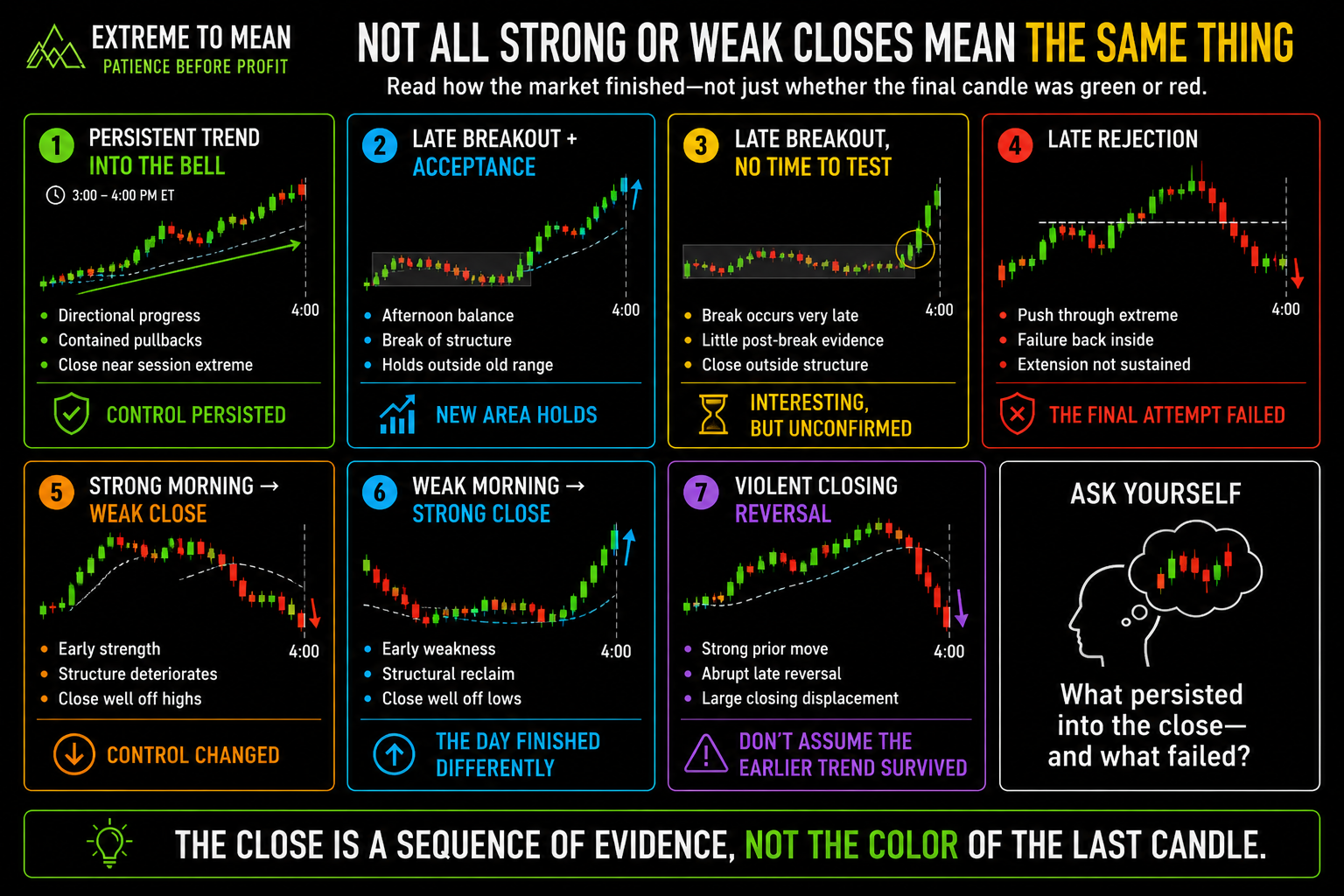
A persistent trend into the bell is the clearest version of closing continuation. Price keeps making directional progress, pullbacks remain contained, and the market finishes near the session extreme rather than surrendering the move. If related index futures are behaving similarly, the close carries broader confirmation. That combination can become useful context for tomorrow, but it is still context rather than a promise of follow-through.
A late breakout requires more care because timing compresses the amount of evidence available. Price may spend most of the afternoon balanced, break an important level after 3:00, and then hold outside the old structure into the close. That can show late acceptance, especially if the move persists through the final minutes. A breakout that occurs at 3:58 and never has time to be tested offers much less information than one that breaks earlier and survives a meaningful retest.
Late rejection is almost the mirror image. Price may attack the day’s high or low, briefly move through it, and then fail back into the prior structure before the bell. That failure can weaken the continuation story that looked obvious only minutes earlier. The market has not necessarily signaled a reversal for tomorrow, but it has shown that the final attempt to extend was not sustained.
Some of the most useful closes contradict the morning. A strong morning followed by a weak final hour can show that early directional control was not preserved, especially if the market gives back key structure and settles well off the high. A weak morning followed by a strong close can show the reverse: sellers controlled early trade but could not maintain that control into the cash close. Those changes in character often matter more than simply labeling the entire day green or red.
A violent closing reversal deserves its own category because it can dominate the final read of the session. If price trends for hours and then reverses sharply during the final hour, the move can reflect profit taking, repositioning, auction-related flow, or a genuine change in short-term control. The chart alone cannot identify the exact motive with certainty. What it can show is that the day did not finish with the same structure it carried earlier.
Closing Volume Needs Context
Volume can strengthen an interpretation, but closing volume is easy to misuse. The U.S. equity close concentrates substantial auction activity, and exchanges disseminate imbalance information as the closing process approaches, so heavier volume near 4:00 can reflect benchmark execution and auction mechanics as well as directional conviction. High volume accompanying persistent price acceptance is different from high volume during a violent two-sided auction. This is another reason context comes before the candle, even when the candle is accompanied by unusually heavy volume.
What Does the Close Say About Tomorrow?
This is where the broader lesson that the market comes first becomes useful. A strong final hour inside an established directional environment carries different information from the same move after an exhausted, two-sided session. Closing behavior can reinforce trend, expose transition, or leave the market rotational. The close should update the market classification rather than replace it.
The next-day question is where traders most often overreach. A strong close can become useful starting context because it tells you that buyers retained control into the cash bell, while a weak close tells you sellers did. Research does not support a universal rule that large late-day moves simply continue the next session, which is consistent with thinking in terms of the three market states rather than permanent continuation rules. The evidence is better used to define a hypothesis for tomorrow than to manufacture certainty.
Overnight Can Rewrite the Story
The overnight session can change that hypothesis before the next cash open arrives. Equity-index futures continue trading, new headlines can appear, overseas markets can move, and scheduled economic releases can reprice the entire complex. A strong close followed by an overnight failure back through important structure is no longer the same setup that existed at 4:00. Tomorrow begins with today’s close as one input, not with an obligation to honor yesterday’s final-hour direction.
Scheduled events deserve special attention because they can make the prior close stale very quickly. CPI, employment data, central-bank communication, major earnings, geopolitical developments, and other catalysts can materially change index pricing before 9:30 the next morning. The correct response is not to ignore the close, but to re-evaluate it against the new information. Context must be refreshed before commitment.
A Cleaner Power Hour Evaluation Process
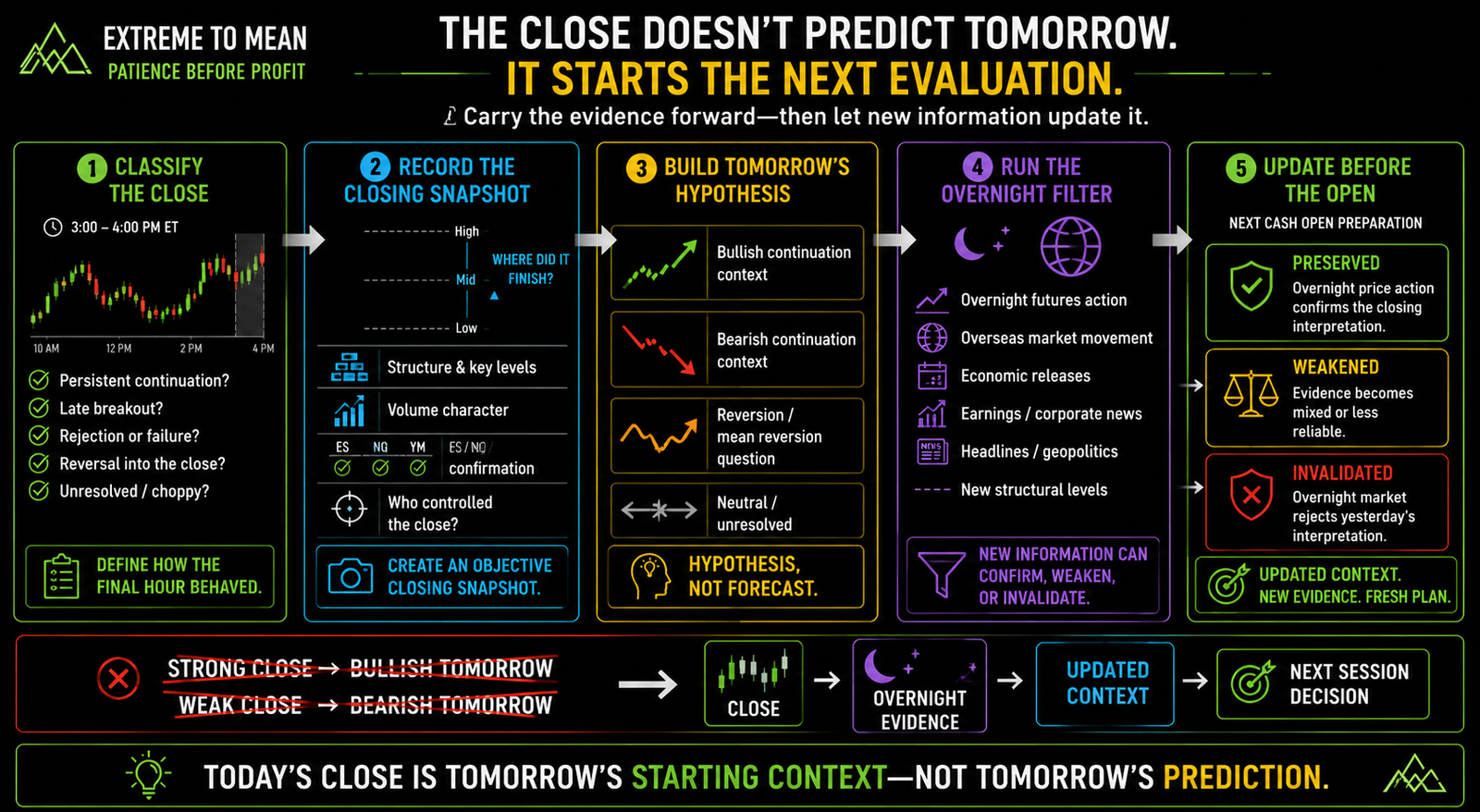
A cleaner process begins by classifying what actually happened during the final hour. Was there persistent continuation, a late breakout, a failed extension, a reversal, or a meaningful change from the morning’s structure? Then note where price finished relative to the day’s high, low, midpoint, and important structural references. That creates a closing snapshot that can be carried forward without pretending it predicts the next session.
Next, separate persistence from mere activity. Ask whether the move held through pullbacks, whether related markets confirmed, whether volume accompanied acceptance or only a chaotic closing auction, and whether the final hour strengthened or contradicted the day’s earlier structure. A close that survives those questions earns more weight in tomorrow’s preparation. A close that does not may still be informative because it tells you the market finished unresolved.
The final step happens before the next session begins. Compare the closing snapshot with the overnight structure, current futures location, known catalysts, and any fresh economic information. If the overnight session confirms the closing behavior, the prior-day context remains relevant; if it rejects it, the trader should update the story rather than defend yesterday’s conclusion. Flexibility here means responding to new evidence before entry, not changing the explanation after risk is already committed.
Better Questions After Power Hour
The goal of this process is not to forecast whether tomorrow opens higher or lower. It is to begin the next session with a structured question: did the market preserve, weaken, or invalidate what the final hour appeared to show? That question makes the close part of scenario planning rather than a directional prediction. It also keeps the trader focused on evidence that can be updated as the market changes.
- Did the final hour continue the day’s structure or contradict it?
- Did price finish near the high, low, or middle of the session range?
- Was the late move persistent or quickly rejected?
- Did a late breakout have time to establish acceptance?
- Did ES, NQ, and YM broadly confirm one another?
- Did increased closing volume accompany directional acceptance or two-sided auction activity?
- Was the final move fresh, or did it occur after substantial movement had already been spent?
- What important structure should carry into tomorrow’s preparation?
- What overnight behavior would confirm the closing interpretation?
- What overnight behavior would invalidate it?
- Are important economic releases or other catalysts scheduled before the next cash open?
A practical review works best when it records both the closing behavior and what happened afterward. That allows the trader to study whether certain kinds of closes tend to retain relevance in their market and timeframe without assuming a universal rule. The review should distinguish the quality of the close from the eventual next-day outcome. Otherwise, hindsight can make every winning continuation look obvious and every reversal look predictable.
Final Thought
The final hour deserves attention because the cash market is moving toward an important benchmark close while participants are making decisions that do not occur with the same intensity at midday. Persistent trend, failed extension, closing reversal, auction volume, and closing location can all add useful information. None of them survives the night automatically. The value of power hour is that it helps define tomorrow’s starting context more clearly.
A strong close can support a bullish scenario and a weak close can support a bearish one, but both scenarios remain conditional. Overnight price action and new information can confirm, weaken, or erase the meaning of the prior close before the next cash session begins. For a deeper framework on reading structure and context together, Decode the Market is the natural next step. The close becomes tomorrow’s starting context, not tomorrow’s prediction.
Educational content only. Trading involves substantial risk and is not suitable for everyone.