
Many traders spend most of their energy trying to figure out where the market is going next. They study candles, indicators, headlines, levels, patterns, and reactions because they want confidence before they act. That desire makes sense. Trading feels easier when the next move seems obvious.
But being right about direction is not the same as making a good trade.
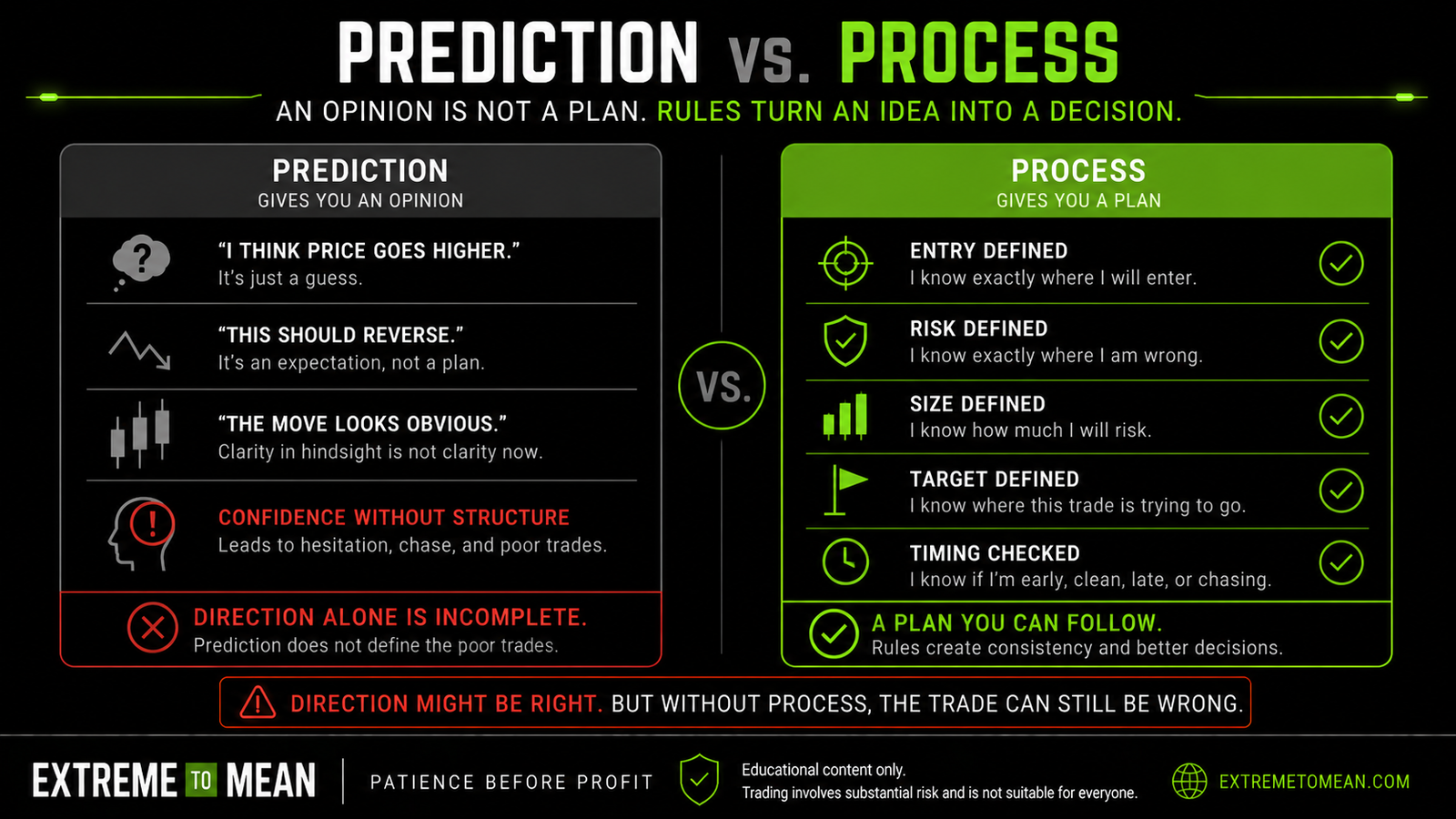
A trader can correctly think the market is likely to move higher and still enter too late, size too large, place the stop poorly, ignore the target, or chase after the clean opportunity has passed. The idea may be reasonable while the execution still makes the trade weak. That is why process matters more than prediction.
Extreme to Mean teaches trading as a decision-quality problem, not a certainty problem. The goal is not to know what the market must do next. The goal is to have a clear way to decide what deserves attention, what deserves risk, and what should be left alone. That is why this lesson belongs with the broader trader psychology lessons, where patience, discipline, and rules matter as much as chart reading.
Prediction Feels Powerful, but It Is Not a Plan
Prediction feels good because it gives the mind something to hold onto. If a trader believes the market is going higher, they feel organized. If they believe the market is going lower, they feel prepared. The opinion gives the moment a sense of direction.
The problem is that an opinion does not answer the practical trade questions.
Where is the entry? Where is the invalidation point? How much size makes sense? What is the target? What market condition would cancel the idea? What will the trader do if price moves toward the idea but never gives a clean entry? What happens if the first reaction is messy?
Prediction does not answer those questions. Process does.
A prediction might say, “I think price will revert toward the mean.” A process asks, “Where is price located, what structure supports the idea, where is the trade wrong, and is there enough room to justify the attempt?” A prediction might say, “This breakout should continue.” A process asks, “Did the breakout occur from a clean base, is the pullback holding, and is the risk still defined?”
The difference is important. Prediction can create confidence before the trade is qualified. Process forces the trader to qualify the trade before confidence turns into action.
This is why protect your next decision is more than a mindset phrase. Each decision affects the next one. A trader who enters because of an opinion may spend the rest of the trade defending that opinion. A trader who enters because of a process has a clearer standard for what to do next.
Being Right About Direction Is Not Enough
One of the hardest lessons in trading is that a correct read can still become a poor trade. This frustrates newer traders because they often judge themselves only by whether the market eventually moved in the direction they expected.
They might say, “I was right, but I still lost.” Or, “I knew it was going to go there, but I got shaken out.” Or, “The move happened, but I entered too early.” These moments feel unfair, but they usually reveal a process problem.
Direction is only one part of a trade. A complete trade also needs entry, stop, size, timing, and target structure. If those pieces are missing, the trader may be relying on the market to rescue an incomplete decision.
For example, a trader may correctly believe price is stretched and could revert. But if they enter before the setup confirms, the market can keep stretching and force a bad exit. Another trader may correctly identify a strong trend day, but if they buy after an extended move into resistance, the idea may be right while the location is poor. A third trader may correctly expect a breakout, but if the stop is random and the size is emotional, the trade is not controlled.
This is where process separates a market opinion from a trading decision. A strong opinion can still produce a weak trade if the structure is unclear. A clean process can help a trader avoid acting just because they feel confident.
This is closely connected to the setup principle that the trade is not ready until the risk is clear. If the risk cannot be defined before the trade, the trader does not yet have a complete decision. They may have a view, a bias, or an idea, but they do not have a qualified trade.
Clear Rules Reduce Emotional Negotiation
Rules matter most when the market starts moving and emotions start rising. Before the open, it is easy to sound disciplined. After a fast candle, a missed entry, a sudden reversal, or a near-target pullback, discipline becomes much harder.
That is when traders negotiate with themselves.
They move a stop because “price just needs more room.” They enter late because “this one still looks good.” They take extra size because “the setup is obvious.” They skip the target because “this could run.” They take a trade outside the plan because “it looks too clean to miss.”
In the moment, these choices can feel reasonable. The market is moving, the chart looks convincing, and the trader does not want to miss a good opportunity. But emotional negotiation usually begins where rules are unclear, which is central to understanding why traders break rules they already know.
Clear rules do not make trading easy, and they do not make outcomes certain. They simply give the trader a standard to compare against. When the rule says the setup must be at a specific location, the trader does not need to debate a random middle-of-range trade. When the rule says risk must be defined first, the trader does not need to invent a stop after entry. When the rule says no chasing after the clean entry is missed, the trader does not need to justify a late decision.
A rule is useful because it removes some of the burden from the moment. The trader does not have to decide everything while adrenaline is high. They already made part of the decision when they built the process.
This is why a trading plan matters before the market opens. A good plan does not predict the day perfectly. It gives the trader boundaries. The lesson behind a trading plan promise before the open is that discipline is easier when expectations are written before price starts moving.
Traders who need those boundaries in practical form can begin with how to build a trading plan from scratch.
Process Gives You Something to Review
Prediction is hard to review honestly because it is often vague. A trader can say, “I thought the market would go up,” but that does not reveal whether the trade was good. It only reveals the opinion.
Process creates a better review because it leaves clearer evidence. Did the trade match the rules? Was the location valid? Was the entry planned or chased? Was the risk defined before entry? Was the size appropriate for the plan? Was the target logical? Did the trader follow the exit rule?
These questions are uncomfortable, but they are useful. They help the trader separate a bad outcome from a bad decision. Sometimes a planned trade will not work. Sometimes an unplanned trade will work. If the trader only judges by the outcome, they may reward bad habits and punish good discipline.
That is dangerous.
A poorly planned trade that wins can teach the wrong lesson. It can make the trader believe that impulse is skill. It can make late entries, oversized trades, or unclear risk feel acceptable because the last one worked. Over time, that can pull the trader farther away from process.
A planned trade that loses can still provide useful information. The trader can review whether the setup was valid, whether the timing was clean, and whether the risk was followed. If the answer is yes, the lesson may not be “never take that setup again.” The lesson may be “this was a reasonable decision with an uncertain outcome.”
Trading will always include uncertainty. Process gives the trader a way to learn inside that uncertainty without turning every result into an emotional verdict.
A Clear Process Tells You When Not to Trade
One of the most valuable things a process can do is keep a trader out of trades that only feel urgent. This matters because many bad trades do not begin with a terrible idea. They begin with a half-formed idea that becomes urgent.
The chart starts moving. The trader sees a familiar shape. The move feels early enough to catch but late enough to create pressure. The trader does not want to miss it, so they act before the full setup is clear.
A process should slow that down.
A trader with rules can ask, “Does this meet my standard?” If the answer is no, the trade does not need to be taken. That does not mean the market will not move. It means the opportunity did not qualify under the trader’s process.
That distinction is critical. The market can move without you. A move can be real and still not be your trade. A pattern can work and still not fit your rules. A missed move can be frustrating and still be better than forcing a weak decision.
This is why doing nothing is still a trading decision. A trader who waits because the rules are not met is not being passive. They are following a standard. They are protecting attention, capital, and emotional control for a cleaner opportunity.
A process does not exist only to find trades. It also exists to reject trades.
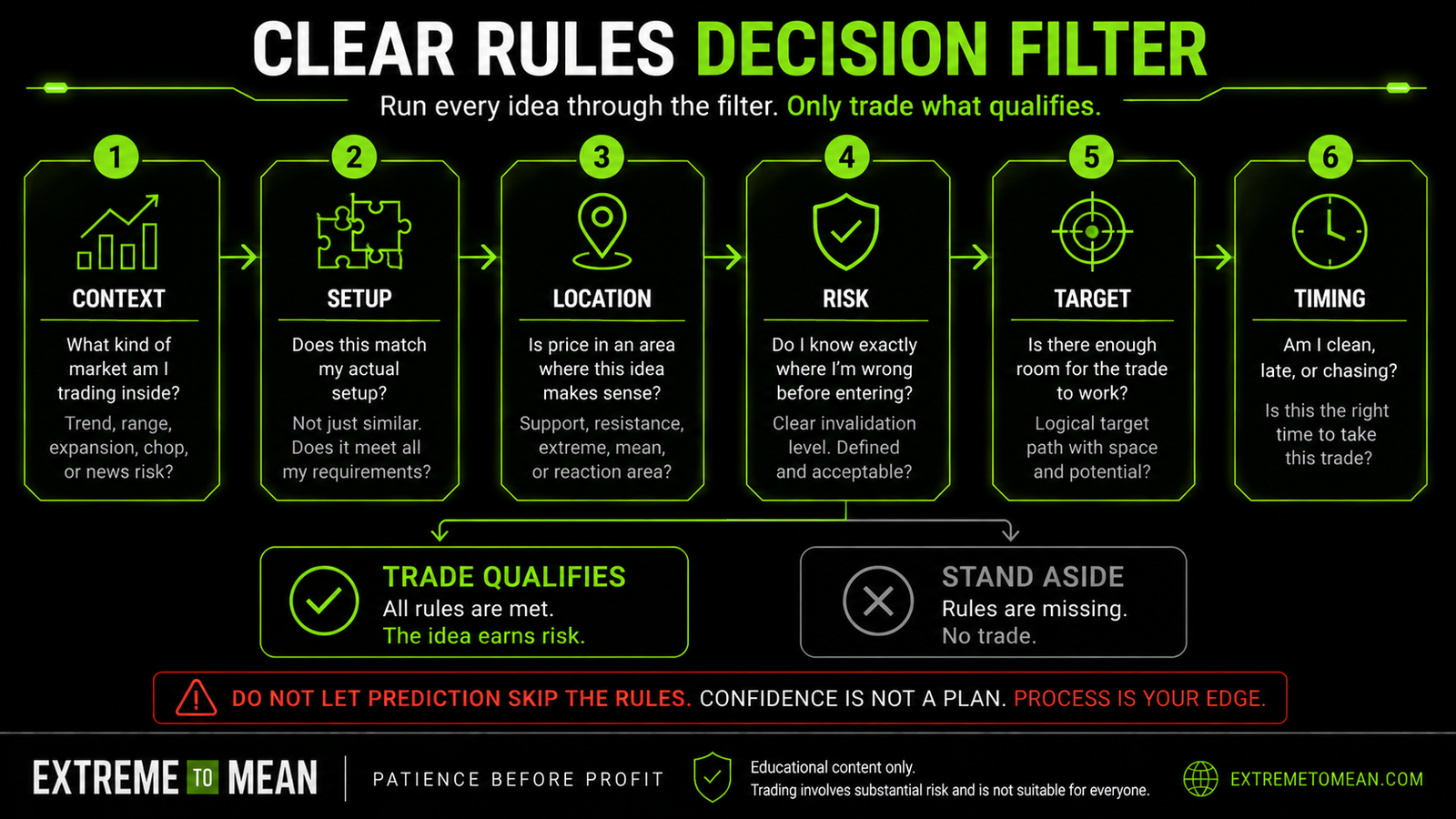
A Simple Rules Filter Before Acting
A useful process does not need to be complicated. In fact, rules that are too complex can become difficult to follow in real time. A trader needs a standard that is clear enough to apply when the market is moving.
Before taking a trade, ask:
- Context: What kind of market am I trading inside?
- Setup: Does this match my actual setup, or only resemble it?
- Location: Is price in an area where this idea makes sense?
- Entry: Do I have a planned entry, or am I reacting?
- Risk: Do I know where the idea is wrong before entering?
- Size: Is the position size already defined?
- Target: Do I know where the trade is trying to go?
- Timing: Am I early, clean, late, or chasing?
- Rule check: If this trade loses, will I still be able to say I followed my process?
That last question is powerful because it forces honesty before the result is known. It shifts the trader away from “Will this win?” and toward “Is this a decision I can stand behind?”
A better question before acting is: Am I taking this because it meets my rules, or because I want my prediction to be right? Writing conditional if-then rules in advance is one practical way to keep that question honest before urgency arrives.
That question can stop a lot of impulse. It does not make trading comfortable, but it makes the decision cleaner. It reminds the trader that the goal is not to prove an opinion. The goal is to follow a repeatable process.
For traders who want to build a more structured approach, the next practical step is to learn the full TMT System and study how setup, market context, risk, and execution can be organized into a repeatable framework.
Final Thought
Prediction can make a trader feel confident, but confidence is not enough. A strong opinion about direction does not define the entry, the stop, the size, the target, or the conditions that would cancel the idea.
Process does that work.
A clear process gives the trader a standard before emotion enters the room. It helps separate a real setup from a reaction, a planned trade from a chase, and a disciplined decision from a defended opinion.
The market does not need to be predictable for a trader to be prepared. The rules simply need to be clear enough to guide the next decision.
Clear records are especially useful when deciding whether to persist, adjust, or move on, which is the central question in the strategy-hopping decision framework.
Making the rule visible before pressure begins can keep emotional memory from quietly rewriting it. Why written rules beat emotional memory explains how an external standard makes exceptions easier to see.
Educational content only. Trading involves substantial risk and is not suitable for everyone.