
Risk appetite is the market’s willingness to hold exposure that requires investors to accept more uncertainty, volatility, credit risk, or economic sensitivity. In a stronger risk-on environment, capital is generally more willing to move toward higher-risk exposure; in a stronger risk-off environment, investors place greater weight on liquidity, perceived safety, and capital preservation. These terms describe the environment around a trade, not a reason to enter one.
A trader who labels the entire market from one chart can easily confuse price movement with confirmation. Stocks can rise while breadth deteriorates, credit spreads widen, or volatility refuses to fall. The better approach is to read broader market context by asking whether several parts of the market tell a consistent story.
Sector rotation is one useful way to read whether that broader risk appetite is shifting.
What Risk-On and Risk-Off Actually Mean
Risk-on describes an environment in which investors are showing a relatively stronger willingness to hold assets and exposures that depend on growth, liquidity, confidence, or continued risk-taking. Risk-off describes an environment in which investors become more defensive and place greater value on liquidity, perceived safety, or capital preservation. Neither label tells you what the next candle, session, or week must do.
The Federal Reserve evaluates measures such as equity premiums, corporate-bond spreads, and the excess bond premium when assessing risk compensation and investor sentiment. That reinforces the central point: risk appetite is broader than whether the S&P 500 happened to close green or red. (federalreserve.gov)
Risk-On and Risk-Off Are a Spectrum, Not a Switch
Markets rarely move from one perfectly clean regime to another. There are periods when equities, credit, volatility, rates, the dollar, and sector leadership align clearly, but there are also long stretches when the evidence is mixed. One strong session is not enough to establish a durable risk environment.
Confirmation occurs when several independent parts of the market support the same interpretation, while disagreement appears when important inputs contradict it. A mixed reading is not a failure of the framework; it is information that the environment may be less stable or less supportive than the headline index suggests. This is separate from the three market states, which describe price behavior rather than broad risk appetite.
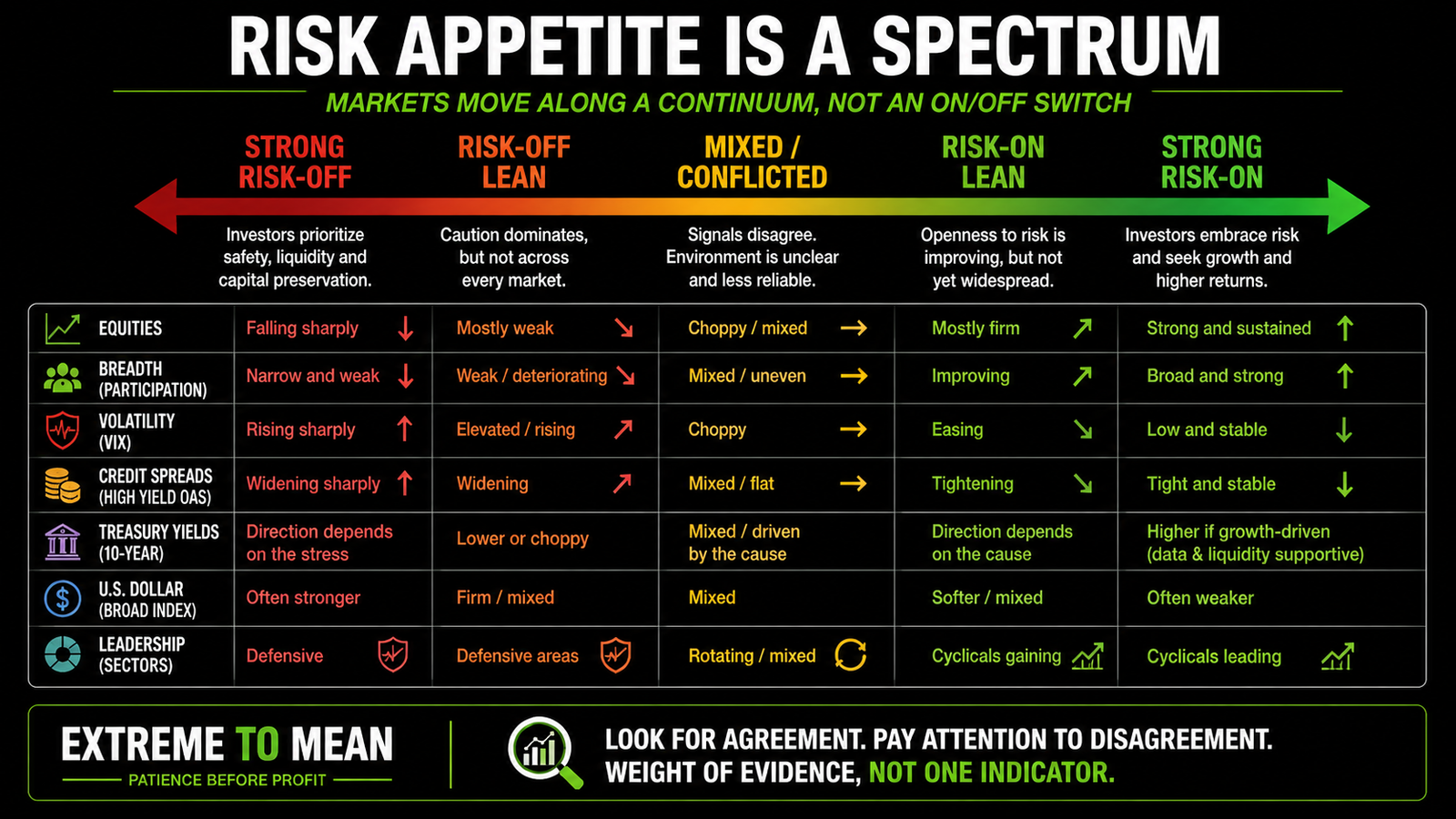
The Risk-On / Risk-Off Confirmation Stack
The stack begins with equity price, then asks whether participation supports that move. Breadth shows whether strength or weakness is broad, while sector leadership helps reveal whether investors are leaning toward more aggressive or more defensive parts of the equity market. Price matters, but index movement driven by a narrow group of large stocks is not the same evidence as broad participation.
Volatility answers a different question: how much uncertainty is being priced into equities. Cboe defines the VIX as a non-directional measure of approximately 30-day expected S&P 500 volatility derived from SPX options, so it is not designed to predict whether tomorrow’s market will rise or fall. Rising volatility can strengthen a risk-off interpretation and falling volatility can strengthen a risk-on interpretation, but VIX alone does not define the regime. (cboe.com)
Credit spreads add another independent view. The ICE BofA U.S. High Yield option-adjusted spread measures the additional spread on below-investment-grade corporate debt relative to a Treasury curve, while the Federal Reserve also uses corporate spreads and the excess bond premium as measures of risk compensation. Tightening or stable spreads generally support stronger risk appetite; persistent widening can indicate that investors are demanding more compensation for credit risk. (fred.stlouisfed.org)
Treasury yields and the dollar require more interpretation than simple risk-on/risk-off tables allow. A 10-year yield move can reflect growth, inflation, monetary-policy expectations, liquidity, or term premium, and those drivers do not carry the same message for equities. The dollar can benefit from safe-haven demand during global stress, but relative monetary conditions and the source of the shock can change that relationship. (fred.stlouisfed.org)
| Input | Risk-On Tendency | Risk-Off Tendency | Important Caveat |
|---|---|---|---|
| Equities | Strength / broad participation | Weakness | Index strength can be narrow |
| Breadth | Broadening | Deteriorating | One reading is not enough |
| Volatility | Stable / falling | Rising | VIX measures expected volatility, not direction |
| Credit spreads | Tightening / stable | Widening | Watch change and persistence |
| Treasury yields | Depends on driver | Depends on driver | Growth, inflation, liquidity, and term-premium shocks differ |
| U.S. dollar | Often softer | Often stronger | Not a permanent relationship |
| Sector leadership | Cyclical / aggressive | Defensive | Rotation can precede or lag index movement |
What a Cleaner Risk-On Environment Tends to Look Like
A cleaner risk-on environment usually begins with broad equity participation rather than an index being lifted by only a handful of names. Breadth is improving, cyclical or aggressive groups are participating, volatility is stable or declining, and credit spreads are stable or tightening. The overall message is that investors are showing a wider willingness to hold risk rather than merely bidding one isolated asset higher.
Rates and the dollar still need context. Rising Treasury yields can coexist with stronger equities when growth expectations are improving, while a stronger dollar may reflect relative U.S. strength rather than a generalized flight to safety. The role of bonds, yields, and the dollar therefore has to be interpreted through the economic driver. Federal Reserve research likewise shows that the source of a rate or currency move materially changes its implications. (federalreserve.gov)
What a Cleaner Risk-Off Environment Tends to Look Like
A cleaner risk-off environment tends to show the opposite weight of evidence: weaker participation, defensive leadership, rising volatility, widening credit spreads, and a stronger preference for liquidity or perceived safety. When several of those conditions appear together, the interpretation is stronger than it would be from an index decline alone. Independent confirmation matters more than any one component.
Treasuries, the dollar, gold, and commodities can still behave differently depending on what caused the stress. A growth scare can pull yields lower, while an inflation or fiscal shock can pressure equities even as long-term yields rise. Geopolitical, liquidity, and central-bank shocks can create still different combinations. Federal Reserve research provides examples of both safe-haven Treasury demand and risk episodes in which the behavior of rates and the dollar depended on the source of the shock. (federalreserve.gov)
Why the Classic Risk-On / Risk-Off Map Sometimes Breaks
The classic map breaks because markets respond to causes, not labels. Inflation shocks, growth scares, fiscal or term-premium shocks, liquidity events, geopolitical events, central-bank repricing, and asset-specific problems can all reduce willingness to take risk while producing different cross-asset correlations. A trader who memorizes “yields down equals risk-off” or “dollar up equals risk-off” will eventually encounter a regime where the shortcut fails.
The Federal Reserve’s May 2026 Financial Stability Report illustrates the value of looking at several measures at once. It separately evaluates equity premiums, corporate-bond spreads, the excess bond premium, Treasury term premiums, volatility, and liquidity rather than collapsing risk appetite into one market price. The trader’s version of that idea is simple: build a weight of evidence and pay attention to what is not confirming. (federalreserve.gov)
Agreement Matters More Than One Indicator
Agreement is strongest when signals come from different parts of the system. Stocks rising with broadening breadth, tightening credit, and declining volatility gives stronger risk-on confirmation than stocks rising while breadth weakens, spreads widen, and volatility stays elevated. Price may continue higher in either case, but the second environment is less internally consistent.
The same logic applies on the downside. Stocks falling while volatility rises and credit spreads widen provides stronger risk-off evidence than stocks falling while breadth stabilizes and credit stops deteriorating. Disagreement does not predict a reversal; it tells the trader that the current story has less confirmation.
How Futures Traders Should Actually Use the Information
For futures traders, the risk regime is context for ES and NQ, not a replacement for the setup. A broad risk-on backdrop may support expectations for stronger participation or continuation, while a risk-off backdrop may coincide with greater volatility, weaker breadth, and sharper failed rallies. None of those conditions provides an automatic long or short entry.
The trade still has to qualify through location, structure, invalidation, and defined risk. A technically valid pattern can be lower quality if the broader environment is working against the behavior the trader expects from it, which is why market conditions can change the quality of a setup. The environment influences evaluation; it does not determine the outcome.
A Practical Risk-On / Risk-Off Review
Use the sequence Observe → Compare → Confirm → Qualify. Observe what is changing, compare related markets, confirm whether enough independent evidence agrees, and then qualify whether the setup fits that environment as well as its location and risk structure. This prevents a macro label from becoming an automatic trade decision.
Before labeling the environment, ask:
- What is equity price doing?
- Is participation broad or narrow?
- Is volatility confirming or contradicting price?
- Are credit spreads tightening or widening?
- What are Treasury yields doing, and why?
- Is the dollar confirming or contradicting the broader story?
- Which sectors are leading?
- Which major input disagrees with the rest?
- Is the evidence clear enough to describe the environment, or is the market mixed?
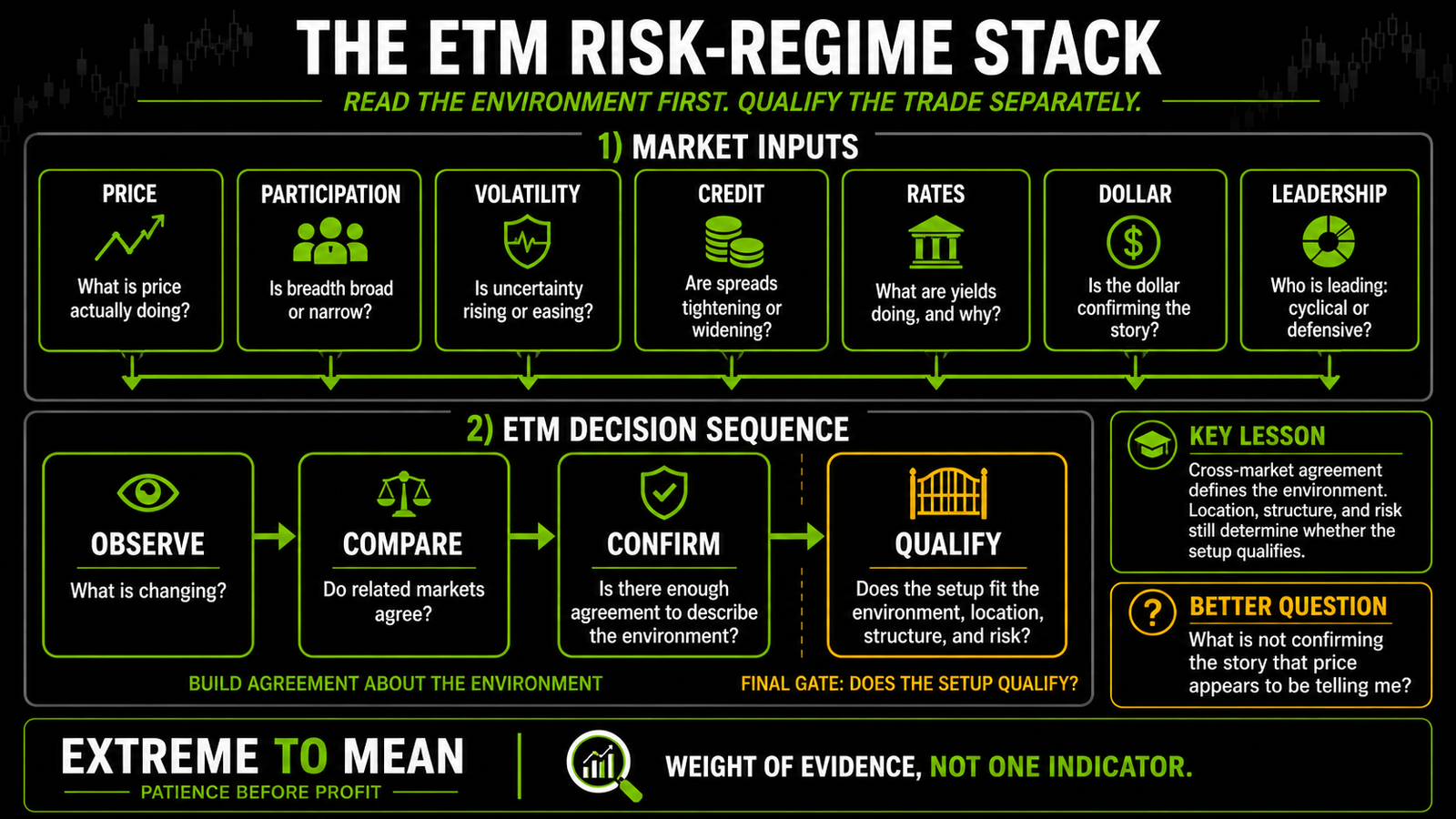
A practical review should end by identifying the largest disagreement, not by forcing the market into a category. The better question is: Which parts of the market are accepting risk, which parts are rejecting it, and how much agreement exists between them? Then ask: What is not confirming the story that price appears to be telling me?
Final Thought
Risk-on and risk-off are useful because they organize market context, not because they predict the next candle. The strongest read comes from price, participation, volatility, credit, rates, the dollar, and leadership telling a reasonably consistent story while the trader remains alert to disagreement. The goal is to understand the environment well enough to evaluate rather than react.
You do not need every indicator to agree. You need enough evidence to understand whether the backdrop is supportive, defensive, or conflicted, and the setup still has to qualify on its own terms. Readers who want to go deeper into how these market internals work together can continue with Decode the Market.
Educational content only. Trading involves substantial risk and is not suitable for everyone.