
Many traders focus entirely on the stock index in front of them. They watch price, volume, support, resistance, and short-term momentum without checking whether the larger financial environment is helping or fighting the move. That approach can work during simple sessions, but it leaves the trader with less context when stocks suddenly weaken, leadership rotates, or a familiar setup stops responding normally. Cross-market information can help explain those changes before the chart alone provides a complete answer.
The lessons in The Market category begin with the idea that context comes before execution. Bonds, yields, and the dollar are part of that context because they influence borrowing costs, investment choices, company earnings, commodity prices, and global flows of money. None of them controls stocks by itself, and none should be treated as a perfect signal. Their value comes from helping the trader understand the environment in which stock prices are moving.
Begin With the Relationship Between Bonds and Yields
A bond is a loan made to a government, company, or other borrower. In return, the investor receives interest and expects the original amount to be repaid later. Government bonds, especially US Treasury securities, are closely watched because they are used throughout the financial system as reference points for interest rates and perceived safety. When traders discuss the bond market, they are often discussing changing expectations about inflation, economic growth, central-bank policy, and risk.
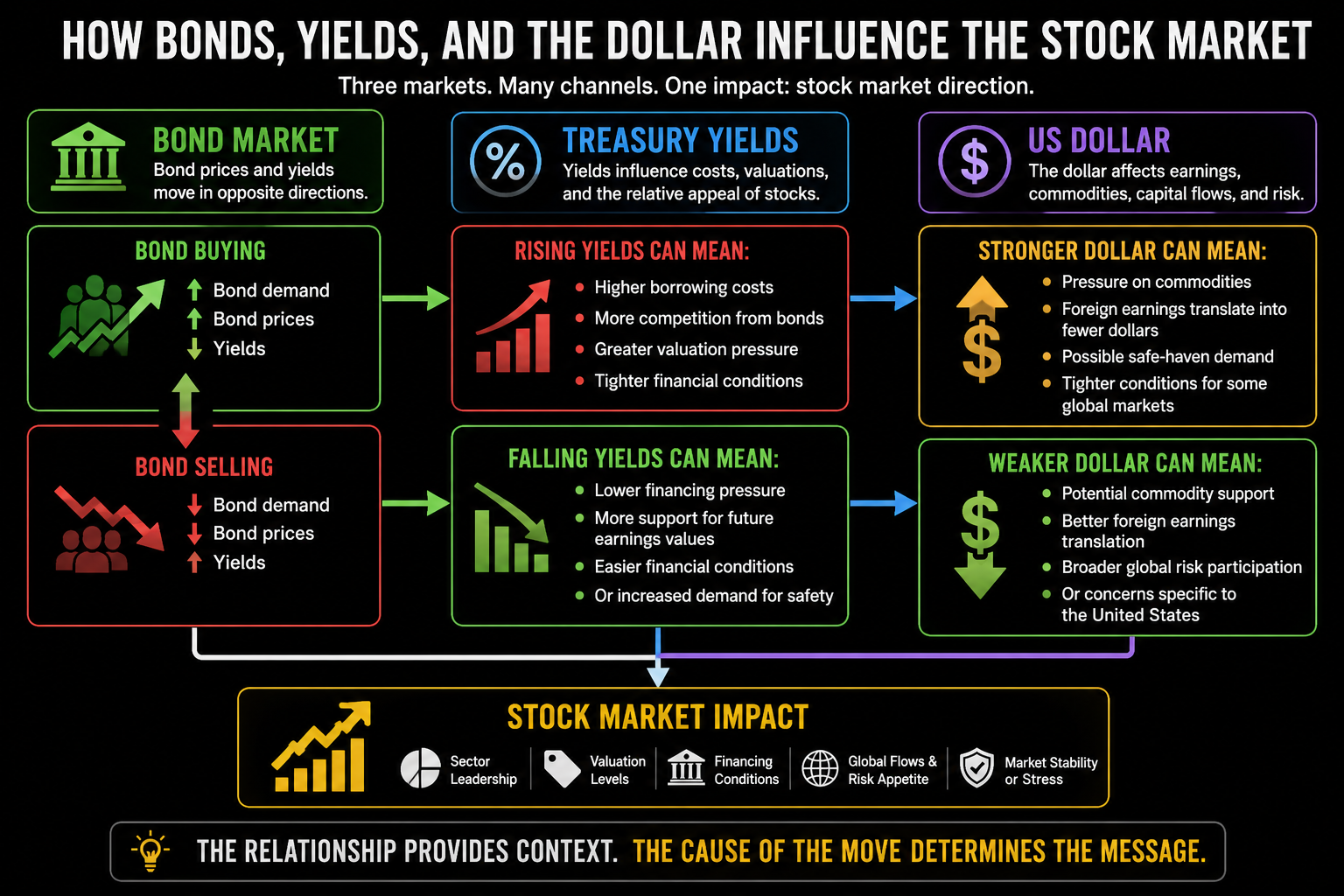
Bond prices and yields generally move in opposite directions. When investors buy bonds aggressively, bond prices rise and the yield available to a new buyer falls. When investors sell bonds, prices fall and yields rise until the return becomes more attractive at the lower price. This relationship is one reason the principle that the market comes first extends beyond the stock market itself.
Why Rising Yields Can Pressure Stocks
Rising yields can make future company earnings less valuable in today’s terms. Investors often compare what they might earn from owning a stock with what they can receive from bonds or other interest-bearing assets. As relatively safer yields rise, investors may demand a better expected return before accepting the additional uncertainty of stocks. That adjustment can pressure stock valuations even when the underlying companies have not suddenly become weaker businesses.
Higher yields can also increase borrowing costs throughout the economy. Companies may pay more to finance expansion, consumers may face more expensive mortgages or loans, and investors using leverage may carry higher financing costs. Those pressures can reduce expectations for future spending and earnings. The effect is usually strongest when yields rise quickly enough to force markets to reconsider assumptions that had already been priced in.
Not every yield carries the same message. The two-year Treasury yield often reacts strongly to expectations for Federal Reserve policy, while the ten-year yield reflects a broader mix of inflation, economic growth, and demand for longer-term bonds. Traders do not need to become bond specialists, but they should know which part of the yield curve is moving and why. The lesson on the 10-year Treasury yield and the stock market goes deeper into how traders should read that specific relationship. A sharp move in shorter-term yields may communicate something different from a gradual rise in longer-term yields.
Why Falling Yields Can Support Risk Appetite
Falling yields can make stocks more attractive relative to bonds. Lower rates may reduce financing pressure, increase the present value investors assign to future earnings, and support companies whose value depends heavily on growth expected years from now. This is one reason technology and other long-duration growth stocks can respond positively when yields fall. The response is not guaranteed, but the relative financial pressure may become less restrictive.
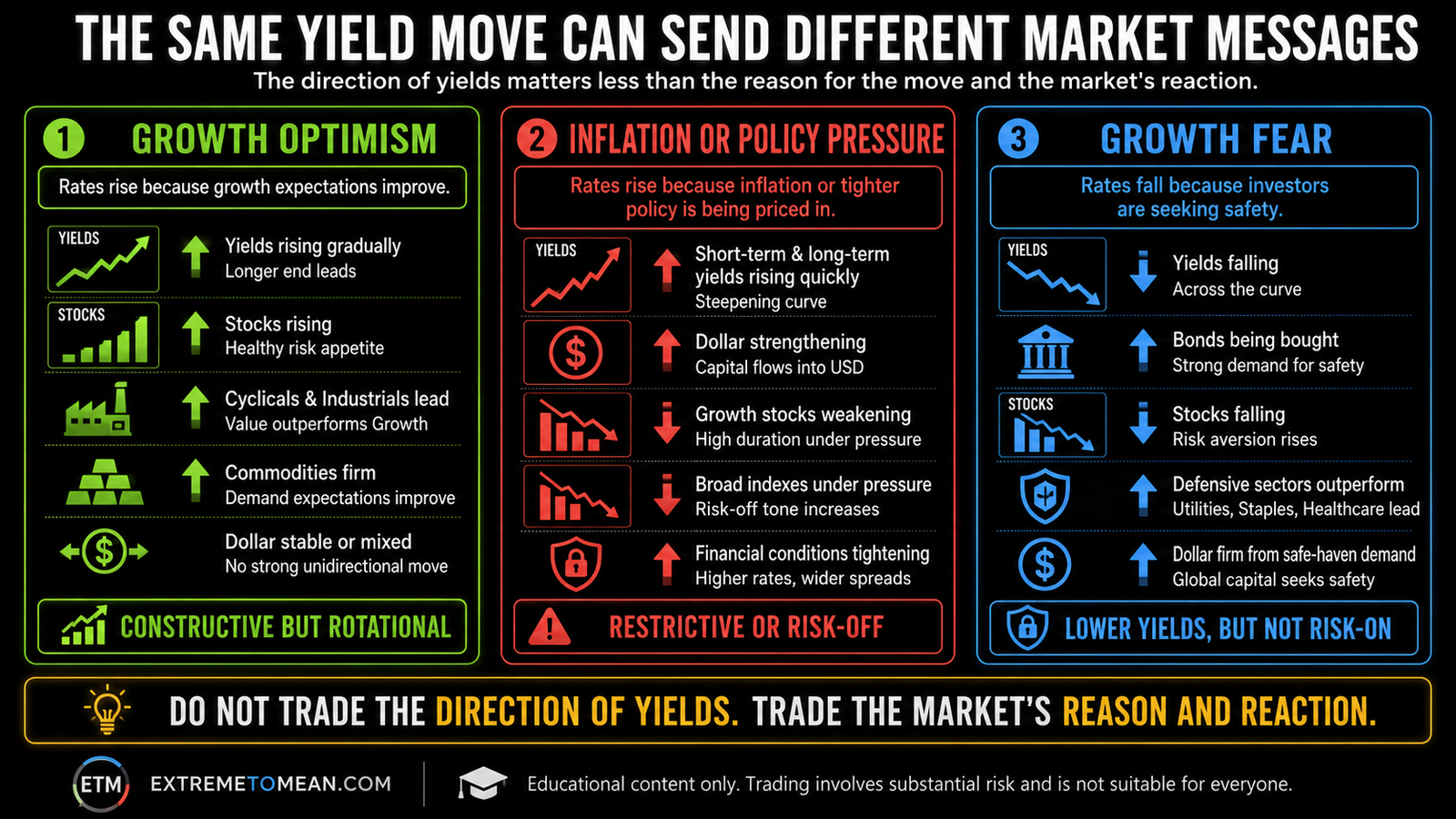
Falling yields are not automatically bullish, however. Investors may be buying bonds because they are worried about slowing growth, weak employment, financial stress, or another risk that could also hurt corporate earnings. In that environment, yields may fall while stocks fall as well. The trader must determine whether lower yields represent easier financial conditions or fear about the economy.
The Dollar Is a Global Market Variable
The US dollar is more than the currency used to quote American stocks. It is widely used in global trade, borrowing, reserves, and the pricing of commodities such as oil and gold. A stronger dollar means each dollar buys more relative to other currencies, while a weaker dollar means it buys less. Those changes can affect companies, sectors, and countries differently, a relationship explored further in DXY and the stock market.
A stronger dollar can create pressure for US companies that earn a large share of their revenue overseas. Foreign sales may translate into fewer dollars when those earnings are converted back into the company’s reporting currency. Dollar strength can also make dollar-priced commodities more expensive for buyers using other currencies. At the same time, a stronger dollar may reflect demand for safety, expectations of higher US interest rates, or stronger relative US growth.
A weaker dollar can provide support to commodities, multinational earnings translations, and some areas of global risk appetite. Investors outside the United States may find dollar-priced assets less expensive in their local currencies, while commodity producers may benefit if raw-material prices rise. Dollar weakness does not guarantee that stocks will rally because the reason for the weakness still matters. The market may be responding to easier financial conditions, changing rate expectations, or concerns specific to the United States.
Different Parts of the Stock Market React Differently
Growth-oriented stocks are often more sensitive to changes in longer-term yields. Much of their perceived value may depend on earnings expected well into the future, which makes valuation assumptions more important when discount rates change. A fast rise in yields can therefore pressure technology and other high-valuation groups more than mature businesses whose earnings are expected sooner. A decline in yields can reverse some of that pressure when the economic backdrop remains stable.
Banks, industrial companies, energy producers, and defensive sectors may respond differently. Banks can sometimes benefit from higher rates, but the result depends on lending demand, deposit costs, credit quality, and the shape of the yield curve. Industrial and energy stocks may perform well when yields rise because economic growth expectations are improving. Defensive sectors may attract money when investors are more concerned with stability than expansion.
Commodities and international markets add another layer. A rising dollar can pressure oil, metals, and emerging-market assets, especially when borrowing or trade is heavily tied to the US currency. A falling dollar can reduce that pressure and support broader participation outside the largest US companies. These relationships are tendencies rather than fixed rules, which is why the trader must observe confirmation across markets.
The Cause of the Move Matters More Than the Direction Alone
The same yield move can carry different meanings in different environments. Rising yields caused by improving growth expectations may occur alongside rising stocks, stronger industrial shares, and firm commodity prices. Rising yields caused by inflation fears or tighter policy expectations may pressure valuations and reduce risk appetite. The direction of the yield is visible, but the reason for the move determines how the stock market is likely to interpret it.
Falling yields also require interpretation. They may support stocks when investors expect slower inflation and less restrictive monetary policy without a major decline in growth. They may accompany weakness when investors are rushing into bonds because recession or financial stress appears more likely. This is why market conditions change the quality of a setup, even when the chart pattern looks familiar.
Traders should also connect these moves to the current three market states. In a strong directional market, stocks may temporarily ignore a modest move in yields or the dollar. In a rotational market, rates and currency changes may explain why leadership shifts from one sector to another. In a choppy market, conflicting signals across stocks, bonds, and currencies may be evidence that conviction is weak.
Read the Relationship, Not One Asset Alone
A practical intermarket read begins by observing whether the major markets are confirming or contradicting one another. Rising stocks, stable credit conditions, firm commodities, and a controlled dollar may support a constructive risk environment. Falling stocks, a rapidly rising dollar, higher policy-sensitive yields, and weaker commodities may point toward tighter conditions. Mixed signals often suggest rotation or uncertainty rather than a clean directional message.
The trader should also compare the speed of each move. A slow increase in the ten-year yield may be absorbed without major disruption, while a sharp overnight jump can force investors to adjust positions quickly. A dollar move that develops over several weeks may influence sector leadership differently from a sudden safe-haven surge. Rate and currency levels matter, but the pace of change often determines the immediate market reaction.
The better question is not, “Are yields up or down?” It is, “What is causing yields and the dollar to move, and which parts of the stock market are most exposed to that cause?” That question follows the broader lesson that context comes before the candle. The trader is using cross-market evidence to evaluate conditions rather than reacting to one isolated number.
A Practical Pre-Market Filter
Before the open, the trader can use a short sequence to organize the intermarket picture. The purpose is not to predict every market move but to identify whether financial conditions appear supportive, restrictive, fearful, or mixed. The answers should be compared with overnight price action and current sector leadership. No single answer should override the evidence on the stock chart:
- Are two-year and ten-year Treasury yields rising, falling, or separating?
- Did yields move because of inflation, growth, central-bank expectations, or demand for safety?
- Is the dollar strengthening or weakening, and is the move gradual or sudden?
- Are commodities confirming the growth message or moving in the opposite direction?
- Are growth stocks, cyclicals, banks, and defensive sectors responding as expected?
- Are stock indexes moving together, or is the market rotating beneath the surface?
- Is the intermarket picture supportive, restrictive, mixed, or risk-off?
- Does the planned trade align with that environment, or must the setup provide stronger evidence?
Traders who want a repeatable framework can incorporate these questions into the 2026 Trader’s Macro Playbook. The goal is not to collect more information than can be used. It is to create a consistent process for deciding which cross-market developments deserve attention before the trading session begins. A simple framework is more useful than watching every yield, currency pair, and economic headline without a clear purpose.
Review the Reaction, Not Just the Prediction
Trade review should include how stocks reacted to the bond and currency environment. A trader may correctly identify that yields rose but still misread whether the move reflected growth optimism or tighter financial conditions. The review should compare the original interpretation with sector leadership, index behavior, commodities, and the dollar. That comparison helps the trader learn which relationships mattered during the session.
The journal should also record when stocks ignored the expected relationship. Markets can absorb higher yields, rally with a stronger dollar, or fall while yields decline because another force is more important at that moment. These exceptions are not reasons to stop using intermarket analysis. They are reminders that context improves evaluation without creating certainty.
Final Thought
Bonds, yields, and the dollar help explain the financial environment surrounding the stock market. Rising yields can pressure valuations and borrowing conditions, while falling yields can support risk appetite when they are not being driven by serious growth concerns. Dollar strength and weakness can influence multinational companies, commodities, sectors, and global flows. The trader’s task is to understand the relationship rather than memorize a one-direction rule.
The purpose of this analysis is not to predict stocks from bonds or currencies alone. It is to recognize whether the larger environment supports the trade, conflicts with it, or requires more patience before risk is taken. A chart setup still needs location, structure, and confirmation. Bonds, yields, and the dollar help the trader judge the conditions in which that setup is being asked to work.
Those same cross-market relationships become especially important when evaluating whether recession evidence is beginning to align.
Educational content only. Trading involves substantial risk and is not suitable for everyone.