
Risk-to-reward is one of the first concepts traders learn because the math is simple. Risk one unit to make two, and the trade is described as 1:2; risk one to make three, and it becomes 1:3. The simplicity is useful, but it also creates a trap because the ratio can look objective even when the stop and target behind it were chosen arbitrarily. A clean number does not automatically mean a clean trade.
Inside The Setup, the ratio should be treated as the result of planning rather than the starting point. First determine where the trade belongs, what would invalidate the thesis, and where price could reasonably travel if the idea works. Only then does the distance between those points tell the trader something useful. When the ratio is built backward to satisfy a preferred number, the math begins replacing the market structure it was supposed to describe.
Risk-to-Reward Is a Measurement, Not an Edge
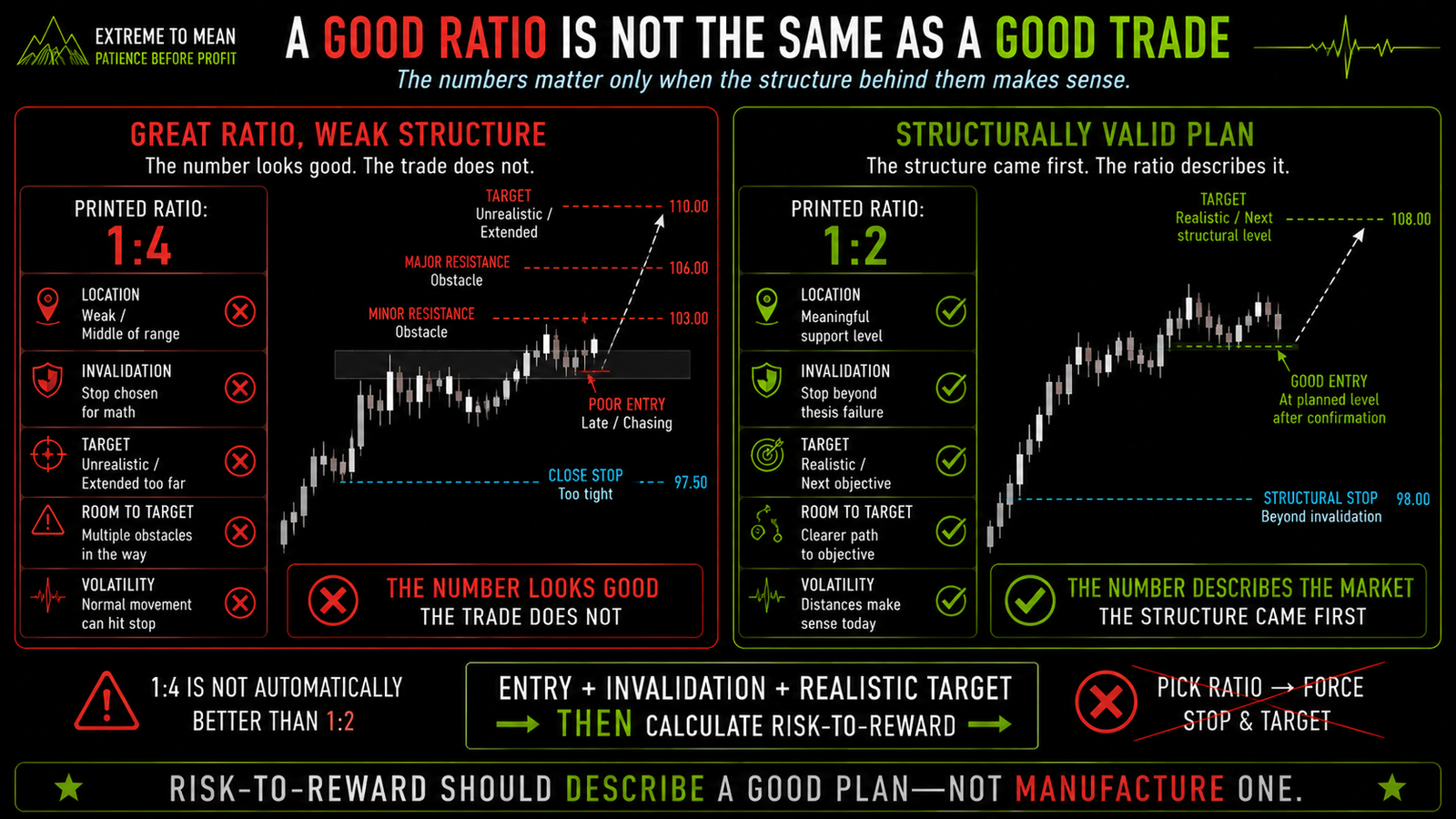
A 1:3 ratio sounds attractive because the potential reward is three times the planned risk. That description says nothing, however, about whether price is likely to reach the target, whether the stop belongs where it was placed, or whether the setup is occurring at a useful location. Two traders can both write “1:3” in their plans while taking trades of completely different quality. The ratio measures distances; it does not evaluate the entire decision.
This is why traders can misuse risk-to-reward without realizing it. The arithmetic creates a sense of discipline because the trade appears planned, but a mathematically neat plan can still rest on poor assumptions. If the target requires price to break three major levels or the stop is squeezed inside normal market noise, the 1:3 label does not fix those weaknesses. A ratio becomes meaningful only after the structural decisions underneath it are credible.
The Stop Comes From Invalidation
The risk side of the equation begins with a simple question: what market behavior would make the trade thesis wrong? A stop may belong beyond a structural extreme, failed reclaim, range boundary, support or resistance level, or another point where the original setup no longer makes sense. The distance between entry and that invalidation becomes the trade's structural risk. Choosing the stop first because a certain number of points would create a better ratio reverses the process.
This is the same principle behind the trade is not ready until the risk is clear. If a setup logically needs a 30-point invalidation, moving the stop to 10 points just to convert a weak ratio into an attractive one has not reduced the market's actual invalidation distance. It has simply placed the stop somewhere price may reasonably trade while the thesis remains intact. The ratio improved on paper while the planning became worse.
The Target Has to Be Realistic
The reward side deserves the same discipline. A target should be based on a plausible destination such as a structural level, prior extreme, mean, range boundary, liquidity area, or other objective that fits the setup and market condition. A trader can always make a ratio look better by extending the target farther away. The problem is that theoretical distance and usable opportunity are not the same thing.
Suppose a long setup risks 20 points and the next meaningful resistance is 30 points above the entry. Calling the trade 1:3 because the trader writes a 60-point target does not create 60 points of clean opportunity. Price still has to deal with the resistance that sits halfway there. A more useful plan recognizes the first realistic objective and evaluates whether the available reward justifies the required risk.
Location Changes the Entire Ratio
Entry location affects both sides of the calculation at the same time. A better location can place the trader closer to structural invalidation while preserving more usable distance toward the target, whereas a late entry can increase risk and reduce remaining reward. This is why location is the first filter before the ratio becomes relevant. The same directional thesis can produce very different risk-to-reward profiles depending on where the trader enters.
Imagine two traders buying the same move toward the same target. One enters near the planned support after confirmation, while the other waits until price has already traveled halfway toward the objective. The second trader may need the same structural stop but now has less distance remaining to the target. Nothing about the market idea changed, but the trade quality did because the entry changed the geometry of the decision.
Room to Move Matters More Than the Printed Number
The path between entry and target matters because price rarely travels through empty space. Congestion, prior highs and lows, opposing supply or demand, range boundaries, and other structural references can interrupt the move. A ratio calculated without considering those obstacles assumes that every point between entry and target is equally available. Real markets do not behave that neatly.
This is why room to revert is useful even outside pure mean-reversion setups. Whether the trader is planning a reversion, breakout, or continuation, the question is similar: what stands between the entry and the intended objective? A 1:2 trade with relatively clean space may be structurally stronger than a nominal 1:4 trade that requires price to fight through several major barriers. The better ratio is not always the larger number.
Probability and Reward Cannot Be Separated Completely
Risk-to-reward is often discussed as if probability does not matter. Traders sometimes hear that a large enough reward relative to risk can compensate for a low win rate, which is mathematically true under certain assumptions. The problem is that the probability of reaching the target is influenced by the setup, location, market condition, and how ambitious that target is. Increasing the target distance can improve the printed ratio while simultaneously making the target less realistic.
That does not mean traders need to know the exact probability of every trade before entering. Exact probabilities are rarely available in real time, and pretending otherwise creates false precision. The practical question is whether the target is consistent with what this setup and current market environment can reasonably produce. Risk-to-reward and setup quality should support one another instead of being evaluated as completely separate ideas.
Volatility Changes What Counts as Reasonable
A 20-point stop and 40-point target can mean very different things in different volatility environments. During a quiet session, those distances may represent a substantial move; during an expanding session, the same distances may sit inside ordinary noise. Volatility changes the scale at which price is moving, so fixed ratios built from fixed distances can lose context quickly. The structure still has to determine whether the stop and target are practical.
This is one reason traders should avoid designing every trade around the same exact 1:2 or 1:3 template. Market conditions change, setup types differ, and normal movement expands and contracts. The ratio can remain part of the plan while the distances adapt to the market. Consistency should come from the decision process, not from forcing every chart into identical geometry.
A High-Quality Setup Can Have an Unattractive Ratio
Sometimes the market produces a valid setup but the current entry no longer offers enough reward relative to the necessary risk. That can happen after confirmation arrives late, after price moves too far from the intended entry, or when the logical target is unusually close. The setup may still be real even though the trade is no longer attractive. Recognizing that distinction prevents traders from confusing “good idea” with “good entry now.”
This is where where you enter matters more than what you predict becomes especially important. A trader can correctly identify direction and still decline the trade because the available geometry no longer makes sense. Passing does not mean the analysis was wrong. It means the trade stopped earning risk at the price currently available.
Do Not Reverse-Engineer the Ratio
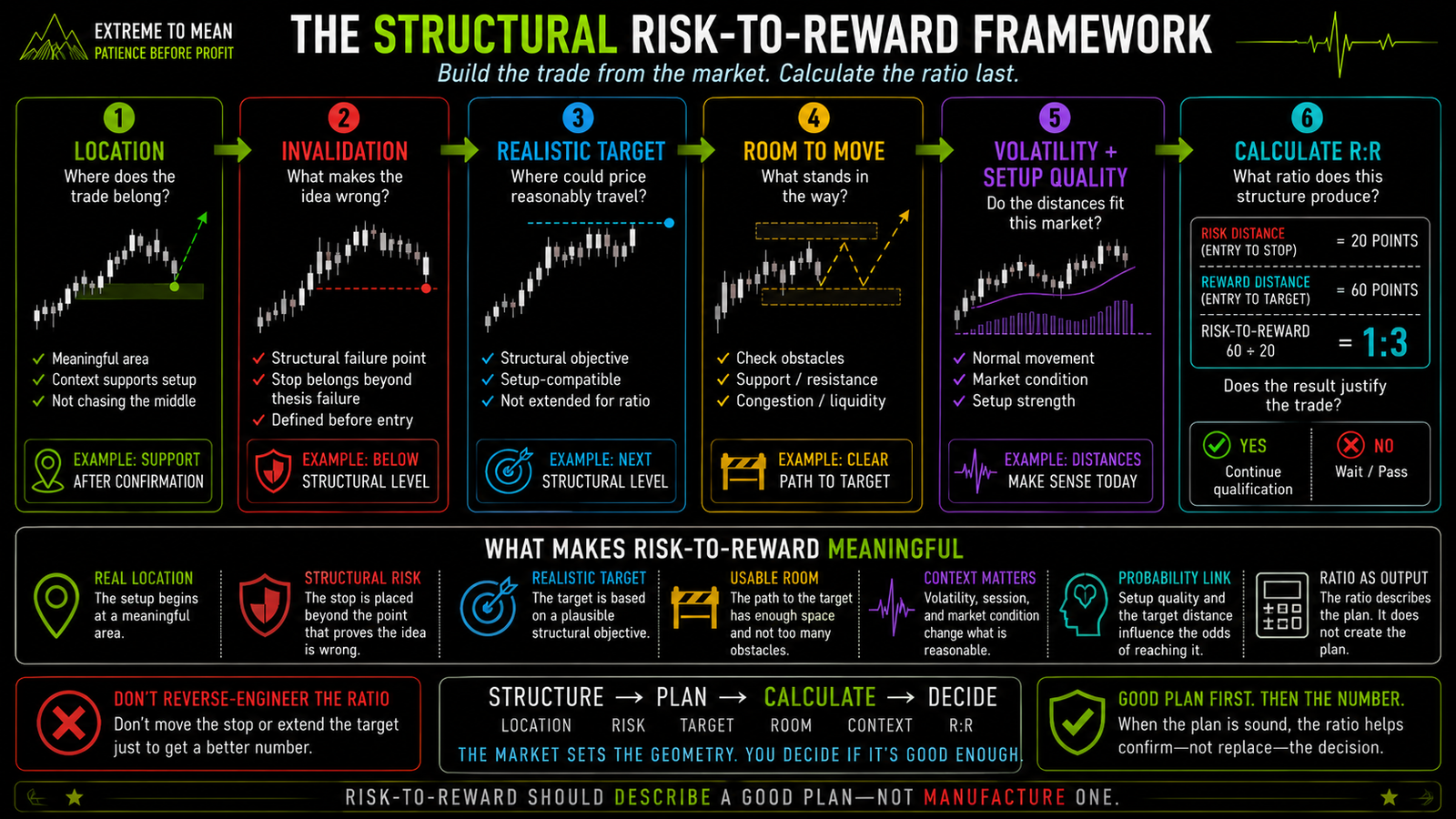
A common planning mistake begins with the desired ratio instead of the market. The trader decides that every trade must offer 1:3, then adjusts either the stop or target until the calculator produces that number. The process feels disciplined because a rule is being followed. In reality, the market structure has been forced to fit the spreadsheet.
The cleaner sequence works in the opposite direction. Identify the entry area, define where the thesis becomes invalid, locate the realistic objective, and then calculate the ratio those three points create. If the result does not meet the trader's minimum planning standard, the answer may simply be no trade. The ratio should help reject weak geometry rather than encourage the trader to invent better geometry.
Better Questions Before Using Risk-to-Reward
A useful risk-to-reward review should test the assumptions underneath the number. The best question is not, “Is this at least 1:2?” but, “Are the entry, stop, and target each justified by the market before I compare their distances?” That keeps the ratio connected to structure. It also makes it much harder to manipulate the calculation after becoming emotionally attached to the setup.
- Is the entry occurring at a meaningful location?
- What specifically invalidates the trade thesis?
- Is the stop placed beyond that invalidation rather than at an arbitrary distance?
- Is the target based on a realistic structural objective?
- What obstacles sit between the entry and target?
- Does the current volatility support these distances?
- Has the entry become late enough to damage the ratio?
- Does the setup quality justify expecting price to travel toward that objective?
- Am I extending the target only to improve the number?
- Am I tightening the stop only to improve the number?
- Would I still like this trade if the ratio were hidden from me?
- Does the actual structure justify taking this risk now?
These questions make risk-to-reward more useful because they turn the ratio into a final planning filter rather than a shortcut. The trader can review losing and winning trades using the same process: was invalidation structural, was the target realistic, was the entry well located, and did the available room justify the risk? That produces more actionable information than recording only that a trade was “1:2.” Traders who want to connect this planning process with the broader framework can continue into the Extreme to Mean system.
Final Thought
Risk-to-reward matters because traders need a clear relationship between what they are willing to risk and what the market may reasonably offer in return. But the ratio has no independent intelligence. It cannot tell the trader whether the setup is valid, whether the stop belongs where it was placed, whether the target is realistic, or whether the entry came too late. Those decisions have to be made first.
The clean process is structural: identify the location, define invalidation, establish a realistic objective, evaluate the path between them, and then calculate the ratio. If the resulting relationship is unattractive, the answer is not to manipulate the stop or target until the number improves. Sometimes the correct decision is to wait for a better entry or let the trade go. Risk-to-reward should describe a good plan, not manufacture one.
Educational content only. Trading involves substantial risk and is not suitable for everyone.