
Many beginners hear people talk about “the market” as if it is one continuous experience. They hear phrases like pre-market, the open, regular session, the close, and after-hours, but they may not understand what those terms actually mean. That creates confusion when price moves before the bell, gaps at the open, slows midday, or reacts after the regular session ends.
A trading day is not just a block of time. It has structure.
Different parts of the day can attract different levels of participation. Some periods may have more volume and tighter spreads. Others may have less liquidity, wider spreads, and sharper reactions to news. The same chart can behave differently depending on which session price is moving through.
At Extreme to Mean, this belongs in The Basics lesson library because session awareness comes before deeper lessons on timing, volatility, structure, or setup quality. A trader does not need to turn session knowledge into a strategy right away. First, they need to understand when the market is active and why the environment may not feel the same all day.
A Trading Session Is a Block of Market Time
A trading session is a specific period when trading activity is allowed or commonly takes place.
For U.S. stocks, the regular trading session is generally 9:30 a.m. to 4:00 p.m. Eastern Time on normal trading days. That is the period many traders mean when they say “the market is open.” It is also the session most beginners hear about because it includes the opening bell, the main trading day, and the closing bell.
But trading activity can also occur outside that main session. Pre-market trading can take place before the regular open, and after-hours trading can take place after the regular close. Common U.S. equity extended-hours reference windows are 4:00 a.m. to 9:30 a.m. ET for pre-market and 4:00 p.m. to 8:00 p.m. ET for after-hours, though access and exact availability can depend on the broker, product, and exchange rules.
The important beginner lesson is not to memorize every possible schedule for every product. The important lesson is to understand that “the market” is not always operating under the same conditions. A stock trading at 8:00 a.m. may not behave the same way it behaves at 10:00 a.m. A price move at 4:30 p.m. may not carry the same participation as a price move during the middle of the regular session.
Session context helps a trader avoid treating every price move as equal.
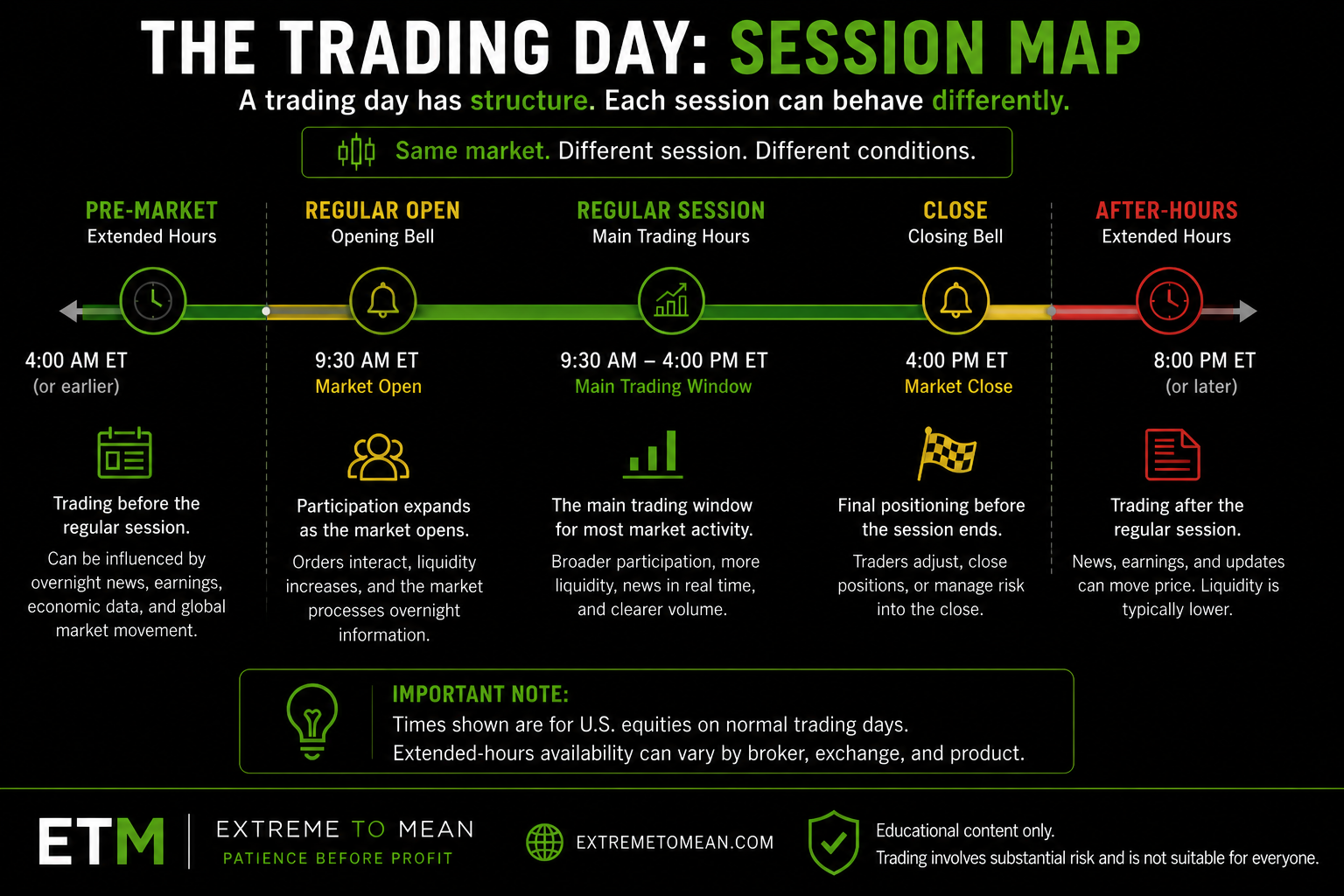
Pre-Market: Before the Regular Open
Pre-market is the period before the regular session begins.
This is when some stocks, ETFs, and other products may trade before the main market opens. Pre-market activity can be influenced by overnight news, earnings reports, economic data, analyst updates, global market movement, or large traders adjusting positions before the regular session begins.
For beginners, pre-market can feel exciting because price may already be moving before the official open. A stock may be up or down sharply before 9:30 a.m. ET. Futures may have moved overnight. Headlines may already be affecting expectations.
But pre-market movement needs to be understood carefully.
Participation can be thinner than during the regular session. Liquidity may be lower, meaning there may be fewer buyers and sellers available at each price. Spreads can be wider, meaning the difference between the price someone wants to buy at and the price someone wants to sell at can be larger. Prices may move quickly because fewer participants can sometimes create more sensitive reactions. That is why it helps to understand why spreads can change by session.
That does not mean pre-market movement is meaningless. It means the trader should avoid treating it exactly the same as regular-session movement. A pre-market high or low may matter later, but the trader still needs to see how the regular session responds when more participation enters.
A better question is: “Is this pre-market move supported by broad participation, or is it a thin move before the main session begins?”
That question does not predict the answer. It simply keeps the trader from reacting too quickly.
The Open: When Participation Expands
The regular session open is one of the most watched moments of the trading day.
At the open, more participants enter the market at once. Orders that built up before the bell may begin interacting with live trading. Traders, investors, institutions, algorithms, and market makers are all responding to overnight information, pre-market movement, and the first prices of the day.
This is why the open can feel fast.
Price may move sharply in one direction, reverse quickly, test pre-market levels, fill gaps, or expand into a new area. The first minutes of the regular session can carry energy because the market is trying to process information that developed while the regular session was closed.
For a beginner, the open can create urgency. A green move can feel like something to chase. A red move can feel like something to fear. A breakout can look clean for a moment and then fail. A flush can look dangerous and then recover — the kind of early turn examined in how traders should read opening-session reversals.
That is why session awareness matters. The open is not automatically a clean opportunity. It is often a discovery period. Price is searching for balance as more participants arrive and early orders get processed.
Extreme to Mean thinking does not require a trader to react just because the bell rings. The trader’s job is to evaluate whether the early movement is creating useful information or simply noise. A setup still has to earn attention before it earns risk.
This connects to the earlier lesson on what a timeframe actually means. A 1-minute chart at the open may show a lot of movement, but not every movement is meaningful in the larger session context.
The Regular Session: The Main Trading Day
The regular session is the main trading window for most U.S. stock market activity.
This is when participation is generally broader. More institutions, active traders, market makers, and investors are involved. News is being digested in real time. Volume is usually easier to evaluate compared with thin extended-hours trading.
That does not mean the regular session is always clean.
The market can trend, range, chop, reverse, stall, or do very little. Some periods may be active and directional. Other periods may be slow, overlapping, and frustrating. Midday can sometimes feel different from the open or close because urgency may fade and participation may shift.
A beginner should not assume the regular session has one personality. The open may be fast. The middle of the day may be quieter. The final hour, covered in the lesson on whether the last hour predicts the next day, may become more active as traders adjust positions before the close. These are tendencies, not rules.
The regular session matters because it often provides the clearest picture of broad participation. If a pre-market move looked important, the regular session can show whether that level still matters when more traders are involved. If the open was emotional, the rest of the session can show whether price follows through, balances, or rejects the early move.
This is where a trader starts to understand session context as part of market context.
The lesson on buyers, sellers, and price explains that price is the result of ongoing negotiation. A session simply tells the trader when that negotiation is happening and who may be more or less active during that period.
The Close: Final Positioning Before the Session Ends
The close is the end of the regular session.
As the closing bell approaches, traders may adjust positions, close short-term trades, rebalance portfolios, manage risk, or respond to how the day has developed. This can make the final part of the day feel different from the middle of the session.
The close can matter because it shows where price finishes the regular session. A market may trade above a level during the day but close back below it. Another market may look weak earlier, then recover into the close. The closing price does not guarantee what happens next, but it can become an important reference point.
Beginners often focus only on where price went during the day. But where price closes can also carry information.
This connects back to candlestick reading. A daily candle’s close is the final price of that day’s regular session for many common chart views. The lesson on reading a candlestick becomes more useful when the trader understands that each candle is tied to a specific period of time.
The close can also create emotional pressure. A trader may feel rushed to do something before the session ends. They may want to force one more trade, recover from earlier mistakes, or avoid missing a late move. That is not session awareness. That is reaction.
A better question is: “Is the close giving me useful information, or am I trying to force a decision before time runs out?”
That question protects decision quality.
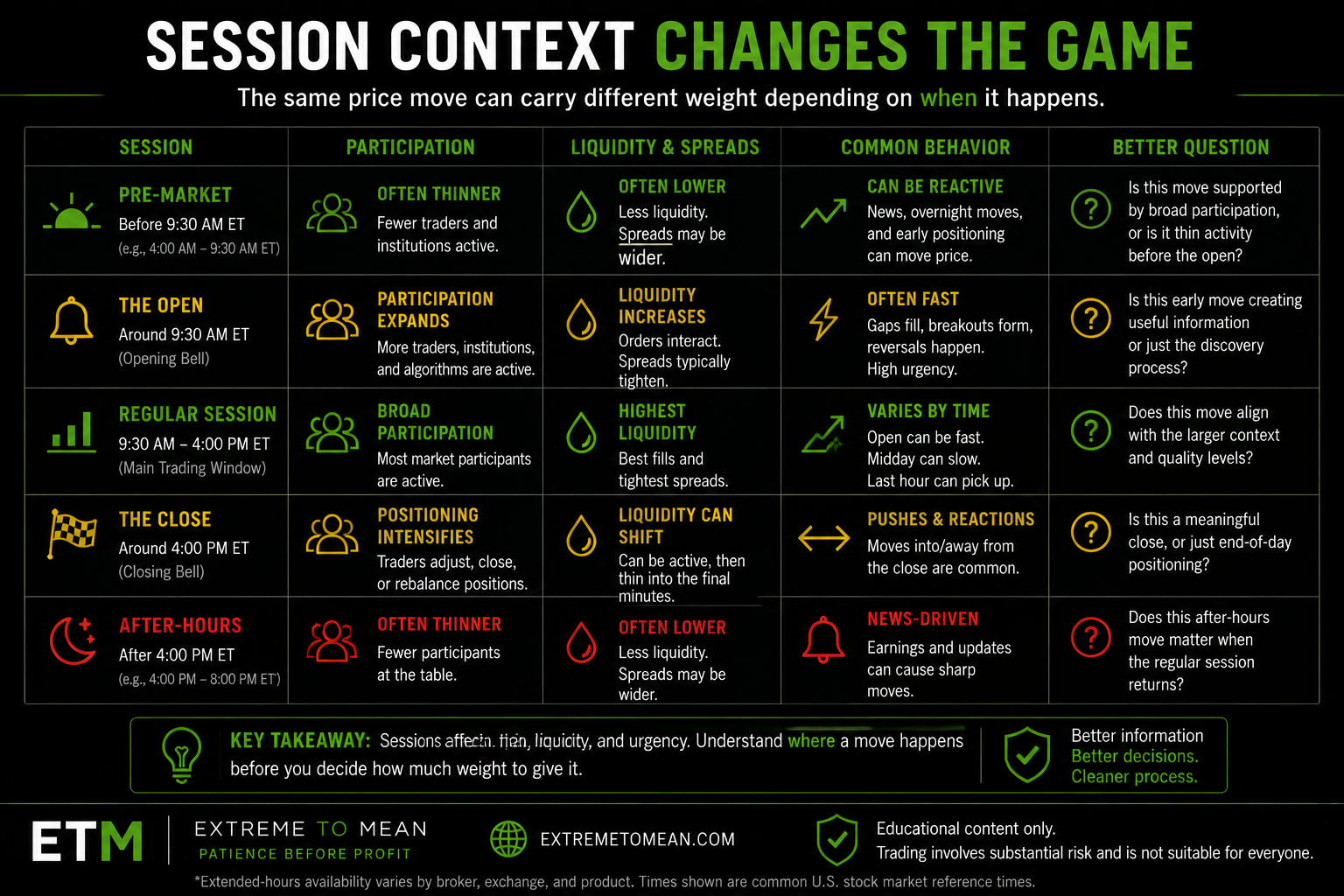
After-Hours: Trading After the Regular Close
After-hours trading takes place after the regular session ends.
This period can matter because companies often release earnings, news, guidance, or other updates after the close. Prices may react quickly when fresh information hits a thinner market. A stock can move sharply after-hours and then look different again when the next regular session opens.
After-hours trading can be useful for understanding market reaction, but beginners should be careful with it.
Liquidity may be lower than during the regular session. Spreads can be wider. Some orders may not execute the way a beginner expects. Price can move sharply because fewer participants may be available to absorb buying or selling pressure. Broker rules and product access can also differ during extended hours.
That does not mean after-hours price is fake. It means the trader should understand the environment. A move after the regular close may be important, but it still needs to be evaluated in context. The next regular session may confirm, reject, extend, or ignore part of that movement.
This is why session labels matter on a chart. A price level formed after-hours may not represent the same kind of participation as a level formed during the regular session. Both can be useful, but they should not automatically be treated as identical.
The trader’s job is not to react to every extended-hours move. The job is to understand where the move happened, how much participation may have been involved, and whether the information matters when the regular session returns.
A Simple Session Awareness Filter
Before reacting to a price move, a beginner should know which session they are looking at.
Start with these questions:
- Is this pre-market, regular session, near the close, or after-hours?
- Is the market broadly open, or is this an extended-hours environment?
- Is liquidity likely to be normal, thin, or changing?
- Is the spread tight or wide?
- Did this move happen before most participants arrived?
- Did this level form during regular trading or outside regular hours?
- Am I evaluating the session, or reacting to movement?
- Does this session match the decision I am trying to make?
These questions help the trader slow down. They do not predict what price will do. They simply organize the environment so the trader can make a cleaner decision. The next useful layer is understanding how liquidity can change across the trading day.
The better question is not, “Is the market moving?”
The better question is, “What session is this move happening in, and does that change how much weight I should give it?”
That is the point of session awareness. It keeps the trader from treating all movement as equal. It helps separate information from urgency.
For readers building the full Extreme to Mean foundation, the next step is to use the market calendar as part of a broader preparation process. Knowing when the market is open is useful. Knowing what kind of environment you are stepping into is better.
Final Thought
A trading session is a defined part of the trading day.
Pre-market, the open, the regular session, the close, and after-hours can all show price movement, but they do not always carry the same participation, liquidity, or behavior. A move before the open may not mean the same thing as a move during the regular session, which is one reason overnight gap trading requires its own evaluation. A move after-hours may not mean the same thing as a move when the full market is active.
That does not make one session good and another bad. It means each session has to be understood before the trader reacts.
The better trader does not ask only, “Is price moving?” The better trader asks, “When is this move happening, who may be participating, and does this session give me enough quality information to make a decision?”
That is session awareness. It also explains why scalping and day trading operate inside session boundaries.
The opening deserves its own preparation because the first 30 minutes can define an important reference range.
As the session develops, distinguishing a trend day from a range day helps the trader update expectations without forcing a label too early.
Educational content only. Trading involves substantial risk and is not suitable for everyone.