
A trader can watch six futures markets and still have a good reason to trade only one. The decision is how many markets the process can handle without lowering standards.
More markets create more possible trades, not automatically more good trades.
When ES is quiet, NQ may be moving, gold breaking a level, and crude reacting to a report. Looking elsewhere feels productive after hours of waiting. But movement is not necessarily qualified opportunity, and switching instruments adds decisions before a trade has earned risk.
The better question is not whether successful traders focus on one market or several. It is whether another instrument adds a tested opportunity that the trader can recognize, size, execute, and review without compromising the original process. Inside The Trader, that is a decision about trading permission, not personal preference.
The Three Market Lists Are Not the Same
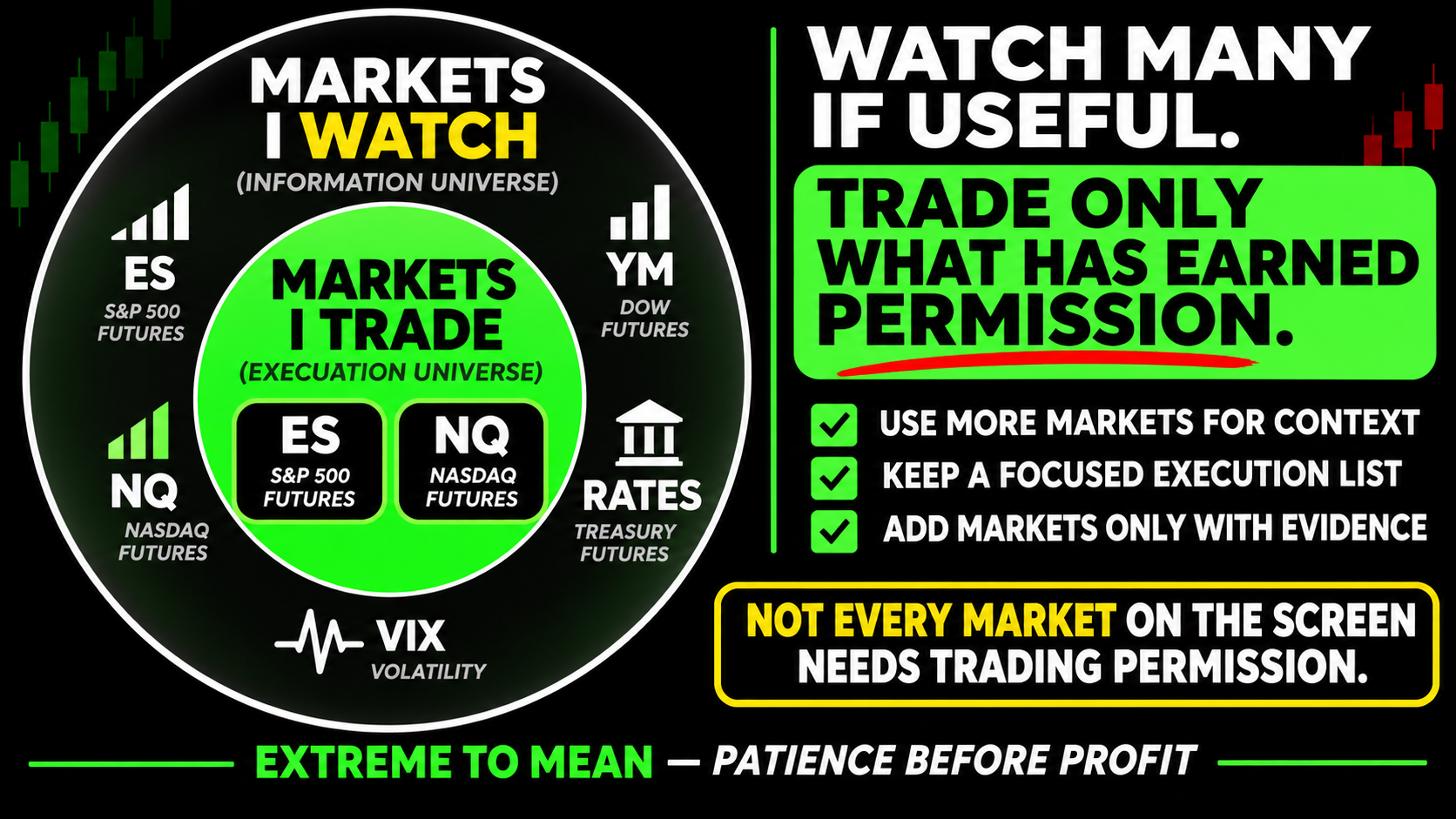
We can separate markets into three groups. The information universe contains markets observed for context, the watchlist contains markets where a setup may be developing, and the execution universe contains markets the trader is prepared and authorized by their own plan to trade. Those groups can overlap without being identical, and the execution universe may be much smaller than everything being monitored.
Consider someone who trades ES but also watches NQ, YM, Treasury yields, and volatility measures. Those additional markets may help that trader understand broad participation or notice when indexes are behaving differently. Nothing about observing them requires an NQ or YM position, because information can improve a decision without adding a trade.
A watchlist tells us where to look; a trading plan tells us where we are allowed to act. We might have five charts open, two markets with potential setups, and only one contract approved for live execution. WATCHING A MARKET ≠ TRADING A MARKET. Specialization in execution does not require blindness to the rest of the market.
What Specializing Can Actually Improve
Focusing on one or two instruments reduces the number of details we must recall under pressure. Each contract has distinct multipliers, ticks, liquidity, and event risks. A trader who moves from ES to NQ, crude oil, and gold without adjusting those assumptions can make a sizing or execution mistake even when the chart setup looks familiar.
Market familiarity also makes practice and review more coherent. If we collect trades from one defined ES setup, we can compare similar decisions across different days while tracking changing market conditions. If the journal combines six instruments and inconsistent rules, it becomes harder to separate the strategy from the market and our execution. The related lesson One Good Setup Is Better Than Ten Random Trades explains why trade count alone is not a quality measure.
One Market Is Not an Edge by Itself
Trading ES every day will not make its behavior uniform. The same contract can trend, rotate, compress, expand, or react abruptly to news, and a setup that belongs in one environment may be unsuitable in another. We can specialize in an instrument without pretending the conditions inside it stay constant.
A narrow list also creates an uncomfortable reality: some days the approved market offers no qualified trade. Boredom can make that feel like a failure, particularly when another chart is moving aggressively. If we respond by inventing an entry in ES or abandoning the plan to chase elsewhere, specialization has not solved the behavioral problem; it has merely exposed it.
Nor does repeated screen time manufacture a statistical advantage. A trader can know ES contract mechanics thoroughly and still use a setup without positive expectancy, defined risk, or consistent execution. Familiarity can reduce avoidable mistakes, but it cannot create an edge that has not been demonstrated.
When Several Markets Can Be Useful
A second market may be worthwhile when it adds qualified setups that the primary market does not provide often enough. For example, a trader might test a defined breakout approach on ES and then separately evaluate whether the same conditions work on NQ. If the additional market has acceptable results after costs, appropriate size rules, and a manageable schedule, it may earn a place on the execution list.
The important word is separately. ES and NQ futures share broad equity-market context, but they have different underlying indexes, contract values, volatility characteristics, and trading behavior. A strategy does not become portable merely because the new chart also contains candles, and its historical results should not be borrowed from another ticker.
Three Tickets Can Still Be One Economic Bet
Suppose a trader opens long positions in ES, NQ, and YM because each chart displays a bullish entry. The three orders may depend on the same rise in U.S. equities. If that common exposure reverses, the positions can lose together even though the entries appeared on different screens.
This distinction separates opportunity diversification from risk diversification. More instruments may offer more setup occurrences without creating independent sources of risk or return. Before stacking related positions, the trader needs to evaluate the combined exposure, not just the stop on each ticket in isolation.
When the Watchlist Becomes a Menu for FOMO
Imagine a trader watching ES, NQ, YM, crude oil, gold, and Bitcoin futures. ES is quiet, NQ accelerates, crude breaks out, and gold reverses near a prior high, so the trader chooses whichever chart currently looks most exciting. After sixty trades across different markets and loosely defined setups, the journal contains activity but little evidence about what is repeatable.
This is how a large watchlist can turn into organized fear of missing out. The more charts we monitor, the easier it becomes to confuse movement with opportunity, especially when the market we planned to trade is doing nothing. A trader may call the switch flexibility, even when the real change was a lower entry standard.
Another version appears after losses: four losing ES trades lead to NQ, followed by three losing NQ trades and a switch to crude. The trader believes the problem is the instrument, although the same impulsive entry habits travel with them. Changing the ticker can feel like fixing the strategy while leaving the actual decision error untouched.
Market Focus and Setup Focus Are Different Decisions
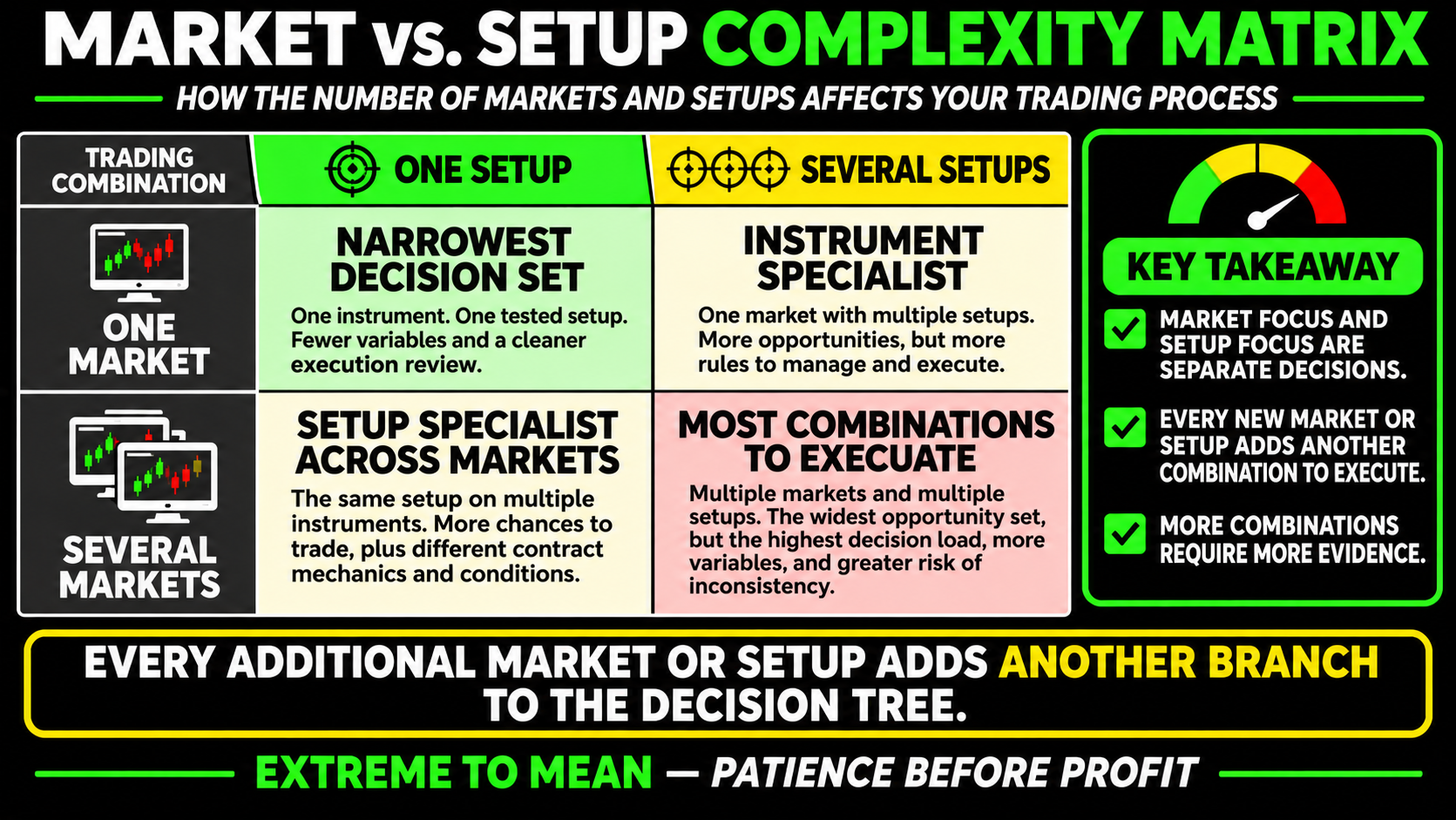
A trader can run one setup across several markets or several setups within one market. Neither choice is automatically better. What matters is whether the combination of instruments and setups is defined well enough to test and execute without improvisation.
One market with one setup creates one primary decision combination, while four markets with three setups create twelve possible market-and-setup combinations. That does not mean twelve independent strategies, but it illustrates how the number of rules and evaluations can grow. MARKET SPECIALIZATION ≠ SETUP SPECIALIZATION, and every new combination deserves evidence rather than automatic permission.
Give Markets Different Levels of Permission
The answer need not be one market forever or ten markets immediately. A practical structure is a core market where most execution occurs, an approved alternate with its own tested rules, and context-only markets that inform decisions but cannot trigger live orders. The alternate becomes active only when its defined setup, risk limits, and attention requirements are satisfied.
For example, ES might be the core market, NQ an alternate with its own tested setup, and YM a context-only reference. The trader can use all three for information without opening three positions. Broader awareness does not require broader trading permission.
The structure must also allow a no-trade day. If ES offers nothing and the NQ alternate fails its own criteria, the answer is not to search for a third market until something looks tempting. The plan has done its job when it prevents a low-quality trade as well as when it identifies a valid one.
Test Expansion and Measure What It Changes
Before expanding, we should be able to explain the limitation we are trying to solve. Is the primary setup genuinely too infrequent, or are we merely uncomfortable waiting? Are missed opportunities occurring in a second market under repeatable conditions, and do the results still justify participation after transaction costs, slippage, and execution differences?
Review each approved instrument separately, not only through combined dollar P&L. Record trade frequency, expectancy, average win and loss, drawdown, execution quality, and rule adherence for each instrument. The futures trading journal lesson provides the broader review structure; here the purpose is to see whether the added ticker improves the process or obscures a weak component.
The One-Market-or-Several Checklist
Before giving a new futures market live trading permission, ask these questions.
- Is our current setup clearly defined and executed consistently?
- Do we know the new contract's tick value, multiplier, hours, event risks, and sizing rules?
- Has the setup been tested on this instrument rather than assumed to transfer?
- Does it add qualified opportunity, not simply a chart that moves more?
- Does it create distinct opportunity or stack correlated exposure?
- Can we manage simultaneous setups without weakening attention or risk control?
- Can we track results and rule adherence separately for this market?
- Could we monitor this instrument for context without trading it?
- What evidence would justify removing it from the execution list?
- Are we solving a real process limitation, or just trying to avoid boredom?
The ETM Framework: Focus → Prove → Expand → Compare → Prune
The sequence is deliberate. FOCUS on an execution universe small enough to manage, then PROVE that the rules can be applied and evaluated consistently. EXPAND only when a new market has earned permission through its own evidence, COMPARE what it contributes after costs and behavioral effects, and PRUNE markets that add noise, redundant risk, or poor execution.
Final Thought
There is no universal correct number of futures markets to trade. Specialization may simplify mechanics, attention, and review, while variety may add legitimate setups when the strategy has been tested in each instrument. Neither creates an edge by itself, and neither removes the need to evaluate market conditions, execution quality, and combined risk.
Watch as broadly as useful, but risk capital only where the process has earned the right to act. Ask what measurable limitation the next market would solve and what evidence would make you remove it. The ETM free trading tools can support that preparation and review, because expansion should solve a process problem—not an entertainment problem.
Educational content only. Trading involves substantial risk and is not suitable for everyone.