
Most traders understand the basic idea of keeping records, but the journal often stops at date, contract, entry, exit, and profit or loss. Those numbers are useful because they tell you what happened financially, yet they leave out most of the information needed to understand why the trade happened. A trader can look back at a profitable trade and have no record of whether the setup was planned, the risk was clear, or the entry was driven by FOMO. That makes the journal accurate as a transaction history but weak as a learning tool.
A better journal belongs inside The Trader because the real subject is decision quality. The purpose is not to prove that every loss was a mistake or that every winner was evidence of skill. It is to preserve enough information that you can later compare what the market was showing, what your plan required, and what you actually did. The journal becomes useful when it helps you recognize which decisions deserve repetition and which ones need to change.
What a Futures Trading Journal Really Is
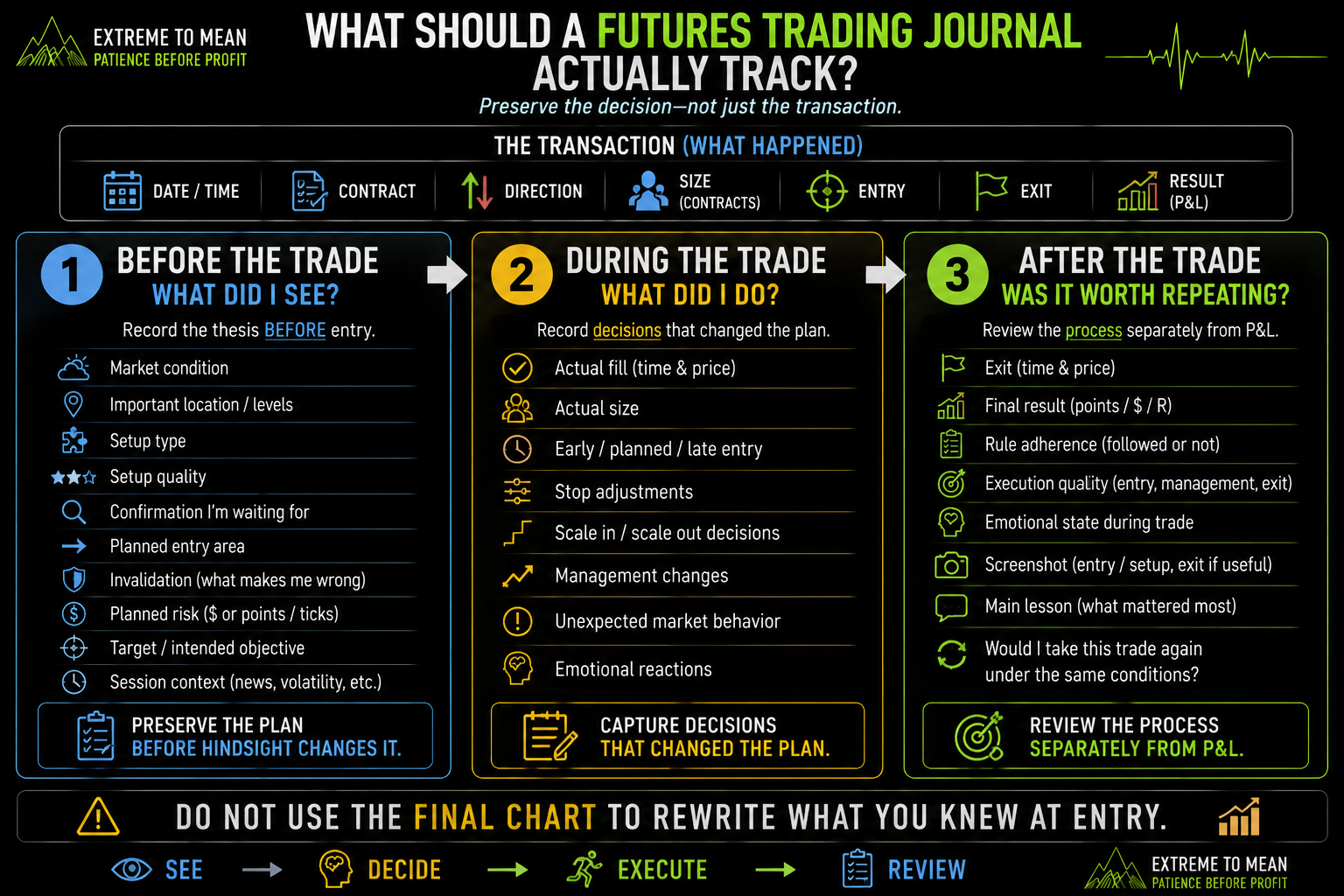
A futures trading journal is a structured record of your trades and the decisions surrounding them. At the most basic level, it should identify the contract, date, time, direction, entry, exit, size, and result, but those facts are only the skeleton. The journal becomes more valuable when it also records market condition, location, setup type, planned risk, execution quality, management decisions, and whether the trade followed the rules you intended to use. Those details turn a historical record into something you can actually review.
This is easiest when the journal grows out of a defined trading process rather than being invented after each trade. If you already know your accepted setups, trading hours, risk limits, and entry requirements from a complete trading plan, the journal can simply ask whether the trade matched them. Without that standard, review becomes subjective because every trade can be explained differently after the result is known. The journal needs a plan to compare the decision against.
A Trade Log and a Decision Journal Are Not the Same Thing
A trade log answers what happened. It records information such as contract, long or short, number of contracts, entry price, exit price, time, points or ticks, fees if tracked, and final P&L. Those facts matter for measuring activity and identifying basic performance patterns. They do not, by themselves, explain whether the trade was well planned.
A decision journal answers why the trade happened and how it was handled. It records the condition of the market, the location of price, the setup being taken, what confirmed the idea, where the trade was invalidated, how the position was managed, and whether the trader followed the rules. That distinction reinforces the broader principle that process matters more than prediction. The transaction tells you the result; the decision record tells you whether the process that created that result is something you would want to repeat.
What to Record Before, During, and After the Trade
Before entry, capture what you actually know at the time. Record the market condition, important levels or locations, setup type, confirmation you are waiting for, planned entry area, invalidation, intended risk, and realistic objective. If relevant to your process, note volatility, session timing, economic events, or confirmation from related markets. The goal is to preserve the thesis before hindsight changes it.
During the trade, record decisions that materially change the original plan. That can include the actual fill, position size, whether the entry was early or late, stop adjustments, scaling decisions, unexpected market behavior, or a deliberate management change. You do not need to narrate every candle while the position is open. Record the moments when your decision process changed.
After the trade, document the exit, realized result, rule adherence, emotional state, and a short explanation of what you believe mattered most. Ask whether the setup behaved as expected, whether your execution matched the plan, and whether anything you did was driven by fear, FOMO, frustration, or an urge to protect a small gain. The review should describe the trade that actually happened rather than the cleaner version you wish you had taken. That honesty is what makes the journal useful later.
Judge the Process Separately From the Outcome
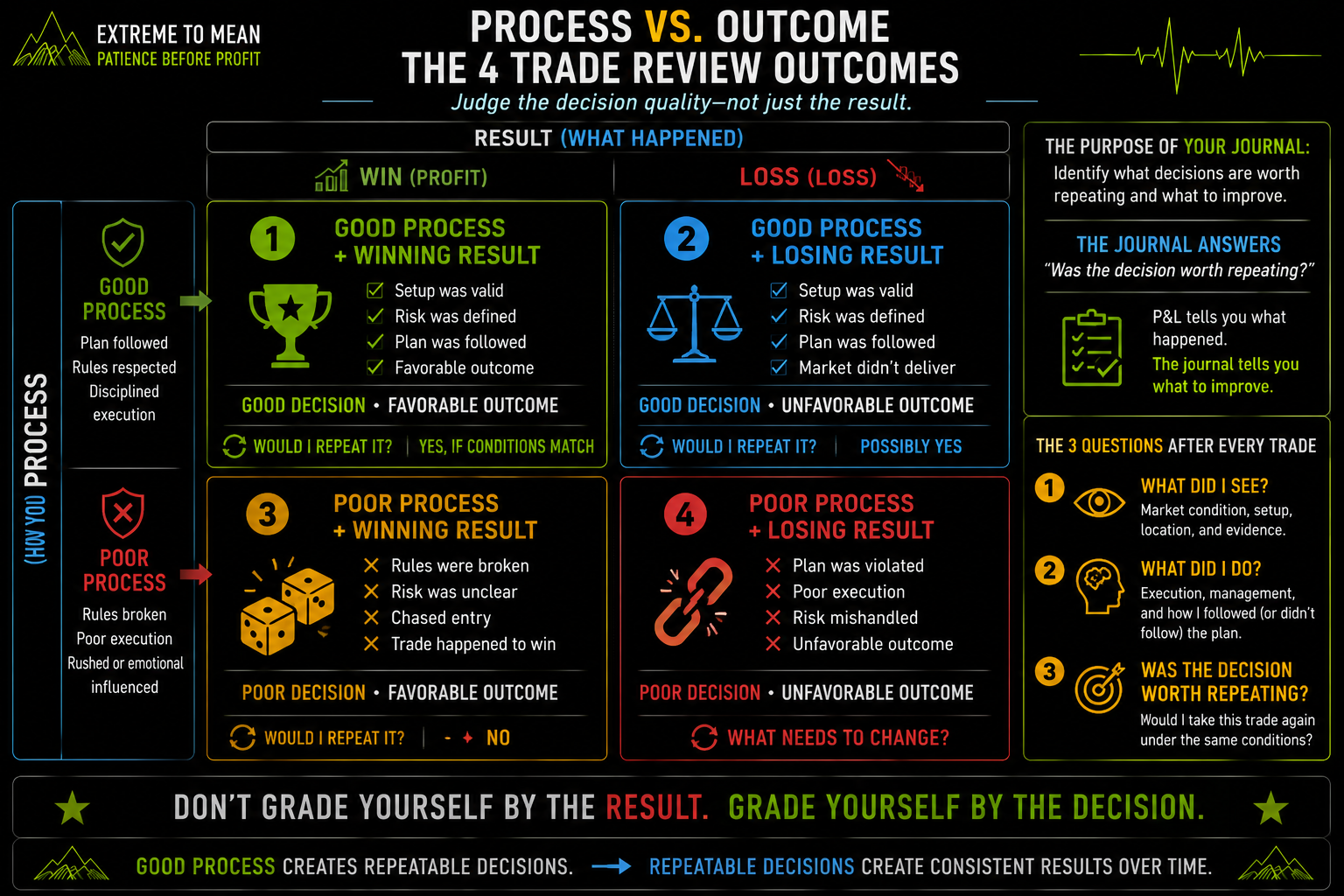
One of the most useful things a journal can do is prevent P&L from becoming the entire definition of a good or bad trade. A planned setup with clear risk can lose because no trading process controls the next market move. An impulsive rule-breaking entry can win because markets sometimes reward poor decisions in the short term. If the journal grades only profit and loss, both trades teach the wrong lesson.
There are four basic combinations worth separating:
- Good process + winning result: The trade followed the plan and produced a favorable outcome.
- Good process + losing result: The trade followed the plan, risk was defined, and the market simply did not produce the expected outcome.
- Poor process + winning result: The trade made money, but the entry, risk, management, or rule adherence would not be worth repeating.
- Poor process + losing result: Both the decision process and the outcome require review.
The critical question is not whether you should feel good about the winner or bad about the loser. Ask, "Would I take this trade again under the same conditions?" That question forces you to evaluate repeatability instead of allowing one outcome to rewrite the process. The distinction between delayed results and repeatable decisions is also a natural bridge into The Patience Principle, because a disciplined process has to survive periods when immediate feedback is noisy or uncomfortable. A journal gives you evidence for that evaluation instead of requiring you to rely on memory.
Screenshots Preserve Context That Numbers Cannot
Screenshots are especially useful in a futures trading journal because a numerical log cannot show where the trade occurred in the larger market structure. A chart image can preserve the relationship between price and important levels, the amount of available room, the condition of the market, and what confirmation was visible when the decision was made. Ideally, the screenshot should reflect the chart close to the decision point rather than being recreated much later. Otherwise, hindsight can make the setup appear cleaner than it actually looked.
You do not need a gallery of ten charts for every trade. One clear entry screenshot and, when useful, one exit or post-trade screenshot are often enough to preserve the important evidence. Marking the entry, stop, target, and relevant location can make later review faster. The objective is not to create beautiful annotated charts; it is to preserve the information your future self will need to judge the decision honestly.
Use Daily Review to Find the Decision Behind the Day
Daily review should be short enough that you can maintain it consistently. Look across the trades from the session and ask whether you followed the plan, took only accepted setups, respected risk, and responded appropriately to the market conditions you actually received. One trade may deserve a deeper review, but the purpose of the daily process is to understand the session as a group of decisions. That prevents the largest winner or loser from becoming the entire story of the day.
This is also where protecting your next decision becomes practical. A difficult loss matters, but the journal should also reveal what happened immediately afterward: Did size change, did patience disappear, did you chase, or did you continue following the same rules? The daily journal can expose a sequence in which one emotional reaction created the next poor decision. That information is often more useful than staring at the loss itself.
Weekly Review Is Where Patterns Begin to Matter
Individual trades can be noisy, which is why weekly review should look for repetition rather than dramatic conclusions. Group your trades by setup, market condition, time of day, location quality, rule adherence, and any other categories that actually belong to your process. Then look for behaviors or conditions that appear repeatedly rather than changing your rules because of one result. A journal becomes more useful as the sample begins to show tendencies.
The weekly review should identify both strengths and problems. You may discover that one setup is executed cleanly during the first part of the session but becomes rushed later, or that your best decisions occur when market conditions are clearly defined even when the trades do not always win. You might also see that certain emotional states repeatedly precede late entries, widened stops, or unnecessary trades. Those observations give you something specific to work on next week.
Look for Process Leaks, Not Just Losing Trades
A process leak is a repeated way that your execution drifts away from your rules. Examples might include entering before confirmation, trading poor locations, increasing size after a loss, moving stops without a structural reason, taking trades during conditions your plan normally rejects, or continuing after your decision quality has clearly deteriorated. One occurrence may be a mistake. Repetition turns it into something the process needs to address.
Strengths deserve the same attention because the journal should not become a catalog of everything you did wrong. Look for conditions under which you consistently wait well, define risk clearly, follow management rules, or recognize that no trade is the correct decision. The goal is to discover what your better decisions have in common. That gives you a process to reinforce instead of relying only on criticism.
Common Journaling Mistakes
The first mistake is trying to record so much information that journaling becomes another job. An enormous template may look professional, but if it takes twenty minutes to complete after every trade, it will often be abandoned during active periods. Record information that can change your review or expose a pattern. More fields do not automatically create more insight.
The second mistake is turning the journal into a courtroom where every loss must be explained as somebody's fault. Traders sometimes use review to prove that an entry was "actually good" or to rewrite the thesis using information that was not available when the trade began. That defeats the purpose. Your trading plan is a promise made before the open, and the journal should compare what you did with that prior standard rather than creating a new standard after the result.
Build a Minimum Viable Futures Trading Journal
You do not need specialized software to begin. A spreadsheet, database, notebook, or other system can work if it captures enough information to reconstruct the decision and is easy enough to maintain. Start with the smallest journal that gives you useful review data, then add a field only when you know why you need it. Consistency of use matters more than having the most elaborate template.
A practical futures trading journal checklist can include:
- Date and time
- Futures contract
- Long or short
- Position size
- Market condition
- Meaningful location or level
- Setup type and setup quality
- Planned entry and actual entry
- Planned invalidation and risk
- Target or intended objective
- Exit and realized result
- Important management decisions
- Emotional state
- Rule adherence
- Entry or setup screenshot
- One sentence describing the main lesson
That is enough to separate the transaction from the decision without turning the journal into paperwork for its own sake. Over time, you can add tags for time of day, volatility, specific setup variations, or recurring errors if those categories are producing useful information. Avoid adding fields simply because another trader tracks them. Your journal should answer questions about your process.
End Every Review With Three Questions
A useful journal can become complicated over time, but the final review can remain remarkably simple. First ask, "What did I see?" That forces you to describe the market condition, location, setup, and information available before the decision. It helps separate the chart that existed at entry from the chart that became obvious afterward.
Then ask, "What did I do?" Record the actual entry, risk, size, management, exit, and any rule changes without cleaning up the story. Finally ask, "Was the decision worth repeating?" That last question combines the first two without allowing the winner or loser to decide the answer automatically. Those three questions keep the journal centered on observation, execution, and repeatability.
Final Thought
A futures trading journal should give you more than a history of your P&L. The transaction log tells you what happened, but the decision journal preserves the context, setup, risk, execution, management, emotion, and rule adherence that produced the trade. Daily review helps you understand the session, while weekly review helps you find repeated strengths, mistakes, time-of-day patterns, emotional triggers, and process leaks. The objective is not to label every loss as bad or every winner as good.
The most valuable journal entry may be a losing trade you would willingly take again because the conditions, setup, risk, and execution all matched your process. The most dangerous may be a profitable trade you would not repeat because luck rewarded a broken rule. A journal helps you tell the difference. What did I see? What did I do? Was the decision worth repeating?
Educational content only. Trading involves substantial risk and is not suitable for everyone.