
One of the hardest things for newer traders to accept is that the chart can be active without being useful. Price can move quickly, candles can look dramatic, and reactions can feel important in real time, but that does not mean the market is giving a clean signal.
The market produces constant movement because buyers and sellers are always adjusting. Orders come in. Liquidity shifts. Short-term traders enter and exit. Algorithms react. News gets absorbed. Stops get triggered. Some of that movement matters. Much of it does not.
The problem is that noise often looks like information when a trader is staring at the chart too closely. A fast candle feels urgent. A wick feels meaningful. A small breakout feels like opportunity. A quick reversal feels like warning. The trader feels pressure to respond, even when the larger structure has not changed.
Extreme to Mean teaches that the market comes first because conditions decide whether movement matters. This lesson belongs with the broader market context lessons because learning to separate signal from noise is one of the first steps toward better decision quality.
Signal Needs Context
A signal is not just movement. A signal is movement that means something inside the current market environment.
That distinction matters. A candle by itself can only tell you what happened during that moment. It does not automatically tell you whether the market is changing, confirming, rejecting, exhausting, or continuing. For movement to become useful, it needs context.
Context answers the question, “What does this move belong to?”
A bullish candle in the middle of a messy range may not mean much. The same candle coming out of a clean pullback in a trending market may carry more weight. A sharp selloff into a known lower extreme may mean something different from a sharp selloff breaking down from a weak support area. A wick near a meaningful level may deserve attention. A wick in the middle of random chop may only be noise.
This is why the market comes first. Traders who start with the candle often react too quickly. Traders who start with the environment are more likely to ask whether the candle is actually changing anything.
Signal usually has a relationship to something bigger than itself. It connects to structure, location, prior behavior, a key level, a range edge, a trend, a failed breakout, or a change in pace. Noise is usually movement without that larger meaning.
A useful price move should help answer a question. Is price holding structure? Is an extreme being rejected? Is a range breaking with follow-through? Is a trend weakening? Is the market moving away from balance or back toward it?
If the movement does not help answer a meaningful question, it may not be information yet.
Noise Feels Important Because It Moves Fast
Noise is dangerous because it often feels urgent. The market does not whisper when it wants your attention. It moves, flashes, rejects, breaks, snaps back, and makes the trader feel late.
That urgency is why traders react to candles that do not matter.
A small breakout above a minor high can feel like the beginning of a real move. A fast red candle can feel like the start of a breakdown. A quick bounce can feel like a reversal. A two-minute push can feel like momentum. When the trader is watching every tick, the smallest movement can start to feel larger than it is.
The mistake feels reasonable because real signals also begin as movement. Every meaningful trend, reversal, breakout, and reversion starts with price doing something. The challenge is that not every price move grows into something meaningful.
That is why the trader needs a filter.
Without a filter, the trader may treat every reaction as a clue. They may take trades because price moved, not because the move mattered. They may enter during chop, chase middle-of-range candles, or switch bias repeatedly because every new candle changes how they feel.
This is where the article context comes before the candle becomes important. A candle can look convincing in isolation, but the market does not trade in isolation. A candle needs surrounding information before it earns weight.
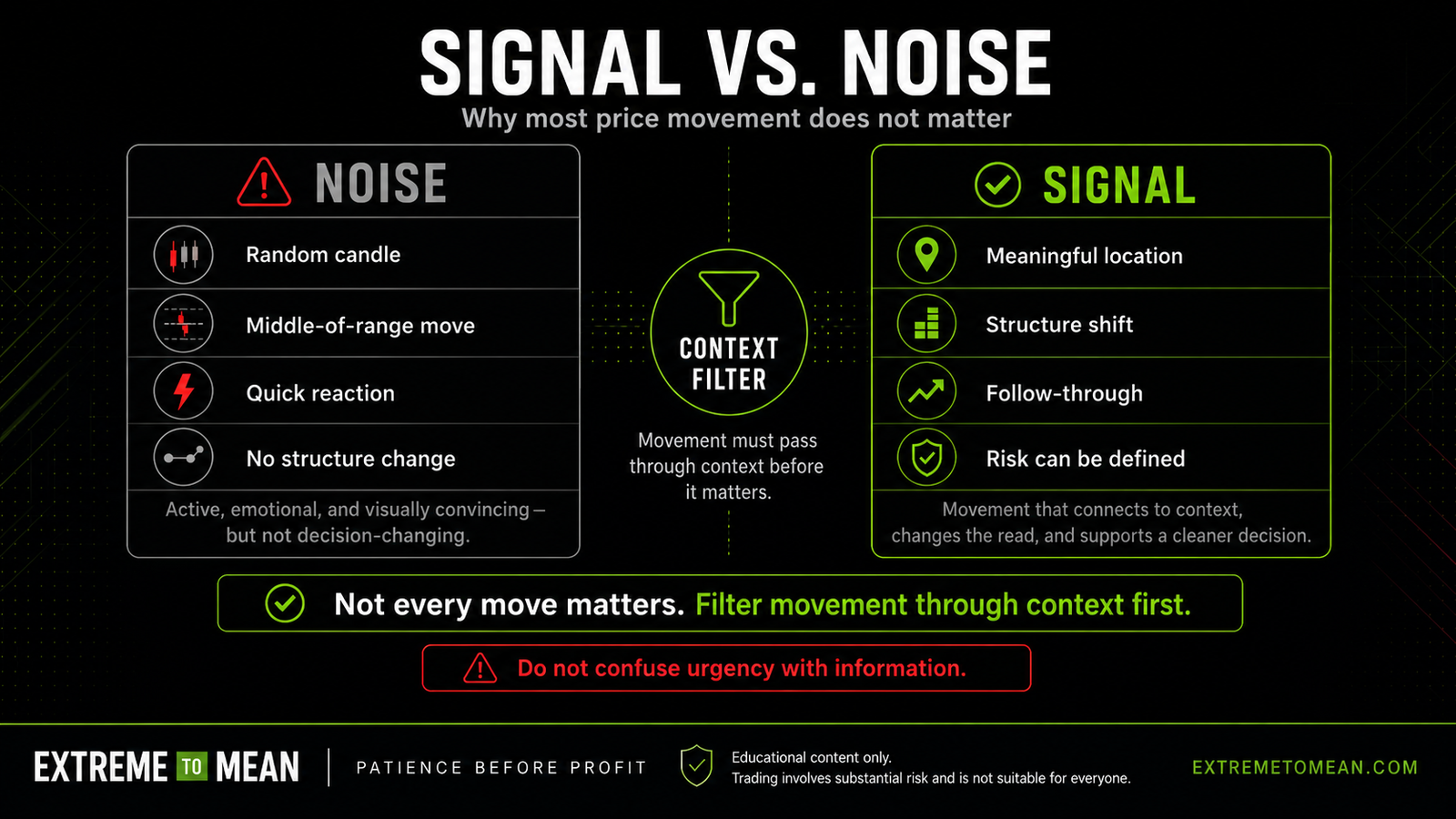
Noise tends to create motion without decision clarity. The trader sees activity, but the trade questions are still unanswered. Where is the important location? What structure has changed? What level has been accepted or rejected? Where is the risk clear? What would prove the idea wrong?
If those answers are missing, the movement may be loud, but it is not necessarily useful.
The Middle of the Market Produces the Most Confusion
A lot of noise happens in the middle.
The middle of a range, the middle between major levels, the middle after a move has already traveled, or the middle of an unclear session can create some of the worst decision-making conditions. Price is moving, but the movement may not be attached to a clean edge.
This is where traders often get chopped up. They see small breaks, minor reactions, and quick rotations that appear meaningful for a few candles, only to reverse again. The trader buys one push, sells the next failure, then buys the next bounce. The market may not be doing anything important. It may simply be rotating inside an area where neither side has control.
In reversion-to-mean trading, this matters because the best information often comes from location. Extremes, range edges, meaningful deviations from the mean, prior reaction areas, and failed moves can help create context. The middle usually offers less clarity. There may be less room, weaker structure, and more back-and-forth movement.
Noise is not always random, but it is often irrelevant to the decision the trader wants to make. A small candle inside the middle of a range may be real movement, but it may not be useful movement. A bounce after a tiny drop may happen, but it may not create a qualified opportunity. A breakout of a minor micro-level may occur, but if it runs directly into a larger obstacle, the signal may be weak.
That is why traders need to understand three common market states. Trending, ranging, and choppy markets do not produce the same quality of information. A move that matters in one environment may mean very little in another.
The trader’s job is not to respond to every movement. The trader’s job is to judge whether the movement changes the read.
Follow-Through Helps Separate Real Information From Reaction
One of the simplest ways to separate signal from noise is to look for follow-through. Follow-through means the market does something after the initial move that confirms the move may matter.
A breakout candle by itself may be noise. A breakout that holds above the prior range, pulls back without failing, and attracts more buying may carry more information. A rejection wick by itself may be noise. A rejection followed by structure shifting back the other way may deserve more attention. A fast push into an extreme may be noise until the market shows whether that area is being accepted or rejected.
Follow-through does not guarantee anything. It simply gives the trader more evidence than the first reaction alone.
This is important because many false signals look convincing at first. A candle breaks a level, then immediately returns inside the range. Price rejects an area, then drifts back into it. A move accelerates, then stalls with no continuation. These are not failures of the market. They are reminders that the first move is often incomplete information.
A patient trader can let the first move speak, then watch what happens next. Does price hold the area? Does structure change? Does the move create acceptance, or does it fail quickly? Does volume or pace support the move, or does it fade? Does the market create a cleaner opportunity after the initial reaction?
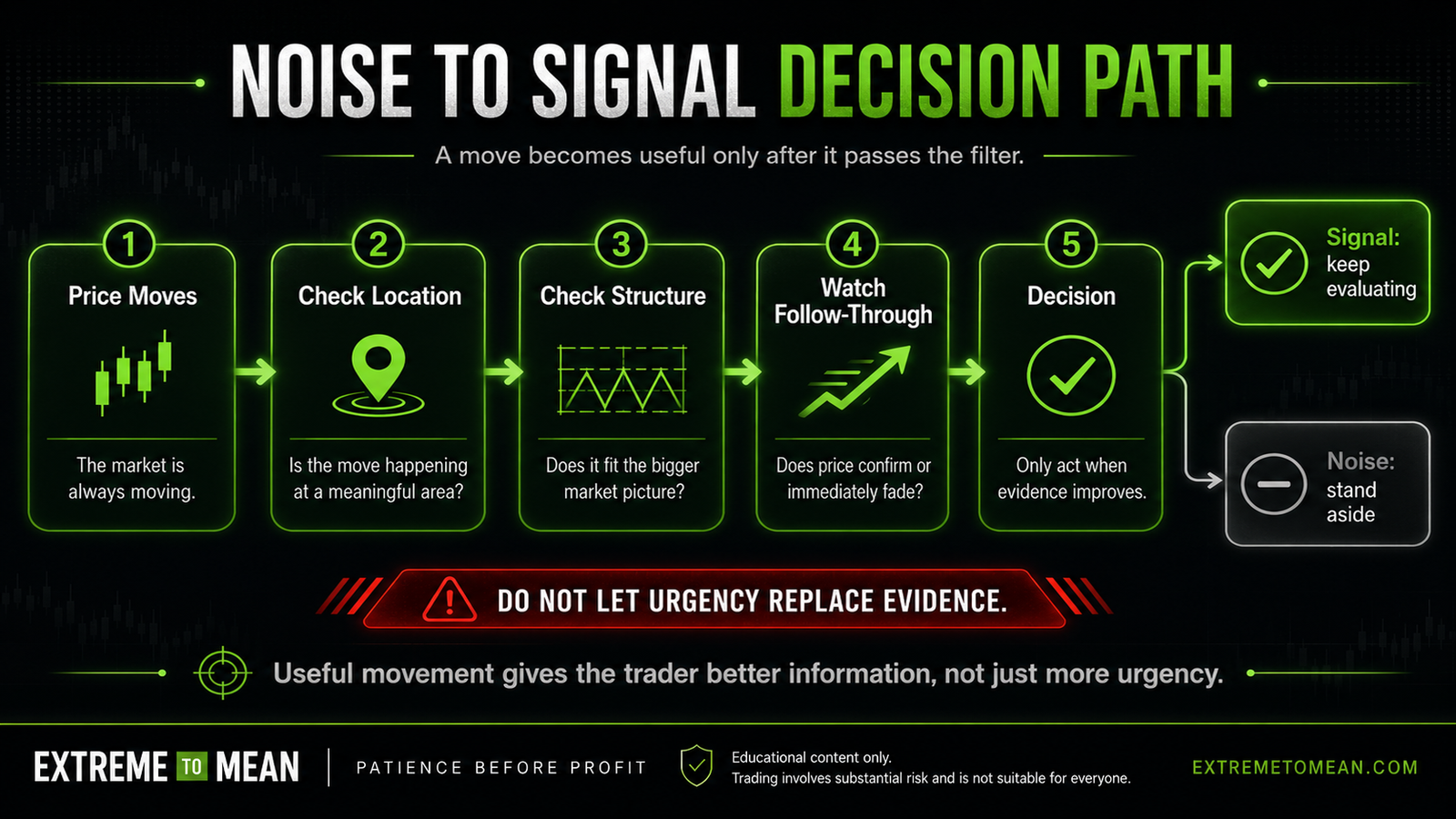
This is where patience is practical. Waiting for more evidence may mean missing some moves, but it can also keep the trader from acting on every temporary reaction. The goal is not to catch the first candle. The goal is to make a better decision with better information.
A Simple Signal vs. Noise Filter
A trader does not need a complicated model to begin filtering noise. A few questions can slow the decision down and bring attention back to structure.
Before reacting to a move, ask:
- Context: What kind of market am I trading inside?
- Location: Is this move happening at a meaningful area?
- Structure: Did this movement actually change anything?
- Follow-through: Is price confirming the move or immediately fading it?
- Room: Is there space for the idea to develop?
- Risk: Can the idea be defined clearly before entry?
- Relevance: Does this movement matter to my setup, or is it just activity?
The better question is: Did this move change the decision, or did it only change my emotions?
That question is useful because noise often changes the trader before it changes the market. A candle can create urgency. A wick can create fear. A quick push can create FOMO. But if the larger structure is still the same, the trader may be reacting to emotion rather than information.
This is especially important in choppy conditions. When price is moving without clean structure, traders can feel like opportunities are everywhere. In reality, the better decision may be to wait for conditions to improve. If the market is unclear, studying the problem of trading the chop can help newer traders recognize why constant movement does not always deserve constant action.
A clean signal usually gives the trader something specific to work with. It occurs at a meaningful location. It fits the current market state. It shows some form of confirmation or follow-through. It helps define risk. It creates a clearer decision.
Noise does the opposite. It creates activity without clarity.
Final Thought
Most price movement does not matter because most movement does not change the larger read. The market can be active, emotional, fast, and visually convincing without giving a trader a clean signal.
That is not a problem with the market. That is the market.
The trader’s job is to filter. Context comes first. Location gives movement meaning. Structure shows whether something has changed. Follow-through helps separate temporary reaction from useful information. Risk clarity decides whether the idea can become a trade.
Do not trade every move. Do not trust every candle. Do not let noise turn into action just because it feels urgent.
Wait for the movement that actually matters.
Educational content only. Trading involves substantial risk and is not suitable for everyone.