
A checklist sounds simple until a trader tries to use one in real time. It is easy to create a page filled with rules when the market is closed, but a checklist that takes five minutes to complete is usually abandoned as soon as volatility increases. The opposite problem is a checklist so vague that every trade can somehow pass it. A useful checklist lives between those extremes: specific enough to reject weak decisions and simple enough to use under pressure.
The checklist should also come from the trading process rather than from a generic template copied from someone else. Inside The Setup, the important questions involve whether the market condition fits, whether price is at meaningful location, whether a defined setup exists, and whether the trade can be planned with clear risk. Different strategies may answer those questions differently, but the categories remain useful because they force the trader to explain the decision. The objective is not to make trading mechanical; it is to make the decision less vague.
A Checklist Should Filter Decisions, Not Decorate the Plan
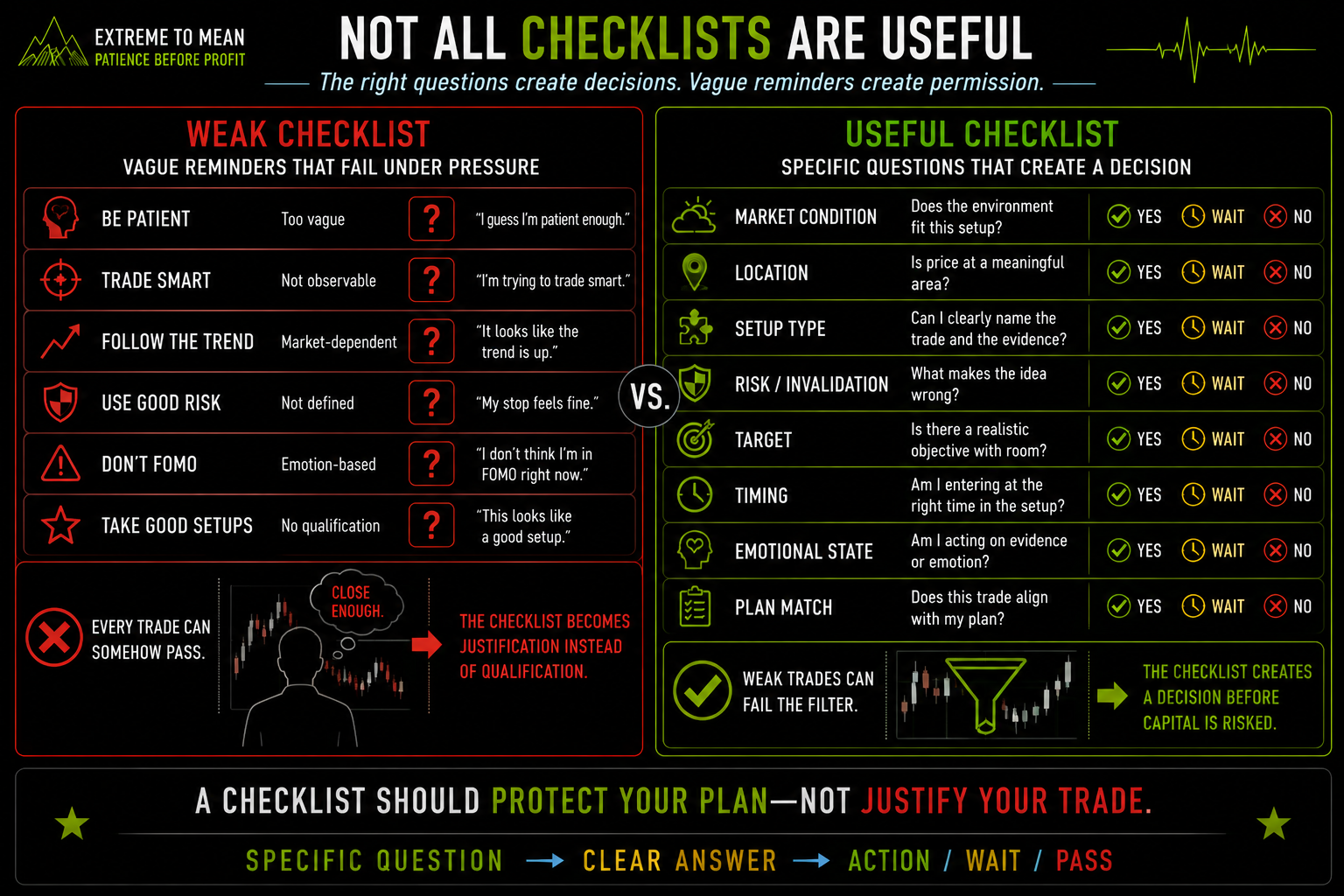
Many traders create checklists that describe good intentions instead of observable criteria. Items such as “be patient,” “trade smart,” or “follow the trend” sound responsible, but they are difficult to answer clearly when an actual setup appears. A checklist works better when each question points to something the trader can identify on the chart, in the market environment, or in their own plan. The question should help produce a decision rather than simply remind the trader to behave well.
This is why the weaker checklist often feels useful even when it is not. Writing down general principles creates the feeling of preparation, and checking boxes can create the feeling of discipline. Yet a checklist only improves decision clarity when a failed answer has consequences, including the possibility of waiting or skipping the trade. If every setup receives a checkmark eventually, the checklist has become permission rather than qualification.
Start With the Market Condition
The first part of the checklist should ask what kind of market the trader is dealing with. Is price trending cleanly, balancing inside a range, transitioning between states, or behaving erratically enough that the trader cannot describe the condition with confidence? Different setups require different environments, so this question prevents a trader from applying the same pattern to every market. The objective is not to name the condition perfectly but to determine whether the current environment supports the type of trade being considered.
This matters because a recognizable setup can behave very differently when the surrounding condition changes. A reversion idea that makes sense in a balanced market may be far weaker when price is moving directionally with persistent momentum, while a breakout idea can struggle when the market repeatedly rejects range extensions. The trader should therefore ask what the market is doing before asking what they want to trade. Context becomes the first gate through which the setup has to pass.
Check the Location and Name the Setup
After market condition, the checklist should ask where the trade is occurring. A pattern at a meaningful support, resistance, prior extreme, range boundary, higher-timeframe reference, or other planned area carries different information from the same pattern appearing in random space. This is why location is the first filter before a trader becomes attached to the entry. If the location cannot be explained, the checklist has already exposed a weakness.
The next question is whether the trader can clearly name the setup. A reversion, breakout, pullback, continuation, or other planned trade should have characteristics that distinguish it from movement that merely looks interesting. The broader principle of setup, not signal helps here because one candle or indicator event should not automatically define the trade. If the trader cannot describe what setup is developing and why it belongs at this location, the idea may still be recognition rather than qualification.
Define the Risk and the Target Before Entry
The checklist should require a clear answer to what makes the trade wrong. Structural invalidation may sit beyond an extreme, failed reclaim, range boundary, support or resistance level, or another point where the original thesis no longer makes sense. The exact method can vary, but the answer should exist before the order is entered. If risk still needs to be invented after entry, planning has not finished.
This is why the trade is not ready until the risk is clear. The checklist should also ask where price could reasonably travel if the thesis works, because a stop without a usable objective does not complete the trade plan. A target should respect current volatility, nearby structure, and the type of setup being taken rather than simply provide an attractive number. Risk and target work together to show whether the available trade is practical from the actual entry.
Check Timing and Your Emotional State
A valid setup can become a poor entry when timing deteriorates. Price may already have moved too far from the planned location, the stop may now require more distance, or much of the available path toward the target may already have been used. This is where where you enter matters more than what you predict, because being correct about direction does not automatically make the current price attractive. The checklist should therefore ask whether the trade is still being taken where the original plan expected it.
Emotional state belongs on the checklist too, but it should not become a vague question about whether the trader feels calm. A more useful question is why am I trying to enter this trade right now? If the answer is that the setup appeared at the planned location with defined risk, that describes market evidence; if the answer is that price is running and the trader is afraid of missing it, that describes urgency. The checklist does not remove emotion, but it makes emotional motivation harder to disguise as technical analysis.
Does the Trade Actually Match the Plan?
The final major filter should ask whether this trade belongs to the strategy the trader intended to execute. Traders often have a plan before the session and then quietly expand its boundaries once price starts moving. A setup that was not part of the plan suddenly becomes “close enough,” or a location that would normally be rejected becomes acceptable because momentum looks convincing. The checklist should make that change visible before capital is committed.
This question protects against improvisation being mistaken for flexibility. Markets change, and a good trader may adapt, but adaptation should still have a clear reason grounded in price and context rather than a desire to participate. The better question is, “If I saw this exact trade during preparation, would I have considered it valid?” If the answer is no, the trader should be able to explain what objectively changed before making an exception.
Keep the Checklist Short Enough to Use
The best checklist is not the one containing the most rules. A twenty-five-question form may look comprehensive, but it can become impractical when the setup is developing quickly and the trader has to make a decision. The stronger approach is to identify the few categories that repeatedly determine whether a trade fits the plan. The checklist should reduce decision clutter rather than create a second analytical system.
Each item should also be difficult to rationalize. “Good location?” is weaker than “What specific level or structural area makes this location meaningful?” and “Risk okay?” is weaker than “What invalidates the thesis?” Specific questions create specific answers, which makes it easier to identify when something is missing. Simplicity does not mean lowering the standard; it means removing questions that do not change the decision.
Build Your Simple Day Trading Checklist
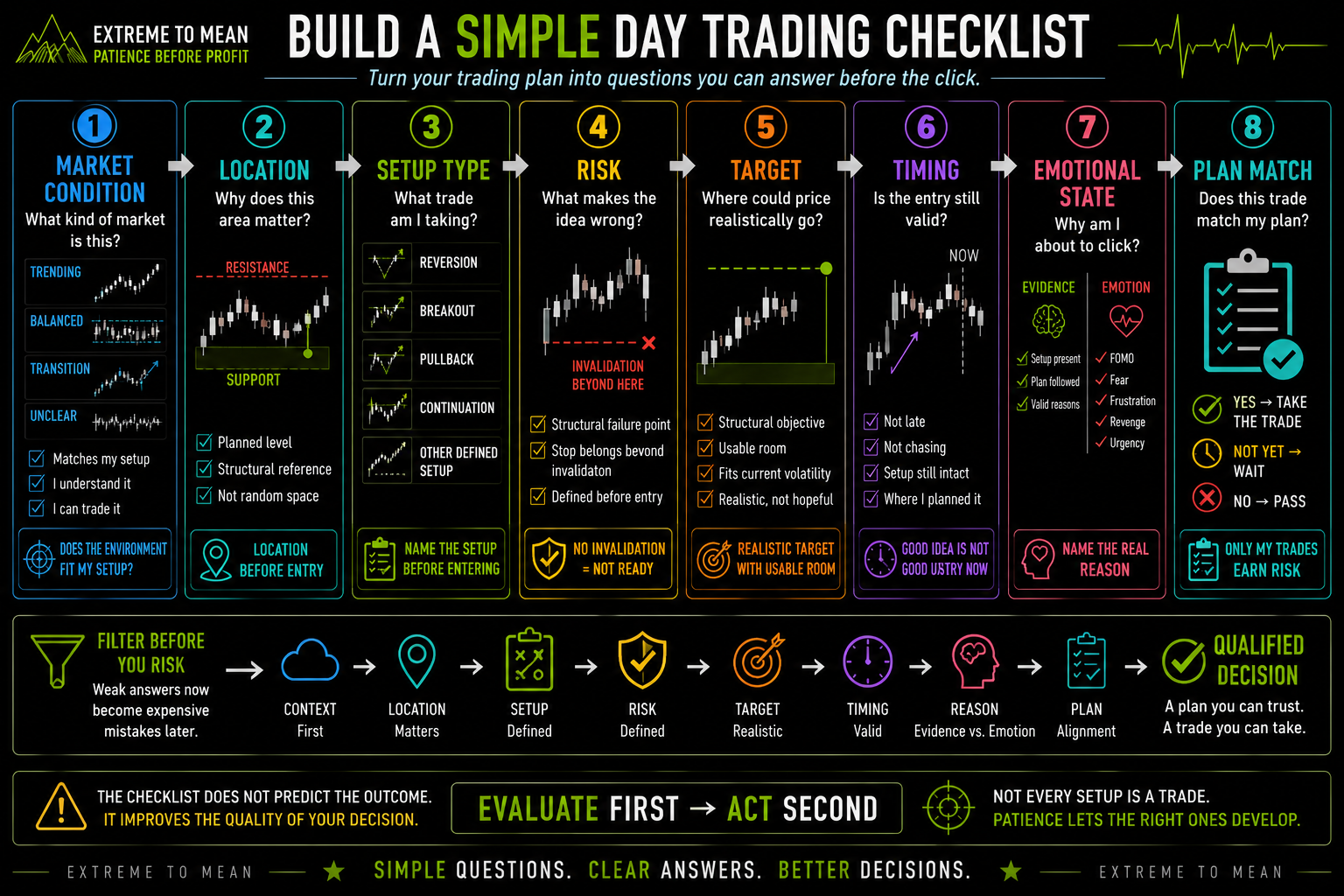
A practical checklist can be built around eight categories without turning every trade into paperwork. The exact wording should reflect the trader’s own setups, but each question should be answerable before entry and should help determine whether the trade deserves further consideration. The point is not to force every item into a yes-or-no formula when nuance is necessary. The point is to make the reasoning explicit before the click.
- Market condition: Does the current environment fit the setup I am considering?
- Location: Is price at a meaningful area where this setup belongs?
- Setup type: Can I clearly name the trade and the evidence that defines it?
- Risk: What specifically invalidates the thesis, and is that risk defined before entry?
- Target: Is there a realistic objective with usable room from this entry?
- Timing: Am I still entering where the setup was planned, or am I late and chasing?
- Emotional state: Am I acting on evidence or reacting to FOMO, frustration, fear, or urgency?
- Plan match: Does this trade actually satisfy the rules I intended to follow today?
The checklist should not require every trade to look identical. A trend setup and a reversion setup can pass the same high-level categories for different reasons because their conditions, locations, invalidations, and targets are different. What should remain consistent is the requirement that the trader can explain each decision before entry. Sometimes the result of the checklist will be “not yet,” and sometimes it will be “this is not my trade.”
Use the Checklist After the Trade Too
The same checklist becomes valuable during review because it provides a more precise way to describe what happened. Instead of writing “bad trade” or “should have been more patient,” the trader can identify whether market condition was misread, location was weak, the setup never fully developed, risk was unclear, timing was late, or emotion overrode the plan. Specific process errors are easier to study than general frustration. Over time, repeated failures in the same category can show where the trading process itself needs more attention.
The checklist also keeps outcome separate from decision quality. A trade that violated several criteria can still win, while a trade that matched the plan can still lose because no checklist controls the next market move. The purpose is to improve clarity and consistency of evaluation, not to create guaranteed outcomes. Traders who want to connect these filters with the broader decision framework can continue into the Extreme to Mean system.
Final Thought
A simple day trading checklist should not tell the trader what the market will do next. It should tell the trader whether the current idea matches the conditions, location, setup, risk, target, timing, and planning standards that were supposed to govern the decision. That creates a small but important separation between seeing movement and deciding that the movement deserves capital. The checklist becomes useful because it makes missing pieces visible before the trade begins.
The strongest checklist is usually the one the trader can remember, answer, and respect when the market becomes active. Build it from the actual trading plan, remove questions that do not affect the decision, and make the remaining questions specific enough that weak answers are difficult to rationalize. Patience does not mean checking boxes forever while a valid trade disappears; it means requiring the setup to satisfy the process before committing. The trader’s job is to evaluate first and act only when the trade matches the plan.
Educational content only. Trading involves substantial risk and is not suitable for everyone.