
Calling single prints “unfinished business” makes it sound as though price must revisit them. The idea feels persuasive because the finished profile highlights an area the market crossed quickly. Yet a record of past trading is not a forecast: PRIOR FAST AUCTION ≠ REQUIRED FUTURE REVISIT.
Inside The Market, the better question is what these structures measure and how price responds if they are tested. That means understanding TPO, distinguishing similar-looking features, and separating a reference from an entry or target. We can use the information without inventing predictive powers.
First Understand the Letters in a TPO Profile
TPO stands for Time Price Opportunity, the basis of traditional Market Profile. The session is divided into time brackets—often 30 minutes—each represented by a letter or block. A bracket contributes one TPO to every price row it visits, regardless of how many contracts traded there.
Repeated visits by different brackets create a wider profile at that price; a single bracket leaves one TPO. The counts measure which time brackets included trading at price, not precise minutes or contracts. That distinction matters because the profile is a time-based summary, not a volume ledger.
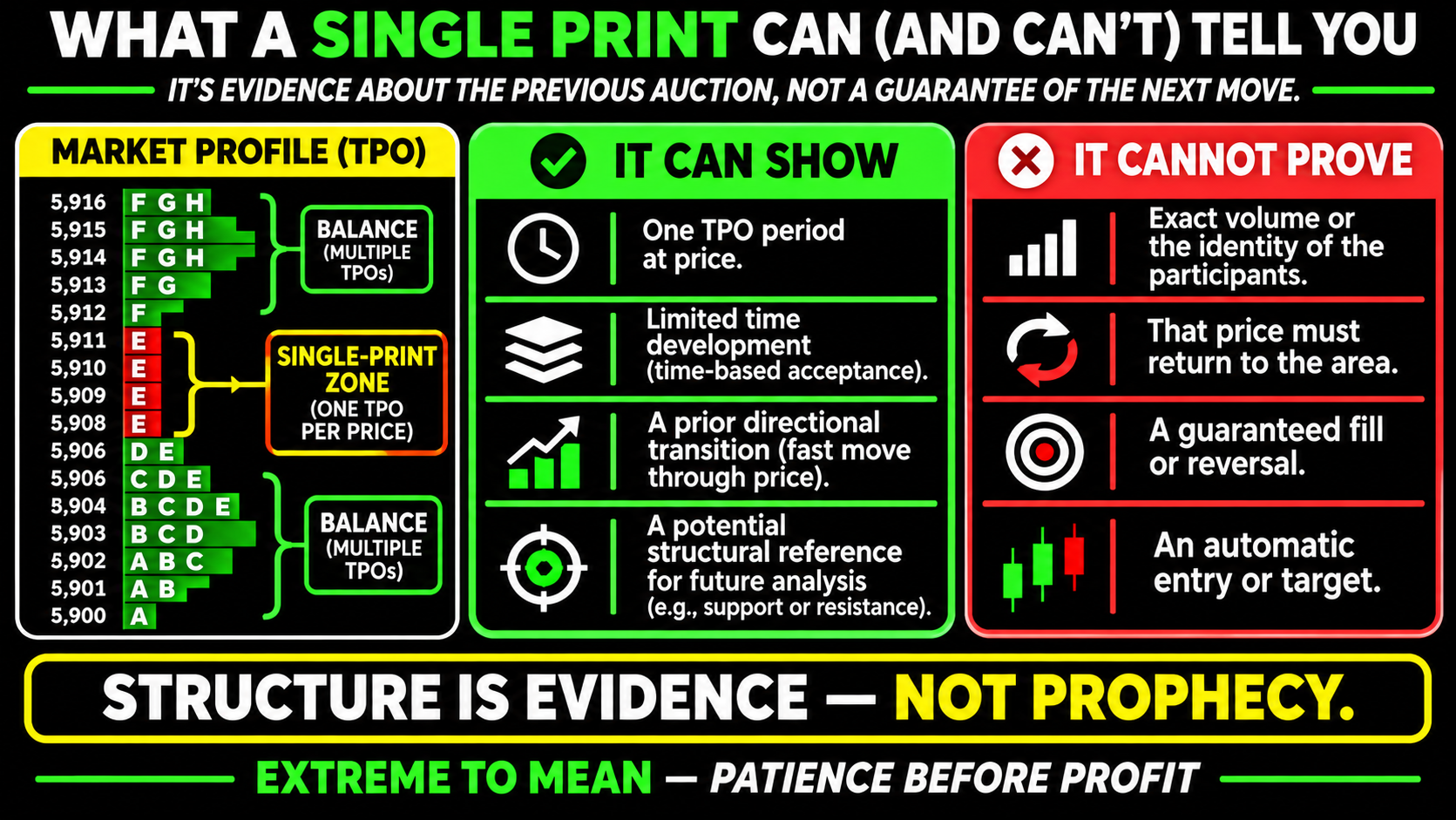
Imagine ES rotating near 5,900 over several brackets, then crossing 5,905–5,910 in one bracket before trading repeatedly near 5,915. The profile may be wide below and above, but narrow during that transition. The one-letter bridge is often the useful single-print zone, rather than one isolated row.
What a Single Print Can—and Cannot—Tell Us
An internal single print is a non-extreme row with one TPO, often part of a run between more developed areas. Price traded there during one bracket but not others in that profile. It indicates limited repeated time opportunities, not an absence of transactions: LIMITED TIME AT PRICE ≠ NO TRADING AT PRICE.
Market Profile traders often read that shape as evidence of a directional, relatively fast transition away from a previous area of balance. The structure can be consistent with initiative activity, but it cannot identify a bank, fund, or other participant behind the move. The profile shows where and when price traded according to its construction, not the identity or intentions of the people submitting orders.
A highlighted single print can mark prior directional movement and a future reference. It cannot establish exact volume or identify its participants. Nor can it guarantee support, resistance, a return visit, or an entry simply because the platform drew a label.
Internal Single Prints Are Not Tails or Low-Volume Nodes
Location changes the meaning of a one-letter structure. An internal single-print zone sits between areas with more developed TPO activity; a one-TPO extension at the top or bottom of a profile is usually discussed as a tail or excess. A buying tail near the lower extreme or selling tail near the upper extreme may suggest rejection at an auction boundary, while an internal zone more often describes a fast transition between prices.
A single print is also not the same as a low-volume node, or LVN. A TPO counts brackets that included a price, while Volume Profile counts the quantity traded at that price. One TPO bracket could contain substantial contract volume, and several brackets could collectively contain relatively little volume, so the two tools can disagree without either being wrong. The Volume Profile versus Market Profile lesson explains the measurement difference in depth.
Fair value gaps and candle wicks can accompany similarly sharp moves, but they are defined differently. A candle wick summarizes price range within a bar, while a single print counts TPO brackets at price. Similar appearance does not make these structures interchangeable.
What Does It Mean to “Fill” a Single Print?
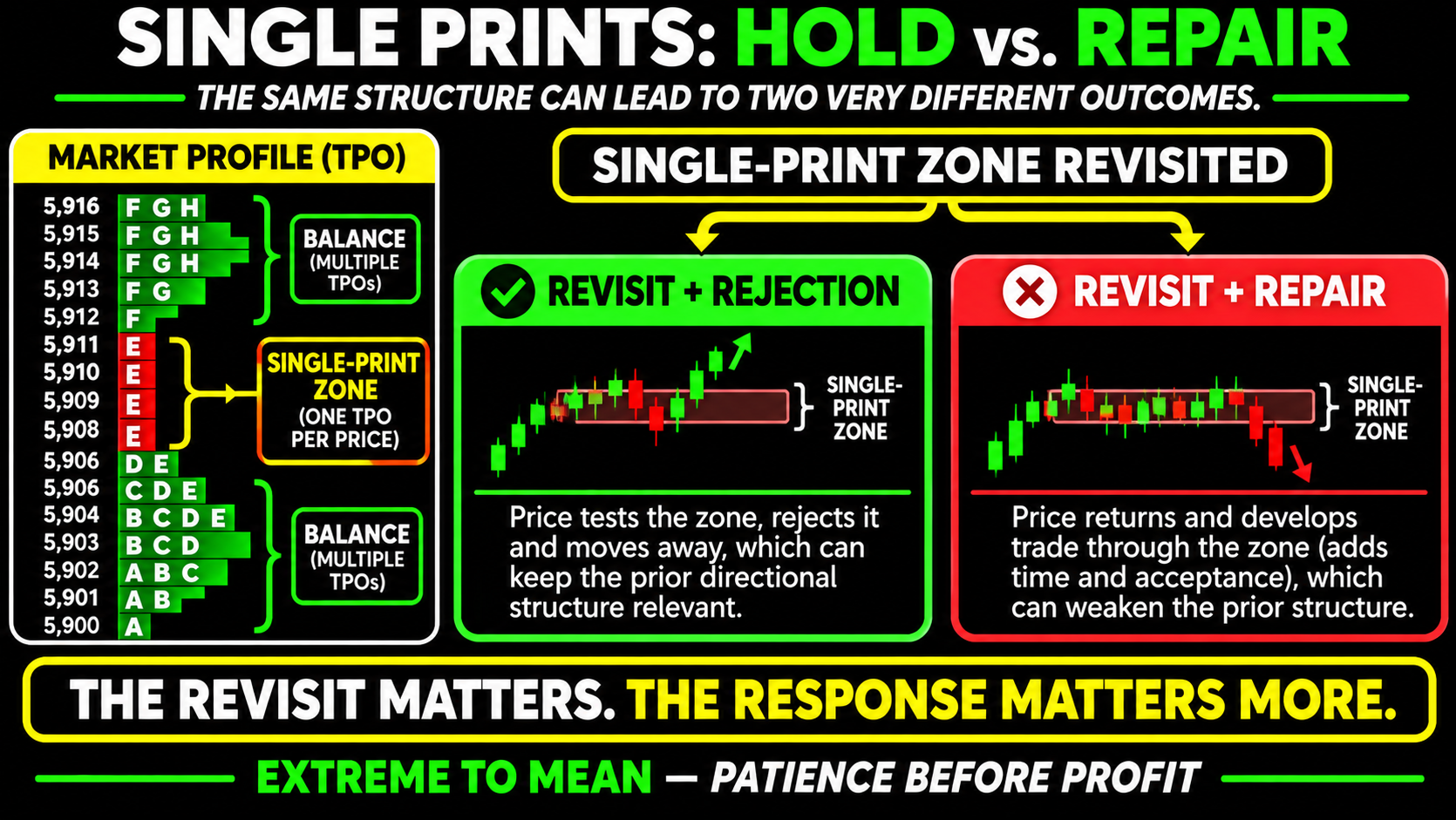
Traders often say a single print was “filled” or repaired when price returns through a formerly one-TPO area and additional time-based trading develops there. If a zone runs from 5,905 to 5,910 and price revisits only 5,909–5,910, that is a partial revisit, not a full traversal of the zone. REVISIT ≠ FULL REPAIR, and merely touching an edge should not be presented as equivalent to developing trade throughout the entire structure.
Within an active session, later brackets can add letters to the same profile rows. After that session closes, a new session’s revisit does not rewrite its old letters, although traders may still call the old zone “repaired.” What appears on-screen depends on whether the platform displays separate or composite profiles.
None of this creates a deadline for price to return. “Unfinished business” is a metaphor for a past structural feature, not an order awaiting compulsory execution, and no universal fill probability or timetable should be assumed without a defined, tested sample. Often revisited and must fill are very different claims.
The Revisit Matters; the Response Matters More
Consider a hypothetical rally that leaves single prints between 5,912 and 5,917 and later develops sustained trade around 5,925. On a pullback, price reaches the top of that earlier thin zone near 5,917, stalls, and moves higher again. The zone may have served as a useful support reference, but we know that from the subsequent rejection—not from a promise contained in the original print.
Now consider the same starting structure followed by a return through 5,917 down to 5,912, with renewed trading across the zone. The prior area of rapid passage is being revisited and, where applicable to the profile, further developed. That response can weaken the original interpretation that buyers were able to leave those prices behind decisively, but it does not guarantee what happens after the repair.
The same label can precede REVISIT + REJECTION or REVISIT + REPAIR / ACCEPTANCE. The Auction Market Theory lesson explains why renewed acceptance can change the reading of an earlier move. The zone can help assess an existing thesis without identifying the next destination.
Your Profile Settings Can Change the Structure
Market Profile depends on the selected data. An ES regular-hours profile and a full Globex profile can show different letters because they include different sessions. Overnight brackets may add visits that remove a single-print zone visible in the cash-session profile.
Bracket length matters just as much. A 30-minute profile can show one bracket visiting a row while a 15-minute profile shows multiple brackets there, and the price-row aggregation can change how the blocks line up. The underlying trades are real; the profile's shape partly reflects the session, bracket, and row settings we chose.
The profile can also change while it is forming. A fast move may initially leave a clean run of one-letter prices, only for the next bracket to return and remove the developing single-print condition. Some platforms do not mark the structure as confirmed until a subsequent bracket closes without revisiting it, which is one more reason not to trade the unfinished profile as though we already know its final shape.
A Single Print Is a Reference, Not a Trade Plan
A common mistake is declaring an unrepaired zone above price the next target simply because it remains open. A reference may support a target thesis, but the trade still needs a reason, a qualified setup, invalidation, and acceptable risk. A chart level cannot pull price toward itself.
Another mistake is treating a rejection at the zone as an automatic long or short. A brief reaction may be consistent with the prior auction, yet the market could still reverse again or develop acceptance through the area. The failed-auction lesson offers a related way to distinguish testing a price area from proving a sustained rejection; STRUCTURAL REFERENCE ≠ ENTRY SIGNAL.
A better pre-trade question is: “If this chart had no single-print label, would the structure, current response, and risk still justify the trade?” If the answer is no, the label may be doing more work than the evidence. If the answer is yes, the single print can add useful context without becoming the entire strategy.
The Single-Print Review Checklist
Before assigning importance to a single-print area, ask:
- Am I looking at a TPO/Market Profile, not merely a Volume Profile or low-volume node?
- Which session and bracket length produced this profile?
- Is the structure internal, or is it a tail at an extreme?
- Is it one row or a meaningful sequence of single-TPO prices?
- Was it confirmed after the next bracket, or am I reading a developing profile?
- Did price leave an established balance area, and was new trade developed beyond the zone?
- Has the area already been partially revisited or fully traversed?
- On a fresh test, does price reject, stall, or accept back through the zone?
- Am I calling it a reference—or assuming the market owes me a target?
- What independent setup and invalidation would authorize a trade here?
The ETM Profile → Location → Structure → Response → Decision Framework
Use PROFILE → LOCATION → STRUCTURE → RESPONSE → DECISION. PROFILE checks the TPO construction and session; LOCATION asks whether the print is internal or at an extreme; STRUCTURE examines the directional move and any new balance beyond it. RESPONSE watches how price behaves on a revisit, and DECISION asks whether that evidence supports an actual setup with defined risk—or only a level worth monitoring.
That sequence can be shortened to REFERENCE → TEST → CONFIRM OR REJECT. It keeps the order correct: observe the completed structure, watch what happens next, and evaluate the current conditions before taking action. The ETM free tools can support preparation and review, but a drawing on a profile cannot substitute for a trade thesis.
Final Thought
A single print is evidence that a price appeared during only one TPO bracket within a chosen Market Profile. A run of internal single prints often marks a fast transition between better-developed trading areas, making it a potential structural reference if price returns. It does not mean no contracts traded there, reveal who caused the move, or guarantee that price will revisit and fill the zone.
The important decision happens on the subsequent test. Rejection can preserve the significance of the earlier transition, while renewed trade through the zone can weaken that original reading; neither outcome automatically qualifies an entry. The single print tells us where to pay attention. The market's response tells us whether that attention becomes useful.
Educational content only. Trading involves substantial risk and is not suitable for everyone.