
A failed auction sounds more complicated than it is. The market tried to move beyond an established area, tested new prices, failed to build acceptance there, and returned to the area where business had already been taking place. The failure is not that price crossed the level; the failure is that the market could not establish acceptance beyond it.
A market can visit new prices without deciding to live there.
Market Profile becomes easier to understand when you stop treating every excursion beyond a level as a breakout. The useful question is not simply, “Did price get above or below the reference?” It is, “Could the market actually conduct business there after it got there?”
That distinction belongs inside the broader Market curriculum because it turns a failed auction from a pattern to memorize into an acceptance-and-rejection problem. The basic sequence is REFERENCE → PROBE → ACCEPTANCE TEST → RETURN → CONTEXT → DECISION. The label becomes useful only after you understand what the market attempted and what happened next.
Market Profile Starts With a Simple Idea: Markets Test Prices
A Market Profile, or TPO Profile, organizes trading according to time spent at price. A TPO is a letter or block showing that a particular price traded during a particular time period, so thicker areas of the profile represent more time spent there and thinner areas represent less. The beginner takeaway is simple: Market Profile helps you see where the market spent time and where it did not.
Time at price does not predict the future. It helps you observe whether the market continues doing business in an area or rejects it quickly. Context comes before the candle, and the same principle applies when price moves beyond an established area.
What a Successful Auction Beyond Balance Looks Like
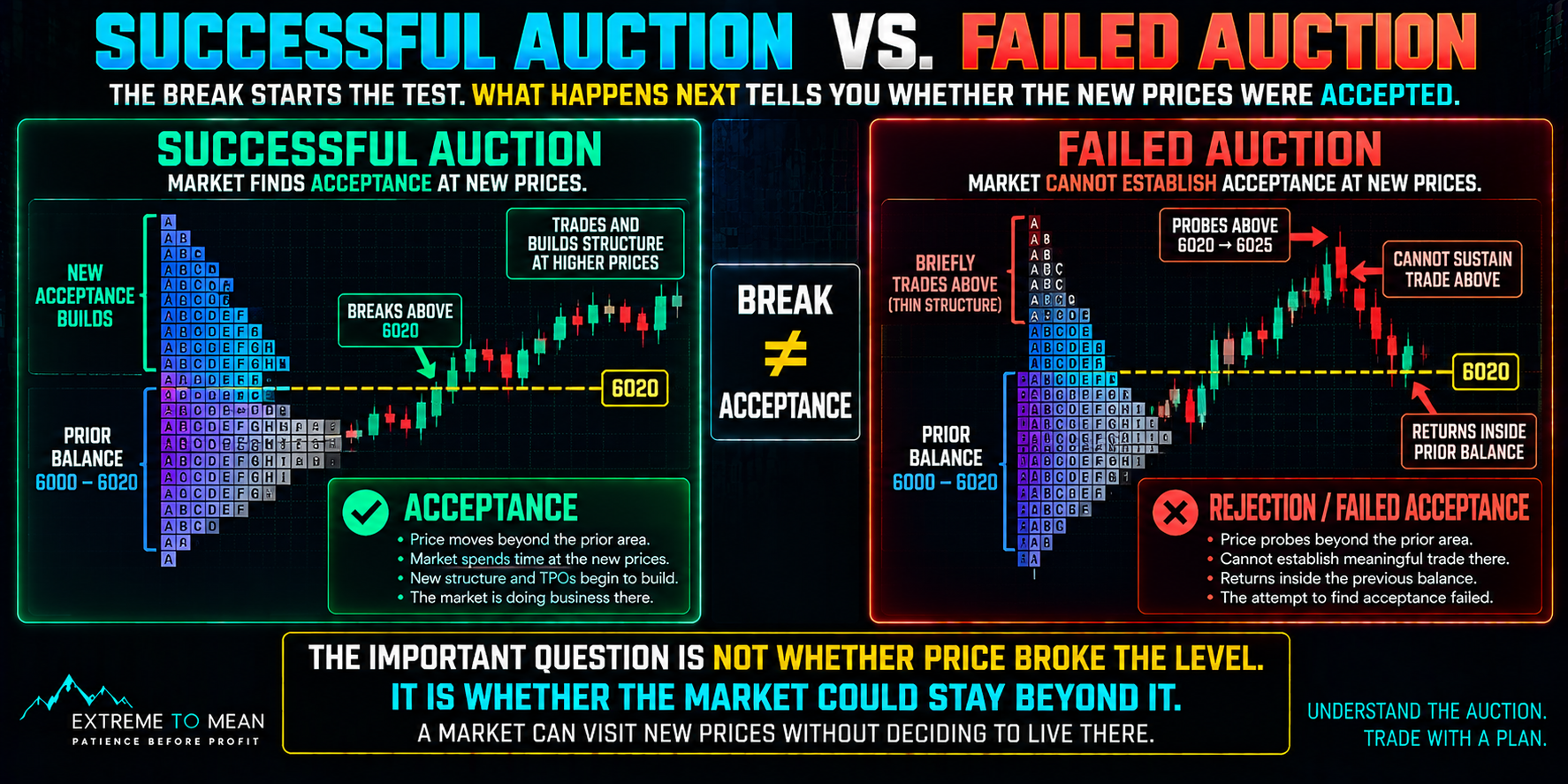
Suppose an index future spends much of the morning trading between 6000 and 6020. For our simplified example, that is the area where buyers and sellers have repeatedly been willing to transact. Price eventually pushes above 6020, which means the market has begun testing higher prices.
If price remains above 6020, trades repeatedly there, and begins building new time and structure at the higher prices, the move is doing more than briefly crossing a boundary. The auction is beginning to find participation outside the old balance. A breakout becomes more meaningful when the market can live above the breakout—not merely visit it.
Acceptance does not mean the new area will hold forever. It means the market is currently willing to conduct business there, and new information can change that condition. The profile helps the trader observe that transition instead of declaring permanence from one candle.
So What Exactly Is a Failed Auction?
Start with the same 6000–6020 balance. Price pushes above 6020 and perhaps reaches 6024 or 6025, but instead of building sustained trade there, the move stalls and price returns below 6020. The market then begins rotating again inside the area it had previously accepted.
That is the basic failed-auction story: BREAK → TEST NEW PRICES → NO SUSTAINED ACCEPTANCE → RETURN INSIDE. The market explored higher prices but could not stay there during that attempt. Failed means the attempt failed, not that those prices can never be tested again.
The same logic works below balance. If price probes beneath 6000, cannot build sustained trade there, and returns back above 6000, the lower auction failed to gain acceptance. That does not automatically make the market bullish; it tells you that the attempt to establish trade at lower prices was rejected at that point.
Acceptance Matters More Than the Level Crossing
A candle crossing a balance edge is only the beginning of the question. The trader should then observe whether price remains outside, repeatedly trades there, develops additional structure, or instead returns quickly into the old area. Touching outside is exploration; staying outside begins to demonstrate acceptance.
This is why the market comes first before any label or trade idea. A fast directional market may probe beyond a prior area and immediately continue building business outside it, while another session may reject the same type of reference almost instantly. The level can be identical while the auction response is completely different.
A useful better question is: “Did price merely break the reference, or did the market actually prove it could operate beyond it?” That keeps attention on behavior instead of the excitement of the breakout itself. It also prevents one wick beyond a level from being treated as enough evidence to declare either acceptance or failure.
Why the Return Inside Matters
Returning inside the old area changes the information available to the trader. Breakout buyers may now be holding positions from an area the market failed to accept, while the prior balance has become relevant again. Rotation through that accepted area may become more plausible, but no destination is guaranteed.
Some traders may use the POC, midpoint, or opposite side of balance as later references, but those are references rather than promises. Price can pause, form a new balance, retest the failed area, receive new information, or eventually break out successfully on another attempt. A return inside tells you something about the failed attempt; it does not dictate the next destination.
The failed-auction interpretation also has to remain open to invalidation. If price later moves back above 6020 and begins building sustained trade there, the earlier rejection is no longer the newest information. A failed auction is evidence, not a lifetime sentence for the level.
Failed Auction vs. an Ordinary False Breakout
On a standard candlestick chart, a failed auction may look very much like a false breakout. Price crossed a boundary, failed to hold beyond it, and returned. The difference is mainly the lens used to interpret what happened.
Classic technical analysis often asks, “Did price break the level and fail?” Market Profile asks, “Did the market find acceptance at the new prices?” The second question focuses less on the line itself and more on how the auction behaved after crossing it.
The ideas can overlap, but they are not identical in every situation. A wick through an arbitrary technical line is not necessarily a Market Profile failed auction when no meaningful balance or auction reference is involved. Location is the first filter, so the reference being tested matters.
The terminology is not perfectly standardized. Some traders use failed auction broadly for a probe beyond a meaningful auction reference that cannot gain acceptance and returns, while stricter formulations tie the term more specifically to Initial Balance or balance-area behavior. For a beginner, the shared logic matters most: attempted price discovery → failed acceptance → return to the prior area.
Failed Auction, Excess, and Poor Highs or Lows Are Different Ideas
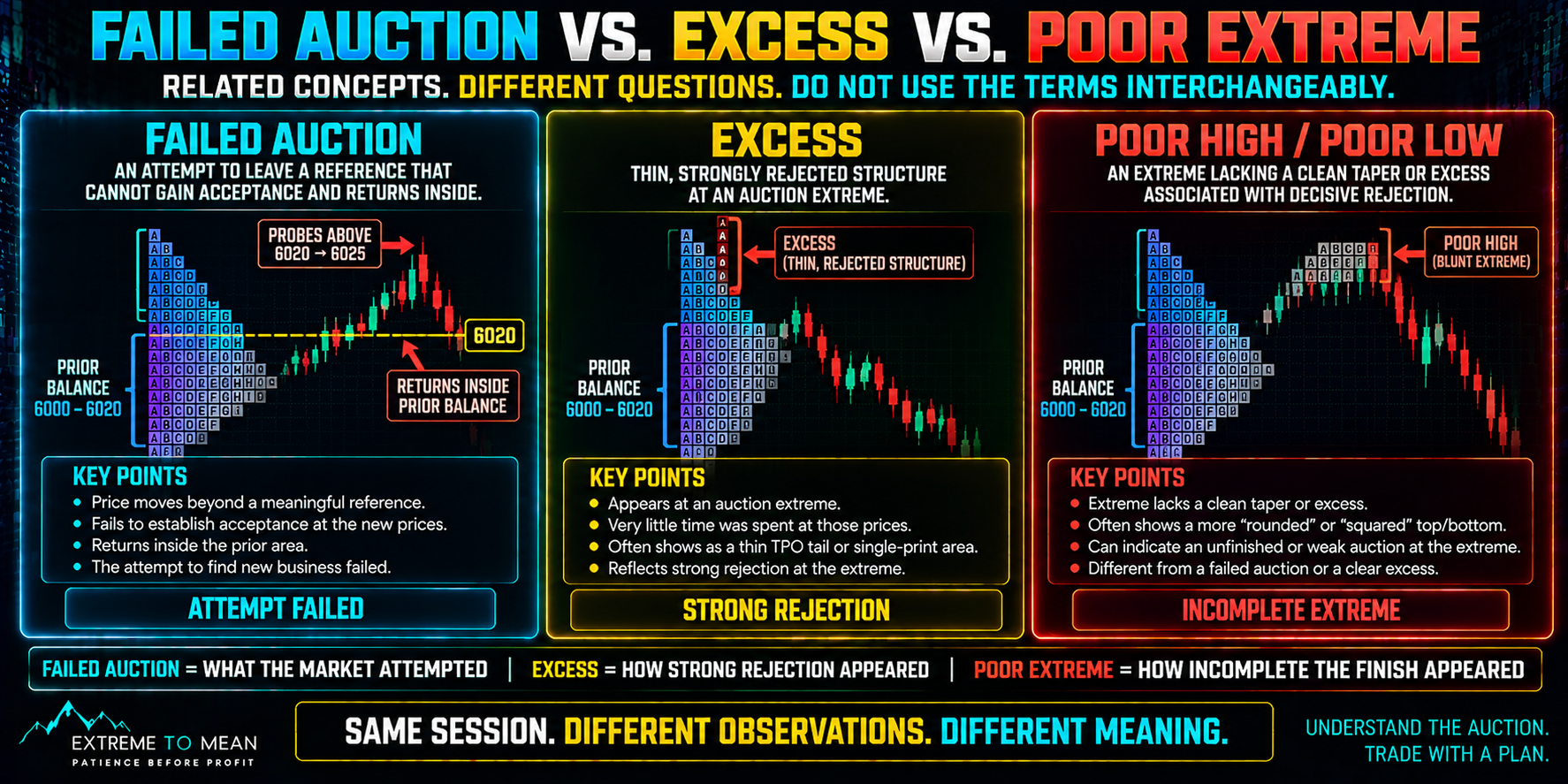
Beginners often encounter failed auction, excess, and poor high/poor low at roughly the same time and assume they describe the same thing. They do not. Each term asks a different question about the auction.
A failed auction describes an attempt to move beyond a meaningful reference that cannot establish acceptance and returns. Excess describes a thin, strongly rejected structure at an auction extreme, often seen on a TPO profile as a tail or single-print area. A poor high or poor low describes an extreme that lacks a clean, decisive auction finish and may appear blunt or unfinished rather than tapered.
Those observations can interact, but they should not be used interchangeably. Failed auction describes what the market attempted; excess describes one way rejection may appear at the extreme. A poor extreme, meanwhile, is a separate observation about the quality of the auction's finish.
A Failed Auction Is Context, Not an Automatic Reversal Signal
The biggest mistake is turning the phrase failed auction into an entry command. In the 6000–6020 example, Trader A sees price trade to 6025, return below 6020, and immediately concludes SHORT. Trader B instead asks what was tested, whether acceptance failed, how the return inside fits the broader market, and whether a real setup now exists.
Trader B has better context, but still does not automatically have a trade. The trader still needs a qualified setup, clear invalidation, acceptable risk, and enough room for the thesis to make sense. This follows a setup not being just a signal: useful information is not complete entry permission.
A failed auction can also fail. If the market reclaims the rejected area and begins building new acceptance there, the trader must update rather than defend the old label. Today's rejection does not give yesterday's interpretation permanent authority over new information.
The ETM Failed-Auction Framework
Use this sequence when someone says the market produced a failed auction:
- REFERENCE — What meaningful area is price attempting to leave?
- PROBE — Did price actually explore beyond it?
- ACCEPTANCE TEST — Did the market begin conducting sustained business at the new prices?
- RETURN — Did price return into the previously accepted area?
- CONTEXT — What does that rejection mean inside the broader market condition?
- DECISION — Does an actual setup with clear invalidation and acceptable risk exist: TRADE / WAIT / PASS?
The process keeps the trader from trading the phrase instead of reading the auction. It separates failed acceptance from the assumption that price must reverse through the entire prior balance. If the trade cannot define where the idea is wrong, unclear risk matters more than the label.
The final review question is simple: “What failed—the price level, or the market's attempt to establish business beyond it?” The answer should be the second. Once that is clear, the trader can use the rejection as information without pretending it has already produced a complete trade.
Final Thought
A failed auction is easiest to understand as a failed attempt at price discovery. The market moved beyond an established area, tested whether participants would conduct business at the new prices, failed to establish enough acceptance there during that attempt, and returned to the area that had already been accepted. The failure is not that price crossed the level; the failure is that the market could not establish acceptance beyond it.
That rejection can matter, but it does not guarantee a reversal, a target, or an entry. Read what the auction attempted, watch whether the rejection continues to hold, and let the broader market condition and complete setup decide whether the new information deserves risk. A failed auction gives you information about what the market just rejected; it still has to earn a trade.
Educational content only. Trading involves substantial risk and is not suitable for everyone.