
Stock market crashes can feel sudden on the chart, but serious market stress often develops as weaknesses begin appearing across several parts of the economy and financial system.
The word “crash” encourages traders to think in extremes. They look for one indicator that will supposedly reveal the top, tell them when to short, or warn them before everyone else. That approach feels reasonable because every major decline looks obvious when studied afterward. In real time, however, the cleaner task is not predicting the crash—it is recognizing when the environment has become less stable.
That distinction matters inside The Market because systemic risk develops differently from an ordinary pullback. The Federal Reserve’s financial-stability framework focuses on vulnerabilities that can amplify stress precisely because shocks themselves are inherently difficult to predict. (federalreserve.gov) A trader therefore gains more from monitoring whether several systems are weakening together than from waiting for one perfect crash indicator. The market can correct with very little economic damage, while deeper selloffs become more concerning when deterioration begins spreading beyond price alone.
Why Convergence Matters More Than One Signal
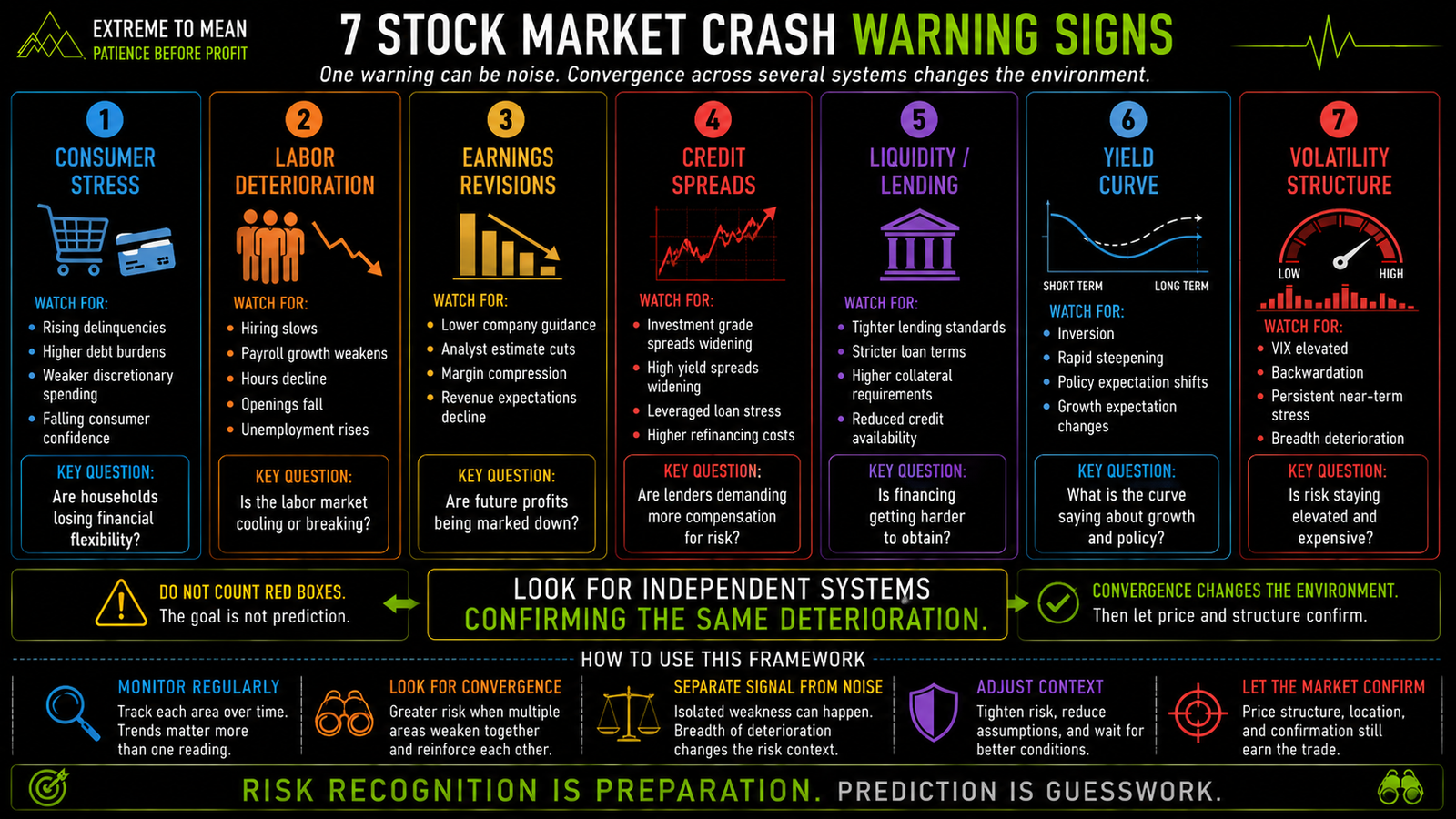
Every warning sign in this article can produce a false alarm when viewed alone. Consumers can experience pockets of stress while employment remains healthy, credit spreads can widen temporarily, the yield curve can invert long before recession, and volatility can spike because of a short-lived event. None of those conditions automatically means equities must collapse. The stronger evidence comes when several independent systems begin confirming the same deterioration.
This is similar to thinking in terms of the three market states. One weak data point may simply be noise inside an otherwise healthy environment, while a growing collection of weaker signals can indicate that the underlying state is transitioning. The sequence will not look identical before every major decline, and an external shock can still arrive with little warning. The practical objective is to recognize when the market has fewer healthy supports available if something goes wrong.
1. Consumer Stress Begins to Broaden
Consumer stress is useful because household spending and credit conditions can reveal pressure before it becomes obvious in headline economic data. Traders can monitor delinquency trends, debt burdens, discretionary spending, consumer confidence, and whether financial problems are spreading beyond one borrower group. The New York Fed’s Household Debt and Credit framework tracks mortgages, auto loans, credit cards, student loans, and transitions into delinquency, making household balance-sheet conditions observable over time. (newyorkfed.org) The important signal is not that debt exists; it is whether the ability to carry that debt is deteriorating more broadly.
Consumer stress becomes more meaningful when employment and income are also weakening. A rise in one delinquency category can reflect temporary or highly specific circumstances, so it should not be treated as a market-timing signal. When households become more cautious at the same time that job conditions soften and credit becomes harder to obtain, the pieces begin interacting. That interaction matters because weakness in consumer demand can eventually feed into company revenue and earnings expectations.
2. The Labor Market Starts Losing Resilience
Labor deterioration often develops in stages rather than through one dramatic unemployment report. Hiring can slow, openings can decline, hours can fall, temporary employment can weaken, and payroll growth can lose momentum before companies move toward larger reductions in headcount. The important question is whether the labor market is merely cooling from a strong level or beginning to show persistent weakness across several measures. Traders should therefore examine the direction and breadth of employment deterioration rather than treating one payroll miss as confirmation of systemic risk.
The economic connection is straightforward. Employment supports household income, borrowing capacity, confidence, and spending, so sustained labor weakness can reinforce consumer stress already developing elsewhere. That does not mean every rise in unemployment creates a crash or recession. It means the labor market becomes more important when it stops offsetting weakness in other areas and begins contributing to it.
3. Earnings Expectations Begin Moving Lower
Stock prices are forward-looking, so traders should pay attention when expectations for future corporate profits begin weakening. Companies may lower guidance, analysts may reduce estimates, margins may compress, or investors may become less willing to pay high valuations for uncertain future earnings. The Federal Reserve explicitly monitors equity valuations relative to analysts’ expected earnings, illustrating how expected—not merely historical—profits matter to the valuation environment. (federalreserve.gov) A market priced for strong future earnings has less room for disappointment when those assumptions begin deteriorating.
The more dangerous combination is weaker earnings expectations alongside weaker economic demand. A company can absorb a temporary slowdown when credit is available and the consumer remains healthy, but that flexibility declines if borrowing costs, lending conditions, and demand all worsen at once. This is why context comes before the candle even when the chart still appears technically stable. Price may not have broken yet, but the environment supporting previous valuations may already be changing.
4. Credit Spreads Begin Widening
Credit spreads measure the additional yield investors demand to hold corporate debt rather than comparable Treasury securities. When investors become more concerned about default risk, liquidity, or the economic outlook, that required compensation can rise. The Federal Reserve includes corporate bond and leveraged-loan spreads in its financial-stability monitoring because changes in risk pricing can reveal stress beyond the equity market. (federalreserve.gov) A sustained widening is therefore worth more attention than a one-day move in a stock index.
Credit stress also affects the real economy. Companies that need to refinance debt, fund inventory, invest, or maintain operations may face more expensive financing as spreads widen. That can become particularly difficult for weaker borrowers or businesses already experiencing slowing revenue. The warning becomes stronger when rising credit costs coincide with falling earnings expectations and tighter bank lending.
5. Liquidity and Lending Conditions Tighten
Liquidity problems become important when capital is not merely more expensive but also harder to obtain. The Federal Reserve’s Senior Loan Officer Opinion Survey tracks changes in lending standards and terms for businesses and households, including collateral requirements, covenants, premiums on riskier loans, and credit availability. In its April 2026 survey, banks reported tighter standards for commercial and industrial loans on balance, illustrating the type of information this framework captures rather than providing a standalone crash signal. (federalreserve.gov)
Tighter lending can turn economic weakness into a feedback loop. A business experiencing slower demand may simultaneously find refinancing or additional credit more restrictive, while stressed households may face less financial flexibility. The Federal Reserve’s broader framework specifically emphasizes how funding and leverage vulnerabilities can amplify shocks once stress begins. (federalreserve.gov) The key question is whether liquidity remains functional or whether multiple financing channels are becoming restrictive together.
6. The Yield Curve Signals Changing Expectations
The yield curve can provide information about expected monetary policy and future economic conditions, but it is frequently misused as a crash timer. The New York Fed maintains a recession-probability model based on the spread between the 10-year and 3-month Treasury rates, yet it explicitly notes that the resulting probability is not an official Federal Reserve forecast. (newyorkfed.org) An inverted curve can remain inverted for an extended period, so inversion alone does not tell a trader when stocks will fall.
What happens afterward can matter just as much. A curve can steepen because long-term yields rise, because short-term yields fall as markets anticipate policy easing, or because both ends move for different reasons. A rapid shift driven by growing economic weakness carries different information from steepening driven by stronger long-run growth or inflation expectations. The better question is not “Is the curve inverted?” but “What change in growth and policy expectations is the curve currently pricing?”
7. Volatility Structure Changes
VIX is commonly called a fear gauge, but its actual purpose is to estimate expected S&P 500 volatility over roughly the next 30 days rather than predict market direction. The term structure adds another dimension by comparing expected volatility across different horizons, allowing traders to observe whether short-term uncertainty is becoming unusually expensive relative to later periods. Cboe describes the VIX term structure as a way to observe how expectations for S&P 500 volatility change across maturities. (cboe.com)
This distinction matters because a high VIX reading by itself does not prove systemic deterioration. Near-term volatility can spike around elections, wars, policy announcements, or temporary market dislocations and then normalize quickly. Cboe notes that VIX-futures backwardation can accompany periods of heightened near-term uncertainty but does not reliably mean the market must continue lower. (cboe.com) Volatility becomes a more serious warning when it stays elevated, its structure reflects persistent near-term stress, and credit, liquidity, breadth, and earnings are deteriorating at the same time.
A Normal Correction Does Not Require a Broken Economy
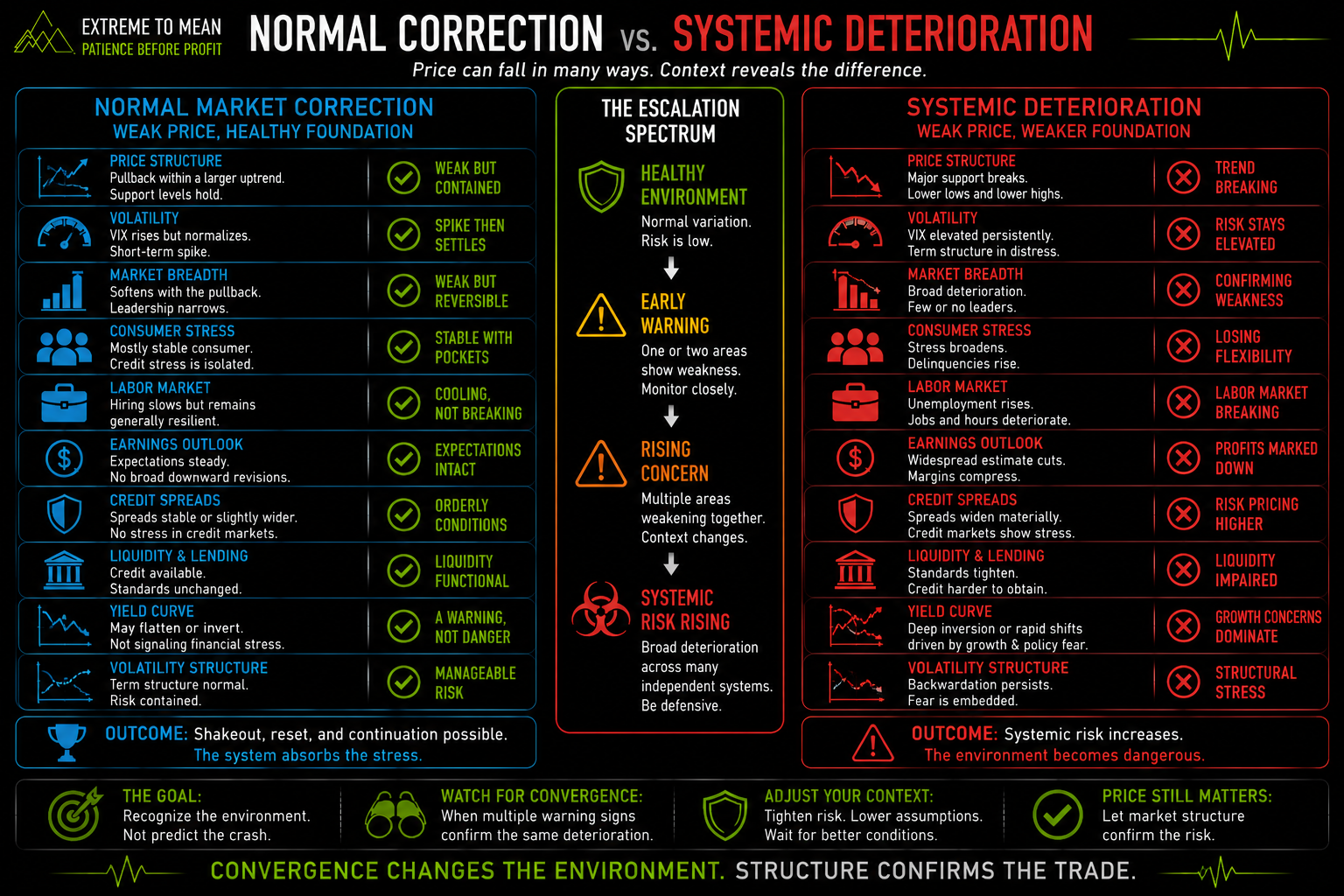
Markets correct regularly because expectations, positioning, valuation, and short-term risk appetite change. A normal correction can include falling indexes, rising VIX, weaker breadth, and nervous headlines without producing widespread economic or financial damage. Credit markets may remain orderly, lending may remain available, earnings expectations may stay broadly intact, and labor conditions may continue supporting households. In that environment, falling prices alone do not establish systemic deterioration.
The weaker decision is seeing every 5%, 10%, or fast futures decline as the beginning of a crash. That feels reasonable because volatility compresses time and makes current movement seem more important than the evidence surrounding it. Market conditions change the quality of a setup, but the conditions have to actually change rather than simply feel uncomfortable. A correction becomes more concerning when market weakness starts agreeing with deteriorating fundamentals, credit, liquidity, and volatility structure.
Systemic Deterioration Looks More Connected
A more dangerous environment begins to look different because separate warning systems start reinforcing one another. Consumers weaken as labor deteriorates, earnings expectations fall as demand becomes less reliable, credit spreads widen as lenders demand more compensation, and financing standards tighten as borrower quality becomes less certain. Volatility remains elevated because the range of possible outcomes is widening rather than because of one temporary event. The problem is no longer one weak area—it is the increasing number of channels through which weakness can spread.
This is the logic behind monitoring vulnerabilities rather than trying to forecast shocks. The Federal Reserve’s framework focuses on how valuation pressures, borrowing, leverage, and funding risks can interact and amplify stress once adverse conditions appear. (federalreserve.gov) Traders can use the same general principle at a simpler level: ask whether weak conditions remain isolated or whether the market and economy are beginning to create feedback loops. Convergence changes the risk context without guaranteeing a crash.
Markets Can Reprice Before the Economic Evidence Is Obvious
Equities and futures do not wait for economists to agree that conditions have become dangerous. Markets continuously price expectations about future earnings, growth, rates, credit, and risk, so deterioration can appear in asset prices before backward-looking economic statistics clearly confirm the story. The reverse is also true: equities can begin recovering while economic data still looks terrible because prices are anticipating improvement. Traders therefore need to separate current economic conditions from what markets believe those conditions are becoming.
This is why the goal is not to build a seven-box crash checklist and short futures when enough boxes turn red. Price structure, location, breadth, and confirmation still matter. A deteriorating macro environment may justify higher caution, different assumptions, or greater selectivity without creating an immediate trade. The setup still has to earn risk.
A Cleaner Crash-Risk Process
Start by establishing a baseline rather than judging every indicator as good or bad in isolation. Ask whether consumer credit, labor, earnings expectations, credit spreads, lending conditions, the yield curve, and volatility structure are improving, stable, or deteriorating relative to their recent behavior. Then look for breadth of deterioration across those categories. One warning sign earns attention; several deteriorating together change the environment.
Next, distinguish between confirmation and prediction. You do not need to know whether the S&P 500 will fall 8%, 20%, or 40% to recognize that systemic risk is increasing. You only need enough evidence to question assumptions that were appropriate during healthier conditions. Market comes first, which means the final decision still depends on what price and market structure are actually doing with that risk.
Better Questions When Crash Risk Appears to Be Rising
A useful warning framework should make the trader slower to declare certainty, not faster. Seven indicators are not seven automatic signals, and their importance changes across economic regimes. The purpose is to determine whether several independent systems are moving toward the same conclusion. A better question is, “Is this weakness still primarily a market correction, or is the environment underneath price beginning to deteriorate with it?”
- Is consumer stress isolated or broadening?
- Is labor merely cooling or deteriorating persistently?
- Are earnings expectations being revised lower?
- Are corporate credit spreads widening materially?
- Are lending standards and financing terms becoming more restrictive?
- Is liquidity functioning normally during market stress?
- What is driving the current shape and movement of the yield curve?
- Is VIX elevated briefly, or is volatility structure showing persistent near-term stress?
- Is market breadth deteriorating alongside the major indexes?
- Are cyclical and economically sensitive areas confirming weakness?
- Are several independent warning signs now moving together?
- Is the market absorbing bad news, or losing important structure as conditions worsen?
- Am I recognizing risk, or trying to predict a crash?
These questions improve both preparation and post-market review because they force the trader to separate discomfort from systemic evidence. A correction can feel frightening while remaining fundamentally contained, while a quieter market can be developing important weaknesses beneath the surface. Tracking the relationships over time provides more context than reacting to whichever warning indicator is receiving attention that day. The Macro Playbook is the natural next step for organizing these signals alongside inflation, employment, rates, the dollar, and financial conditions.
Final Thought
Stock market crashes do not come with a reliable seven-step countdown. Consumer stress, labor weakness, falling earnings expectations, widening credit spreads, tighter liquidity, yield-curve changes, and volatility structure can all provide useful information, but none proves that a crash is imminent. Their value increases when several independent areas deteriorate together and begin creating feedback loops. That is when a normal correction deserves to be evaluated inside a more serious risk environment.
The objective is not to call the top or become permanently bearish whenever a warning appears. It is to recognize when the foundations beneath the market are becoming less stable, adjust assumptions accordingly, and continue requiring price to confirm the trade. Serious risk recognition should improve preparation and decision quality, not create artificial certainty. The trader’s job is to evaluate the environment—not predict the crash.
Educational content only. Trading involves substantial risk and is not suitable for everyone.