
Strategy hopping is the habit of abandoning or repeatedly redesigning a trading approach before enough useful evidence exists to judge it fairly. It often appears after a losing streak, a frustrating week, or exposure to another trader whose recent results look cleaner. Changing something feels productive because it relieves the discomfort of uncertainty. Inside The Trader, however, the better question is not whether the current strategy feels good but whether the evidence actually supports changing it.
That does not mean traders should remain loyal to every strategy forever. Markets change, assumptions can prove wrong, and testing can reveal weaknesses that deserve correction. The mistake is treating discomfort as diagnosis or consistency as stubbornness. A cleaner process separates legitimate change from emotional escape before any rules are altered.
What Strategy Hopping Actually Looks Like
The obvious version of strategy hopping is moving from one method to another every few weeks. The less obvious version keeps the same strategy name while constantly changing its filters, indicators, entry rules, stops, targets, or trading hours. The strategy appears stable on paper, but its rules never remain unchanged long enough to create comparable evidence. That is strategy hopping in disguise.
The behavior feels reasonable because every modification offers a fresh explanation for recent pain. A new filter promises to eliminate the last losing trade, while another trader's recent success makes an entirely different setup look more attractive. Each substantial change, however, can create a new dataset and make the previous one harder to interpret. The trader keeps restarting the experiment before learning what the experiment was showing.
A Losing Streak Is an Outcome, Not a Diagnosis
Losses matter, but a group of losing trades does not explain why those losses occurred. A sound strategy can experience losing clusters, while a weak strategy can produce several winners and temporarily look excellent. Recent P&L tells you what happened; it does not automatically tell you what caused it. This is the same reason protecting your next decision matters after a difficult trade: the most recent outcome should not dictate what happens next.
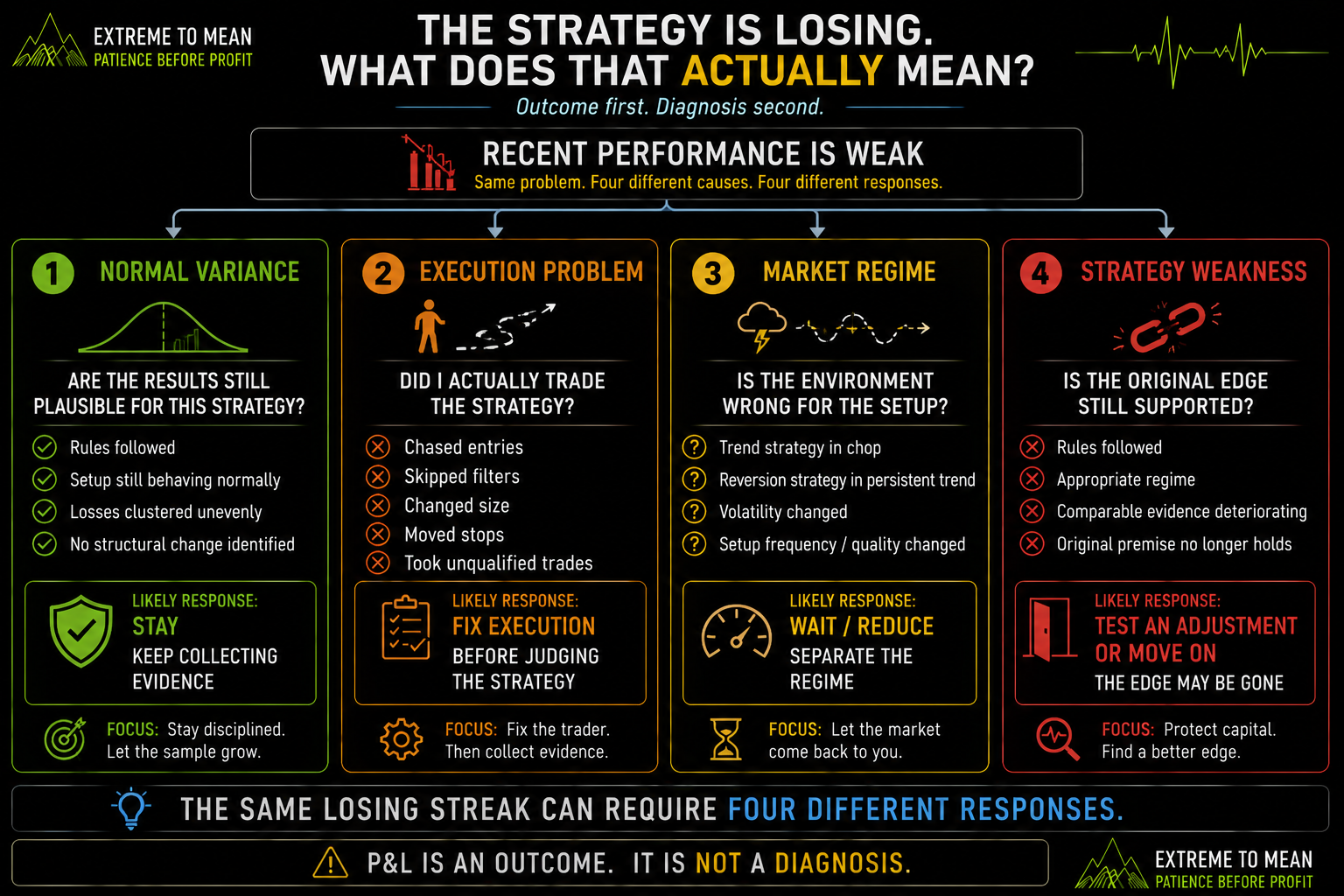
Before blaming the strategy, separate four possible explanations. Normal variance means the results may still fit the strategy's ordinary range of outcomes; execution means the trader did not follow the method well enough to judge it fairly. Market regime means the environment may currently be unfavorable for the setup, while strategy weakness means the underlying logic may genuinely deserve modification or retirement. Those diagnoses can lead to very different decisions even though all four may initially look like “the strategy stopped working.”
Strategy Performance and Trader Performance Are Different Datasets
A trader cannot fairly evaluate a strategy that was not actually executed according to its rules. Chased entries, skipped filters, widened stops, emotional size changes, and trades taken outside defined conditions turn the results into a mixture of strategy performance and trader behavior. That mixture can make a reasonable strategy appear broken or make a poor strategy appear stronger than it is. A futures trading journal helps separate the planned trade from the trade that was actually executed.
The practical question is: Did I trade the strategy I am trying to evaluate? If the answer is no, the first repair may belong in execution rather than in the strategy itself. That does not excuse losses or poor decisions; it identifies the correct problem. Changing systems before fixing execution can simply carry the same behavior into the next strategy.
There Is No Universal Number of Trades That Proves a Strategy
No fixed trade count can prove or disprove every trading strategy. A high-frequency setup generates evidence differently from a low-frequency setup, and strategies can have very different outcome distributions and variability. The appropriate amount of evidence depends on what is being tested, how often the strategy trades, and the conditions in which those trades occurred. A universal 10-, 30-, or 100-trade rule sounds precise but can create false confidence.
Win rate is incomplete for the same reason. A strategy can win frequently while its average loss is much larger than its average win, while another may win less often but produce larger average winners. In plain English, expectancy considers both how often wins and losses occur and how large they tend to be. Even expectancy does not promise a smooth sequence of results, so a short run should not automatically become a verdict on the strategy.
Market Regime Can Change the Evidence
A strategy can remain logically valid while becoming less effective in a particular market environment. Trend-oriented methods may struggle when price becomes rotational and choppy, while reversion strategies may face different challenges during persistent directional pressure. Volatility, liquidity, and session behavior can also change how often a setup appears and how cleanly it follows through. This is why market conditions change the quality of a setup even when its written rules remain unchanged.
That creates a meaningful difference between a broken strategy and one operating outside its preferred environment. If the strategy has historically been weaker under similar conditions, waiting for a better regime may make more sense than rebuilding the method. If performance deteriorates repeatedly in the conditions where the strategy was specifically designed to work, the evidence deserves closer investigation. Regime is therefore another diagnosis to test before deciding that the edge disappeared.
When to Stay, Adjust, or Move On
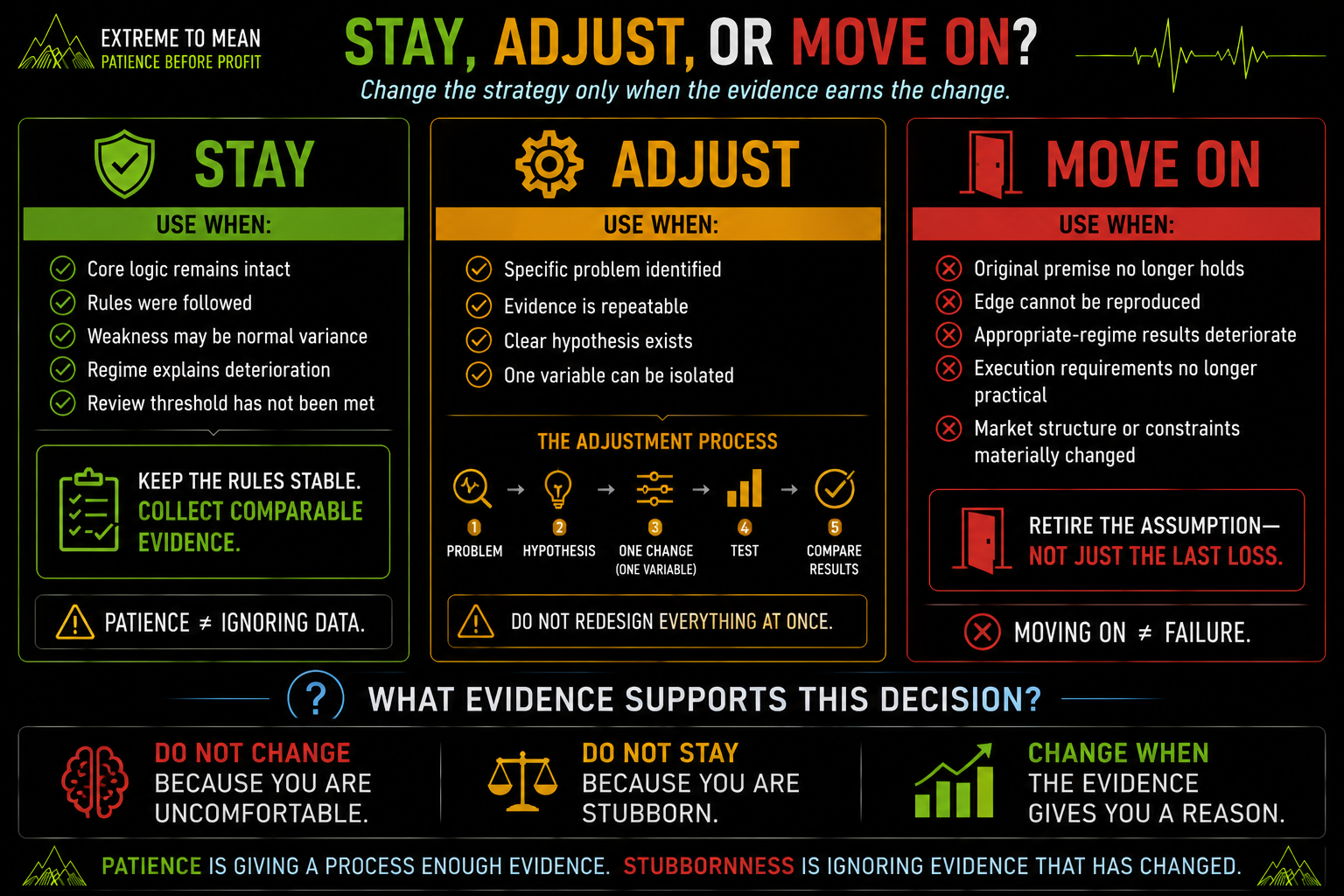
Stay when the strategy's logic remains intact, execution has been reasonably faithful, and recent weakness still appears compatible with normal variability or a recognizable unfavorable regime. Staying does not mean ignoring evidence or accepting endless deterioration. It means continuing to collect comparable information while following review rules that were established before the losing stretch. Patience is appropriate when the evidence has not yet earned a change.
Adjust when a specific and repeatable problem has been identified and there is a testable reason to believe one part of the strategy can be improved. Begin with a hypothesis rather than a general desire to remove recent losses. Change one variable while keeping the rest of the framework as stable as possible, then compare the modified version with the original under relevant conditions. That gives the trader a chance to learn whether the adjustment actually addressed the problem.
Move on when the underlying premise is no longer supported, the expected behavior cannot be reproduced where the strategy is supposed to work, or the method is no longer practical to execute consistently. Changes in market structure, liquidity, costs, or other constraints can also provide legitimate evidence. The important distinction is that the decision comes from accumulated information rather than emotional exhaustion. Leaving because the evidence changed is flexibility; leaving because discomfort became intolerable is strategy hopping.
Hidden Strategy Hopping Through Constant Modification
Continuous optimization can become strategy hopping without ever changing the strategy's name. A trader adds a filter after one loss, removes it after a missed winner, changes the stop after another loss, and then modifies the target because the previous trade reversed early. Every adjustment has an explanation, which makes the process feel analytical. Several variables are changing at once, however, so cause and effect become almost impossible to isolate.
A cleaner modification process is deliberately slower. Identify one specific problem, form one hypothesis, change one variable, and test whether that change affects the behavior you intended to improve. A trading plan is a promise made before the open, so significant strategy changes belong in scheduled review rather than in the emotional aftermath of the latest trade. Keeping the rest of the process stable is what makes the comparison meaningful.
Use a Pre-Change Checklist
A pre-change review prevents discomfort from masquerading as evidence. It should not force the trader to stay when genuine weaknesses are present, but it should require the reason for changing to be explicit. If you cannot identify what is failing, whether the rules were followed, and what evidence would support the proposed fix, the modification is probably premature. Strategy change should operate more like a research decision than an emotional reset.
- Problem: What exact behavior or result am I trying to fix?
- Execution: Was the strategy followed closely enough to evaluate it fairly?
- Variance: Could these results still fit the strategy's normal outcome distribution?
- Regime: Has the strategy been operating in conditions where it is designed to work?
- Evidence: Am I reacting to a few recent trades or a broader comparable record?
- Expectancy: Am I considering the size and distribution of wins and losses, not only win rate?
- Hypothesis: Why do I believe the proposed change addresses the identified problem?
- Variable: Can I change one element instead of several at once?
- Test: How will I compare the modified version with the current one?
- Decision: Does the evidence currently support Stay, Adjust, or Move On?
No checklist guarantees that the decision will be correct. Its value is that it makes the reasoning visible enough to review later instead of relying on “the strategy just stopped working.” The better question is: What evidence tells me the strategy changed rather than my execution, the market environment, or my tolerance for recent losses? That question turns discomfort into something that can actually be investigated.
Define the Review Rules Before You Need Them
The best time to decide how a strategy will be evaluated is before the next losing streak. Define what information you will collect, how rule adherence will be judged, which market conditions will be separated, and what kind of evidence would justify a modification. This does not require a universal trade count or a rigid statistical threshold. It requires a review process stable enough that the standard itself does not change whenever results become uncomfortable.
This is where patience becomes practical rather than philosophical. The Patience Principle is not an argument for keeping a strategy after the evidence has deteriorated; it is about giving a defined process enough room to produce useful evidence before reacting to temporary discomfort. Patience without review can become stubbornness, while constant change without evidence becomes strategy hopping. The cleaner middle ground is to stay while the evidence supports staying, adjust when a specific weakness can be tested, and move on when the original case no longer holds.
Final Thought
Strategy hopping is not simply changing strategies too often. The deeper problem is changing before you understand why the results changed, which can erase the evidence needed to distinguish normal variance, execution problems, regime effects, and genuine strategy weakness. A few losses do not prove an edge disappeared, just as a few winners do not prove an edge exists. Strategy performance and trader performance have to be separated before either can be judged fairly.
The practical standard is neither “never change” nor “always adapt.” Stay when the evidence still supports the strategy, adjust when a specific problem creates a testable hypothesis, and move on when the original premise no longer survives honest review. Change one variable at a time whenever possible, and establish the review process before the next emotional stretch arrives. Do not change because you are uncomfortable. Do not stay because you are stubborn. Change when the evidence gives you a reason.
Educational content only. Trading involves substantial risk and is not suitable for everyone.