
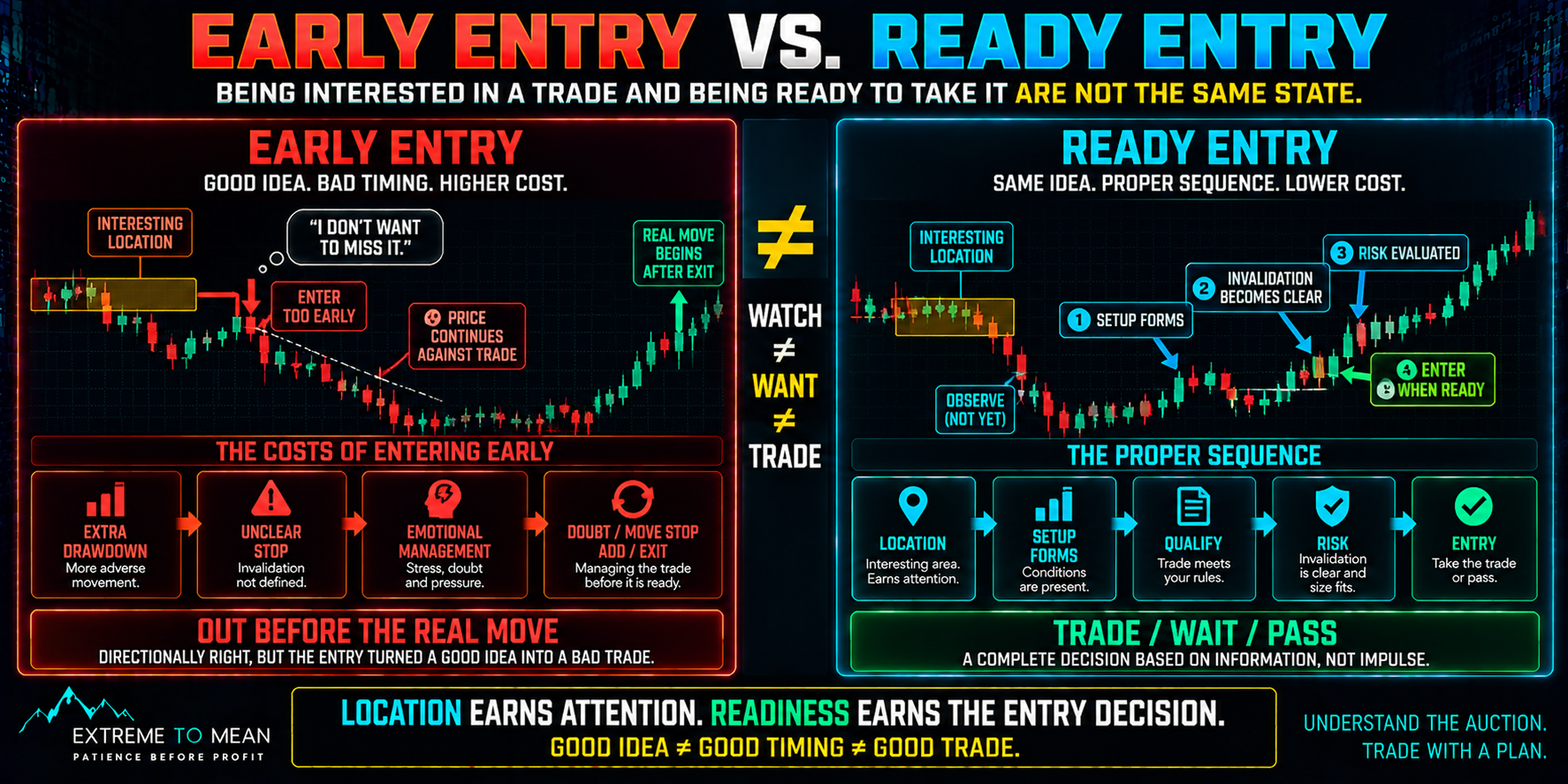
A trader can be right about direction and still turn the idea into a bad trade by acting before the setup is ready. The market may eventually move exactly where expected, but the early entry can force unnecessary drawdown, weaker stop decisions, and emotional management before the opportunity has fully formed. Being right later does not make every earlier price a good entry.
Early is not measured by the clock. It is measured against the process.
A premature entry happens when the trader acts before the conditions their own strategy requires are present. Price may have reached an interesting area, but the setup is still forming, pressure has not weakened, the pullback is incomplete, the breakout has not confirmed, or invalidation remains unclear. The problem is not that the trader entered five minutes before someone else; it is that they entered before their process had earned the decision.
That distinction belongs inside the broader Trader curriculum because a good idea, good timing, and a good trade are not interchangeable. The cleaner progression is LOCATION → SETUP FORMS → QUALIFICATION → RISK → ENTRY. The impatient shortcut is LOCATION → ENTRY, or worse, FEELING → ENTRY.
Early Is Measured Against Your Process, Not the Clock
The same entry can be early for one strategy and valid for another. Some systems intentionally anticipate, scale, or use limit orders before more obvious confirmation, while others require a completed setup before risk is allowed. What matters is whether the entry matched the rules that were supposed to exist before the outcome was known.
This is why location is the first filter, not the final entry signal. Meaningful location can make a trade interesting, but it does not automatically make the trade ready. Being right about where price may eventually go does not make every earlier price a good entry.
Better Price Versus Better Information
Entering early feels attractive because the price may look better. A long entry taken sooner may be lower, a short entry may be higher, and waiting can mean giving up part of the eventual move. The trader naturally thinks, “If I wait, I am giving away edge.”
Sometimes waiting really does cost price advantage, but it can provide information in exchange. The setup develops further, invalidation may become clearer, pressure may change, and the trader can see whether the market is behaving as expected. Earlier can mean better price with less evidence; later can mean worse price with more evidence.
The goal is not to wait as long as possible or demand endless confirmation. It is to wait until the setup has delivered the information the strategy actually requires. A disciplined entry model decides in advance how much evidence is enough rather than changing the requirement because the trader is afraid of missing the move.
How Early Entries Create Extra Drawdown and Worse Stops
Suppose a mean-reversion idea eventually becomes valid near 100. Trader A enters at 105 because price already looks stretched, price continues to 110, and only then begins the reversal. Trader A was eventually right about direction but first absorbed five points of adverse movement because the entry came before the setup was ready.
That extra excursion can create a stop-out, more stress, or weaker management before the real move begins. The market can prove your idea right after your early entry has already made the trade unmanageable. The trade is not ready until the risk is clear, and premature entries often violate that order.
When the setup is incomplete, structural invalidation may not yet be obvious. The trader then tends to choose between a tight arbitrary stop and an overly wide stop designed to “give it room.” Entering before invalidation is clear means risking money before knowing where the idea is actually wrong.
Early Entry Turns Observation Into Emotional Management
Before entry, the trader can observe what price is doing, whether pressure is changing, and whether structure is stabilizing. Once money is at risk, those questions become harder to answer neutrally because every new candle also changes open P&L. The trader is no longer only reading the market; they are managing their reaction to the position.
The internal dialogue changes quickly: “Should I move the stop?” “Should I add?” “Why is it not turning?” The position begins demanding decisions before the setup that was supposed to guide those decisions has completed. Early entry turns observation time into emotional management time.
Once money is at risk, observation can also become justification. Neutral candles become “support,” small bounces become confirmation, and contradictory evidence gets minimized because the trader now needs the thesis to work. Protecting your next decision sometimes begins with protecting the current read from a position that did not yet need to exist.
Early Entries Can Shake You Out Before the Real Move
One frustrating sequence begins with a useful idea and ends with the trader missing the move they anticipated. The trader enters too soon, absorbs drawdown, waits through stress, and finally sees price return to the entry. Relief replaces analysis.
The thought becomes, “Thank God. Get me out.” The trader exits at breakeven, a tiny profit, or a small loss, and then the actual setup finally completes and the move begins. Entering early can use up your emotional capital before the trade uses your thesis.
That does not mean the later entry would have guaranteed success. It means the premature position consumed patience, confidence, and decision quality before the strategy's real conditions were present. By the time the market became ready, the trader may no longer be willing to take the trade that originally interested them.
Planned Anticipation Is Different From Impatience
Not every entry that occurs before obvious confirmation is premature. Some strategies are deliberately built around anticipation, scaling, or limit orders, and those entries can be valid when defined and tested in advance. The question is whether the trader followed the intended model or jumped ahead of it.
Anticipation can be a strategy; improvising anticipation because you are afraid of missing the move is not the same thing. Later is not always better because excessive confirmation can destroy location or cause the opportunity to disappear. The correct standard is the amount of evidence the strategy requires—not less and not endlessly more.
Waiting also has a real cost. Price can turn before the trigger, the entry can become less attractive, or the move can happen without the trader. Missing a move is one cost of discipline; unnecessary drawdown is one cost of impatience, and the strategy has to decide which cost it accepts.
Trader A Spent Risk. Trader B Spent Time.
Imagine price has extended sharply lower into an area both traders consider interesting. Trader A thinks, “This is stretched enough,” and buys even though selling pressure remains strong, no rejection has formed, and invalidation is unclear. Price falls another 15 points while Trader A considers moving the stop, adding, and abandoning the trade.
Trader A eventually exits a small bounce for a loss. Five minutes later, selling pressure weakens, price rejects the low, structure stabilizes, and the actual setup forms. The original idea may have been useful, but the early execution consumed the trader before the opportunity became ready.
Trader B saw the same extension and said, “Interesting location. Not a trade yet.” Price continued lower, but Trader B had no open loss to defend; when the setup later qualified and invalidation became clear, the decision became TRADE / PASS. Trader A spent risk waiting for the setup. Trader B spent time waiting for the setup.
The same problem appears in breakout trading. A trader may buy before price actually breaks because they want the best price, only to discover the breakout never happens and they are simply long inside the old range. Sometimes entering early means trading the setup you hope will form rather than the setup that exists.
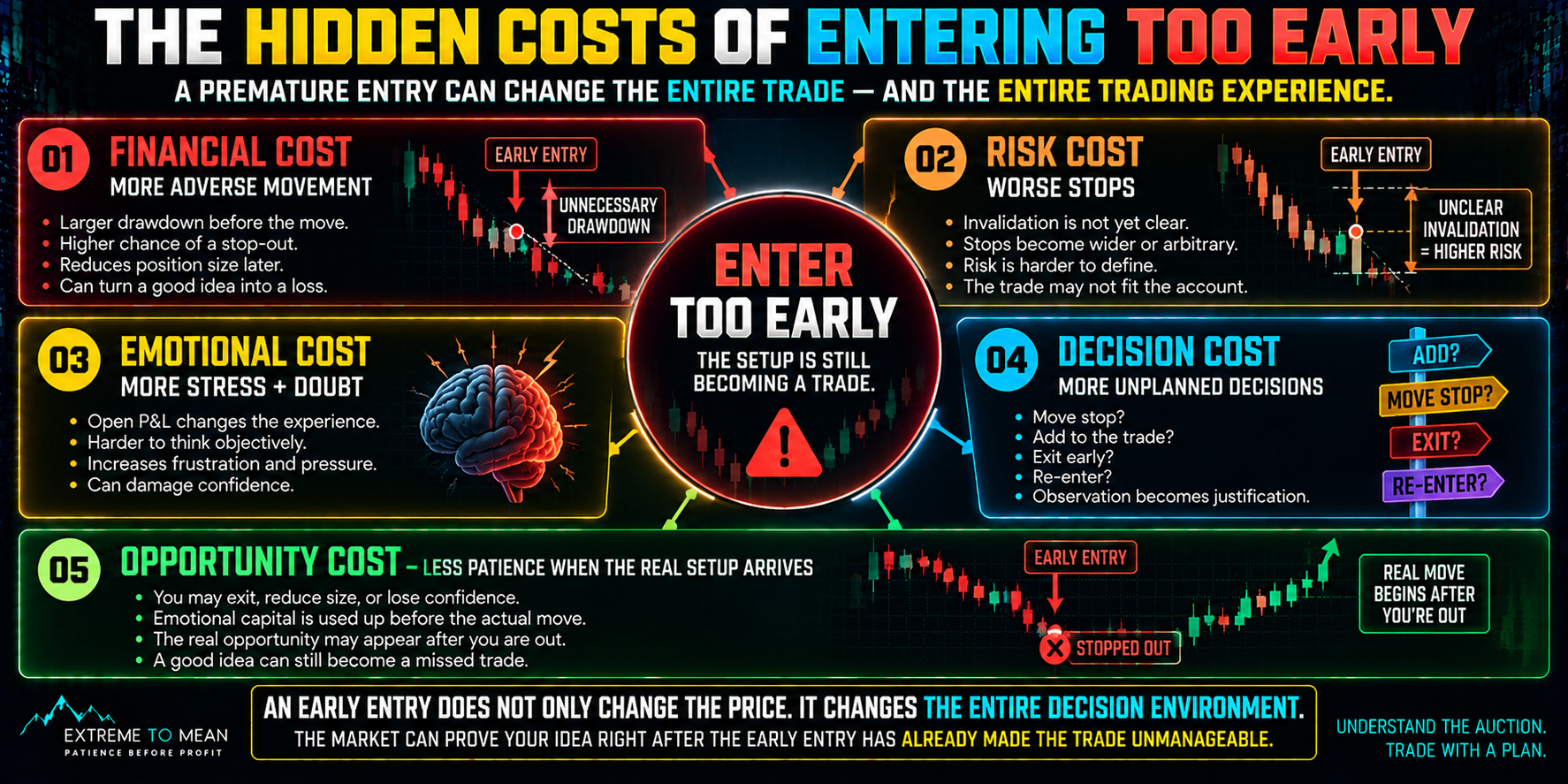
The Five Hidden Costs of Entering Too Early
A premature entry can create five different costs:
- FINANCIAL COST — unnecessary adverse movement or an avoidable stop-out.
- RISK COST — wider, arbitrary, or poorly defined invalidation.
- EMOTIONAL COST — stress, doubt, frustration, and reduced confidence.
- DECISION COST — open P&L begins influencing how new information is interpreted.
- OPPORTUNITY COST — the trader may exit, lose confidence, or use up risk before the actual setup appears.
Those costs explain why “I was right, just early” can be an incomplete diagnosis. The issue is not merely whether the trader eventually predicted direction correctly. The better review is whether the entry created costs that would not have existed if the process had been allowed to finish qualifying the trade.
The ETM Entry-Readiness Framework
Use this sequence before entry:
- LOCATION — Is price somewhere meaningful? This earns attention, not entry.
- READINESS — Has the actual setup formed?
- INVALIDATION — Do I know where the idea is wrong?
- RISK — Does the stop distance and position size fit?
- ENTRY — Only now is execution considered.
The progression is INTEREST → SETUP → RISK → ENTRY, not INTEREST → ENTRY. A trading plan made before the open helps because the trader already knows what must happen before an idea becomes executable. The market should not renegotiate those requirements merely because price is moving quickly.
Before entering, ask whether you would call the setup complete if you had no position. Ask whether invalidation is clear, whether fear of missing the move is influencing the decision, and what you gain by entering now instead of waiting for the planned condition. If the only answer is “a better price,” decide whether that advantage compensates for the missing evidence.
Sometimes the correct answer is NOT YET. That is a complete trading decision when the location is interesting but the setup remains incomplete. Traders create premature risk when they turn a possible future trade into a current position because they cannot tolerate that middle state.
If the market runs without satisfying the entry model, the result can be a legitimate missed move. Refusing to force the trade keeps the process intact even when the chart later makes the opportunity look obvious. If urgency turns the missed move into a new reason to enter, chasing the trade has replaced qualification.
Final Thought
Entering early can feel like getting ahead of the market, but it often means putting money at risk while the trade is still becoming a trade. That extra time in the position can create avoidable drawdown, unclear stops, emotional pressure, distorted interpretation, and enough doubt to push the trader out before the move they anticipated begins. Good idea ≠ good timing ≠ good trade.
The goal is not to wait forever or demand perfect confirmation. It is to know what your strategy requires and refuse to spend risk while you are still waiting for those conditions to arrive. Location can make a trade interesting; readiness earns the entry decision.
Educational content only. Trading involves substantial risk and is not suitable for everyone.