
Many traders create a list of setup conditions and call it a trading plan. They may check for direction, location, confirmation, and risk before entering, which is useful. The list can improve consistency at the moment of decision. It still does not define the complete framework required to manage an entire trading day.
The lessons in The Trader category emphasize that discipline should be supported by rules rather than left to willpower. A trader needs standards for selecting trades, but also needs rules for risk, timing, daily limits, preparation, execution, and review. A checklist handles only part of that responsibility. Confusing it with the complete plan leaves important decisions undefined until emotional pressure appears.
A Trading Plan Defines How the Trader Operates
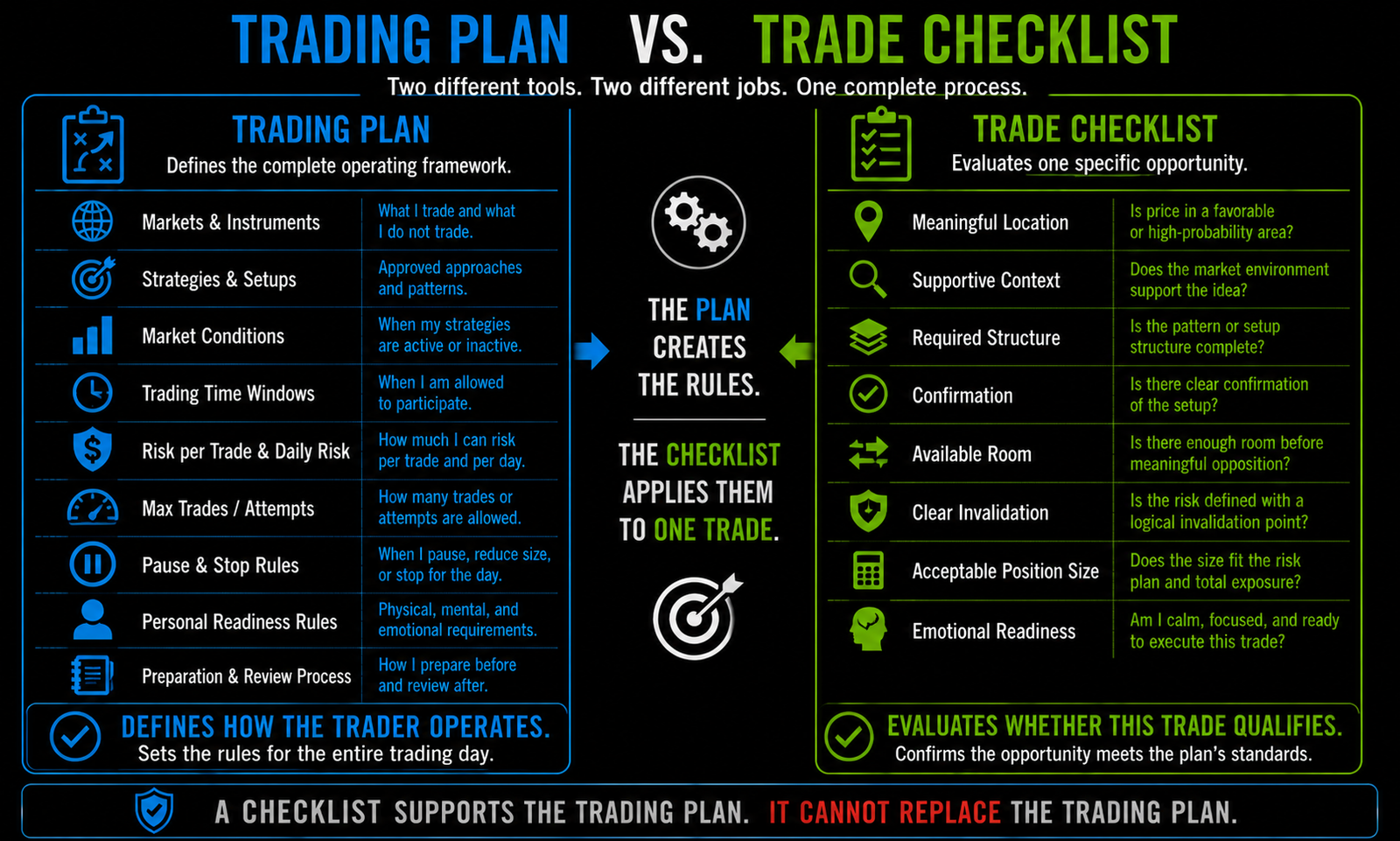
A trading plan describes the full operating framework for the trader. It identifies which markets and setups may be traded, when participation is allowed, how risk is limited, and what conditions require the trader to stop. It should also explain how preparation and review will be handled. The plan governs the process before, during, and after individual trades.
This is why a trading plan is a promise made before the open. The rules are created before a fast move, loss, missed entry, or winning streak can influence them. They establish the boundaries within which later decisions must occur. The plan is broader than any one chart pattern or entry signal.
A Checklist Evaluates One Opportunity
A checklist is a decision filter applied to a specific trade. It may ask whether the setup is at a meaningful location, whether the market context supports it, whether there is enough room, and whether invalidation is clear. Each item helps the trader determine whether the opportunity meets the established standard. The checklist turns broad rules into observable questions.
The checklist does not decide what the trader’s total daily risk should be or how many trades may be taken. It does not define which hours are permitted, which setups belong in the strategy, or when the trader must stop after repeated mistakes. Those rules should already exist in the plan. The checklist evaluates the opportunity inside that larger structure.
Why the Checklist Can Feel Like a Complete Plan
Checklists feel complete because they are visible at the moment of action. The trader can look down the list, confirm several boxes, and reach a clear yes-or-no decision. That process creates structure when the chart is moving quickly. It can therefore feel more practical than broader rules that are not directly tied to the current candle.
The checklist also produces a sense of control. A trader may believe that if every box is checked, the trade has been handled responsibly. The checklist can confirm that the setup meets its criteria, but it cannot determine whether the trader has already exceeded the day’s risk or violated the approved time window. A qualified setup can still be an unapproved trade.
The Plan Must Define the Strategy
A trading plan should define which opportunities belong to the trader’s approach. It should describe the permitted setups, the market conditions they require, and the timeframes used for context and execution. Without those definitions, the checklist may be applied to patterns that were never part of a tested process. The trader ends up evaluating trades without first deciding which trades deserve evaluation.
The plan should also explain what the strategy does not trade. Certain market states, locations, news conditions, or time windows may be incompatible with the approach. These exclusions prevent the trader from inventing new permissions during the session. A strong plan narrows the field before the checklist is used.
Setup recognition remains different from complete trade qualification. A pattern may appear correctly while the broader strategy rules forbid participation at that time or under those conditions. The plan establishes eligibility, and the checklist evaluates quality. Both decisions must support the trade before risk is accepted.
The Plan Must Define Risk Beyond One Trade
A checklist can confirm that one trade has a clear stop and acceptable position size. It cannot determine the total amount the trader may risk across the entire session unless those limits already exist. The plan should define maximum exposure, daily loss limits, trade limits, and any rules for reducing size. These boundaries protect the complete day rather than one isolated position.
The plan should also address what happens after a loss, a mistake, or an emotionally difficult trade. A trader may be required to pause, review the execution, reduce size, or stop for the session. Those decisions should not depend on how confident the next setup appears. The broader risk framework must remain in control when the checklist produces another qualified opportunity.
Time Windows and Operating Conditions Belong in the Plan
A setup can satisfy every chart-based criterion and still appear outside the approved operating window. The trader may have decided to avoid the opening minutes, stop after a certain hour, or remain inactive around major scheduled events. These are not setup characteristics. They are operating rules defined by the trading plan.
Personal readiness also belongs at the plan level. The trader may have rules for poor sleep, unusual stress, illness, distraction, or limited time. Those conditions can change whether trading normally is appropriate, even when the chart looks clean. The plan defines how participation must adjust before the checklist reaches the setup.
The Checklist Must Come From the Plan
A useful checklist should be derived from the trading plan rather than created as a separate collection of attractive ideas. Every checklist item should connect to a rule, requirement, or principle within the larger framework. If location matters in the checklist, the plan should explain which locations are meaningful. If confirmation matters, the plan should define what behavior qualifies as confirmation.
This relationship keeps the checklist from changing whenever the trader learns a new concept. New criteria should not be added simply because they sound useful or appeared in a recent winning trade. The trader should first decide whether the idea belongs in the strategy and how it affects the existing rules. The checklist should express the plan, not compete with it.
A Checklist Without a Plan Creates Gaps
A trader using only a checklist may make each trade look responsible while managing the day poorly. The setup could have location, confirmation, room, and defined risk, yet become the sixth trade taken during a frustrated session. Every individual entry appears qualified when viewed alone. The missing plan fails to control the sequence of decisions.
This is where the process of protecting the next decision becomes important. One trade affects the attention, emotional state, and risk capacity available for the next one. A checklist normally evaluates the current opportunity, while the plan accounts for what has already happened. Without that wider view, the trader can repeatedly approve trades that should no longer be available.
A Plan Without a Checklist Creates a Different Problem
A broad trading plan can also fail when it does not provide a practical decision filter. Rules such as “trade with the trend,” “use good risk management,” or “wait for confirmation” may sound responsible while remaining too vague to execute. The trader still has to interpret those phrases when price begins moving. Ambiguity allows emotion to determine what counts.
The checklist converts the plan’s principles into questions that can be answered in real time. It asks whether the specific location, structure, room, and invalidation meet the definitions created beforehand. This helps the trader apply the plan without redesigning it during each setup. The checklist makes the plan operational at the point of decision.
The Two Tools Should Form a Hierarchy
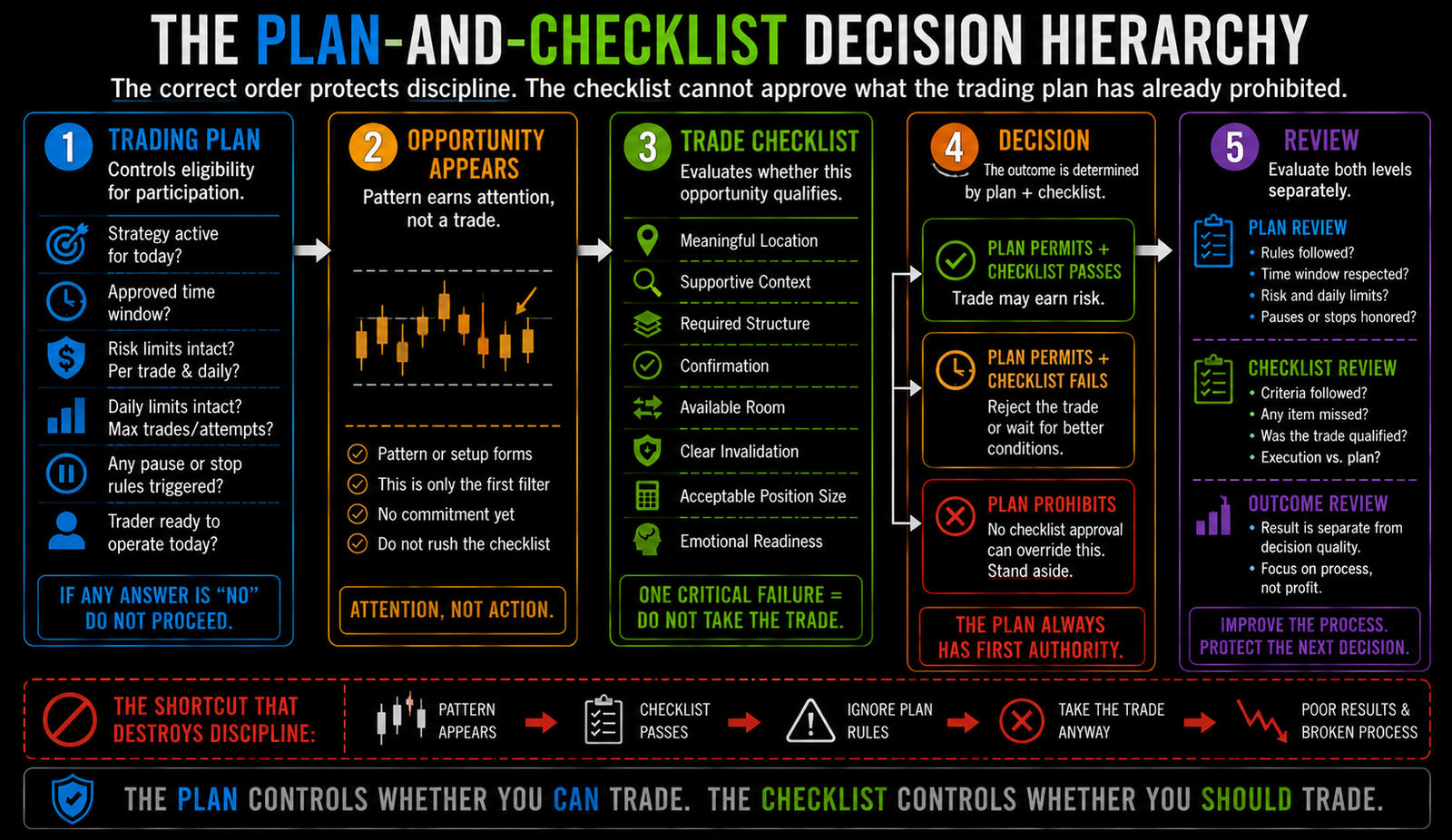
The trading plan should sit at the top of the decision structure. It determines whether the trader is allowed to participate, which strategies are active, how much risk is available, and what operating restrictions apply. Only after those conditions are satisfied should a specific setup reach the checklist. The opportunity cannot earn approval from a checklist when the plan has already disqualified participation.
The checklist then evaluates whether the trade itself meets the required standard. It tests the location, context, structure, room, invalidation, and exposure of the specific opportunity. When one critical requirement fails, the trade can be rejected without changing the broader plan. This is the practical foundation for understanding how good traders disqualify bad trades.
After the trade, the plan governs review. The trader records whether the setup met the checklist and whether the complete session followed the operating rules. A trade can pass the checklist but reveal a plan violation, such as trading outside the approved time or continuing after a daily limit. Reviewing both levels makes the source of the mistake easier to identify.
Build the Plan Before Building the Checklist
The cleaner process begins by defining the full trading operation. The trader should establish the strategy, approved market conditions, setups, time windows, risk boundaries, daily limits, stop conditions, and review process. These rules create the environment in which individual trade decisions will occur. Only then should the checklist be built.
Each checklist question should test one part of the approved trade. The questions should be specific enough to reveal whether the opportunity qualifies, requires more evidence, or should be rejected. A checklist that always produces a flexible answer will not protect the decision. The criteria must be clear before the setup creates urgency.
The hierarchy also makes flexibility easier to manage. The plan may define which rules are fixed and which may adjust when market conditions change. The checklist can then reflect those permitted adjustments without allowing the trader to rewrite the strategy after seeing a desired trade. Flexibility remains part of the plan rather than an excuse created in the moment.
A Practical Plan-and-Checklist Review
Before treating a checklist as a complete trading system, the trader can review both tools separately. The first group of questions should determine whether the broader operation is defined. The second group should confirm whether the checklist applies those rules to one opportunity. Missing answers at either level should lead to clarification before additional risk is accepted:
- Which markets, setups, and timeframes are permitted by the trading plan?
- Which market conditions make each strategy active or inactive?
- What time windows are approved for trading?
- What are the per-trade and daily risk limits?
- How many trades or decision attempts are allowed?
- What conditions require a pause, reduced size, or an end to the session?
- How will emotional and physical readiness affect participation?
- What preparation and review steps are required?
- Which checklist items come directly from the plan?
- Does the checklist test location, context, structure, room, and invalidation?
- Can one checklist failure clearly disqualify the opportunity?
- Can a trade pass the checklist while still being prohibited by the plan?
The better question is not, “Did this setup check every box?” It is, “Was this trade permitted by the plan, and did it then pass the checklist?” That sequence prevents the current pattern from becoming more important than the complete operating framework. The trade needs approval at both levels.
A checklist should make execution clearer without becoming a substitute for strategy design. Traders can use a broader framework such as the Extreme to Mean system to understand how market context, setup qualification, and risk fit together. The checklist belongs inside that framework. It should never be expected to carry the entire responsibility alone.
Review Plan Violations and Checklist Failures Separately
Post-trade review should identify whether the problem occurred at the plan level or the checklist level. Trading after the daily limit, outside the approved window, or during a prohibited condition is a plan violation. Entering from poor location, without enough room, or with unclear invalidation is a checklist failure. Combining them under the label “bad trade” hides the actual correction needed.
The review should also recognize when both tools worked correctly. A setup may be rejected because the checklist exposed a weakness, while a full session may end without a trade because the plan never permitted participation. The principle that doing nothing is still a trading decision applies to both outcomes. No order may be the clearest evidence that the hierarchy was respected.
Final Thought
A trading plan and a checklist are not competing tools. The plan defines how the trader operates across markets, sessions, risk, timing, execution, and review. The checklist evaluates whether one specific opportunity meets the standards created by that plan. Each tool becomes stronger when its responsibility remains clear.
The goal is not to build the longest plan or the most detailed checklist. It is to create a practical hierarchy in which the plan governs participation and the checklist evaluates the trade. A setup can pass every visible criterion and still be prohibited by the broader rules. The trader’s job is to respect both before deciding that the opportunity has earned risk.
Educational content only. Trading involves substantial risk and is not suitable for everyone.