
Trading always includes uncertainty. A qualified setup with reasonable context, clear invalidation, appropriate risk, and clean execution can still lose, while a late chase with poor risk can still get rescued and make money. If P&L becomes the only grading system, good decisions can be punished and poor decisions can be rewarded.
The better question is not only, “Did it work?” It is, “Was this decision worth repeating with the information I had at the time?” That is the distinction this lesson adds to the broader Trader curriculum: outcome tells you the financial result, while process review tells you what kind of decision produced it.
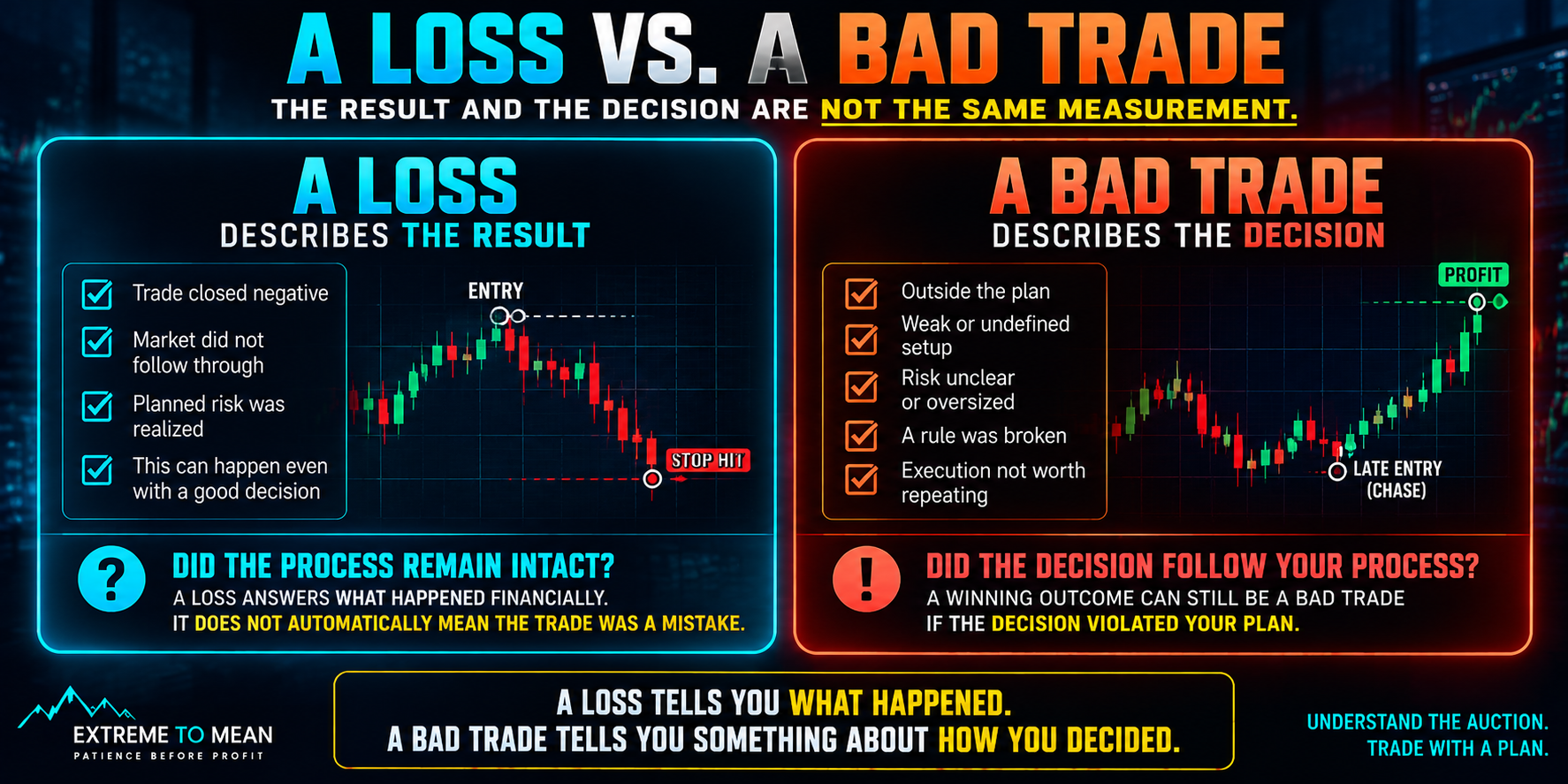
A Losing Trade Is Not Automatically a Bad Trade
Suppose you wait for a setup that belongs to your plan, the market context supports the idea, the location makes sense, invalidation is clear, and your size fits the risk. You enter, manage the trade according to the plan, and the market simply does not follow through. The stop is hit, and the trade closes negative.
Nothing about that outcome automatically proves the trade was wrong to take. A qualified setup does not remove uncertainty; it gives you a reason to accept uncertainty under defined conditions. The trade is not ready until the risk is clear, but clear risk still includes the possibility that the loss you planned for actually occurs.
That does not mean every rule-following loss should automatically be stamped “good trade.” The underlying strategy could be flawed, the context may have been misunderstood, or repeated evidence may eventually show that the setup needs revision. The point is simply that one negative result cannot answer all of those questions by itself.
A Winning Trade Can Still Be a Bad Decision
The mirror image is more dangerous because profit feels like proof. Imagine missing the planned entry, chasing price late, taking more size than intended, and entering without a clean invalidation. The market moves against you, nearly forces you out, then sharply reverses and turns the trade into a winner.
The account made money, but what exactly was rewarded? If the lesson becomes “See, chasing works” or “I can give this more room next time,” the favorable outcome may strengthen behavior that was never worth repeating. Profit does not turn a rule break into a clean decision.
This is why protecting your next decision matters even after a winner. A messy win can create just as much future risk as a frustrating loss if it convinces you to preserve the wrong behavior. Do not confuse being rewarded with being right.
Why Outcomes Rewrite the Story in Our Heads
Once the trade is over, the right side of the chart becomes impossible to ignore. Price may rally far beyond your stop, collapse immediately after your exit, or move exactly where you originally expected after taking a path you could not tolerate. Looking backward, the better decision often appears obvious because you now possess information that did not exist when the decision was made.
That creates a common review error: judging the earlier decision using later information. A stop that was reasonable before entry can suddenly look “too tight” because price reversed afterward, while an impulsive entry can look brilliant because the market eventually rewarded it. The outcome begins rewriting the story.
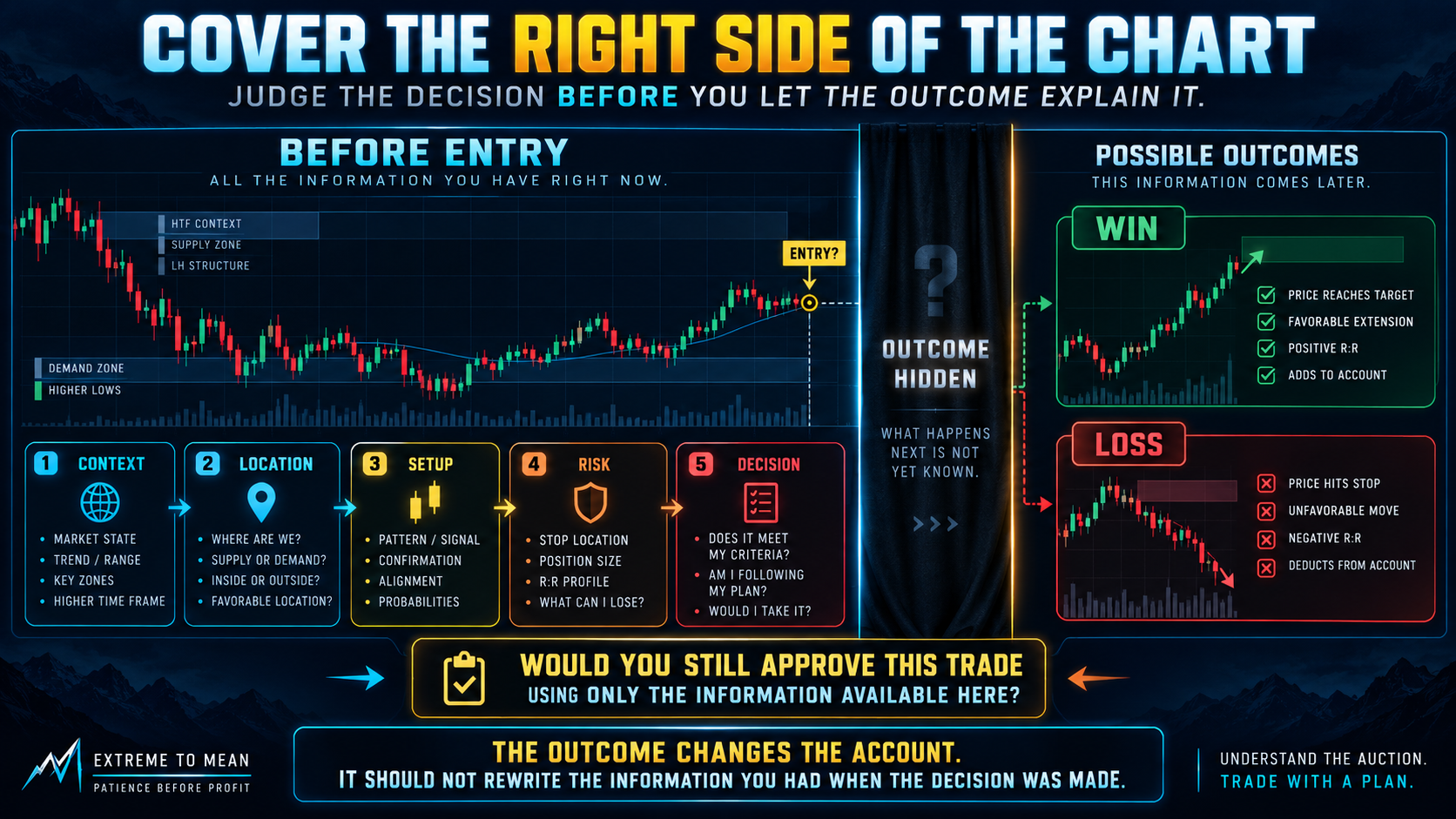
A cleaner review freezes the trade at the decision point. Ask what you actually knew then: what was the context, where was price, what setup was present, where were you wrong, and what risk were you accepting? Do not let information that arrived after the trade rewrite the quality of the decision that existed before it.
Judge the Trade Using What You Knew Before Entry
One of the strongest review questions is simple: Would this still look like a good decision if I covered the right side of the chart? Imagine hiding everything that happened after entry and judging only the information available before the outcome. That removes the easiest source of hindsight contamination.
Now review the trade in order. Was it actually part of the plan? Did the context, location, and setup justify participation? Was invalidation clear, was the size appropriate, and did execution follow what you intended to do?
Only after those questions should the financial result enter the review. That sequence matters because a trading plan made before the open is supposed to guide decisions before outcome information exists. If you reverse the order and start with P&L, the result can quietly become the explanation.
Good Process Does Not Mean Perfect Execution
Trade quality is not always binary. You can have a good idea with poor execution, a valid setup with too much size, a weak setup with a disciplined stop, or a strong entry followed by management that drifted away from the plan. Calling the entire trade simply “good” or “bad” can hide the part that actually needs work.
Precision creates a better lesson. If the setup was valid but the entry was late, fix the entry problem rather than discarding the whole strategy. If the idea was weak but the stop was respected, acknowledge both facts instead of allowing the disciplined exit to excuse the weak decision to enter.
The same applies to winners. A trade can contain one good decision and one poor decision while still finishing profitable, just as a losing trade can contain mostly clean decisions with one execution mistake. The goal of review is not to protect your ego with a nicer label; it is to identify exactly what deserves repetition and exactly what deserves change.
One Loss Should Not Rewrite a Strategy
Separating process from outcome does not mean outcomes stop mattering. A single trade tells you what happened in one instance, while repeated outcomes help you evaluate whether the strategy and rules have evidence behind them. Both forms of information matter, but they answer different questions.
A single clean loss does not necessarily require a strategy change. If you change the process every time a qualified trade loses, normal uncertainty can make your rules unstable. On the other hand, if a setup that meets your rules repeatedly performs poorly across a meaningful sample, “I followed the plan” is not a reason to ignore the evidence.
This is the balance: do not rewrite a process because one good decision had a bad result, and do not preserve a bad process because one poor decision got rewarded. One outcome is feedback; a pattern of outcomes becomes evidence. Review should protect you from both overreacting to one trade and refusing to learn from repeated results.
Ask What Is Worth Repeating
Consider two trades. Trade A is a clean loss: the trader waits for a planned setup, enters at a meaningful location, defines invalidation first, sizes appropriately, respects the stop, and loses when the market fails to follow through. Trade B is a messy win: the trader chases after missing the entry, uses too much size, has no clean invalidation, nearly gets stopped, and then gets rescued by a sharp reversal.
If you grade only by P&L, Trade A failed and Trade B succeeded. If you grade the decision, the more useful question becomes: Which behavior would I rather repeat across the next hundred comparable opportunities? That question does not promise that Trade A would become profitable over a hundred repetitions; it simply forces you to separate repeatability from one outcome.
The review should end with three possibilities: repeat what was clean, adjust what was imperfect, and reject what violated the process. The goal is not to guarantee that the next trade wins. It is to make the next decision more repeatable for the right reasons.
The ETM Loss-vs.-Bad-Trade Framework
Use this order when reviewing a trade:
- PLAN — Was this actually part of my strategy?
- DECISION — Did the context, location, and setup justify participation?
- RISK — Was invalidation clear and size appropriate?
- EXECUTION — Did I follow the process I intended to follow?
- OUTCOME — What happened financially?
- LESSON — What should be repeated, adjusted, or rejected?
That order keeps execution and outcome separate long enough to learn from both. A clean decision plus a loss may require no immediate change beyond recording the result and continuing to collect evidence, while a poor decision plus a win may be the most dangerous category because profit can reward behavior you should not repeat. A clean win still does not prove the setup has an edge, and a poor loss should be reviewed for the exact point where the process broke.
When risk was unclear in the first place, the lesson is not simply that the market moved against you. Having unclear risk makes it harder to distinguish normal loss from process failure because the trade never had a clean boundary to begin with. The better review starts before P&L and asks whether the decision deserved risk at all.
Final Thought
The market decides whether an individual trade wins. Your process decides whether the trade was worth taking with the information available at the time. Those two judgments belong together, but they should not be confused.
A losing trade may cost money without damaging the process, while a bad trade can damage the process whether it wins or loses. Learn to separate the result from the decision, then ask what deserves repetition, what needs adjustment, and what should stop. Otherwise P&L can teach you to abandon clean behavior and repeat weak behavior for exactly the wrong reasons.
Educational content only. Trading involves substantial risk and is not suitable for everyone.