
New traders often calculate a trade in the simplest possible way. They subtract the entry price from the exit price, multiply that difference by the position size, and treat the answer as the final result. That calculation captures the contract’s underlying price risk, but it may not capture the complete cost of participating.
Trading requires access to markets, order processing, execution, and sometimes real-time data or specialized software. Some of those services create direct charges that appear on an account statement, while other costs are built into the way orders interact with buyers, sellers, and available liquidity. Both affect what ultimately remains in the account.
Individually, many trading costs appear small. They become more important when the trader uses larger size, trades frequently, enters during unstable conditions, or targets moves only slightly larger than the cost of participation. This lesson belongs in the broader Basics learning path because understanding price and orders also requires understanding what it costs to turn an idea into an actual position.
The Visible Result Is Not Always the Final Result
Imagine a trader buys an instrument at $100 and later sells it at $101. At first glance, the trade earned $1 per share, which appears to equal $100 on a position of 100 shares. That is the visible price-based result, but it may not be the amount ultimately recorded in the account.
The final result can also be affected by several costs:
- Commissions and transaction fees: Direct charges associated with entering, exiting, routing, clearing, or processing the position.
- Bid-ask spread: The difference between the price available to buyers and the price available to sellers.
- Slippage: The difference between the expected execution price and the actual fill.
- Platform and market-data costs: Recurring charges for software, live quotes, specialized tools, or professional data access.
- Financing and product-specific charges: Interest, assignment fees, exercise fees, or other costs connected to the instrument or account.
Not every trade includes every cost. Some brokers advertise commission-free trading for certain stocks or ETFs, while futures and options may use per-contract or per-side pricing. Some costs appear as separate account charges, while others are reflected in a less favorable entry or exit price.
This is why traders should distinguish between the gross result and the net result. The gross result is the price-based outcome before costs, while the net result is what remains after the applicable costs have been included. A trade can be profitable on a gross basis and meaningfully less profitable after its execution costs are deducted.
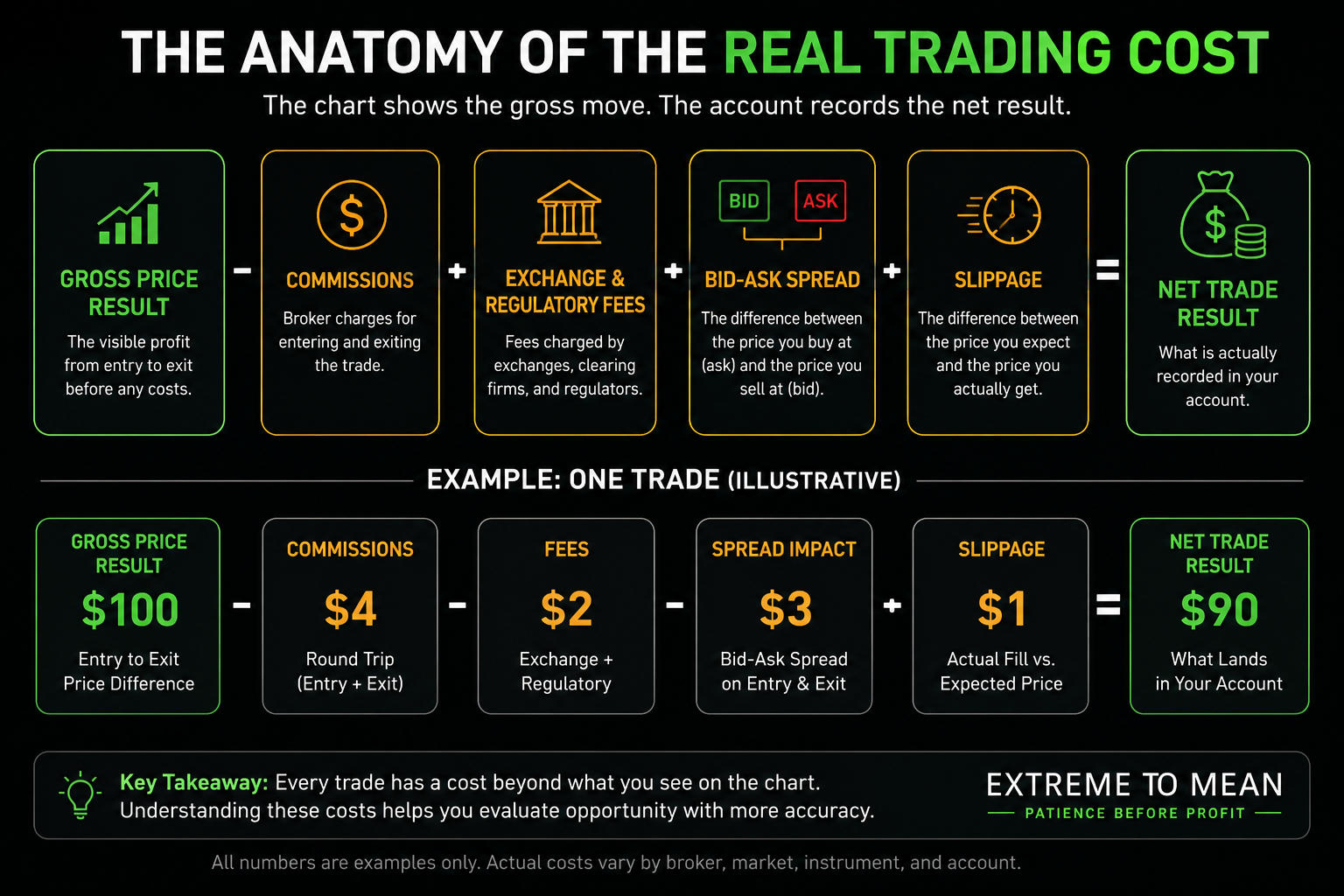
The difference may appear minor on one trade, but it can become a meaningful part of performance across dozens or hundreds of transactions. Cost awareness does not mean avoiding all trading activity. It means evaluating the complete decision instead of assuming every visible price move represents fully usable opportunity.
Commissions: The Direct Charge for Trading
A commission is a direct charge associated with executing a transaction. The pricing structure depends on the broker and instrument and may be calculated per order, per share, per options contract, or per futures contract. It may also be charged on each side of the trade or included within a bundled pricing arrangement.
The phrase per side matters because entering a position is one transaction and exiting it is another. If a broker quotes a commission of $2 per contract per side, one contract creates a $2 charge when the trader enters and another $2 charge when the trader exits. The complete round-trip commission is therefore $4 before exchange, clearing, or other applicable fees are added.
A round trip is the complete entry and exit of a position. A trader may think of the experience as one trade, but the cost structure often recognizes two separate transactions. Futures traders, for example, may pay commissions, exchange charges, and clearing fees when entering and then pay them again when exiting.
Commission-free trading does not necessarily mean cost-free trading. A broker may charge no stated commission on certain stock or ETF orders while the trader still experiences spread, slippage, data subscriptions, financing, or account-related charges. The headline commission is therefore only one part of the pricing model.
The better question is not simply whether the broker charges a commission. It is:
What is the complete round-trip cost for the instrument, size, and order process I intend to use?
That question keeps the trader focused on the actual transaction rather than on one advertised number.
Fees: The Smaller Charges That Add Up
Fees are charges associated with the systems, exchanges, and organizations involved in processing market activity. Depending on the instrument and account, they may include exchange, clearing, regulatory, transaction, routing, platform, and data-subscription fees. Options traders may also encounter exercise or assignment charges, while leveraged or longer-held positions may create financing or margin-interest costs.
Some fees are extremely small and apply only under certain circumstances. Others are assessed on nearly every transaction or appear as a recurring monthly expense. A futures trader may pay exchange and clearing fees alongside the broker commission, while an options trader may pay a contract fee and later face an additional charge if the position is exercised or assigned.
Market-data and platform costs behave differently because they may apply whether the trader places one trade or one hundred. These fixed expenses should still be understood as part of the cost of operating the trading process. They may not change the result of one individual trade directly, but they affect the broader economics of the account.
These charges should not be treated as unknowable mysteries. Reputable brokers normally publish pricing schedules, although those schedules may require careful reading because different products and account types can have different terms. Before trading a new instrument, the trader should review the applicable costs instead of relying only on a promotional headline. Transfer costs matter well beyond trading accounts too — fee erosion is one reason the evidence on Bitcoin use in high-inflation countries is more mixed than the headlines suggest.
This is especially important when comparing products. Stocks, ETFs, futures, and options may look similar on a chart, but their contract structures and trading costs differ. Understanding the basic differences between stocks, ETFs, futures, and options helps explain why one cost model cannot be applied to every market.
The Spread: A Cost Built Into the Quote
The spread is the difference between the highest current bid and the lowest current ask. The bid is the highest displayed price a buyer is currently willing to pay, while the ask is the lowest displayed price a seller is currently willing to accept. The distance between those two prices represents an immediate execution hurdle.
Suppose an instrument displays a bid of $100 and an ask of $100.05. The spread is five cents. A trader who buys immediately with a market order may receive a fill near the ask, while an immediate market sale may execute near the bid if conditions remain unchanged.
That means the position can begin with a small negative difference before the broader market moves at all. The trader bought at the price offered by sellers and would need to sell at the lower price offered by buyers. The market must first overcome that difference before the position begins showing a positive price-based result.
The spread is not normally a separate invoice charged by the broker. It is an execution cost created by the difference between available buying and selling prices. The size of that difference can change throughout the session as liquidity, volatility, and participation change.
Spreads are usually narrower in highly active and liquid markets. They may widen when trading activity is thin, volatility increases, important news is released, the instrument is outside its most active session, or price is moving too quickly for quotes to remain stable. Fewer available participants generally create less competition between bids and offers.
The spread becomes especially important when the intended target is small. A five-cent spread may be relatively minor inside a multi-dollar move but significant when a trader is trying to capture only ten cents. Readers should understand what bid, ask, and spread mean before assuming that the chart’s latest price is simultaneously available for both buying and selling.
Slippage: When the Fill Differs From the Expectation
Slippage occurs when the actual execution price differs from the price the trader expected. It can happen because the available quote changes before the order reaches the market, because other participants consume the available liquidity first, or because the position is too large to fill entirely at one price.
Suppose a trader submits a market buy order while the ask is $100.05. By the time the instruction reaches the market, the available sellers at that price may already be gone. The order might fill at $100.07, $100.10, or across several prices if the requested size exceeds the quantity available at one level.
Slippage can occur on both entry and exit. It becomes more likely when price is moving rapidly, liquidity is limited, the order is large relative to the available market, significant news is being released, or the instrument trades infrequently. Gaps and fast stop-order triggers can also produce fills that differ substantially from the planned level.
Slippage is not always unfavorable. An order can occasionally receive price improvement and execute at a better price than expected. Traders should not, however, build a risk plan that depends on favorable slippage because the market is under no obligation to provide it.
The practical lesson from understanding why fill prices can be different is that an order controls the instruction being sent, not the market environment in which that instruction must execute. A stop can identify the planned exit area, but it cannot guarantee an exact fill during every condition.
Small Costs Become Larger Through Repetition
The cost of one trade may appear insignificant, but trading frequency changes the calculation. Suppose a trader’s average round-trip cost is $5 after commissions, fees, and ordinary execution differences. One trade costs $5, five trades cost $25, twenty trades cost $100, and one hundred trades cost $500.
The cost does not become unreasonable simply because it is repeated. Every trade requires access and execution, so every trade creates another participation cost. The problem begins when the trader repeatedly accepts low-quality opportunities that do not offer enough potential value to justify that cost.
This makes frequent, low-quality trading particularly expensive. A trader may take several similar positions during a choppy session, lose little through actual price movement, and still create a noticeable account loss through repeated entries and exits. The chart may finish close to where it started, but the account paid for every attempt.
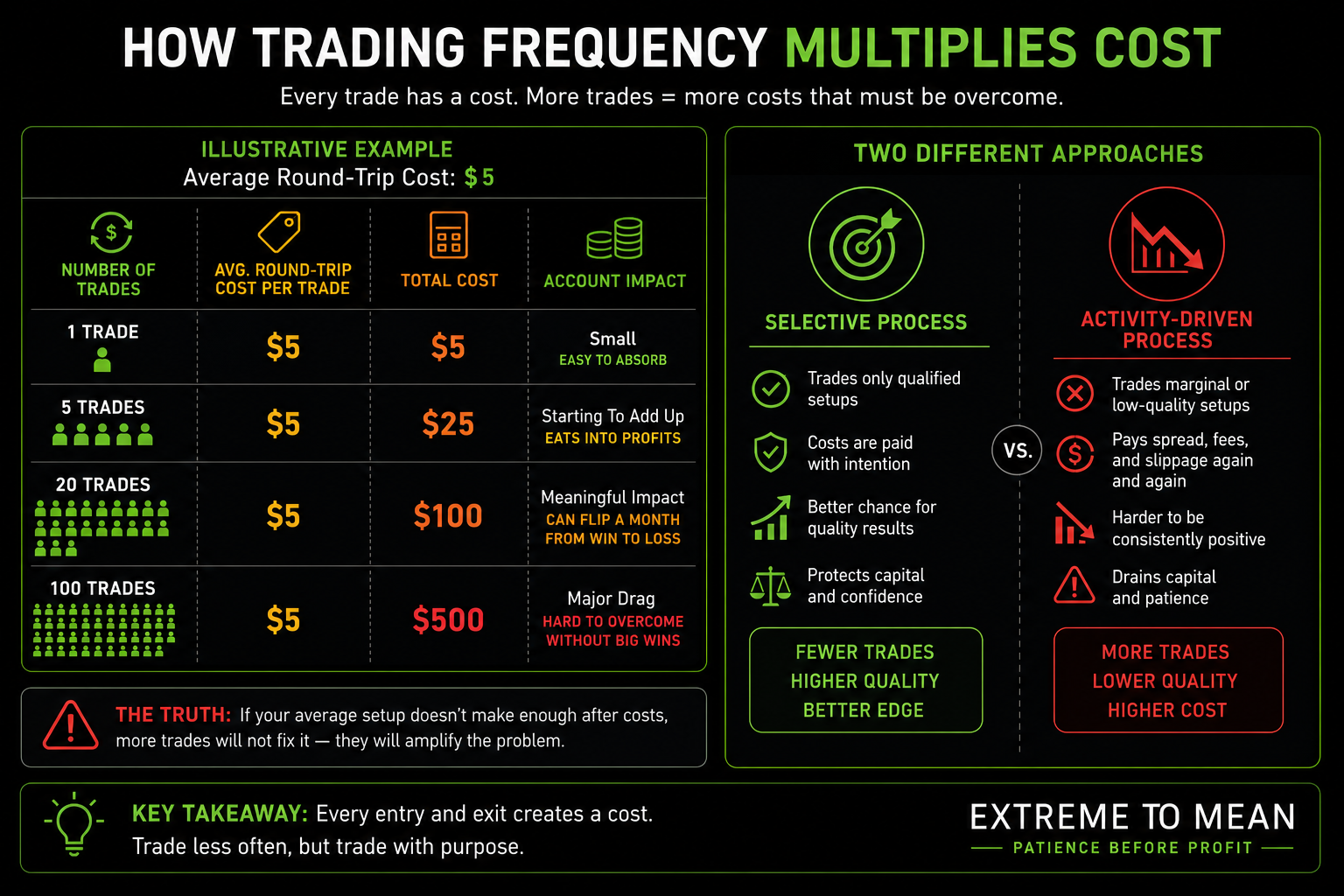
This is one reason more activity is not automatically more productive. A trade should not be taken merely because its visible price risk appears small. The full decision includes the cost of participation and the possibility that several minor decisions will accumulate into a meaningful drag on performance.
Patience can therefore have direct economic value. Rejecting a weak trade avoids not only its market exposure but also the commissions, spread, slippage, and fees attached to an idea that never earned capital. Sometimes doing nothing is the least expensive decision available.
Costs Matter Relative to the Trade
A $5 round-trip cost cannot be judged in isolation. Its importance depends on the position size, intended price movement, target, holding period, instrument, order type, available liquidity, and frequency of trading. The same cost can be almost insignificant in one trade structure and dominant in another.
Consider a longer-duration trade seeking a substantial move. A modest transaction cost may represent only a small fraction of the potential gross result. For a scalper targeting a very small move, that same cost may consume a large portion of the opportunity before market risk is even considered.
Suppose one hypothetical trade has a planned gross target of $500 and an estimated cost of $5. Another has a planned gross target of $15 with the same $5 estimated cost. In the first example, the cost represents 1% of the target; in the second, it represents roughly one-third.
This does not automatically make the first trade better. It may require more risk, a longer holding period, or a target that is less likely to be reached. The comparison only demonstrates that costs must be judged in relation to the complete trade structure rather than viewed as isolated dollar amounts.
A strategy that appears profitable before costs can behave very differently after realistic execution is included. Paper calculations and backtests should therefore account for commissions, fees, spread, and reasonable slippage instead of assuming that every entry and exit occurs at the perfect displayed price. Gross performance may describe the strategy idea, but net performance describes what the trader could actually keep.
A Practical Pre-Trade Cost Check
A beginner does not need to calculate every possible penny before placing each order. They should, however, understand the recurring costs of the chosen instrument and recognize the market conditions that can make execution more expensive.
A useful cost check includes the following questions:
- What is the normal round-trip commission? Include both the entry and exit rather than looking at only one side of the transaction.
- Which additional fees apply? Review exchange, clearing, regulatory, routing, platform, data, financing, and product-specific charges.
- What is the current bid-ask spread? Compare it with the intended target and note whether it is wider than normal.
- How much slippage is realistic? Consider volatility, liquidity, news risk, position size, and the order types likely to be used.
- How frequently am I trading? A small cost repeated many times may become a significant performance drag.
- Is the intended move large enough to justify participation? The potential opportunity should be meaningful relative to both the cost and the uncertainty.
- Am I taking this trade because it qualifies or because I want activity? Activity alone does not justify paying another round-trip cost.
The purpose of these questions is not to create false precision. Actual costs can vary, especially when market conditions change quickly. The purpose is to prevent the trader from evaluating the setup as though participation were free.
The better question is:
After realistic trading costs are included, does this setup still deserve capital and attention?
If the answer is unclear, the trader may need a better location, a cleaner setup, a more appropriate instrument, or no trade at all. A visible opportunity that cannot overcome its likely participation cost may not be a usable opportunity.
Final Thought
The real cost of a trade extends beyond the visible difference between entry and exit. Commissions and fees create direct charges, the spread creates a cost between available buying and selling prices, and slippage can move the actual execution away from what the trader expected. Repeated activity can multiply every one of those costs.
None of this means trading should be avoided. It means trading should be evaluated honestly. The goal is not to eliminate every cost, because participation in a functioning market will always involve some form of expense or execution tradeoff.
A complete process asks not only whether price may move, but whether the potential move justifies the structure, exposure, and cost required to participate. The trader’s job is to evaluate the full decision rather than react to every available button or every small movement.
Readers who want a practical way to slow that decision down can use the free trading tools and checklists to evaluate setup quality before paying the cost of participation.
Educational content only. Trading involves substantial risk and is not suitable for everyone.