
Most beginners assume that the price shown on a chart is the price they will receive. They see the market trading near a level, press Buy or Sell, and expect the transaction to occur exactly where they were looking. Sometimes the fill is close, but in other situations the final execution price is noticeably different. Bitcoin has a related gap between what a trader sees and what has actually settled, covered in the lesson on why an unconfirmed Bitcoin transaction isn’t final.
The chart, quote, and order ticket may each display slightly different information because the market continues moving while the order is being processed. Buyers and sellers change their prices, available liquidity is consumed, and spreads can widen. The difference between the expected price and the actual fill is called slippage.
At Extreme to Mean, this belongs in The Basics lesson library because slippage connects several beginner concepts: liquidity, bid, ask, spread, order type, and execution quality. A trader does not need to fear slippage, but they should understand it before assuming that every order will fill exactly as expected.
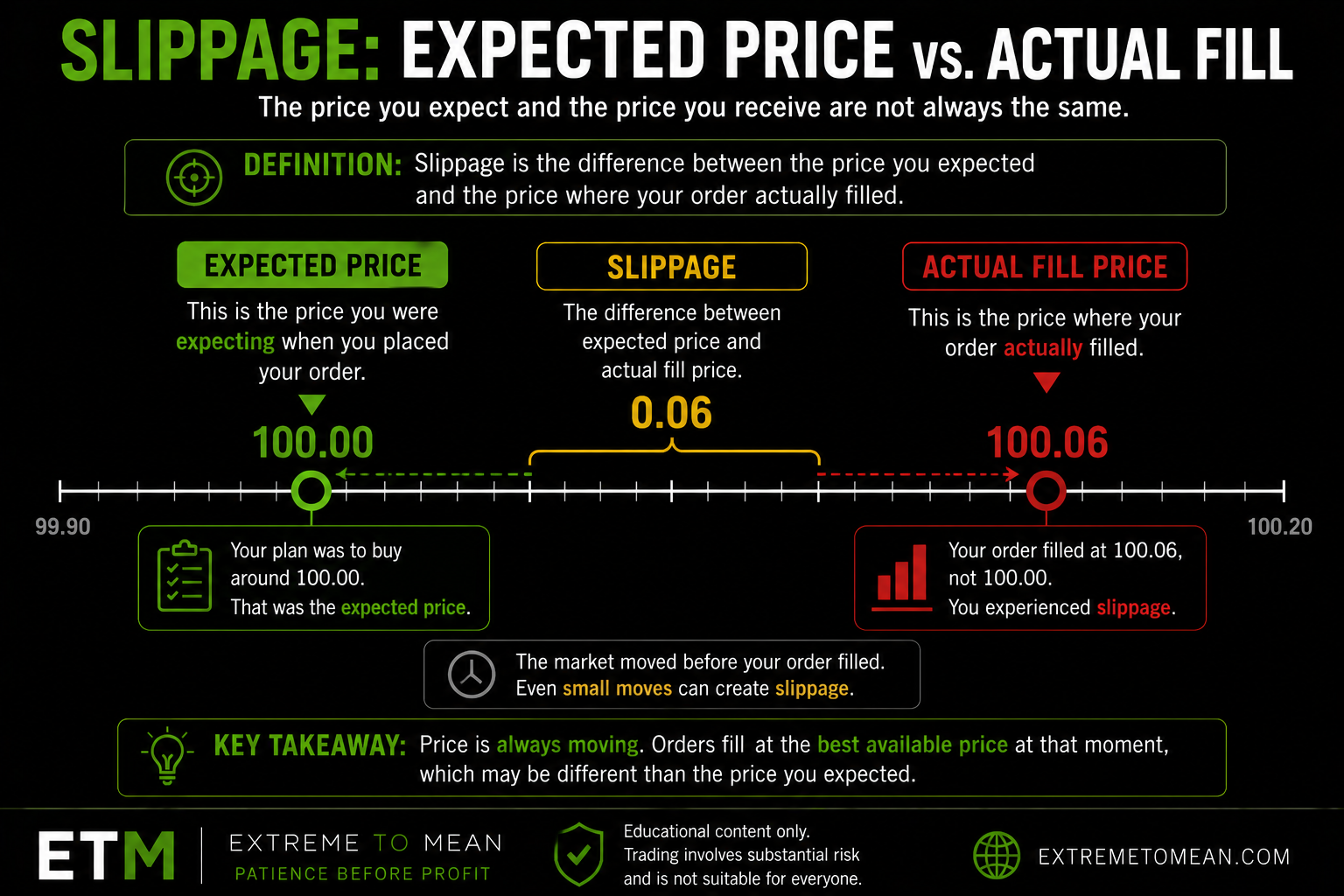
Slippage Means Expected Price vs. Actual Fill Price
Slippage occurs when an order is executed at a different price from the one the trader expected. Suppose a trader sees a stock trading near $100 and submits a buy order. If the actual fill is $100.04, the trader experienced four cents of slippage.
The same principle applies when selling. A trader expecting to sell near $100 who receives a fill at $99.96 also experienced four cents of slippage. The direction of the difference changes, but the essential issue remains the same: the expected price and actual execution price were not identical.
This is why actual fill prices affect profit and loss. Trading results are calculated from the prices where transactions actually occur, not from the prices the trader hoped to receive or briefly saw on the chart.
Slippage can occur on entries and exits, when buying or selling, and when closing either winning or losing positions. It may be small enough to have little practical effect, or large enough to change the account risk, reward-to-risk relationship, or quality of the trade.
Slippage is not automatically evidence that the broker, platform, or order failed. It is often a normal result of live-market execution. An order interacts with the buyers, sellers, and liquidity available when it reaches the market—not with the market conditions that existed a moment earlier.
This is why understanding what bid, ask, and spread mean is important. A chart may display recent price activity, but the execution depends on the prices and quantities currently available on the appropriate side of the market.
Why Slippage Happens
Slippage usually occurs because the market changes between the moment the trader forms an expectation and the moment the order is executed. In a liquid, calm market with a tight spread, the expected and actual prices may be very close. During faster or thinner conditions, the difference may become more noticeable.
Fast price movement can quickly consume the orders available at one price level. Thin liquidity means fewer buyers or sellers may be available to absorb an order. Wide bid-ask spreads also create a larger distance between the price available to immediate buyers and the price available to immediate sellers.
News events, market opens and closes, extended-hours sessions, and sudden volatility can increase these effects. Large orders may also receive several partial fills across multiple prices when there is not enough quantity available at the first quoted level.
The common issue is that the necessary buyers or sellers are no longer available exactly where the trader expected them to be. A market buy order seeks available sellers. If the sellers at the expected price are gone or cannot fill the entire quantity, the remaining order may execute at higher prices.
A market sell order works in the opposite direction. It seeks available buyers, and when the expected buyers are no longer present or do not offer enough quantity, the order may fill lower.
This is why slippage is closely connected to liquidity. The lesson on what volume and liquidity mean explains that market activity and ease of execution are related but not identical. A market can appear extremely active while still producing unstable quotes, wide spreads, and imperfect fills.
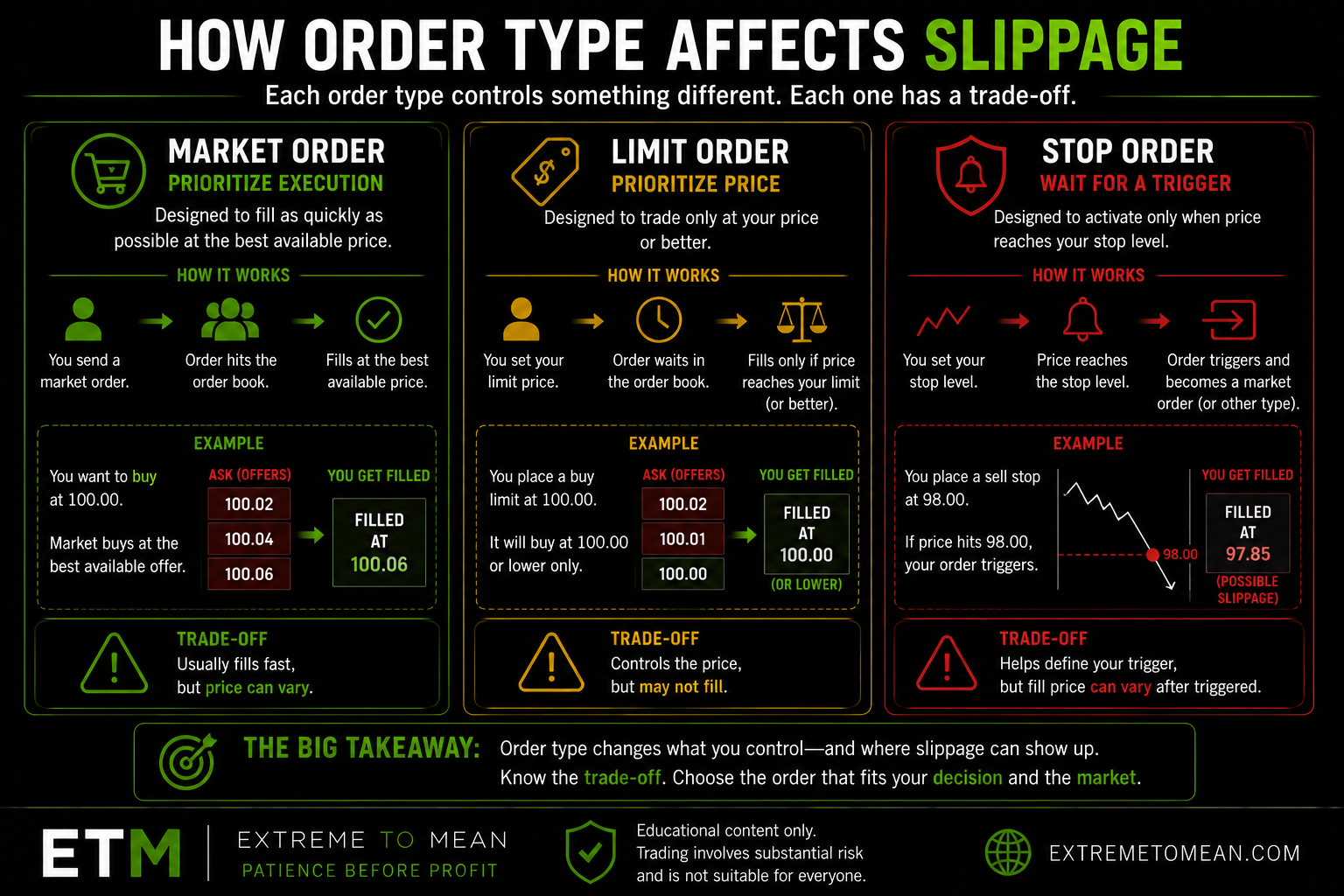
Market Orders and Slippage
Market orders are one of the most common ways beginners encounter slippage. A market order tells the broker to seek execution as quickly as possible at the best prices currently available. The trader is prioritizing participation and speed rather than demanding one exact price.
In a calm, liquid market, a market order may execute close to the quote displayed when the order was sent. If price is moving rapidly or available liquidity is limited, however, the best price may change before the order is completed. A buyer may fill above the expected level, while a seller may fill below it.
This does not make market orders inherently bad. It means they contain a specific tradeoff: greater execution certainty comes with less control over the final price.
When using a market order, the trader is effectively saying, “Execute this position now using the best available liquidity, even if the price changes.” That tradeoff may be appropriate when immediate participation matters more than a small price difference. In other situations, the uncertainty may be too large.
The article on market orders, limit orders, and stop orders explains these differences directly. Market orders prioritize execution, limit orders establish a price boundary, and stop orders wait for a trigger before becoming active.
The better question is not simply, “Will this order fill?” It is, “How much price uncertainty am I willing to accept in exchange for faster execution?”
Limit Orders and Slippage
Limit orders work differently because they establish an acceptable price boundary. A buy limit order instructs the broker to purchase at the specified price or lower. A sell limit order instructs the broker to sell at the specified price or higher.
This gives the trader more control over the execution price and can prevent an order from filling beyond the chosen boundary. The tradeoff is that the order may not execute at all.
Suppose a trader places a buy limit at $100. The order should not purchase above $100, but it may remain unfilled if the market never trades at that level. It can also remain partially filled if there is not enough available quantity to complete the entire order.
That is not necessarily a platform failure. The instruction is doing what it was designed to do: protect the price boundary even when that means sacrificing participation.
A limit order can be useful when the trade is valid only at a specific price or better. The trader may have to choose between waiting, adjusting the order, or allowing the opportunity to pass. Price discipline and execution certainty cannot always be maximized at the same time.
The trader using a limit order is making a different decision from the trader using a market order. One is saying, “I want this trade only at an acceptable price.” The other is saying, “I want this trade now at the best available price.” Neither instruction is automatically correct; the order should match the actual purpose of the trade.
Stop Orders and Slippage
Stop orders can also experience slippage, especially during sharp or fast market moves. A stop order waits for a designated trigger price. Once that trigger is reached, the order becomes active according to its instructions.
A basic stop-market order does not guarantee execution at the stop price. Once triggered, it seeks the best available market price. If the market moves rapidly through the trigger level, the actual fill may occur at a less favorable price.
Suppose a trader owns a position and places a sell stop at $98. If price reaches $98, the stop becomes active. If buyers are still available near that level, the fill may occur close to the trigger. If the market is dropping quickly and the closest available buyers are at $97.90 or $97.75, the order may fill there instead.
The stop did not necessarily fail. It triggered as instructed, but the final execution depended on the liquidity available afterward.
This is why a stop loss does not guarantee a perfect fill. Stops can define where action should begin, but they cannot force the market to provide a specific price during a gap, news shock, liquidity shortage, or fast selloff.
The trader should therefore consider both the intended exit level and the possible execution around that level. Risk is not only about where the trader wants to leave. It also includes whether the trader understands how the exit may actually occur, which is why the trade is not ready until the risk is clear.
Why Slippage Feels Worse Than Expected
Slippage often feels personal because it appears at the exact moment the trader is trying to act. The trader makes a decision, sends the order, and immediately sees an execution that is worse than anticipated. That difference can feel unfair when the chart seemed to display another price.
In many cases, however, the chart price was not a guaranteed transaction price. Markets continue moving while the trader clicks, the platform transmits the order, the broker processes it, and the order reaches available liquidity. Other participants are acting during the same interval.
Quotes can update, spreads can shift, and visible liquidity can disappear. When an order prioritizes execution, the final fill reflects the market available at that moment rather than the price the trader expected based on an earlier observation.
There may occasionally be an execution issue worth reviewing with the broker, but frustration alone does not prove that something malfunctioned. The first step is to examine the market environment and the instruction that was used.
Slippage can also become an emotional trigger. A trader may chase the next move, widen risk, enter another position to recover the difference, or blame the execution instead of reviewing the original plan. Those reactions turn a small execution problem into a larger decision problem.
A cleaner response is to evaluate whether the market was fast, the spread was wide, liquidity was limited, or the order type was inappropriate for the conditions. The trader should also review whether the trade was attempted during news, the opening or closing period, or extended-hours trading.
That process does not eliminate frustration, but it converts frustration into information the trader can use.
A Simple Slippage Filter Before You Trade
Before placing an order, the trader should consider slippage as part of the execution plan rather than as a surprise discovered afterward. A practical slippage review includes:
- What price do I currently expect? Identify the working expectation rather than assuming the latest chart price is guaranteed.
- What price would still be acceptable? Determine whether a slightly different fill would change the setup, stop distance, or reward-to-risk relationship.
- How wide is the current spread? A wider-than-normal spread can make immediate execution more expensive.
- Is the product liquid enough for my order size? The available quantity should be considered, especially for larger orders or less active instruments.
- Which order type am I using? Understand whether the instruction prioritizes speed, price control, or a trigger condition.
- Are current conditions likely to produce unstable execution? News, rapid movement, market opens, closes, and extended hours can increase uncertainty.
- What happens if the fill is worse than expected? Recalculate the account risk, stop distance, and trade quality using a less favorable execution.
- Does the order type match what I am trying to control? The instruction should reflect whether participation or price discipline matters more.
- Is the trade still valid without a perfect fill? A setup that depends on unrealistically precise execution may not deserve capital.
These questions do not guarantee a clean fill. They help the trader prepare for the reality that execution is not always exact and that different order types solve different problems.
The better question is not, “How can I eliminate all slippage?” It is:
Where could slippage occur, and does the trade still make sense if the execution is imperfect?
That approach reinforces a core Extreme to Mean principle: a setup earns attention before it earns risk. When the execution environment is unstable or the available prices no longer support the plan, the trader does not have to force participation.
For newer readers, the best next step is to start with the beginner trading path before moving deeper into execution, risk, and trade management.
Final Thought
Slippage is the difference between the price a trader expected and the price where the order actually filled. It can occur because markets move, liquidity changes, spreads widen, and order types behave according to their instructions.
It becomes especially important during fast, thin, volatile, or news-driven conditions. Market orders may fill quickly but provide less price certainty. Limit orders provide a price boundary but may not fill. Stop orders can trigger at one price and execute at another.
Slippage is not something to fear blindly or ignore completely. It is part of live-market execution. Traders who understand it can choose order types more deliberately, evaluate market conditions more honestly, and avoid assuming that every chart price is immediately available.
The better trader does not ask only, “Where do I want to trade?” They ask, “How might this order execute, what could the actual fill look like, and would that result still fit the risk I am prepared to take?”
Continue with how slippage fits into the total cost of a trade.
Educational content only. Trading involves substantial risk and is not suitable for everyone.