
Beginners often learn trading through ticker symbols. They see AAPL, SPY, ES, or an options contract chain and assume everything is just another version of “buy low, sell high.” The screen can make these products feel similar because they all show prices, charts, and order buttons.
That surface similarity is dangerous.
A stock is not an ETF. An ETF is not a futures contract. A futures contract is not an options contract. Each instrument has its own structure, timing, risk mechanics, and reason for existing. If a trader does not understand the instrument, they can misunderstand the trade before the setup is even evaluated.
This article brings the core differences together in one place. If you are still building your foundation, this belongs inside the broader Basics trading education path, because understanding the product comes before judging the opportunity.
The First Question: What Are You Actually Trading?
Before thinking about direction, prediction, or entries, a trader should ask one simple question: what is this instrument?
That question sounds basic, but it changes everything.
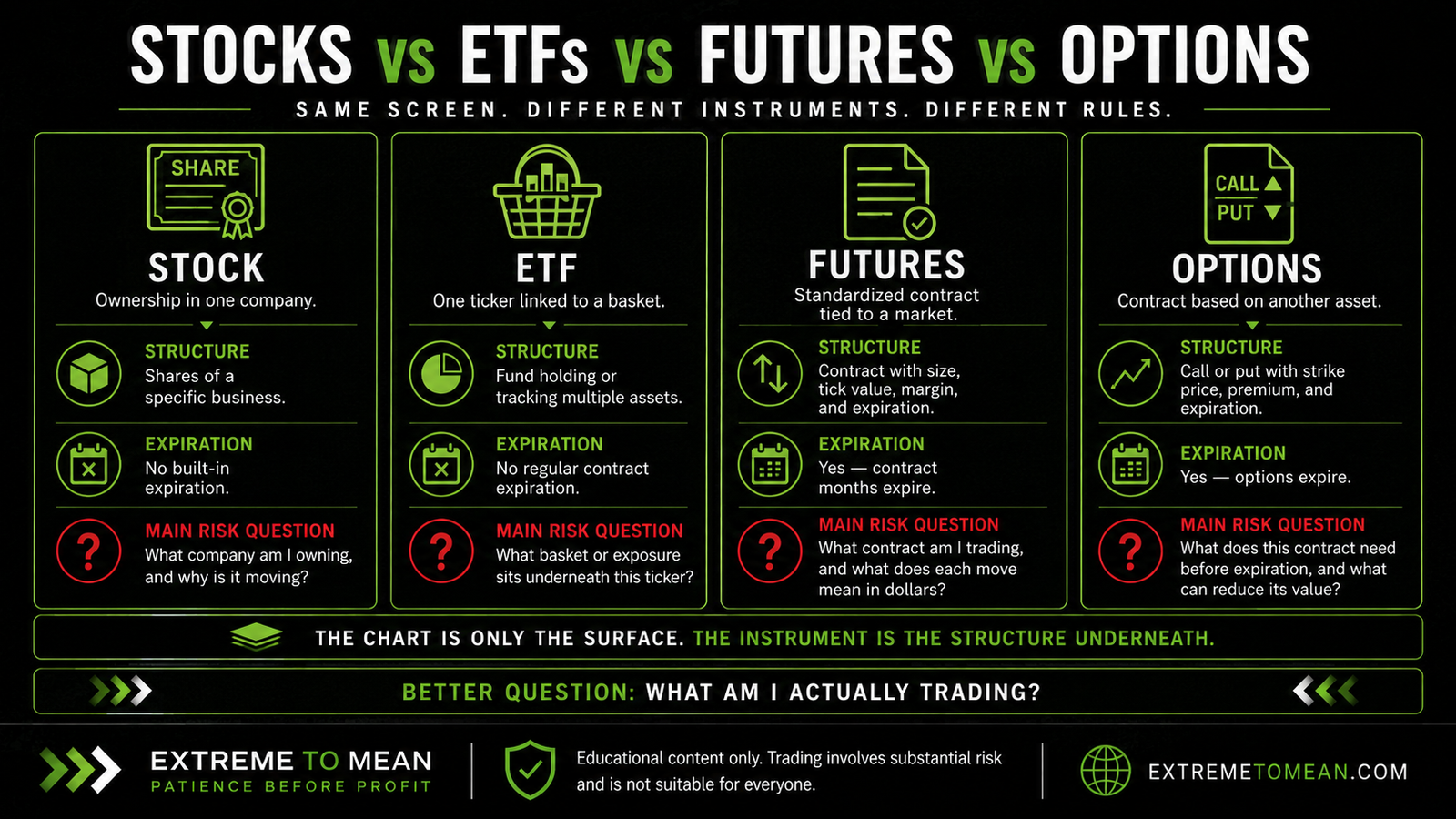
If you are buying a stock, you are buying ownership interest in one company. If you are buying an ETF, you are buying shares of a fund that usually holds or tracks a basket of assets. If you are trading futures, you are trading a standardized contract tied to an underlying market. If you are trading options, you are trading a contract with a strike price, expiration date, rights, and possible obligations.
Those differences are not minor details. They define the risk.
A beginner may look at four charts and see four moving prices. A better trader looks at those same charts and sees four different products. One may represent company ownership. One may represent basket exposure. One may represent leveraged contract exposure. One may lose value because time is running out.
The chart is only the surface. The instrument is the structure underneath.
That instrument structure is separate from long and short direction. Direction tells the trader which way the position benefits, while the instrument determines the rules and risk mechanics around that position.
Stocks and ETFs: Ownership vs. Basket Exposure
A stock usually represents ownership in one specific company. If you buy shares of a company, your exposure is tied to that company’s business, its earnings, its expectations, its sector, and the market’s demand for those shares. The company may be strong or weak, but the instrument itself is built around one business.
That is why beginners should first understand what a stock really is. A stock is not just a ticker. It is an ownership instrument connected to a specific company.
An ETF is different. An ETF trades on an exchange like a stock, but it usually represents a basket of holdings. One ETF may track a broad index. Another may represent a sector. Another may be built around bonds, commodities, currencies such as the dollar tracked by DXY, or a theme.
This is why understanding what an ETF is matters before treating it like a single company. One ETF symbol may contain hundreds of holdings underneath it. The ticker looks simple, but the exposure may be broader than a beginner realizes.
The main difference is structure. A stock points to one company. An ETF points to a fund wrapper and the holdings or index behind it.
That difference affects decision quality. If a stock is moving, a trader may need to understand company-specific news, earnings, sector pressure, and broader market context. If an ETF is moving, a trader may need to understand the basket, the index, the sector, the holdings, and whether a few large names are driving the move.
Neither product removes risk. Both still require a reason, a location, and a plan.
Futures and Options: Contracts, Not Ownership
Futures and options are different because they are contracts. They are not ownership in a company.
A futures contract is a standardized agreement tied to an underlying market. That market may be an index, commodity, currency, interest rate, or another asset class. Futures have contract size and tick value, margin requirements, and expiration cycles.
That makes futures very different from stocks and ETFs. When a trader trades a futures contract, they are not buying shares of a company or a fund. They are trading a contract whose value changes with the underlying market. If you need the dedicated breakdown, review what a futures contract is before treating futures as just another chart.
Options are also contracts, but they work differently from futures. An option gives the buyer a right, and the seller may take on an obligation. Options have strike prices, expiration dates, premiums, and sensitivity to time and volatility.
That structure makes options easy to misunderstand. A beginner may think an option is simply a cheaper way to trade a stock. It is not. An option can lose value even when the underlying asset moves in the expected direction if the timing, volatility, strike selection, or premium works against the position.
That is why understanding what an options contract is matters before strategy enters the conversation. Options are not just directional bets. They are contracts with terms.
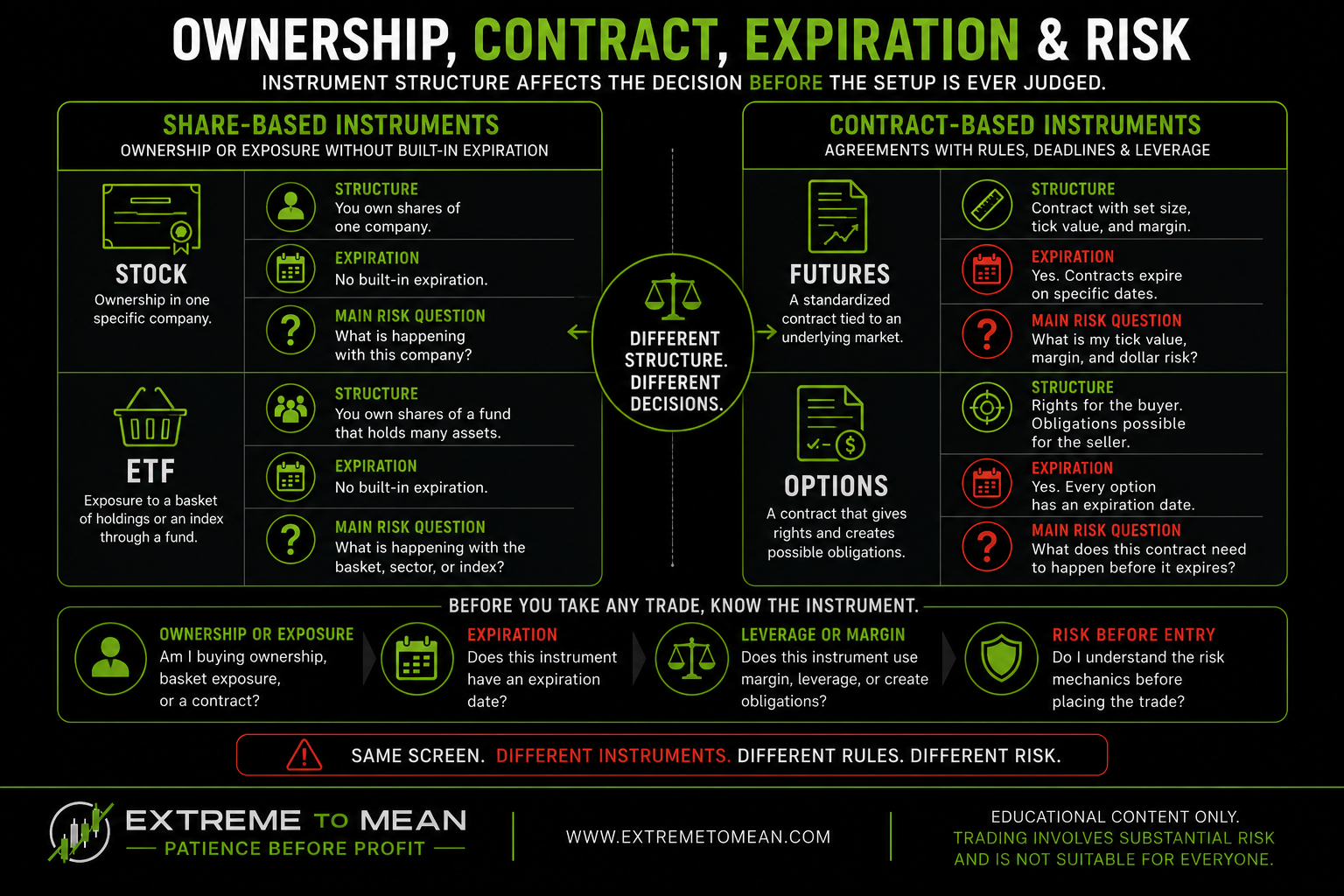
The key distinction is this: stocks and ETFs are share-based instruments, while futures and options are contract-based instruments.
That one distinction can prevent a lot of confusion.
Expiration Changes the Decision
One of the cleanest ways to separate these instruments is expiration.
A regular stock does not have a built-in expiration date. If you buy shares, the shares do not expire on a set Friday. The company can change, the price can move, and the risk remains real, but the stock itself is not a time-limited contract.
An ETF also does not usually have a built-in expiration date in the same way a futures or options contract does. A fund can close or change over time, but the everyday structure of an ETF is not based on a contract expiring next week or next month.
Futures are different. Futures contracts have expiration cycles. Active traders need to know which contract month is being traded and when volume may roll from one contract to another. The symbol, contract month, liquidity, and expiration all matter.
Options also expire. This is one of the most important parts of the product. An options contract has a deadline, and that deadline changes the decision. A trader may be right about direction but wrong about timing. In options, timing is not a side issue. It is built into the instrument.
This is where many beginner mistakes begin. They look at the chart of the underlying asset and ignore the clock built into the contract.
The better question is not, “Do I like the chart?”
The better question is, “Does this instrument have expiration, and if so, how does that expiration affect the decision?”
That question turns the trader’s attention back to structure instead of emotion.
Leverage, Margin, and Risk Mechanics Are Not the Same
Another major difference is leverage.
Leverage means controlling exposure larger than the cash required upfront. Different instruments handle leverage differently, and beginners should not assume that lower upfront cost means lower risk.
Stocks can be bought without leverage if paid for in full. They can also involve margin if a trader borrows money through a brokerage account, but that is a separate account-level decision.
ETFs can also be bought normally like shares. Some ETFs are leveraged or inverse products, but those are more advanced and need separate understanding. A basic ETF is still a fund structure, not a futures or options contract.
Futures are inherently margin-based products. The margin requirement is a deposit behind leveraged exposure, not the full value of the contract. This can make futures efficient, but it also means losses and gains are tied to the full contract movement, not just the deposit.
Options have their own risk mechanics. A buyer pays a premium for the contract, and that premium can be lost. A seller may take on obligations that can involve much larger risk depending on the position. The risk is not always obvious from the price of the option alone.
This is why instrument knowledge is risk management. A trader who does not understand tick value, expiration, margin, premium, or obligation is not fully evaluating the trade.
At Extreme to Mean, the setup does not earn capital just because price is moving. The risk has to be clear first. That principle connects directly to setup and risk lessons, where the focus is not just finding opportunity, but knowing what would make the trade wrong.
A Simple Instrument Comparison Filter
A beginner does not need to master every advanced detail immediately. But before acting, they should be able to identify the instrument and explain the basic mechanics.
A simple filter can help:
- Is this a stock, ETF, futures contract, or options contract?
- Does it represent ownership, basket exposure, or a contract?
- Is there an expiration date?
- Is the product priced like shares, by contract ticks, or by premium?
- Does the product involve margin, leverage, or obligations?
- What underlying asset or market drives the price?
- What specific risk mechanics could surprise a beginner?
- Am I evaluating the product, or just reacting to a moving chart?
For stocks, the question is: what company am I dealing with?
For ETFs, the question is: what basket or exposure is underneath the ticker?
For futures, the question is: what contract am I trading, and what is the dollar impact of each tick or point?
For options, the question is: what does this contract need to happen before expiration, and what can cause it to lose value?
The better question is not, “Which instrument is best?”
The better question is, “Which instrument matches the decision I am trying to make, and do I understand the risk before acting?”
That question keeps the trader focused on process. It avoids the beginner trap of thinking every ticker symbol is the same kind of opportunity.
Final Thought
Stocks, ETFs, futures, and options can all show up on a trading screen, but they are not the same instrument. A stock is usually ownership in one company. An ETF is usually basket exposure through a fund. A futures contract is a standardized agreement tied to an underlying market. An options contract is a right or obligation with a strike price and expiration.
The trader’s job is not to react because a chart is moving. The trader’s job is to understand the instrument, define the risk, evaluate the setup, and decide whether the product actually matches the decision.
If you are still building that foundation, the clean next step is to start with the beginner trading path and keep organizing the basics before moving into deeper trade execution.
Product differences also explain why brokerage access and account permissions differ by instrument.
Educational content only. Trading involves substantial risk and is not suitable for everyone.