
Most beginners look at a chart and think price is one clean number. They see a stock trading around $100, a futures contract moving near a level, or an ETF quoted at a certain price. Then they open an order ticket and suddenly see terms like bid, ask, last, spread, limit, and market.
That is where confusion starts.
The chart may show where price last traded, but a trade still needs a buyer and a seller. One side is willing to buy at a certain price. The other side is willing to sell at a certain price. When those prices meet, a trade can happen.
At Extreme to Mean, this belongs in The Basics lesson library because a trader needs to understand the quote before they can understand order types, slippage, execution quality, or risk. A trade idea may look clean on the chart, but the actual entry or exit happens through the market’s buying and selling prices.
A Market Quote Has Two Sides
A market is built from buyers and sellers.
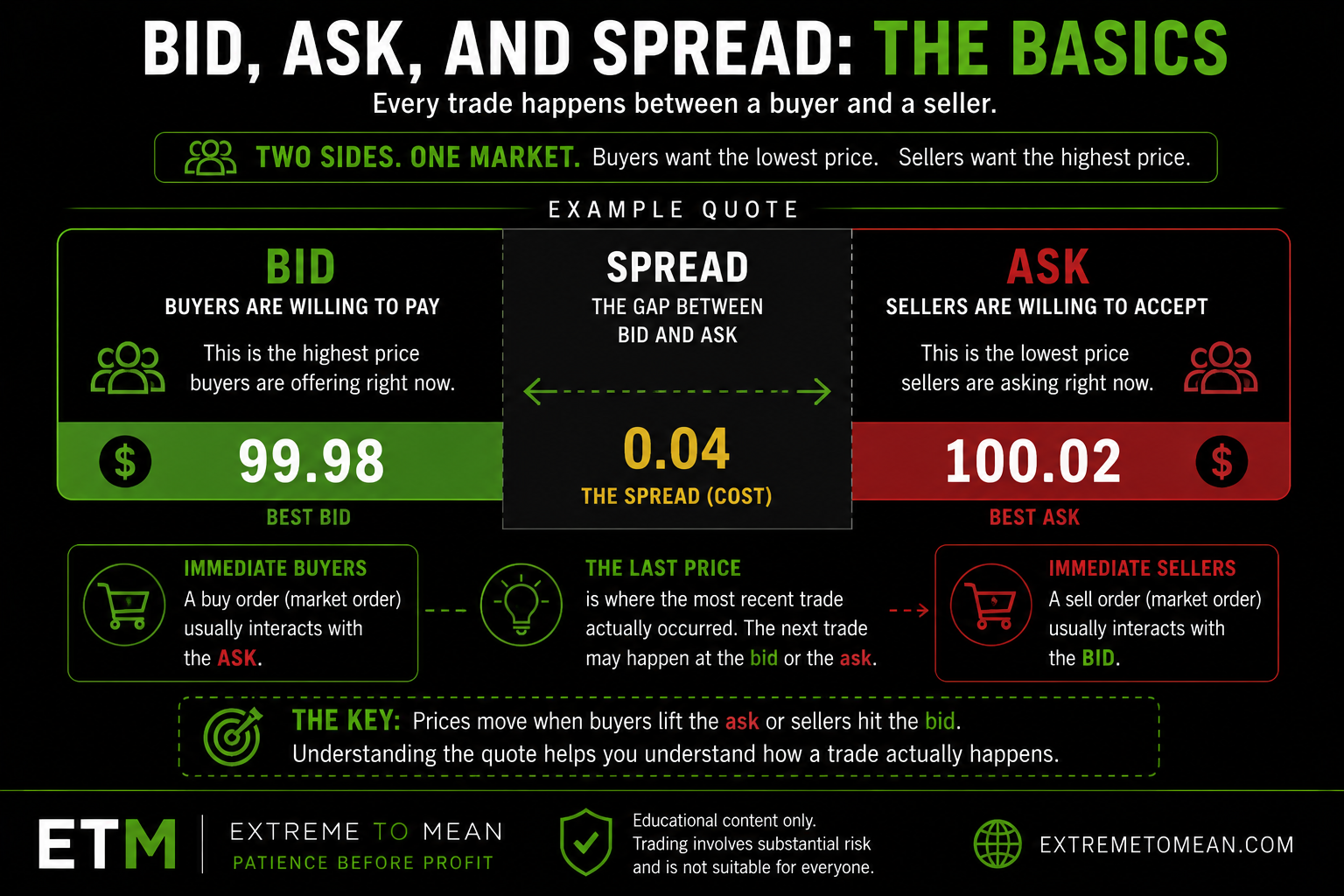
The bid is the price buyers are currently willing to pay. The ask is the price sellers are currently willing to accept. These two prices form the basic quote.
For example, imagine a stock quote shows:
- Bid: $99.98
- Ask: $100.02
This means buyers are currently willing to buy at $99.98, while sellers are currently willing to sell at $100.02. The market has not agreed on one single price at that moment. It has two sides: the buying side and the selling side.
A beginner may ask, “So what is the real price?”
The answer depends on what the trader is trying to do. If a trader wants to sell immediately, the bid matters because that is where buyers are waiting. If a trader wants to buy immediately, the ask matters because that is where sellers are waiting. The last traded price may be nearby, but the bid and ask show where immediate buying and selling interest currently sits.
This connects directly to the earlier lesson on buyers, sellers, and price. Price is not created by a chart line. Price is created when buyers and sellers actually interact.
The Bid: Where Buyers Are Willing to Buy
The bid is the highest price that buyers are currently willing to pay.
If the bid is $99.98, that means there are buyers willing to buy at $99.98. If someone wants to sell immediately, they may be able to sell into that bid. This is why traders often say a seller “hits the bid.”
The bid matters because it shows where immediate buying interest exists. It does not mean every seller will get filled exactly there in every situation. It also does not mean the bid will stay there. Quotes can change quickly as orders are added, removed, filled, or adjusted. The DOM, Level 2, and market-depth lesson explains how those resting quotes appear in the order book and why they can disappear before execution.
For beginners, the bid is easiest to understand as the market’s current buying side. It is where someone is saying, “I am willing to buy, but this is the price I am willing to pay right now.”
If a trader owns shares and wants to exit quickly, the bid is important because that is the side where immediate buyers may be waiting. If the bid is far below the last price or moving quickly, the trader should understand that selling may not happen at the number they expected.
This is one reason execution matters. A trader can be correct about direction and still have a poor experience if they do not understand where the market is actually willing to trade.
The Ask: Where Sellers Are Willing to Sell
The ask is the lowest price that sellers are currently willing to accept.
If the ask is $100.02, that means there are sellers willing to sell at $100.02. If someone wants to buy immediately, they may be able to buy from those sellers. This is why traders often say a buyer “lifts the ask” or “takes the offer.”
The ask matters because it shows where immediate selling interest exists. It is the price at which sellers are currently offering supply to buyers. Like the bid, it can change quickly as market conditions shift.
For beginners, the ask is the market’s current selling side. It is where someone is saying, “I am willing to sell, but this is the price I am willing to accept right now.”
If a trader wants to enter a long position quickly, the ask is important because that is where immediate sellers may be available. If the ask is much higher than the bid, the trader needs to understand that buying immediately may mean paying a higher price than the number they first noticed on the chart.
This does not make the ask good or bad. It is simply part of how the market works.
A trader who understands the ask is less likely to be surprised when a buy order fills above the bid or above the last traded price. The order did not necessarily malfunction. The trader may have simply paid the available selling price.
The Spread: The Gap Between Bid and Ask
The spread is the difference between the bid and the ask.
If the bid is $99.98 and the ask is $100.02, the spread is $0.04. That four-cent gap is the distance between the best current buying price and the best current selling price.
The spread matters because it affects execution.
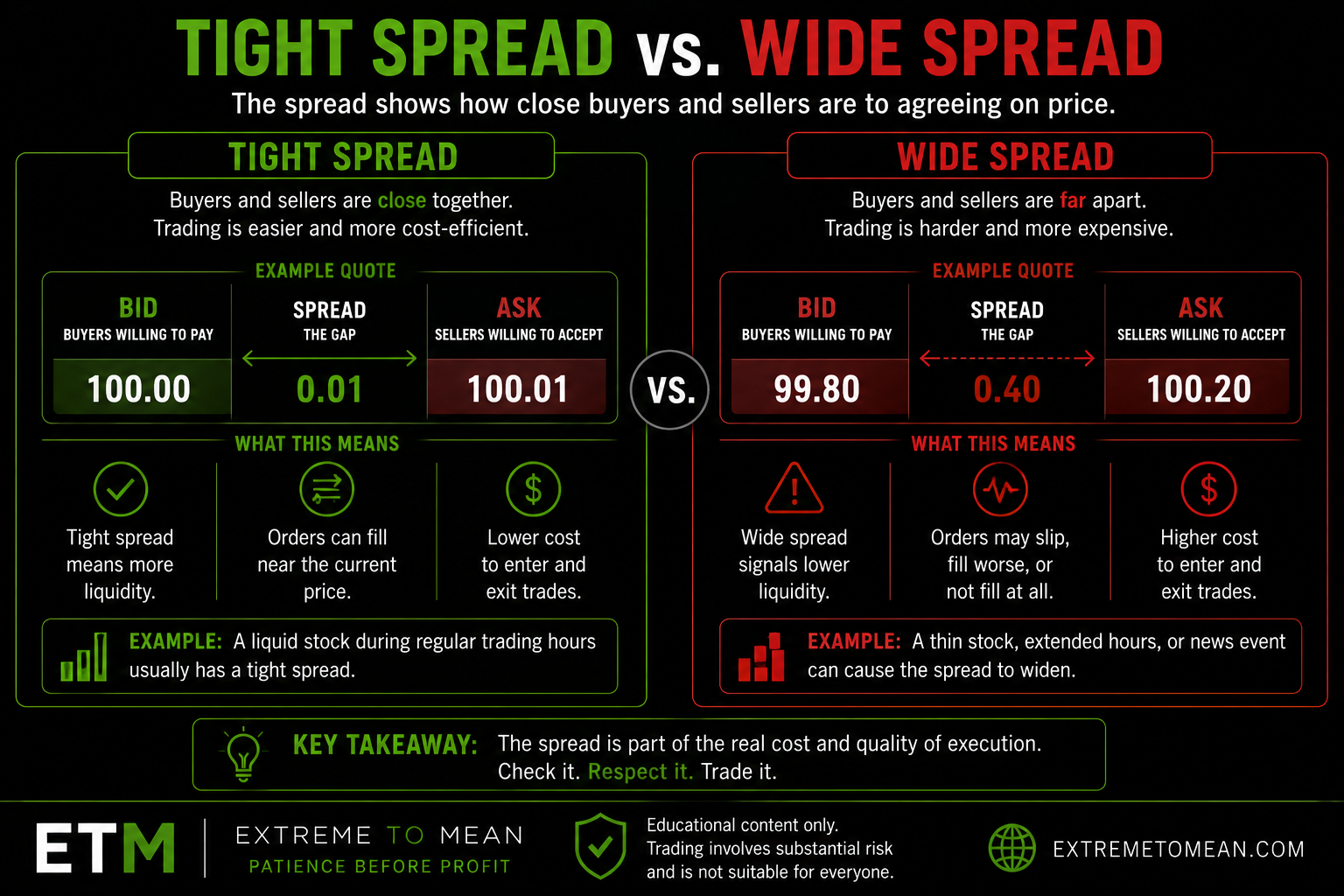
In a liquid market, the spread is often tight. That means the bid and ask are close together. A tight spread can make it easier for buyers and sellers to trade near the current market price. In a less liquid market, the spread may be wider. That means buyers and sellers are farther apart, and trading immediately may come with a larger difference between where someone can buy and where someone can sell.
This connects directly to the prior lesson on what volume and liquidity mean. Liquidity affects how easily buyers and sellers can trade. The spread is one visible clue about that environment.
A wide spread does not automatically mean a trader cannot trade. But it does mean the trader should slow down and understand what the quote is saying. A wide spread can make entering or exiting more expensive than expected. It can also make the chart price feel cleaner than the actual trading experience.
This is why the better question is not, “What is the price?”
The better question is, “What are the bid and ask, and how wide is the spread?”
That question brings the trader closer to the real execution environment.
Why the Last Price Is Not Always the Price You Get
Many chart platforms show a last price.
The last price is the most recent price where a trade actually occurred. It is useful, but it is not the same as a promise that the next trade will happen there. The next available buy or sell price may be different depending on the bid, ask, liquidity, and order flow at that moment.
This is one of the first execution surprises beginners face. They see the last price at $100.00, click buy, and get filled at $100.02. Or they see a price on the chart, click sell, and get filled slightly lower. That difference may be small in liquid products, or it may be more noticeable in thin products, fast conditions, or wide-spread markets. That gap is the next execution layer: why the fill price can be different from the quote.
The order type also matters. A market order tells the broker to execute as soon as possible at the best available price. A limit order sets a specific price or better, but it may not fill if the market does not trade there. This article is not a full order-type lesson, but beginners should know that the order ticket is not just a button. It is how the trader interacts with the bid, ask, and spread. The next step is understanding how market, limit, and stop orders work.
The mistake is assuming the chart price, last price, bid, ask, and fill price are all the same thing.
They are related, but they are not identical.
That is why a trader should understand the quote before acting. The chart helps show movement. The quote helps show where trading is currently available.
Why Spreads Can Change
Spreads are not fixed.
A spread can tighten or widen depending on liquidity, volatility, time of day, news, product type, and participation. A heavily traded stock during the regular session may have a tight spread most of the time. A thinly traded stock after-hours may have a much wider spread. Futures, ETFs, options, and stocks can all have different spread behavior.
Session matters too. During pre-market or after-hours trading, there may be fewer participants. With fewer buyers and sellers available, spreads may widen. During the regular session, participation is usually broader, but spreads can still change quickly around news, economic reports, or fast market movement.
The earlier lesson on what a trading session actually is helps explain why the environment can change across the day. A quote at 8:00 a.m. may not look like a quote at 10:00 a.m. The market may be the same, but the participation may be different.
Spreads can also widen when uncertainty rises. If buyers lower their bids and sellers raise their asks, the gap between them grows. That can happen when traders are unsure how to price new information or when conditions are moving too quickly for stable quoting.
A beginner might see a moving chart and assume the trade is easy to enter. But if the spread is wide, the entry may be less clean than it looks. This is why execution quality is part of decision quality.
Bid, Ask, Spread, and Trade Direction
Bid and ask also connect to whether a trader is buying or selling.
If a trader wants to go long immediately, they usually interact with the ask because they are buying from sellers. If a trader wants to exit a long immediately, they usually interact with the bid because they are selling to buyers.
If a trader wants to go short immediately, they may also sell into the bid, depending on product rules and broker permissions. If a trader wants to cover a short position immediately, they may buy at the ask. The exact rules can vary by product and account type, but the direction logic is still tied to buying and selling.
The lesson on long and short trade direction explains the directional side of the trade. Bid and ask explain the execution side.
This matters because a trader can understand direction and still misunderstand execution. They may be right that a trade needs price to rise, but they still have to know what price they are paying to enter. They may be right that they want to exit, but they still have to know where buyers are available.
Direction answers, “Which way does this trade need price to move?”
Bid, ask, and spread answer, “Where can this trade actually happen right now?”
Both questions matter.
A Simple Bid, Ask, and Spread Filter
Before placing an order, a beginner should pause and read the quote.
Start with these questions:
- What is the current bid?
- What is the current ask?
- How wide is the spread?
- Am I buying, selling, entering, or exiting?
- If I need immediate execution, which side of the quote am I likely to interact with?
- If I use a limit order, am I willing to wait or possibly not get filled?
- Is the spread normal for this product, or unusually wide?
- Is this happening during regular hours, extended hours, or a fast news event?
- Does the quote support a clean decision, or am I rushing?
These questions are simple, but they protect beginners from treating execution as an afterthought.
The better question is not, “Can I place the trade?”
The better question is, “Do I understand where this trade can actually execute, and does that still fit the decision I am making?”
That is part of Patience Before Profit. The trader does not only study the chart and react. The trader checks the environment, the quote, the spread, and the risk before acting.
For newer readers, the best next step is to start with the beginner trading path before moving deeper into order types, slippage, and execution quality.
Final Thought
Bid, ask, and spread are basic parts of every market quote.
The bid is where buyers are willing to buy. The ask is where sellers are willing to sell. The spread is the gap between them.
A chart may show price movement, but the quote shows where trading is currently available. If the spread is tight, the market may be easier to trade near the current price. If the spread is wide, the trader needs to understand that immediate execution may be less clean.
The better trader does not ask only, “What does the chart show?” The better trader asks, “Where are buyers, where are sellers, how wide is the spread, and does this quote support a clean decision?”
That is how bid, ask, and spread become part of a better trading process.
The next step is understanding why the spread is part of the real trading cost.
Educational content only. Trading involves substantial risk and is not suitable for everyone.