
Traders naturally look for repetition because recognizable patterns make the market easier to organize. Pullbacks, breakouts, failed moves, rejection candles, and reversion signals give names to what is happening on the chart. Those names can help a trader identify behavior quickly, but they can also create false confidence when recognition is mistaken for qualification.
A trader may see a familiar pattern and assume that the same action should follow every time it appears. That assumption ignores the environment in which the pattern formed and the conditions the trade would need to survive. The visible setup may repeat, but the structure, location, volatility, and available opportunity around it can be entirely different.
A bullish candle near the lower boundary of a balanced range is not the same trade as an identical candle after an extended rally directly beneath resistance. A pullback during an orderly trend is not the same trade as a pullback inside overlapping chop. A breakout supported by strong participation is not the same trade as a breakout occurring during thin, unstable conditions.
The trader’s job is therefore not simply to recognize the pattern. It is to determine what that pattern means in the market that is actually present and whether a complete trade can be built around it. The broader market structure and context curriculum develops this distinction by treating setups as parts of an environment rather than isolated instructions.
The Setup Is Only the Visible Part
A setup is a recognizable arrangement of price behavior that may deserve evaluation. It could be a pullback, a breakout and retest, failed breakout, rejection candle, double bottom, continuation pattern, or possible move back toward the mean. The pattern describes what price appears to be doing, but it does not determine what the trader should do.
Several unanswered questions remain after the setup is recognized. The trader must determine whether the market is trending, balancing, chopping, or reverting; whether the pattern is aligned with the larger structure; and whether it formed at a location where the decision makes sense. Volatility, available room, invalidation, execution conditions, and the intended trade horizon must also be considered.
Two setups can share the same shape while requiring opposite decisions. One may appear where the dominant structure supports continuation, while the other appears where the market is extended and vulnerable to reversal. One may offer a clear stop and open space toward the target, while the other may sit between nearby obstacles with no practical room to develop.
Pattern recognition should therefore begin the evaluation rather than complete it. The shape earns attention because it may indicate that useful behavior is developing. Context determines whether that behavior can be translated into a clear entry, defined risk, and realistic destination.
The Same Pullback Can Mean Different Things
Consider a simple bullish pullback in which price moves higher, pauses, retraces, and then begins turning upward again. The sequence is easy to recognize, and the final upward reaction may look nearly identical across several charts. The meaning changes according to what the market was doing before the pullback and where the reaction occurs.
In a strong uptrend, the pullback may represent a normal pause within established directional structure. Higher highs and higher lows remain intact, buyers have already demonstrated follow-through, and the retracement has not damaged the area controlling the trend. A renewed upward response may therefore fit the behavior already present in the market.
Inside a balanced range, the same pullback may communicate far less. Price may simply be rotating between two boundaries without sustained control from either side, and a bullish turn near the center may be another temporary reaction within overlapping movement. The pattern is visible, but the location and market state provide little reason to expect durable follow-through.
After an extended advance into major resistance, the pullback may appear too late to offer a useful continuation trade. Most of the available movement may already have occurred, leaving limited room before opposing structure and requiring the trader to accept a poor entry relative to the likely target. A clean trigger cannot restore opportunity that the earlier move has already consumed.
During a high-volatility event, the same pullback may be unstable for an entirely different reason. Expanded candles, rapid repricing, thin liquidity, wider spreads, and inconsistent fills can make ordinary stop placement and position sizing unsuitable. The bullish pullback remains recognizable in all four situations, but each environment changes what the pattern can reasonably support.
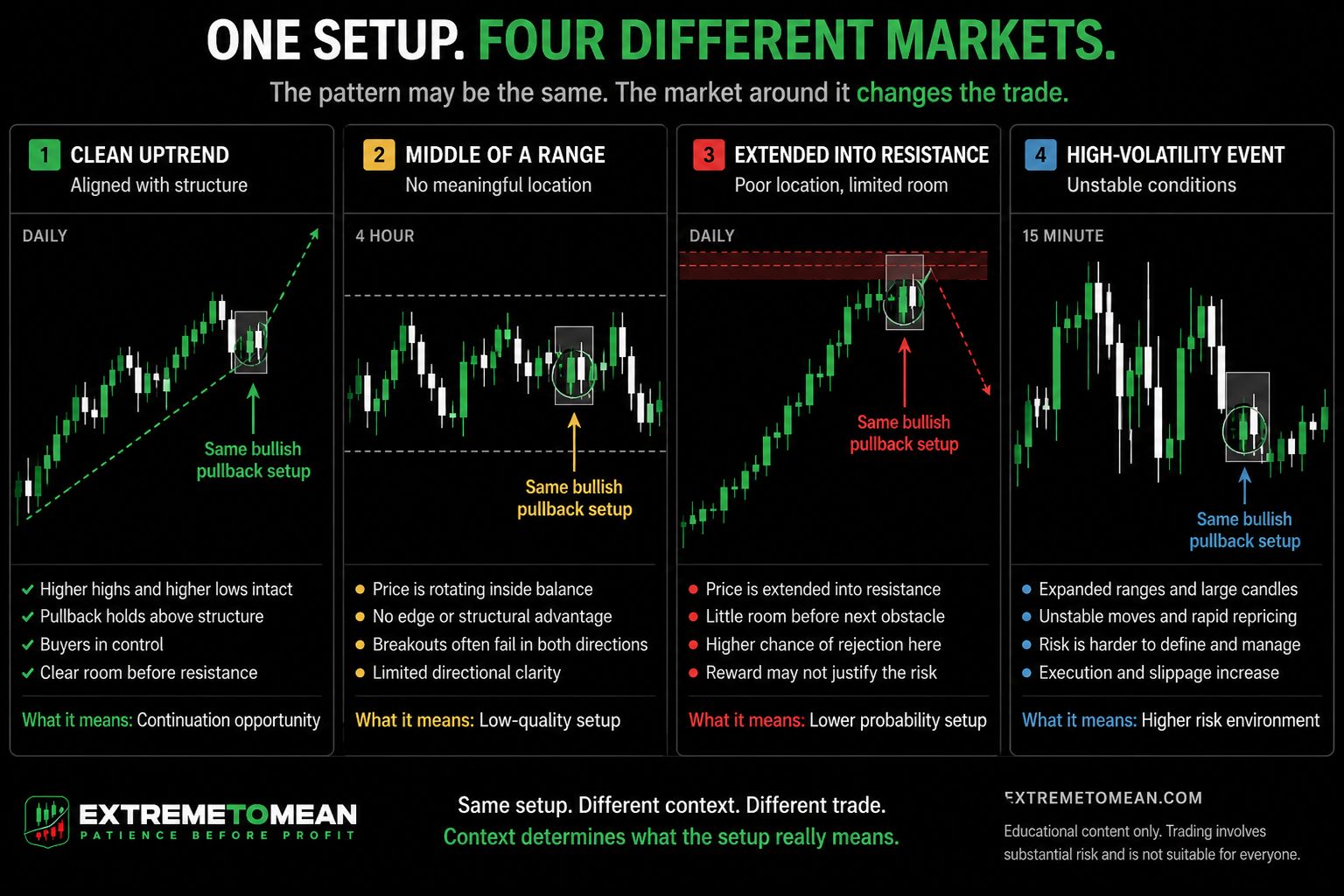
A setup should not be judged by visual similarity alone. The market surrounding the pattern determines whether the pullback represents continuation, ordinary range rotation, a late entry, or unstable event-driven movement. The chart shape may repeat while the trade quality changes completely.
Trend Structure Changes the Directional Meaning
Trend gives a setup directional context. A continuation pattern appearing within clean directional structure should not be evaluated in the same way as an identical pattern fighting the movement that currently controls the market. The setup may look bullish in both cases, but one aligns with established behavior while the other requires that behavior to change.
Suppose price is producing higher highs and higher lows. A bullish pullback that holds above the prior structural low may fit the existing sequence because buyers remain capable of defending higher prices. The trader is evaluating whether the market will resume behavior that has already been demonstrated.
Place the same bullish reaction inside a bearish sequence of lower highs and lower lows, and the decision changes. The move may still produce a temporary bounce, but it is working against the structure that has been controlling price. A countertrend trade may require stronger confirmation, a clearer failure by sellers, and a more conservative expectation for how far the reaction can travel.
This does not mean that every trend-following setup will succeed or that every countertrend trade will fail. It means the trader should know whether the setup is continuing the market’s established behavior or asking the market to become something different. Continuation and reversal are separate ideas, and they should not be assigned the same evidence or expectations.
Market State Changes the Expected Follow-Through
Before judging a setup, the trader should understand the three market states: trend, chop, and reversion. Each state creates different expectations for continuation, failure, and movement away from the entry. A familiar setup can behave very differently depending on which state controls the market.
In a trend, one side of the auction is producing sustained directional progress. Pullbacks may remain contained, breakouts may hold more cleanly, and reactions against the trend may struggle to produce lasting follow-through. A continuation setup can therefore fit the state even though no individual pattern is guaranteed to work.
In chop, neither side maintains control for long. Candles overlap, breakouts fail, momentum disappears quickly, and a pattern that looks clean for several minutes can reverse before meaningful progress develops. A setup that normally benefits from continuation may become unreliable because the surrounding market repeatedly interrupts directional movement.
In a reversion environment, price may stretch away from balance and then rotate back toward it. A strong push that supports continuation during a trend can become vulnerable when it occurs at an emotional or structural extreme. The trader must determine whether the market is building sustained movement or repeatedly returning toward balance.
A breakout is therefore not simply a breakout. It may represent continuation in a trend, an escape from a mature range, a false move inside chop, or a final push at an extreme. The label remains the same, but the expected follow-through changes with the market state.
Location Changes the Opportunity
Location influences what the setup is worth. A bullish rejection at higher-timeframe support carries different information from the same candle in the center of overlapping price action. A breakout with open space ahead is also different from one that runs directly into a major opposing level.
Location affects the available room, clarity of invalidation, likely target, and relationship between risk and potential movement. It can also indicate where other participants may become active and whether the market is approaching an area that previously changed control. A good trigger in a poor location may produce a technically valid entry with little practical opportunity.
Imagine two identical bullish candles. The first forms near major support after sellers fail to continue lower, while the second appears halfway between major support and resistance where neither side has sustained control. The candles look alike, but the first is connected to meaningful structure and the second is surrounded by uncertainty.
This is why location should be the first filter. The trigger can help time the entry, but location helps determine whether the decision deserves attention in the first place. When the pattern forms in an unhelpful area, patience may be more useful than participation.
Volatility Changes the Trade Mechanics
Volatility changes how far and how quickly price normally moves. A setup that can be managed in a calm market may require a different stop, position size, target, and execution plan when movement expands. The same visual pattern does not create the same account exposure under different volatility conditions.
During high volatility, candles may travel farther before pulling back, spreads may widen, and slippage may increase. A stop that normally allows reasonable movement may become too tight, while a familiar position size may create more dollar risk than the trader intended. Targets may also need to reflect greater movement without being placed arbitrarily far away.
Low volatility creates a different problem. Price may move slowly, follow-through may remain limited, and the available reward may not justify the time or risk required. A setup can be visually clean while offering too little movement to overcome costs, nearby obstacles, or the possibility of prolonged stagnation.
The pattern does not adjust itself to current conditions, so the trader must adjust the trade. Stops should reflect the market’s actual movement, position size should reflect the distance to invalidation, and targets should be supported by available structure. Context changes the mechanics of the decision, not merely its appearance.
Timeframe Changes Which Movement Controls the Trade
A setup can look bullish on one timeframe and bearish on another without either chart being wrong. The charts may simply be showing different layers of the same market. A three-minute breakout can be developing beneath hourly resistance, while a fifteen-minute reversal may be only a routine pullback within a daily uptrend.
The smaller timeframe reveals immediate movement, while the larger timeframe shows where that movement is occurring. As explained in why context comes before the candle, a pattern gains meaning from what surrounds it. Multi-timeframe analysis extends that principle by distinguishing the chart used for execution from the chart controlling the larger decision.
The controlling timeframe should match the intended trade. A scalper may act on a short reaction that a swing trader considers ordinary noise, while a swing trader may tolerate movement that would invalidate an intraday setup. The same chart event can therefore be meaningful to one plan and irrelevant to another.
Problems begin when the setup is borrowed from one horizon and managed according to another. A trader may enter from a small chart, ignore that chart’s invalidation, and then appeal to a larger timeframe to justify remaining in the position. The timeframe hierarchy should be defined before entry rather than changed when the original plan becomes uncomfortable.
Available Room Changes Whether the Setup Is Usable
A setup can be structurally valid and still offer too little space to justify a trade. The next support, resistance area, range boundary, prior high, prior low, or other obstacle may sit too close to the proposed entry. When that happens, the market may be capable of moving in the expected direction without providing enough practical opportunity.
Suppose a bullish setup appears directly beneath resistance. The trigger may be clean, the trend may be upward, and buyers may still produce a small continuation. The trade can nevertheless be unattractive because the stop must sit farther away than the realistic movement available before resistance.
Moving the target beyond the obstacle does not solve that problem unless the market structure supports a break and continued movement. A target should reflect a reasonable destination rather than the number required to make the trade appear worthwhile. When available room is limited, the correct decision may be to wait for a better location or stand aside.
This is one reason identical setups can receive different decisions. One pattern may appear with open space and a clear structural target, while the other appears after most of the opportunity has already passed. The entry signal is similar, but the trade being offered is not.
Invalidation Changes the Quality of the Risk
A setup does not become tradable until the trader can explain what behavior would make the idea wrong. Invalidation should be connected to the market structure supporting the trade rather than placed at a convenient dollar amount. Without that boundary, the trader cannot calculate position size or evaluate the full exposure.
Two identical patterns may require very different stops. One may form near a clear structural boundary that allows invalidation to be defined tightly and logically. Another may develop inside loose, overlapping movement where the appropriate stop would be wide or unclear.
A wider stop does not automatically make the second setup unusable, but it changes the position size and the amount of room needed for the trade to make sense. If the trader keeps the same size simply because the trigger looks familiar, the account risk may be much larger than intended. The pattern has not changed, but the trade construction has.
Definable risk is therefore part of setup quality. A recognizable trigger without a clear invalidation point remains an observation rather than a complete decision. The setup earns participation only when the trader can identify both why it may work and what would show that it is not working.
Why Fixed Signals Feel Attractive
Treating setups as fixed signals makes trading appear simpler. The pattern appears, the trader enters, a familiar stop is placed, and the same general outcome that followed the pattern before is expected to happen again. This sequence reduces uncertainty, which is why it can feel appealing.
The market does not produce every pattern under identical conditions. A fixed-signal mindset allows the trader to skip harder questions about market state, structure, location, volatility, available room, and risk. The pattern becomes an answer before the complete problem has been examined.
When the trade fails, the trader may blame timing, execution, or discipline without considering whether the setup appeared in an unsuitable environment. They may continue searching for a more precise trigger even though the larger weakness came from context. Familiarity made the pattern feel valid, but familiarity is not qualification.
This does not make patterns useless. A setup provides a repeatable starting point and tells the trader which behavior may deserve closer examination. Its value comes from supporting an evaluation process rather than replacing one.
Use a Context-First Evaluation
A cleaner process begins by identifying the environment before judging the setup. The trader should determine what state the market is in, which structure controls the decision, and whether the pattern is appearing at a useful location. Only then can the entry signal be interpreted properly.
Volatility, available room, and invalidation should be considered next. The trader needs to know whether ordinary movement can be accommodated, whether a realistic target exists, and whether the account risk can be controlled through appropriate position sizing. A setup that cannot answer those questions has not yet become a complete trade.
The timeframe and intended holding period must also remain consistent with the entry, stop, target, and management plan. A scalp should not become a swing trade merely because the planned exit was missed, and a short-term invalidation should not be ignored because a larger chart still appears favorable. The trade should retain the identity assigned before risk was accepted.
A practical context-first review should answer:
- Market state: Is price trending, chopping, balancing, or reverting from an extreme?
- Structure: Is the setup aligned with the behavior currently controlling the market?
- Location: Is the pattern forming at meaningful support, resistance, a range boundary, or another useful area?
- Volatility: Do the stop, position size, and target fit current movement and execution conditions?
- Available room: Is there enough realistic space before the next meaningful obstacle?
- Invalidation: What market behavior would prove the idea wrong?
- Time horizon: Do the timeframe, holding period, and management rules describe one consistent trade?
These questions are not intended to make every decision complicated. They prevent a familiar pattern from receiving automatic authority and help the trader reject setups that cannot support a complete plan. The objective is to slow the decision enough to distinguish recognition from qualification.
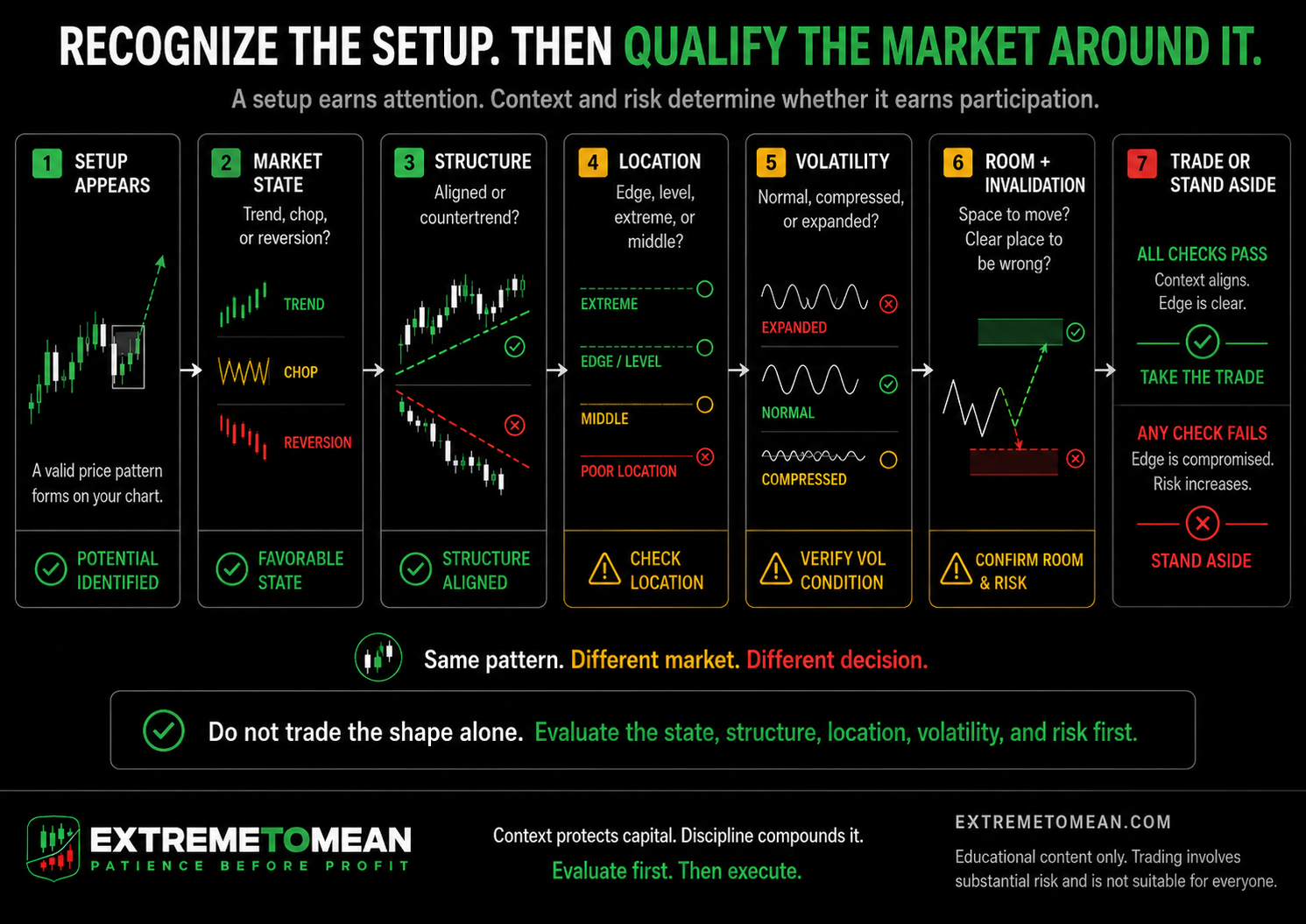
The better question is not merely whether the trader recognizes the setup. It is what the setup means in this market, at this location, under these conditions, and whether the resulting risk can be defined. That question forces the trader to evaluate rather than react.
The related lesson on how market conditions change the quality of a setup develops why technically similar opportunities do not deserve equal risk.
Traders building a repeatable review process can also use the free trading tools and checklists to organize context, entry, invalidation, and exposure before participating.
Final Thought
The same pullback, breakout, candle, or reversion signal does not always create the same trade. Trend structure changes the directional meaning, market state changes the expected follow-through, location changes the opportunity, volatility changes the mechanics, and timeframe changes which movement controls the decision.
Recognizing a setup may earn attention, but it does not automatically earn participation. The surrounding market must still provide useful structure, meaningful location, realistic room, and definable risk. A familiar pattern that cannot support those elements remains an observation rather than a qualified trade.
Evaluate the environment before acting on the signal. Determine what the setup means inside the market that is present, then decide whether the complete trade deserves risk. When the context does not support participation, waiting is part of the process.
Educational content only. Trading involves substantial risk and is not suitable for everyone.