
A breakout answers one important question: can price escape the structure that was containing it? Once price moves beyond the old boundary, the first retracement shows how the market behaves when that new area is challenged. A trader who waits for that test is evaluating more information than a trader who reacts to the initial breakout candle.
This is why the first pullback is attractive and dangerous at the same time. Breakout, retracement, and possible continuation can look clean enough to feel objective. The mistake is treating the sequence itself as proof of quality; the first pullback describes what happened next, not whether the setup deserves risk.
What the First Pullback Actually Tests
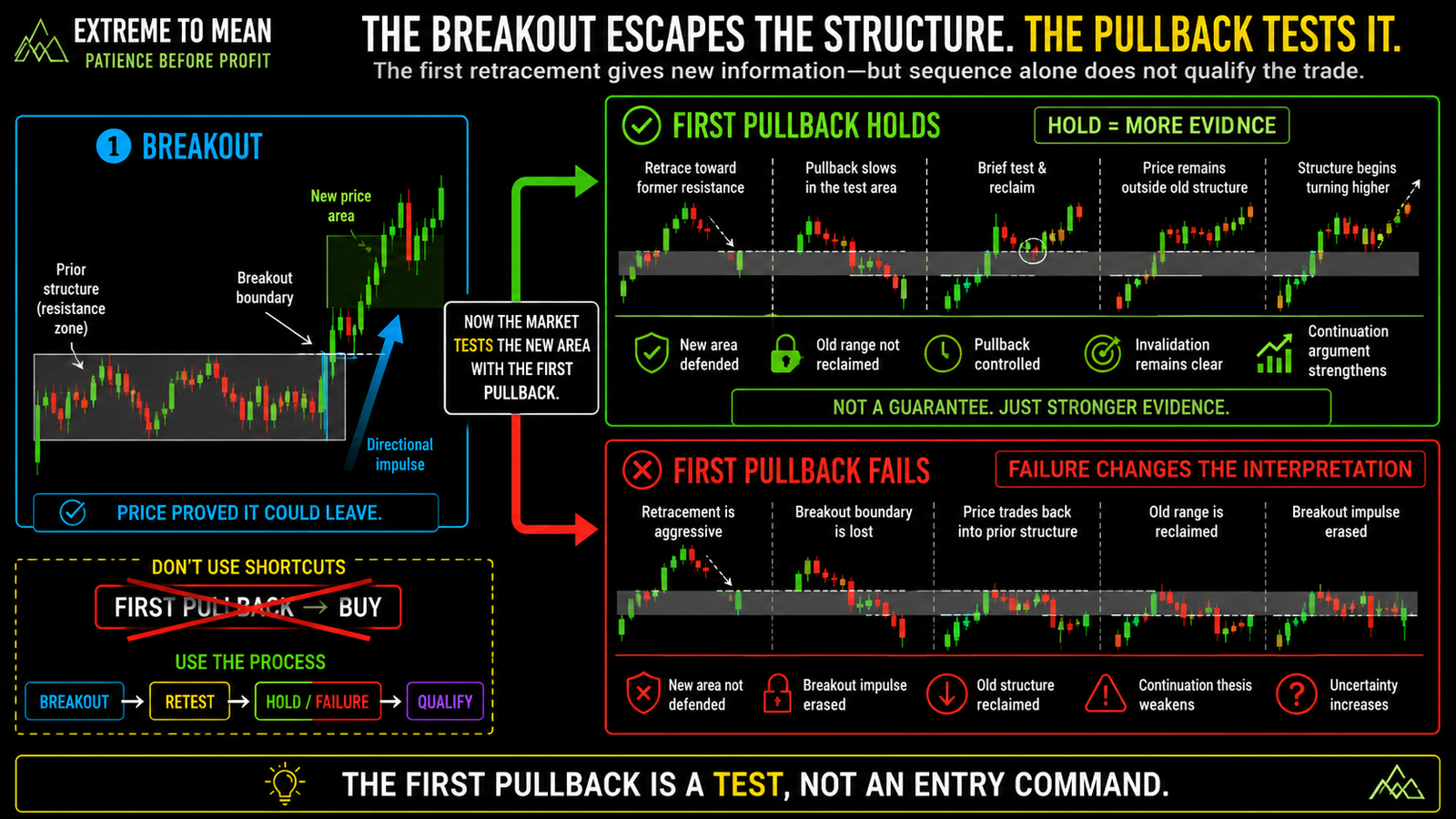
In a bullish breakout, price moves above prior resistance or another meaningful structural boundary and then retraces toward the area it just left. If buyers continue to transact above that old boundary, absorb the retracement, and prevent a meaningful return into the prior structure, the pullback provides evidence that the breakout is being defended. A bearish breakout uses the same logic in reverse. The useful information comes from how price behaves during the test, not from the fact that a pullback occurred.
This makes the setup a natural extension of The Setup curriculum. The breakout establishes a possible structural change, while the retracement asks whether that change is holding under pressure. A successful retest can strengthen the continuation argument and a failed retest can weaken it, but neither outcome is guaranteed.
Chasing the Breakout and Trading the Retest Are Different Decisions
A breakout entry and a first-pullback entry may express the same directional idea, but they are not the same decision. The breakout trader commits while price is expanding away from old structure, often before knowing whether the move will be accepted. The pullback trader waits for additional information about how price behaves when it returns toward the breakout area, accepting that a clean retracement may never come.
The weaker decision feels reasonable because fast movement creates urgency. If price has just broken a visible high and accelerated, waiting can feel like volunteering to miss the trade. That emotion can make an extended entry look safer than it is simply because momentum is obvious. The discipline is not “always wait for a pullback,” but to recognize that a setup is not a signal and that a breakout candle alone does not finish the qualification process.
A Qualified First Pullback Starts With a Real Breakout
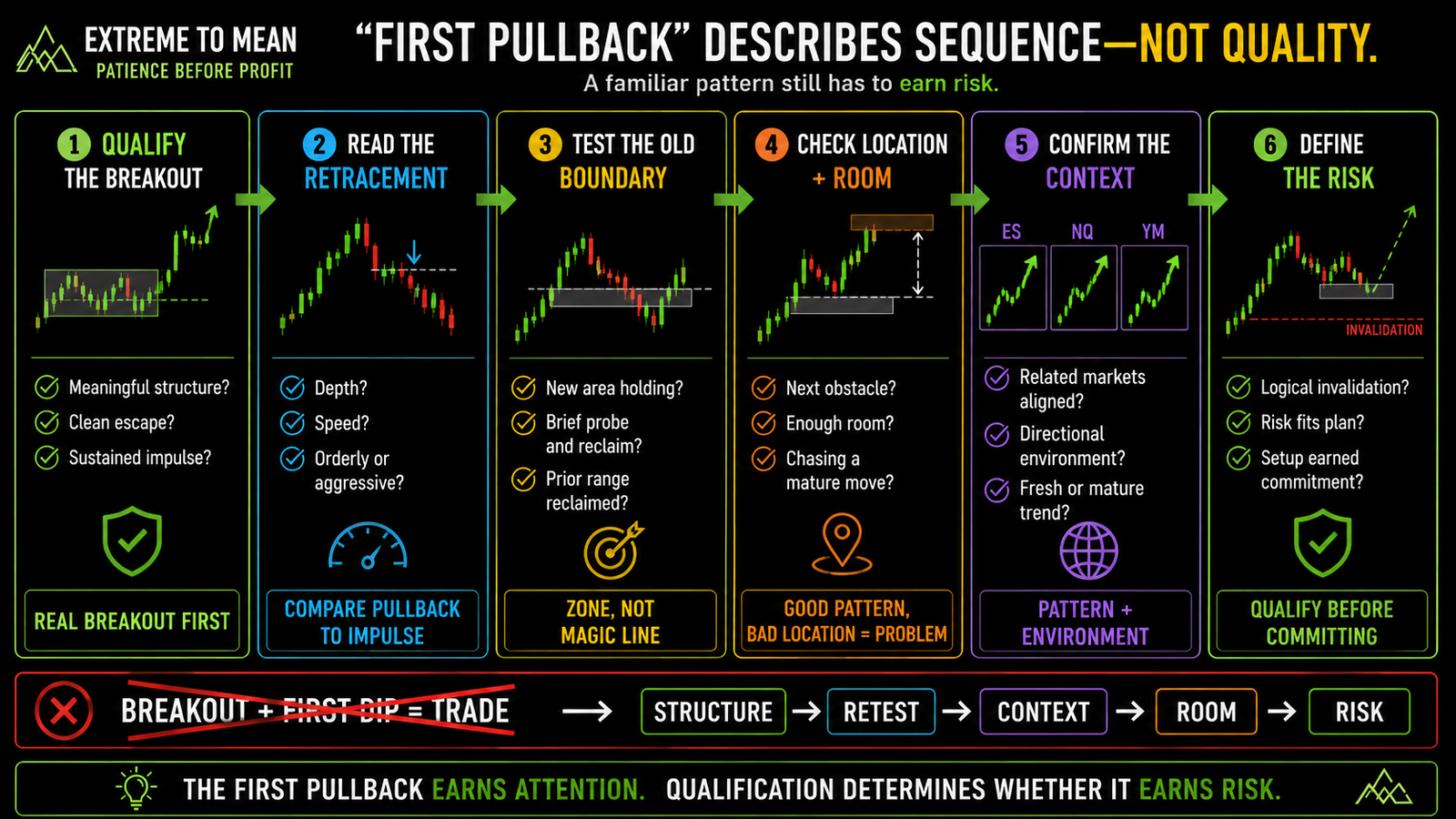
The quality of the retracement begins with the quality of the move that came before it. A clean impulse that leaves a well-defined balance or structural boundary with sustained movement provides a different backdrop from a one-candle poke above resistance that immediately stalls. The trader should ask whether price genuinely escaped the prior structure or merely traded through the line for a moment. If the breakout itself is weak or ambiguous, calling the next dip a high-quality “first pullback” gives the sequence more meaning than the market has earned.
Freshness also matters. A first retracement after a newly developing structural break is different from one that occurs after several extensions and repeated retests. Later in a trend, the same visual pattern carries different location and exhaustion risk. “First pullback” should refer to the first meaningful retracement after the specific breakout being evaluated, not the first countertrend candle noticed after price has already traveled far.
Depth and Speed Change the Meaning of the Retest
A shallow or orderly pullback can suggest limited countertrend pressure, but shallow does not automatically mean strong. A fast pullback can reveal stronger opposition, especially if it erases the breakout impulse quickly. The useful comparison is between the character of the breakout and the character of the retracement.
Depth needs the same contextual treatment. A pullback that tests the breakout area and stabilizes can preserve the structural change, while one that drives deeply through the old boundary and reclaims the prior range is challenging the continuation thesis. There is no universal percentage that separates a healthy pullback from a reversal across every market and timeframe. The cleaner question is whether the retracement is still behaving like a test of new structure or is beginning to undo the structure that made the breakout meaningful.
The Old Boundary Is a Test Area, Not a Magic Line
Technical analysis often describes former resistance becoming support after an upside breakout, with former support becoming resistance after a downside break. That is useful as a framework, but real markets do not have to reverse at the exact prior price. The retest may hold above the level, probe through it briefly, or use a broader zone, so treating the area as a test zone avoids pretending the line must hold to the tick.
What matters more is whether price can remain functionally outside the old structure. A brief probe back through the level followed by a reclaim may preserve the breakout, while sustained trade back inside the prior range can weaken it materially. The trader should define in advance what would count as normal testing and what would represent structural failure. Otherwise, a failed breakout can be relabeled indefinitely as “just a deeper pullback.”
Room and Risk Still Decide Whether the Setup Is Tradable
Even a clean breakout and successful first retest can occur in a poor location. Another major obstacle may sit immediately ahead, leaving limited room for the trade to develop. The pattern can be technically recognizable without offering a clean relationship between entry, invalidation, and the next obstacle, which is why room to revert or extend still matters.
Risk definition matters for the same reason. If the only logical invalidation point is so far away that the trade no longer fits the trader's plan, the first pullback has not solved the problem. A cleaner entry location can make risk easier to define, but it does not make every risk acceptable. The broader rule remains that the trade is not ready until the risk is clear.
Broader Market Confirmation Can Strengthen—or Weaken—the Read
For equity-index futures, a breakout in one contract can be evaluated alongside related markets. If ES breaks meaningful structure, retests successfully, and NQ and YM show compatible behavior, the continuation interpretation has broader support than an isolated ES move. Divergence does not guarantee failure, and cross-market confirmation should strengthen an interpretation rather than become another mechanical trigger.
The broader market state matters too. A first pullback during a freshly developing directional session is different from the same pattern inside a choppy range where breakouts repeatedly fail. Volatility, time of day, nearby session references, and whether significant movement has already occurred can all change the quality of the setup. The pattern can look identical while the conditions surrounding it are materially different.
A Cleaner First-Pullback Qualification Process
Start by identifying the structure that actually broke and whether the breakout was meaningful enough to deserve continued attention. Then evaluate the first retracement for speed, depth, behavior around the old boundary, and whether price is holding outside the prior structure. Add available room, a logical invalidation point, broader market confirmation, and the maturity of the directional move. Only after those pieces align should “first pullback” move from a sequence description toward a qualified setup.
This process also prevents patience from becoming passivity. Waiting for a retest is not about insisting that every move return to the exact breakout level; it is about allowing the market to answer another question before risk is committed. If price never offers a qualified pullback, that does not justify inventing a lower-quality entry simply because the market continued without you.
Better Questions Before Trading the First Pullback
The best review questions force the trader to separate pattern recognition from trade qualification. They should make it possible to explain why this specific pullback deserves attention beyond the fact that it happened first. If the answers depend mostly on urgency, hope, or the visual familiarity of the pattern, the setup probably needs more evidence. A cleaner process can be reviewed after the fact without changing the rules to match the outcome.
- What meaningful structure actually broke?
- Was the breakout decisive or merely a brief move through the level?
- Is this truly the first meaningful retracement after that breakout?
- How deep and how fast is the pullback relative to the breakout impulse?
- Is price holding the new area or reclaiming the old structure?
- Is there enough room before the next meaningful obstacle?
- Where is the logical invalidation point?
- Are related markets and broader conditions supporting the continuation idea?
- Is the trend freshly developing or already mature?
- Has the pullback earned risk, or does it only look familiar?
These questions make the setup easier to review because they turn “I bought the first pullback” into a record of specific evidence. Over time, the trader can compare qualified pullbacks with failed ones and identify which contextual differences mattered most in their own process. That improves consistency of evaluation without assuming that any combination of factors guarantees continuation. The purpose is better decision quality, not a promise about the next price move.
Final Thought
The first pullback matters because it is the market's first meaningful test of what the breakout changed. The breakout shows that price could leave old structure; the retracement shows whether that new area can withstand pressure when price comes back toward it. A hold can strengthen the continuation case, while a reclaim of prior structure can weaken it. That makes the pullback informative, but information still has to be qualified.
Do not trade the sequence just because it has a familiar name. Evaluate the breakout, the retest, the surrounding market, the available room, and the risk before committing. For a deeper framework on reading structure and context together, Decode the Market is the natural next step. “First pullback” describes sequence, not quality; the setup still has to earn risk.
A complementary lesson on trading the retest without chasing the breakout focuses more closely on acceptance and failure at the broken level.
Educational content only. Trading involves substantial risk and is not suitable for everyone.