
Sometimes the hardest trade to evaluate is the one you already want. You may prefer the long, believe the market has gone too far, want another chance at a move you missed, or feel certain that a reversal is coming. None of those feelings automatically makes the trade wrong, but none of them makes it qualified either.
Preference is not evidence.
A trader can prefer a direction, setup, entry, or market narrative without that preference becoming a valid reason to risk capital. The cleaner process is OBSERVE → QUALIFY → DECIDE → ACCEPT OUTCOME. Trouble begins when the process becomes WANT → SEARCH FOR SUPPORT → IGNORE CONFLICT → ENTER.
That distinction belongs inside the broader Trader curriculum because emotional discipline is not about becoming indifferent to every market outcome. The trader can have an opinion and still evaluate honestly. The market does not care which trade would feel most satisfying to take.
Wanting a Trade Is Not the Same as Having One
Preference answers one question: What do I want? Evidence answers another: What is actually here? Those two answers may agree, but the first cannot substitute for the second.
You might prefer a long because you missed the previous rally, have been bullish since premarket, like the way the setup normally looks, or already imagined where the target could be. You might want a short because price seems too extended or because you called the reversal earlier. Those thoughts may explain why the opportunity has your attention, but they do not tell you whether the current trade qualifies.
The practical goal is not to eliminate preference. It is to identify it clearly enough that you stop mistaking it for market information. Know what you want, then require the market to earn the trade anyway.
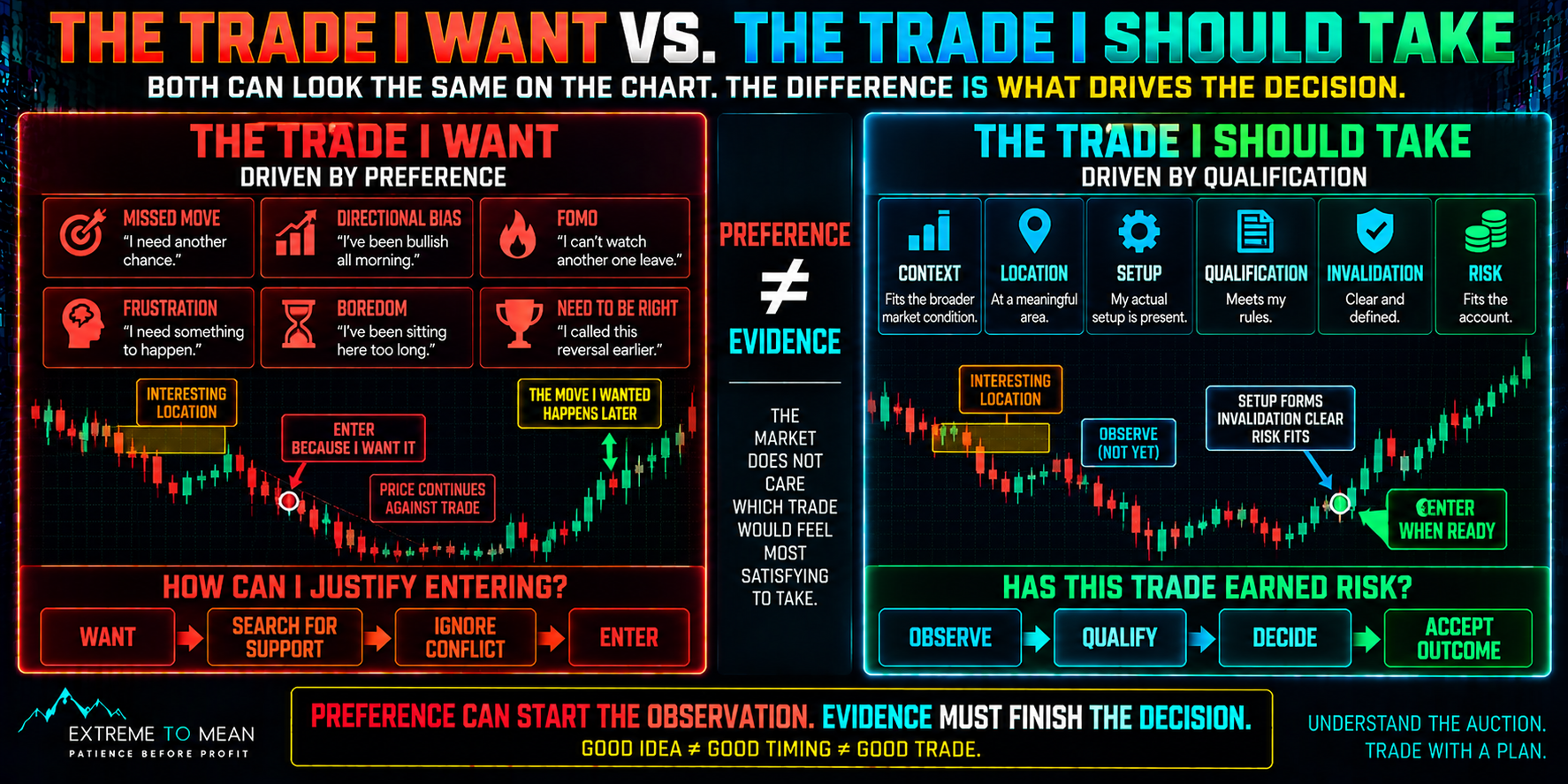
The Trade You Want May Be Solving an Emotional Problem
Sometimes a desired trade is doing more than expressing market analysis. It may be promising relief from something uncomfortable: a missed move, a previous loss, boredom, frustration, FOMO, or the need to prove that an earlier market read was right. Taking the trade begins to feel as though it would solve the feeling.
That is an important warning because emotional relief can make a mediocre setup feel unusually important. A trader who missed the first rally may desperately want the next pullback long, while a trader who just lost on a short may suddenly see another short as the chance to get the money back. When a trade starts solving an emotional problem, qualification becomes harder to judge honestly.
This connects directly to why waiting can feel like losing. Missing one move can make the next opportunity feel as though it deserves a lower admission standard. It does not: missing the first trade does not improve the quality of the second one.
Once You Want the Trade, Supporting Evidence Gets Louder
Suppose you want to short. A weak candle looks bearish, a small rejection looks bearish, nearby resistance looks important, and a divergence suddenly feels convincing. None of those observations necessarily has to be false for the analysis to become distorted.
The problem appears when conflicting information gets quieter. Perhaps the broader trend remains strong, prior shorts have failed, location is poor, the market is still accepting higher prices, or invalidation is unclear. Once the desired conclusion is already chosen, analysis can become a search for enough evidence to defend it.
A useful review question is: “Am I asking whether this trade qualifies, or am I asking whether I can find enough evidence to justify the trade I already want?” That distinction turns analysis back into evaluation. The trader's job is not to build the strongest argument for a preferred conclusion; it is to test whether that conclusion survives the evidence against it.
Bias Can Guide Attention Without Giving Permission
Having a directional bias is not automatically a problem. A trader may reasonably say, “I currently favor higher prices,” and use that working thesis to organize what they are watching. Bias becomes dangerous only when it silently becomes permission.
A bullish trader can still pass on every long setup all morning. Location may be poor, price may already be extended, the actual setup may never form, or the available risk may not fit. Bias can tell you what you are watching for; it cannot tell you that what you are watching for has arrived.
The same applies to strategy preference. A mean-reversion trader may understand fades extremely well, but today's market can remain strongly directional; a breakout trader can prefer expansion while the current auction stays balanced and messy. Your preferred trade style still has to wait for its preferred conditions.
Watch for the Moment Your Standards Start Changing
One of the clearest signs of attachment is that the qualification standard changes after the trader begins wanting the trade. Before attachment, the rule might be “I need A + B + C.” After attachment, A suddenly feels sufficient, B looks “close enough,” and C starts seeming optional.
That is the behavioral tell. The market did not necessarily improve; the trader simply became more motivated to participate. Did the setup improve—or did my standards weaken?
Another useful question is: “Would I accept this exact setup if I did not already want the trade?” If the answer is no, desire may be doing work that evidence was supposed to do. Protecting your next decision sometimes means protecting your standards from the trade you most want them to approve.
Wanting the Direction Does Not Improve the Location
Desire can make poor location feel acceptable. A trader wants the long, sees price already extended, and knows the plan normally calls for a better area—but begins thinking, “It probably isn't coming back.” Urgency has now replaced location.
The mirror image happens with shorts. Price rallies farther than expected, the trader becomes uncomfortable buying at those prices, and that discomfort gets translated into “I should short.” But “I don't want to buy up here” is not the same thing as “I have a short.”
Location remains a filter whether the trader loves the direction or not. Wanting the direction does not improve the location, and conviction does not repair a trade whose entry, invalidation, or available room has deteriorated.
Conviction Does Not Reduce Dollar Risk
The more appealing a trade feels, the easier it can become to rationalize worse terms. A wider stop seems acceptable because “this one needs room,” a poorer entry seems worth it because “it is about to go,” and unclear invalidation gets tolerated because the directional thesis feels unusually strong. Confidence in the outcome begins modifying the risk process.
But the trade you feel best about still has to survive the same risk calculation as every other trade. The trade is not ready until the risk is clear, even when the narrative feels compelling. Conviction does not reduce dollar risk.
The imagined winner can make this worse. Once the trader has mentally pictured the entry, move, and target, future profit begins to feel partly owned before the trade is even structurally valid. The more vividly you imagine the winner, the easier it becomes to stop evaluating the entry.
Missing a Move Can Create a Second, Worse Trade
Imagine NQ rallies strongly during the first part of the session, but your actual setup never appears. You correctly remain flat, yet the missed move is frustrating. When NQ finally begins pulling back, the thought arrives: “This is my chance.”
The problem is that the pullback itself is mediocre. Location is not especially good, structure has not stabilized, momentum remains weak, and invalidation is unclear, but every small bounce feels like confirmation because you already want another chance at the rally. You buy, the pullback continues, and the trade loses.
Trader B sees the same pullback and wants the same long, but separates WANT from NEED. WANT is simple: long; NEED remains location, setup, clear invalidation, and acceptable risk. The market never satisfies the second list, so Trader B passes even though the trade would have been emotionally satisfying.
That is the core distinction. The first trader did not take the pullback because it fully qualified; they took it because they emotionally needed the market to offer another chance at the move they had missed. A missed opportunity does not lower the standard for the next opportunity.
Rejecting the Trade You Want Does Not Mean Taking the Other Side
Suppose you came into the morning bullish, but the market begins losing structure, fails to reclaim important areas, and continues showing downside pressure. At some point, the original long idea may no longer deserve attention. Updating that view does not automatically create a short.
The correct decision may still be PASS. Evidence for the preferred trade can be insufficient while evidence for the opposite trade is also insufficient. Rejecting the trade you want does not obligate you to take the other side.
Changing your mind is not weakness when the evidence changed first. But this article is not asking the trader to become reflexively contrarian; the goal is simply to stop treating the original preference as a permanent instruction. A thesis remains an input, not a permission slip.
The Want vs. Should Test
Before taking a trade you feel strongly about, run this separation:
- WHAT TRADE DO I WANT? — Long, short, reversal, continuation, or a specific entry?
- WHY DO I WANT IT? — Evidence, missed move, frustration, bias, boredom, FOMO, or preference?
- WHAT DOES MY PROCESS REQUIRE? — State the actual qualifications without softening them.
- WHAT EVIDENCE DISAGREES WITH ME? — Deliberately look for information that challenges the preferred answer.
- WOULD I TAKE THIS EXACT SETUP WITH NO DIRECTIONAL OPINION?
- IS RISK STILL ACCEPTABLE? — Apply the same invalidation, size, and risk standard as every other trade.
- IF THIS TRADE DISAPPEARS, AM I WILLING TO LET IT GO?
That final question is especially useful. If letting the trade disappear feels intolerable, attachment may already be influencing the decision. A market opportunity should be allowed to fail qualification without requiring the trader to rescue it.
A simple comparison makes the distinction easier:
| I WANT THIS TRADE BECAUSE... | I SHOULD TAKE THIS TRADE BECAUSE... |
|---|---|
| I missed the last move | The setup qualifies |
| I think price went too far | Location supports the setup |
| I've been bullish all morning | Current evidence supports the long |
| I'm tired of waiting | Risk is clear |
| It looks like it's about to go | Qualification actually exists |
| I want to make back a loss | Position fits the risk plan |
| Everyone else seems to be in | The trade meets my rules |
The left column is not automatically bad. It can explain preference, attention, or emotion, but it is not enough. The right column is where trade permission has to come from.
The ETM Preference → Evidence → Permission Framework
Use three layers:
PREFERENCE — What outcome or trade do I currently want?
EVIDENCE — What does the market actually show, including both information that supports my idea and information that conflicts with it?
PERMISSION — Does the complete setup justify risk under the plan?
The resulting decision is TRADE / WAIT / PASS. Preference can start the observation, but it does not skip evidence and go directly to permission. Preference can start the observation. Evidence must finish the decision.
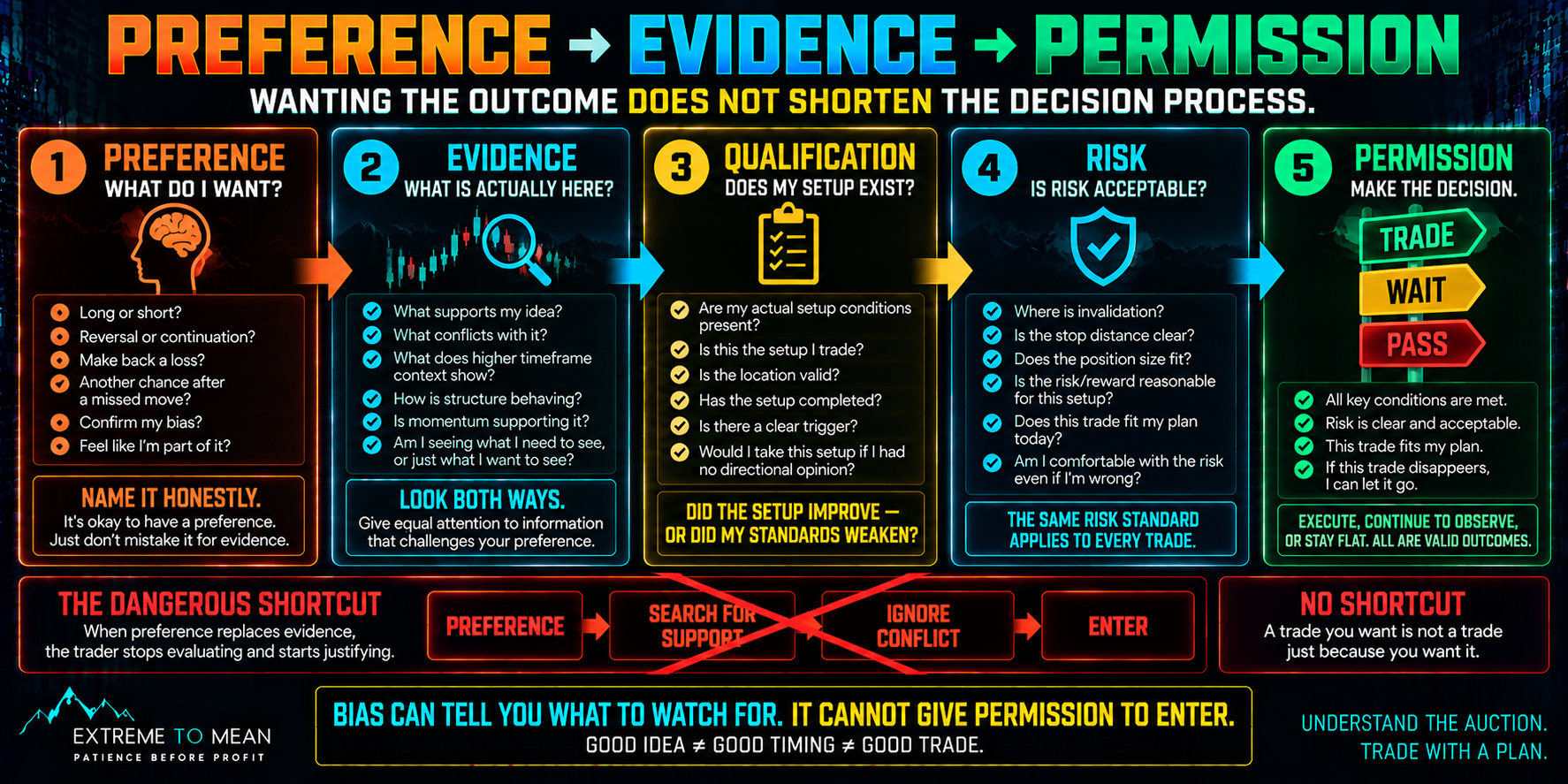
If the preferred trade fails the test, let it fail. If it later becomes qualified, evaluate it then; if another trade qualifies instead, evaluate that one independently; and if nothing qualifies, remaining flat is a complete outcome. If attachment turns rejection into a late forced entry, chasing the trade has replaced the qualification process.
Final Thought
There is nothing wrong with wanting a trade. You may prefer a direction, specialize in a setup, miss the last move, have a working bias, or genuinely believe one outcome is more likely. The problem begins when that preference changes the standard required to risk capital.
Name the trade you want honestly, then separate it from what the market has actually earned. Look for conflicting evidence as deliberately as supporting evidence, preserve the same location and risk standards, and ask whether the setup itself improved or your standards merely weakened. Let preference tell you where to look. Let evidence decide whether you act.
Educational content only. Trading involves substantial risk and is not suitable for everyone.