
Trading often feels like a reaction game. Price moves quickly, candles expand, alerts fire, and every shift on the chart can feel like something important is happening. The problem is that the market produces far more movement than quality opportunity. If a trader treats every movement as a reason to act, the chart starts controlling the decision process.
That is why filtering matters. Good trading does not begin with finding the next entry. It begins with rejecting ideas that are not clean enough, not located well enough, not structured well enough, or not clear enough to deserve risk. This is a major part of the work covered in trader psychology lessons, because discipline is not only about controlling emotions after entry. Discipline begins before the trade exists.
The trader’s job is not to respond to everything. The trader’s job is to evaluate what is worth attention.
The Market Produces More Decisions Than You Should Take
Every session creates motion. Some of it is meaningful. Some of it is random. Some of it is only a reaction to short-term liquidity, news, positioning, or the normal back-and-forth of auction behavior. A trader who does not filter these movements will eventually start treating noise like information.
This is especially difficult because almost-setups can look convincing. Price may push into an area that seems interesting, hesitate for a few candles, and begin to turn. That can feel like a trade is forming. But “something might happen” is not the same as “the trade has earned risk.”
Filtering starts by accepting that most movement is not there for you. The market is not producing a personal invitation every time price moves. It is simply moving. Your job is to decide whether the movement lines up with your process, your location rules, your context, and your risk plan.
Before a trader studies entries, they need to understand why location is the first filter. A signal that appears in poor location is not automatically better because it looks sharp or moves quickly. If the location is weak, the trade idea may already be damaged before the entry candle appears.
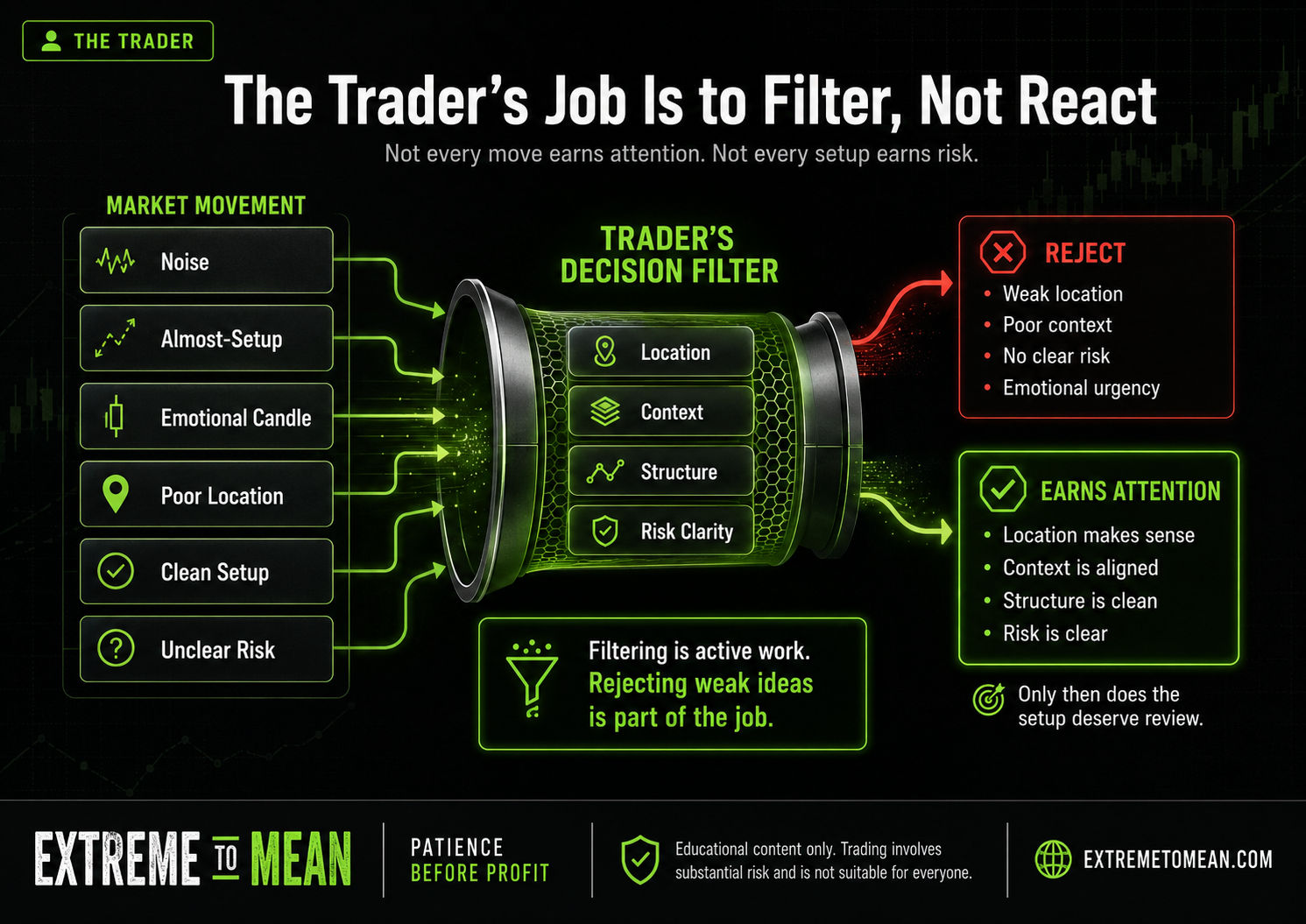
This is why filtering is active work. It is not hesitation. It is not fear. It is the process of separating trades that deserve attention from trades that only create temptation.
Why Weak Ideas Feel Reasonable in Real Time
Weak trade ideas rarely feel weak when they first appear. In the moment, they often feel urgent, logical, and available. A trader sees movement, imagines the possible outcome, and begins filling in the missing pieces.
That is where the danger begins.
A candle expands, and the trader sees momentum. Price taps a level, and the trader sees rejection. A pullback begins, and the trader sees a chance to catch the next leg. None of those observations are automatically wrong, but they are incomplete by themselves. A single visual clue does not create a complete trade idea.
Weak ideas feel reasonable because the mind wants resolution. Traders do not like uncertainty. When the chart is moving, the brain wants to convert that movement into a decision: buy, sell, chase, fade, hold, exit. This can create pressure to act before the full structure is clear.
That pressure becomes stronger when the trader recently missed a move. After watching price run without them, the next almost-setup feels more important than it really is. The trader does not want to miss again, so they lower the standard. Instead of asking whether the trade is clean, they ask whether they can justify taking it.
That is a different question.
A trader can justify almost anything after staring at the chart long enough. There will usually be some candle, level, indicator, wick, trendline, or small reaction that can support the decision. But the ability to explain a trade does not mean the trade met the standard.
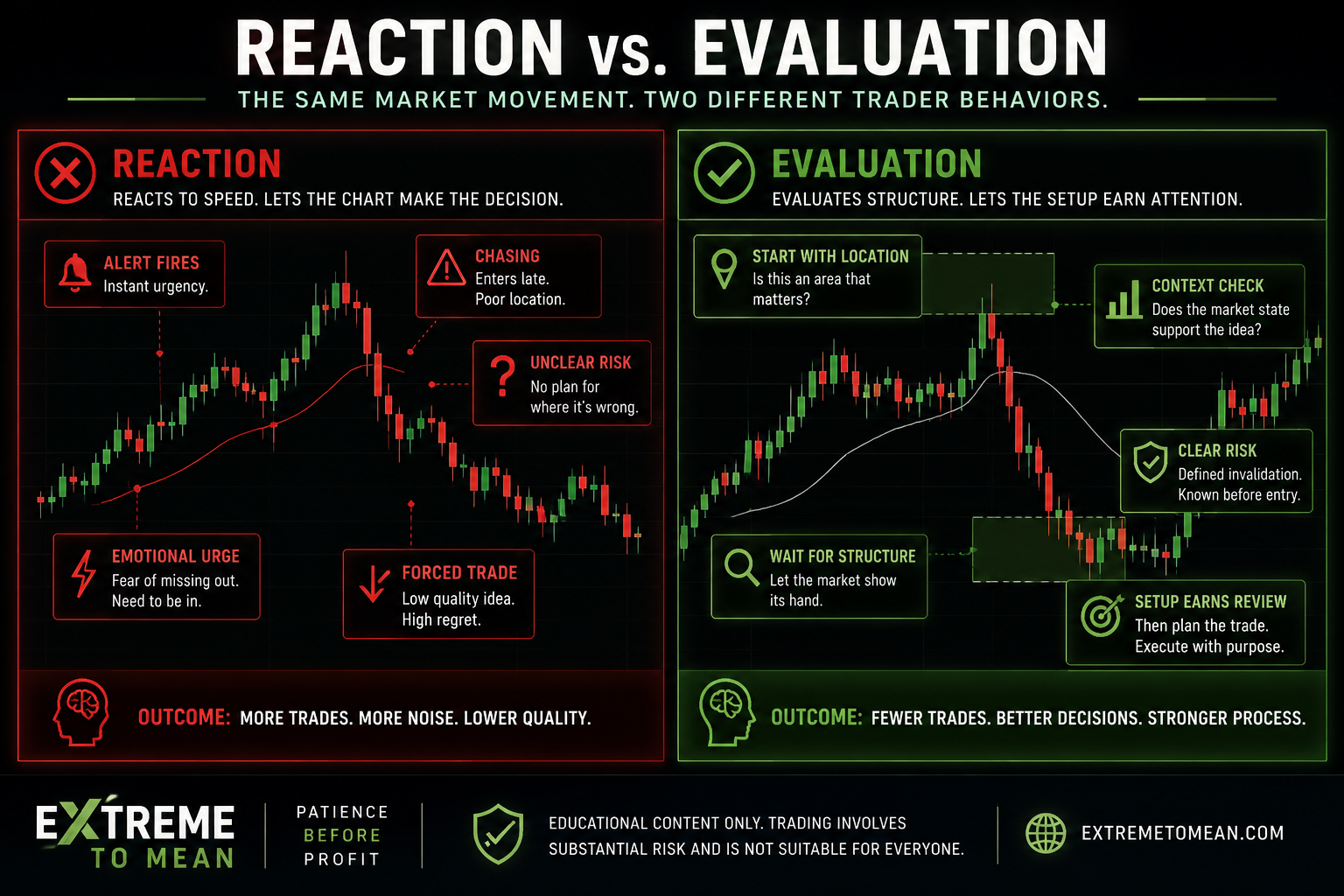
Reacting Turns Movement Into Risk
The market can move without costing you anything. It only becomes your risk when you decide to participate.
That may sound obvious, but it is one of the most important lessons in trading. The chart is allowed to be messy. Price is allowed to move without clarity. Setups are allowed to be incomplete. None of that matters until the trader converts observation into action.
The mistake is believing that movement itself requires a response. This is how traders end up entering from the middle, chasing after expansion, fading strength too early, or forcing trades in chop. The trader reacts because the chart is active, not because the decision is clean.
Extreme to Mean is built around a different idea: the setup has to earn attention first. A move away from the mean does not automatically create a trade. A stretch, spike, or emotional candle may be interesting, but not every extreme is a trade. Some extremes are too early. Some are too crowded. Some have no clean structure. Some have no reasonable room back toward the mean. Some are only dangerous because they look obvious.
Reacting also damages the next decision. A forced trade can create frustration, hesitation, revenge trading, or the need to “make it back.” Once that cycle begins, the trader is no longer filtering the market clearly. They are filtering the market through the emotional residue of the last mistake.
The better process is to keep weak ideas from becoming live positions in the first place.
Filtering Means the Setup Has to Earn Attention
A strong filter does not ask, “Can I take this?”
It asks, “Has this earned my attention?”
That small shift matters. “Can I take this?” invites negotiation. The trader begins searching for permission. “Has this earned my attention?” puts the burden back on the setup. The trade must prove itself through location, context, structure, and risk clarity.
A setup earns attention when several pieces begin to align. Location should make sense. The market state should not directly conflict with the idea. The trade should have room to work. Risk should be clear before entry. The trader should know where the idea is wrong, not just where it might go right.
This does not mean the trade will work. No filter can make the market predictable. A clean setup can still fail, and a messy setup can still move in the desired direction. The point of filtering is not to guarantee the outcome. The point is to improve the quality of the decision before money is involved.
Risk clarity is especially important. If a trader cannot define the invalidation point, the trade is not ready. The entry may look attractive, but the decision is incomplete. That is why the trade is not ready until the risk is clear. Without clear risk, the trader is not making a structured decision. They are hoping the market resolves the uncertainty for them.
Filtering also protects patience. A trader who filters well is not sitting around doing nothing. They are actively rejecting poor conditions, incomplete ideas, and emotional triggers. They are preserving attention for the moments when the chart becomes cleaner.
That is Patience Before Profit in practice.
A Better Question Before You Act
A practical filter should be simple enough to use in real time. If it is too complicated, the trader will abandon it when the market speeds up. The goal is not to create a perfect system. The goal is to slow the decision down just enough to separate structure from impulse.
Before acting, a trader can ask:
- Is this trade forming in a location that matters?
- Does the current market context support the idea, or am I fighting the session?
- Is there enough room for the trade to make sense?
- Do I know where the idea is wrong before entering?
- Am I taking this because the setup is clean, or because I do not want to miss the move?
- Would I still like this trade if I had not missed the previous one?
- Is this a planned decision or a reaction to speed?
These questions are not meant to create paralysis. They are meant to expose weak reasoning. If a trade cannot survive a few basic questions, it probably should not receive capital.
A better question to ask before entry is: “What would make this trade worth rejecting?”
Most traders ask what could make the trade work. That is natural, but it can create confirmation bias. Asking what would make the trade worth rejecting forces the trader to look for problems first. Poor location. No room to revert. Unclear invalidation. Choppy conditions. Emotional urgency. If those problems are present, the cleanest decision may be to pass.
Passing is not failure. Passing is part of the job.
The best traders reject far more trades than they take because most ideas do not deserve risk. That does not make them passive. It makes them selective. They understand that their edge is not only in the trades they enter, but also in the trades they refuse to take.
For traders still building this habit, a written checklist can help make filtering more concrete. The goal is to avoid negotiating with the chart in real time, and the next step is to download the free RTM trade checklist so the decision process has a repeatable structure.
Final Thought
The market will always offer movement, noise, and almost-setups. A trader does not need to answer all of them.
The trader’s job is to filter. That means rejecting weak ideas, waiting for cleaner conditions, and requiring the setup to earn attention before it earns risk. This is not hesitation. It is decision quality.
Good trading begins before the entry. It begins with the trades you choose not to take.
Protect the next decision, because one forced trade can affect more than one result. It can affect the way you see the next setup, the next session, and the next opportunity. A trader who wants a better process must learn to protect your next decision before the market gives them a reason to react.
That filter becomes practical when the trader accepts that activity and opportunity are not the same thing. One good setup is better than ten random trades explains why trade frequency should follow qualified opportunities rather than urgency.
Educational content only. Trading involves substantial risk and is not suitable for everyone.