
Inside The Setup, confirmation belongs after context, location, and a defined trade thesis. The trader should already know why the market deserves attention and what price would need to do next before asking for another candle, indicator, timeframe, or order-flow signal. Confirmation is evidence added to an existing idea—not the idea itself.
That order matters because “I need more confirmation” often feels safer than making a decision under uncertainty. Price reaches location, reacts, structure begins to change, and the trader keeps waiting until the move looks obvious enough to feel comfortable. The trade often feels safest after the best price has already disappeared.
What Trading Confirmation Actually Is
Confirmation is new information that strengthens or weakens a specific trade thesis after the relevant market context and location already exist. It is not the market condition, the setup, the trader's bias, or proof that the next move will work. Confirmation should reduce one important uncertainty without pretending it can remove uncertainty from trading.
That definition also separates confirmation from a trigger. Some strategies may use a particular confirmation event as part of their entry process, while others may act within an area once minimum conditions are satisfied. The important point is that the evidence should have a job before it has a name.
Context, Location, and Thesis Come First
The weak process begins with a signal and searches backward for a reason to care about it. A candle closes green, CVD improves, or an indicator flashes, and the trader starts looking for support, VWAP, trend, or a higher-timeframe argument that makes the signal meaningful. The cleaner process starts with the market and asks whether the strategy belongs there before any confirmation receives a vote.
Location comes next because identical evidence can mean very different things in different places. A bullish reaction in the middle of random balance may add little to a trade, while the same reaction at a preidentified support area can answer a question the trader was already watching. This is why location is the first filter before confirmation becomes useful.
The thesis then defines what the evidence must prove. A continuation trade asks whether the existing directional move is resuming, while a reversal asks whether old control is weakening enough for opposing control to establish itself. A candle cannot confirm a trade whose structure and thesis were never defined.
Confirmation Should Answer a Specific Question
Before opening another indicator, the trader should be able to finish the sentence: “I need confirmation that…” A pullback trader may need evidence that the original trend is resuming, while a breakout trader may need evidence that price can actually operate beyond the boundary. A mean-reversion trader may need evidence that continuation away from balance is beginning to weaken rather than another reminder that price is already extended.
This is where a setup is not a signal becomes practical. The setup explains why the market deserves attention, while confirmation helps decide whether that attention should become risk now. If you do not know the question, every indicator becomes a possible answer.
Different strategies therefore need different confirmation because they are trying to resolve different uncertainties. Continuation confirmation asks whether the old move is restarting, reversal confirmation asks whether the old move is failing and new control is developing, and breakout confirmation asks whether the auction is accepting outside the prior area. Relevant confirmation matters more than abundant confirmation.
Confirmation Can Never Create Certainty
Even an unusually clean setup can lose after several forms of evidence agree. Good location, supportive structure, constructive order flow, aligned participation, and a clean candle can improve the case without changing the basic fact that the next outcome remains uncertain. Confirmation reduces uncertainty; it does not transfer uncertainty out of the trade.
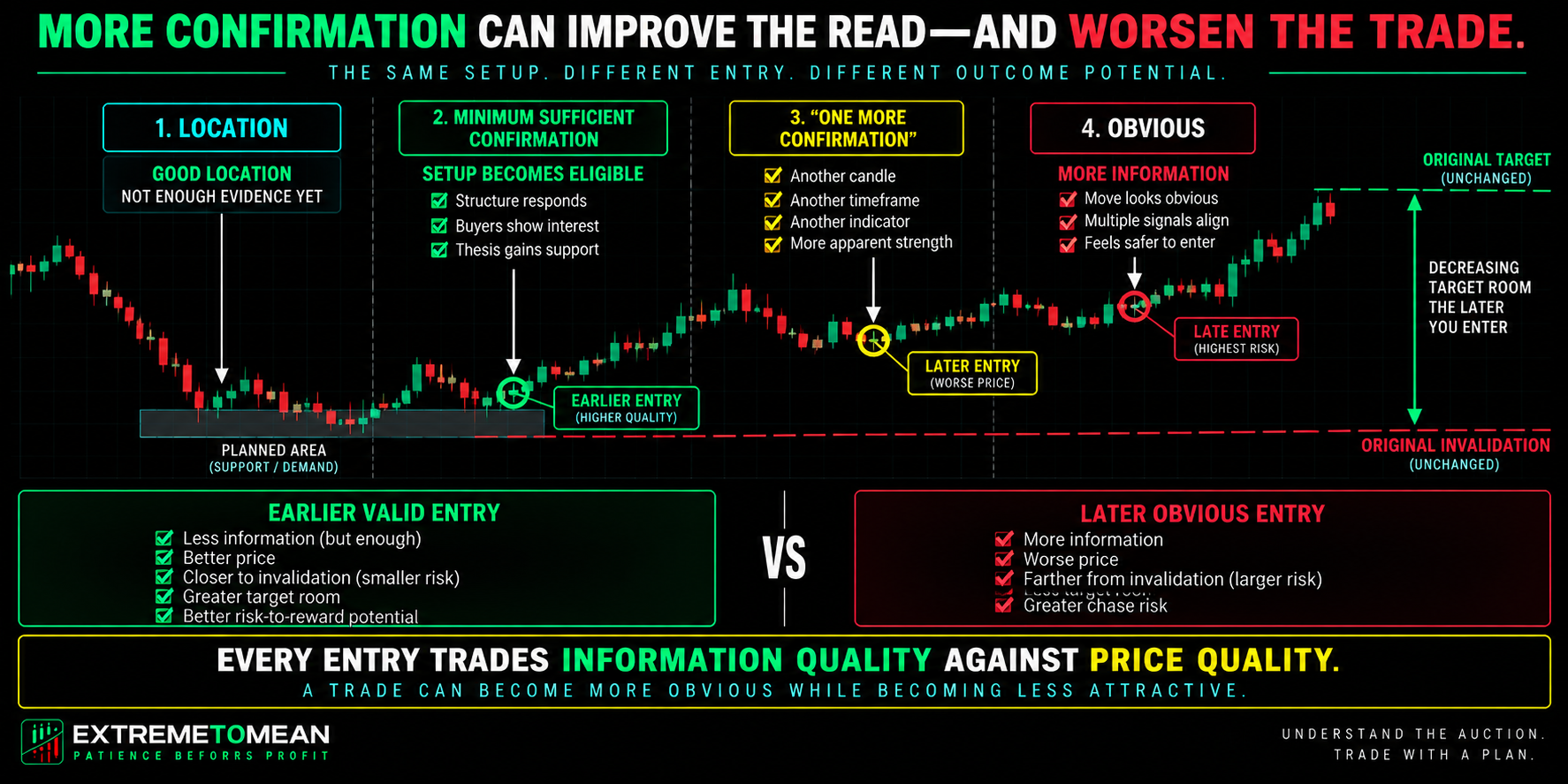
The certainty trap begins when the trader quietly changes the goal from “enough evidence to act” to “enough evidence to feel sure.” Markets often provide that feeling only after price has already traveled, the structure has become obvious, and much of the useful opportunity has been consumed. Markets can become more certain-looking at the same time they become less attractive to enter.
Think of confirmation as having a budget. Every additional layer spends time, price, target room, and risk efficiency, so it needs to purchase genuinely useful information in return. Confirmation is not free; you pay for it with information arriving after price has already moved.
Every Entry Trades Information Quality Against Price Quality
Earlier participation can provide better location, tighter distance to invalidation, and more room, but it comes with less evidence that the setup has finished developing. Later participation can provide clearer structure and more information, but price may be worse and the trade may be closer to its destination. You usually cannot have maximum confirmation and maximum entry efficiency at the same time.
Suppose a reversal thesis has a logical invalidation near 105 and minimum valid confirmation appears around 101. If the trader waits for several more signals and finally enters around 97, the thesis may be more obvious while the invalidation has not magically moved closer. The trader now has a very different trade even though the market idea is largely the same.
That change in geometry is why where you enter matters more than what you predict. Waiting can leave less target room while making the structural stop feel uncomfortably far away, which tempts the trader to invent a tighter stop simply to make the late entry look acceptable. A trade can become more obvious while becoming less attractive.
More Indicators Are Not Necessarily More Confirmation
A trader can load CVD, footprint delta, a delta histogram, buy imbalances, and an aggressive-buy meter and feel as though five separate pieces of evidence agree. Several of those views may derive from the same underlying transaction data, so their agreement is partly redundant. Different pictures of the same evidence should not receive separate votes.
Independent evidence is more useful when it answers genuinely different parts of the trade. Market condition can answer whether the strategy fits, location can answer where it matters, structure can answer what price is doing, participation can add broader context, and execution data can help answer a specific microstructure question. Confirmation becomes stronger when different evidence resolves different uncertainties rather than repeating the same one.
The same restraint applies to timeframes, candles, volume, order flow, and market internals. A candle close can be useful if the strategy specifically requires acceptance, but “wait for the close” is not a universal law, just as more timeframes do not automatically create more clarity. A confirmation tool should earn its place by answering a decision-relevant question.
Define Minimum Sufficient Confirmation Before the Setup Appears
The cleanest way to avoid moving the goalposts is to define the strategy's minimum sufficient confirmation before live pressure arrives. That does not mean choosing a universal number of signals; it means stating what new information is necessary for this particular setup to become eligible. If “enough” is undefined before the market moves, one more confirmation can continue forever.
A good process also looks for disconfirmation. Instead of asking only what supports the trade, ask what would make the idea less interesting: failed defense of the level, continuation still accelerating, poor remaining room, deteriorating participation, or a volatility change that alters the setup. Confirmation should test the trade—not protect the trader's opinion.
Once the required evidence arrives, continued waiting needs a reason. If the setup is clear but the trader suddenly wants another candle, another timeframe, and another indicator because the last trade lost or the current size feels uncomfortable, the missing ingredient may no longer be information. Sometimes “I need more confirmation” really means “I do not yet feel comfortable risking money.”
Risk Can Be the Real Confirmation Problem
If the setup is valid but the planned loss feels too large, adding unrelated confirmation does not solve that problem. The cleaner choices are to size appropriately, use a smaller contract where suitable, or pass if the trade cannot fit the risk plan. When the setup is clear but the exposure feels too large, solve the risk problem instead of pretending it is an information problem.
This becomes especially visible when a trader changes size. A setup that feels easy with two Micros can suddenly require perfect candles, extra order flow, and higher-timeframe agreement when traded with much larger exposure, even though the strategy itself has not changed. If your confirmation standard changes with contract size, the real problem may be exposure rather than information.
Confirmation also cannot rescue poor trade geometry after the fact. After the required evidence appears, the trader still needs to verify that invalidation remains logical, enough target room remains, and the resulting position size fits the plan because the trade is not ready until the risk is clear. Confirmation comes before entry, but trade geometry gets the final vote.
The ETM Confirmation Ladder
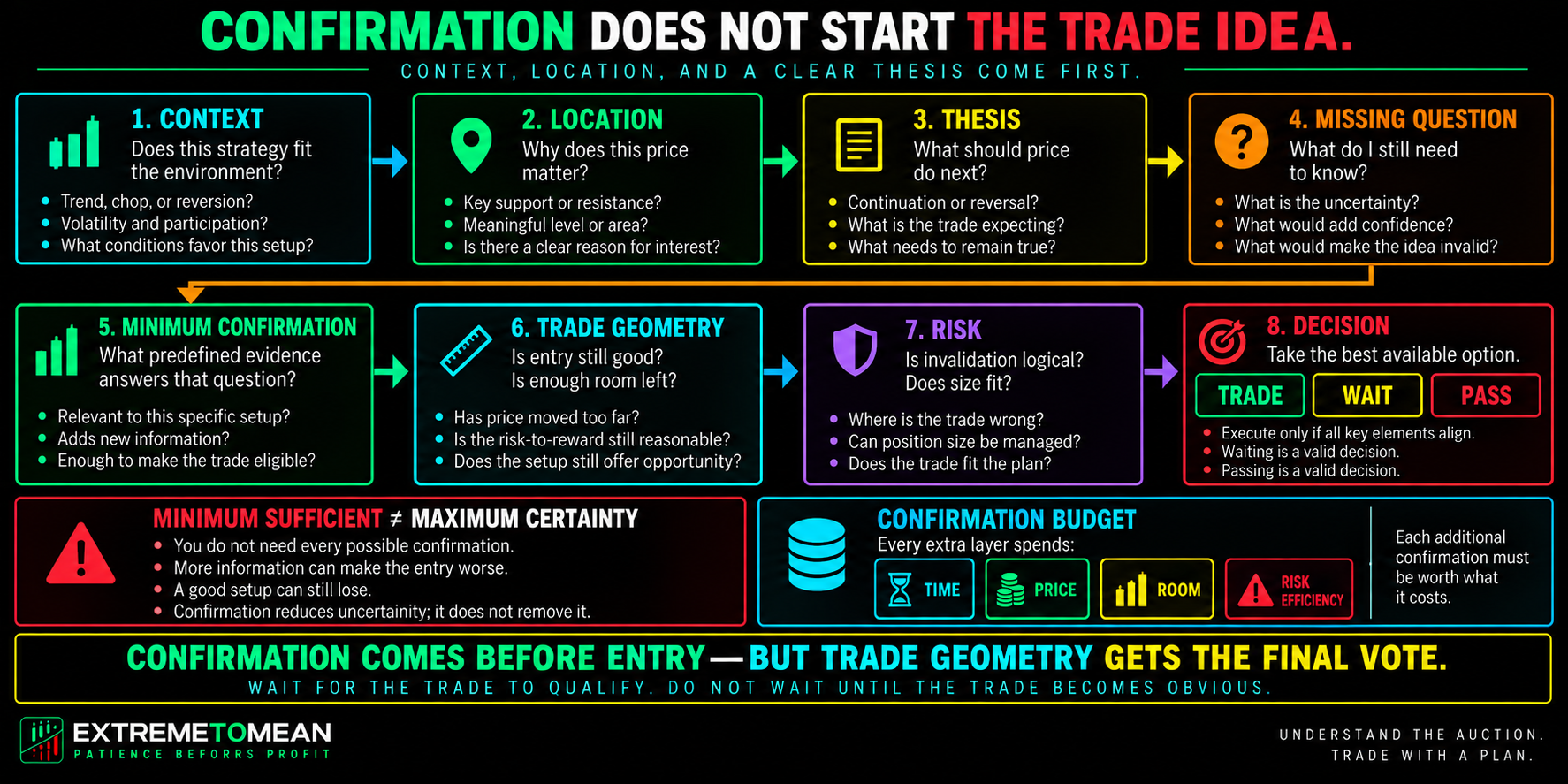
Use Context → Location → Thesis → Missing Question → Minimum Confirmation → Trade Geometry → Risk → Decision. The ladder keeps confirmation in its proper place: after the setup has a reason to exist and before the trader commits capital. It also gives the trader a stopping point so confirmation cannot quietly expand into an endless approval process.
- Context: Does the current market environment fit the strategy?
- Location: Is price somewhere the setup actually matters?
- Thesis: What specifically do I expect price to do next?
- Missing Question: What uncertainty still prevents the setup from becoming eligible?
- Minimum Confirmation: What predefined evidence answers that question?
- Trade Geometry: After confirmation, is the entry still acceptable and is enough target room left?
- Risk: Is invalidation still logical, and does the resulting position size fit?
- Decision: Trade, wait, or pass.
A setup can fail this process in either direction. If required confirmation never arrives and the market leaves, the trade never became eligible; if all required evidence arrives and the trader continues waiting only for more comfort, a qualified setup can turn into a chase. There is a difference between waiting for the trade to become qualified and waiting until the trade becomes obvious.
Confirmation also has a shelf life. A rejection, structural response, or execution change belongs to a particular setup window, and the trader should not assume the same evidence remains fresh after price has traveled far away and later returns. Confirmation belongs to a trade window; it does not remain valid forever simply because it happened once.
Test Whether More Confirmation Actually Helps
Confirmation rules should earn their place through evidence rather than intuition. Compare the strategy after minimum valid confirmation with the same strategy after an additional requirement, then measure what changes in win rate, expectancy, average entry, stop distance, remaining target room, trade frequency, and transaction costs. The important question is not whether another filter improves one statistic, but what it does to the entire trade distribution.
A higher win rate can be purchased at a price that makes the strategy worse. Later confirmation may remove some losing trades while also shrinking winners, reducing opportunity, widening stops, or creating worse fills, and the only useful answer comes from testing the actual rules. Do not use the outcome of one trade to invent the confirmation that the trade supposedly needed.
The same discipline applies after winners. If five confirmation layers were present and the trade worked, that does not prove all five contributed useful information; some may have added nothing except delay. If a confirmation requirement cannot change the decision or improve the tested process, it may be decoration rather than information.
Common Trading-Confirmation Mistakes
Most confirmation errors happen because the trader either asks for evidence too early, asks for too much after the setup is ready, or uses confirmation to solve a problem that actually belongs to risk or location. The common thread is allowing the evidence process to drift away from the specific uncertainty it was supposed to resolve. Watch especially for these mistakes:
- Looking for confirmation before establishing context or meaningful location.
- Letting an indicator create the setup instead of test an existing thesis.
- Using the same confirmation standard for continuation, reversal, breakout, pullback, and mean reversion.
- Counting several correlated delta-based tools as separate confirmations.
- Treating every additional timeframe as another approval vote.
- Waiting for a candle close without a strategic reason for requiring the close.
- Keeping the original target assumption after price has already traveled toward it.
- Entering late and then tightening the stop simply because the original invalidation now feels too far away.
- Adding a new confirmation requirement after every losing trade.
- Lowering confirmation standards because a previous unqualified trade moved without you.
- Continuing to wait after every predefined requirement has already been satisfied.
- Using more confirmation to avoid the discomfort created by oversized risk.
Final Thought
The purpose of trading confirmation is not to make the future feel certain. It is to answer the specific uncertainty that remains after context, location, and a defined trade thesis have already created a valid reason to pay attention. Once that job is done, every additional piece of evidence has to justify the price, time, room, and risk efficiency it costs.
A trader can enter too early, but a trader can also wait until a good setup becomes a poor trade. Patience is not waiting longer regardless of what price does; it is waiting for the required evidence, then evaluating whether the opportunity still deserves risk instead of continuing to delay for emotional comfort. A qualified setup can still feel uncertain, which is exactly why risk management exists.
Define enough before the market becomes urgent, let confirmation solve the missing question, and then recheck the actual trade. If the entry has become poor, the room has disappeared, or the risk no longer fits, passing remains a valid decision even when the directional idea looks obvious. That balance between patience and decisive risk-taking is part of the broader process developed throughout The Patience Principle.
Educational content only. Trading involves substantial risk and is not suitable for everyone.