
The useful question is not whether today will become a trend day or range day before enough evidence exists. The trader begins with context, observes what price is building, and updates the read as the session develops. That is the purpose of broader market context: describe the environment well enough to evaluate the next setup without turning the description into a permanent bias.
What a Trend Day Actually Looks Like
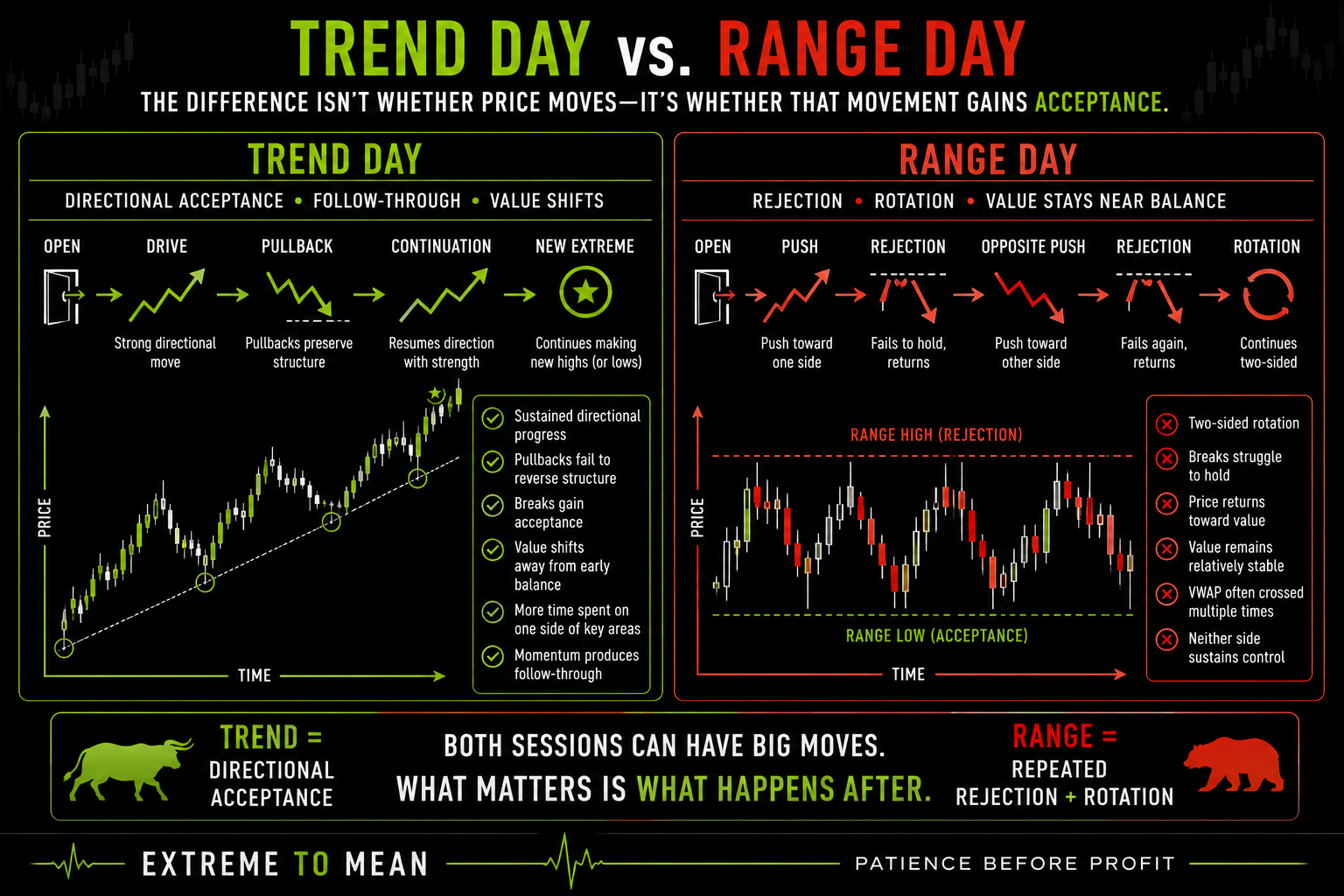
A developing trend day keeps making meaningful progress in one direction. On an uptrend day, higher highs and higher lows become persistent; on a downtrend day, lower highs and lower lows do the same. Pullbacks, pauses, consolidations, and countertrend candles still occur, but they do not repeatedly erase the larger directional structure.
The more important feature is what happens after price leaves an earlier area of balance. Breakouts tend to hold, pullbacks preserve structure, and the market spends more time building away from previously accepted prices. The session does not need to move in a straight line; it needs to keep converting directional movement into additional structure.
What a Range Day Actually Looks Like
A developing range day is primarily two-sided. Price pushes toward one side, attracts enough opposing participation to stall or reject, and repeatedly returns toward the same accepted area. Buyers respond at lower prices, sellers respond at higher prices, and neither side sustains control for long enough to keep moving value in one direction.
A range can still contain fast candles and convincing breakouts. What distinguishes the session is that those pushes repeatedly fail to create durable progress away from balance. The market is not doing nothing; it is repeatedly finding enough two-sided participation to prevent one side from maintaining control.
Trend Day vs. Range Day Is Really Acceptance vs. Rejection
The cleanest distinction is not whether price touched or broke an important level. It is whether the market accepted prices beyond that area or rejected them and returned to prior value. CME describes Market Profile as organizing price and time to help identify areas where price is being accepted or rejected, which provides useful vocabulary for this distinction without requiring a trader to use Market Profile itself. (cmegroup.com)
Directional acceptance tends to look like Break → Hold → Build → Continue. Range-like rejection tends to look more like Break → Fail → Return → Rotate. A fast move is therefore not automatically a trend; what happens after the move matters more than the initial burst.
The Open and Initial Balance Give Information, Not a Final Answer
The open matters because overnight positioning, new information, cash-market participation, and opening order flow begin interacting. Watch whether price drives away and holds, repeatedly returns through the opening area, or allows both sides to reclaim ground. Context should come before bias, especially when the first part of the session tempts the trader to turn an early impression into a fixed day-type label.
The Initial Balance adds another early reference. The guide to reading range extension after the first hour asks whether price merely moved beyond that range or actually held, built structure, and spent meaningful time outside it. Historical Market Profile frameworks used early balance and later range extension descriptively, but those ideas should not be converted into rigid percentage rules for modern ES or NQ sessions. (cmegroup.com)
What Strengthens Each Read
A trend-day read grows stronger when structure keeps advancing, pullbacks fail to reverse the dominant sequence, breakouts remain outside prior balance, and directional pushes continue producing progress. For equity-index futures, breadth, sector participation, volatility, and other internals can add confirmation, while price may spend more time on one side of VWAP. None of those inputs is required individually; the useful information comes from agreement across several observations.
A range-day read grows stronger when directional extensions repeatedly fail, price revisits the same accepted zone, structure overlaps, and large pushes produce little follow-through. Frequent VWAP crossing or conflicting internals can add to that picture, but one cross or one failed breakout does not define the day. Rejection, rotation, overlap, and weak follow-through become more meaningful when they keep appearing together.
Why Traders Misread the Session
Range days are often mistaken for trend days because speed looks like conviction. Price clears a visible level, accelerates, and appears to have chosen direction, only to lose acceptance and return into the range. When the trader treats the breakout itself as proof of trend, the next failed move can repeat the same mistake.
Trend days create the opposite problem, especially for traders who naturally look for mean reversion. Extended price, distance from VWAP, prior resistance, or an overbought reading can make a reversal feel increasingly reasonable even while the market continues discovering price in the same direction. The same setup can behave differently under different market conditions, so extreme location alone does not mean the session is ready to revert.
Brooks’ price-action work offers a useful practitioner nuance: trends still contain pullbacks and smaller trading ranges. A trend day should not be imagined as a perfect diagonal line with no pauses. The larger question is whether those interruptions reverse the directional process or merely pause it. (brookstradingcourse.com)
A “Trap Day” Means the Read Changed
Some sessions look directional early and then lose that character. A breakout gains acceptance temporarily, traders begin treating the trend as established, and later continuation fails, structure changes, and price returns through important references. Calling that a “trap day” can be useful informally, but it should describe how the session evolved rather than imply a standardized pattern that could have been predicted beforehand.
The reverse can also happen. A session can begin rotational and later develop sustained acceptance after one boundary finally breaks. Classification is therefore provisional: the purpose is to improve expectations, not create another bias that must be defended.
How Expectations Should Change
On a developing trend day, the trader may become more cautious about fading every extension, expecting every move to return immediately to VWAP, or assuming old boundaries must hold. More attention can go to pullback structure, continuation, and whether directional acceptance survives important references. These are changes in expectation, not automatic trade instructions.
On a developing range day, the trader may become more cautious about chasing breakouts, entering in the middle, or assuming every fast candle begins sustained expansion. More attention can go to range boundaries, rejection, available room, and whether a breakout has actually earned acceptance. This applies the broader three market states idea to the developing intraday session without replacing setup qualification.
The middle of a range is often especially uninformative because location is weaker, available room is smaller, and direction is conflicted. On a trend day, however, an earlier “middle” can lose relevance as value shifts. Session type and location have to be read together.
A Practical Session-Type Review
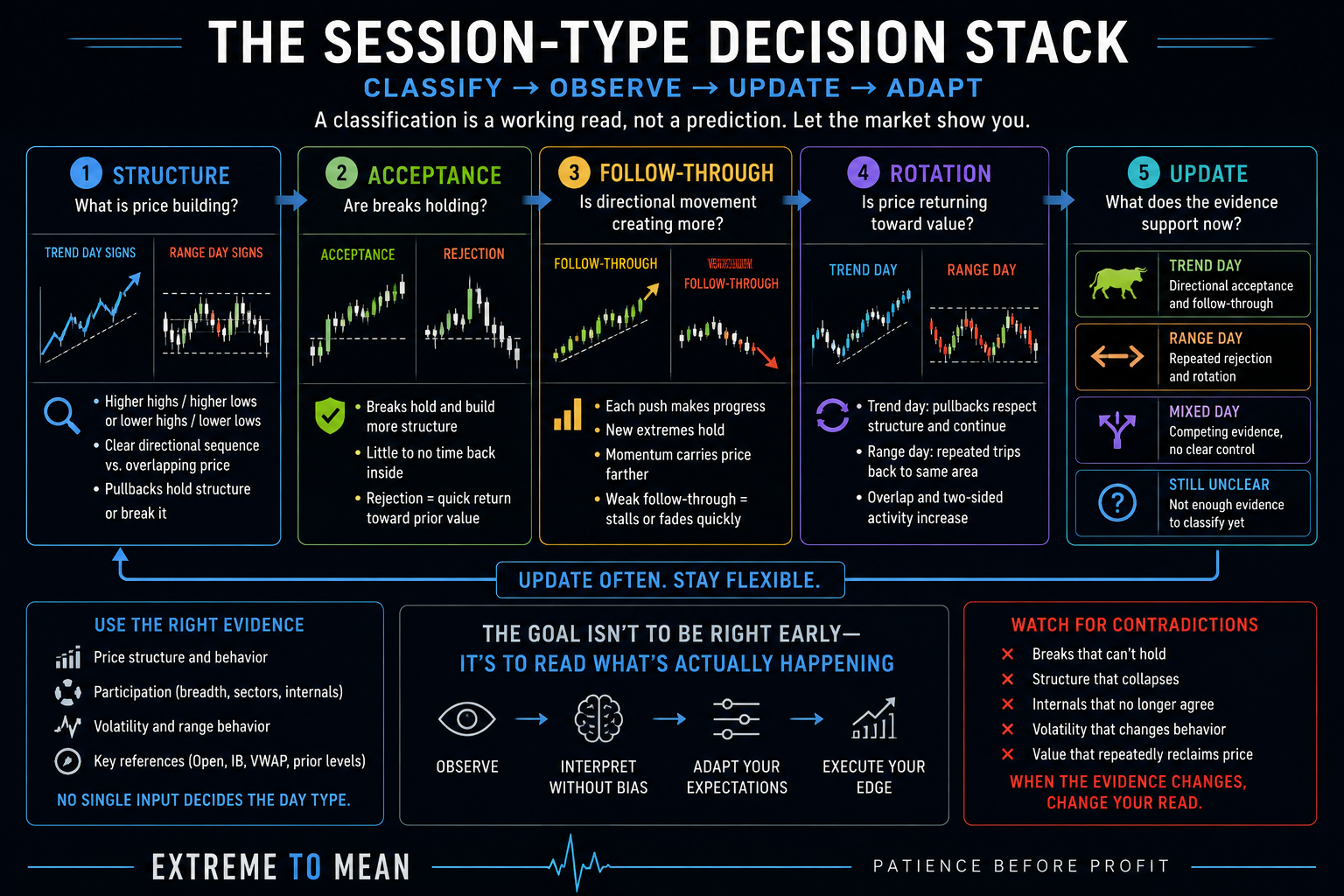
Use Structure → Acceptance → Follow-Through → Rotation → Update as a repeatable review. The purpose is to organize evidence rather than force a binary answer before the market has earned one. At each stage, ask what observation would contradict the current read.
- Structure: Is price making sustained directional progress or returning through the same area?
- Acceptance: Are breaks holding or quickly failing?
- Follow-Through: Does each directional push create additional structure?
- Rotation: Does price repeatedly return toward prior value?
- Participation: Do breadth, sectors, and internals support ES or NQ?
- References: How is price behaving around the open, Initial Balance, VWAP, previous-day levels, and relevant structure?
- Contradiction: What evidence does not fit the current classification?
- Update: Is the session best described as trend, range, mixed, or still unclear?
| Question | Developing Trend Day | Developing Range Day |
|---|---|---|
| Price behavior | Sustained directional progress | Two-sided rotation |
| Breakouts | More likely to gain acceptance | More likely to reject or fail |
| Pullbacks | Often preserve directional structure | Often retrace much of the prior push |
| Value | Shifts directionally | Remains relatively stable |
| VWAP | Often spends more time on one side | Often crossed repeatedly |
| Structure | Directional highs/lows persist | Overlap and reversals persist |
| Main danger | Fading too early | Chasing failed breakouts |
| Classification | Still provisional | Still provisional |
These are tendencies, not rules. No single characteristic determines the final session type, and the read should change when the evidence changes. The better question is not, “Is today going to be a trend day or a range day?” It is: “Is the market currently accepting directional movement, or repeatedly rejecting it and returning to value?”
Final Thought
A trend day is defined less by one strong move than by sustained directional acceptance. A range day is defined less by low volatility than by repeated two-sided rotation and rejection. The trader’s job is to classify, observe, update, and adapt as those behaviors develop.
The most important discipline is remaining willing to be wrong about the label. Ask what would have to change for the current session-type read to stop fitting the evidence, then let the market answer. Readers who want to go deeper into combining price structure, volatility, breadth, internals, yields, the dollar, and broader context can continue with Decode the Market.
Educational content only. Trading involves substantial risk and is not suitable for everyone.