
Context also determines whether apparent balance is meaningful; fair value and the middle are not the same thing.
Many traders begin the session by asking whether the market will go up or down. They may form that opinion from overnight price action, a headline, a prior-day move, or a level they expect to hold. Once the opinion forms, every candle is judged according to whether it supports the preferred direction. The trader is no longer reading the market neutrally but searching for confirmation.
The lessons in The Market category emphasize that market behavior must be understood before individual setups are judged. A strong entry pattern can behave very differently in a trend, range, contraction, or disorderly session. The environment does not guarantee what happens next, but it changes what kinds of movement are more likely to develop cleanly. Context gives the trader a framework for evaluating evidence without pretending the market is predictable.
Context Is a Description, Not a Prediction
Context describes what the market is doing now and what conditions produced that behavior. It may include direction, structure, volatility, participation, sector leadership, overnight tone, and the relationship between risk assets. A useful description stays close to observable evidence rather than claiming certainty about the next move. The trader’s first task is to identify the environment, not forecast its destination. The same discipline applies to monetary history — describing how commodity money and fiat money actually work before deciding which one is "better" avoids the same premature-conclusion trap.
Bias is a conclusion that may follow from that description. A bullish bias can be reasonable when price is accepting higher, pullbacks are holding, participation is broad, and risk conditions are supportive. A bearish bias can be reasonable when lower prices are being accepted, rallies are failing, and defensive behavior is increasing. The principle that the market comes first means the evidence must lead and the opinion must follow.
Begin With the Market’s Structural State
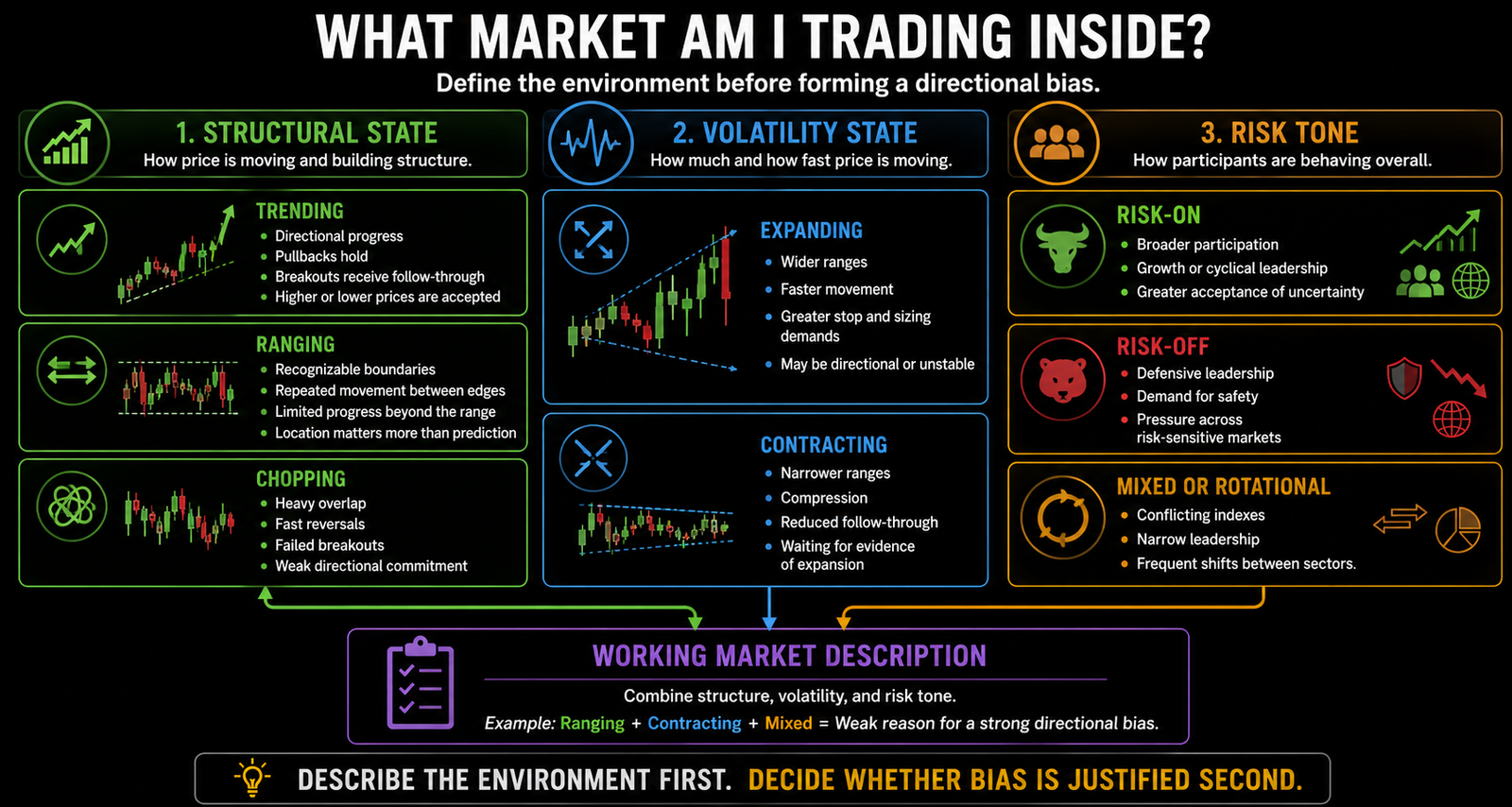
The first question is whether the market is trending, ranging, or chopping. These conditions can look similar over a few candles, but they create different expectations for continuation, reversal, and trade management. A trend rewards alignment and patience with pullbacks, while a range rewards awareness of boundaries and failed extensions. Chop often punishes both directional conviction and repeated attempts to predict the next breakout.
The framework of the three market states gives the trader a starting point for this classification. In a trend, price generally makes directional progress and holds much of that progress after pauses. Pullbacks may be brief or controlled, and breaks from consolidation tend to receive follow-through. The market is communicating acceptance in one direction rather than merely moving back and forth.
A range has structure even though it lacks sustained directional progress. Price repeatedly responds near recognizable boundaries, moves through a middle area, and struggles to establish acceptance outside the range. The trader can describe where buyers and sellers are responding without assuming either side has permanent control. A directional bias near the center may be less useful than an awareness of location and available room.
Chop is less organized than a clean range. Boundaries may shift, breakouts fail quickly, candles overlap heavily, and movement repeatedly reverses before reaching meaningful destinations. The market may appear active while providing little usable progress. In that environment, reducing activity or waiting for clearer conditions can be a more disciplined decision than repeatedly changing bias.
Add the Volatility State
Direction alone does not fully describe the market. The trader should also ask whether volatility is expanding, contracting, or remaining stable. Expansion means price is covering more distance, ranges are increasing, and reactions may become faster or less forgiving. Contraction means movement is compressing, participation may be waiting, and apparent signals can lack immediate follow-through. Checking what the VIX confirms and what it cannot tell you offers one quick read on which of those two states the broader market currently favors.
An expanding market can support strong directional movement, but expansion can also occur during fear, liquidation, or unstable two-way trading. Wider candles do not automatically mean a clean trend is present. The trader must observe whether the increased movement is producing acceptance or merely larger reversals. Stop distance, position size, and expectations for normal variation may all need to adjust.
A contracting market often tempts traders to predict the next large move. Compression can eventually lead to expansion, but the direction and timing are not known in advance. Repeated entries inside the contraction can produce frustration if price continues rotating without commitment. Patience during contraction is active evaluation, not passive avoidance.
Identify the Risk Tone
The market also has a broader risk tone that may be described as risk-on, risk-off, mixed, or rotational. Risk-on conditions generally show investors accepting more uncertainty, with stronger participation across growth, cyclical, or higher-beta assets. Risk-off conditions often show demand for safety, defensive leadership, weaker participation, or pressure across several risk-sensitive markets. Whether Bitcoin fits neatly into either label is its own question, addressed in is Bitcoin a risk-on asset? These descriptions are tendencies rather than fixed rules.
A risk-on tone does not mean every stock should be bought. Indexes may rise while leadership narrows, weaker sectors lag, or individual setups remain poorly located. The broader environment can support continuation without removing the need for structure and risk definition. Context improves the quality of the question; it does not replace setup qualification.
A risk-off tone does not mean every short entry is justified. Markets can become stretched, defensive moves can reverse sharply, and weak conditions can still contain powerful rallies. The trader must distinguish between a difficult environment and a guaranteed direction. A bearish context may justify greater caution without requiring immediate participation.
Mixed conditions often produce rotation rather than broad agreement. One index may rise while another stalls, defensive sectors may strengthen alongside selected growth names, or overnight weakness may be recovered without broad participation. These conflicts are useful information because they show that the market has not produced one clean message. The appropriate bias may be limited, conditional, or absent.
Bias Becomes Dangerous When It Comes First
The same chart pattern can appear in several different environments. A breakout during an established trend and expanding participation is not the same decision as a breakout inside a contracting, overlapping range. The candles may look similar while the surrounding evidence is completely different. Treating the pattern as sufficient ignores the market in which it is being asked to work.
This is why market conditions change the quality of a setup. A pullback may be attractive during an orderly trend but unreliable when the market is rotating violently between boundaries. A reversal may have room at a range extreme but little justification in the middle of a directional move. The setup earns attention only after the environment and location support the idea.
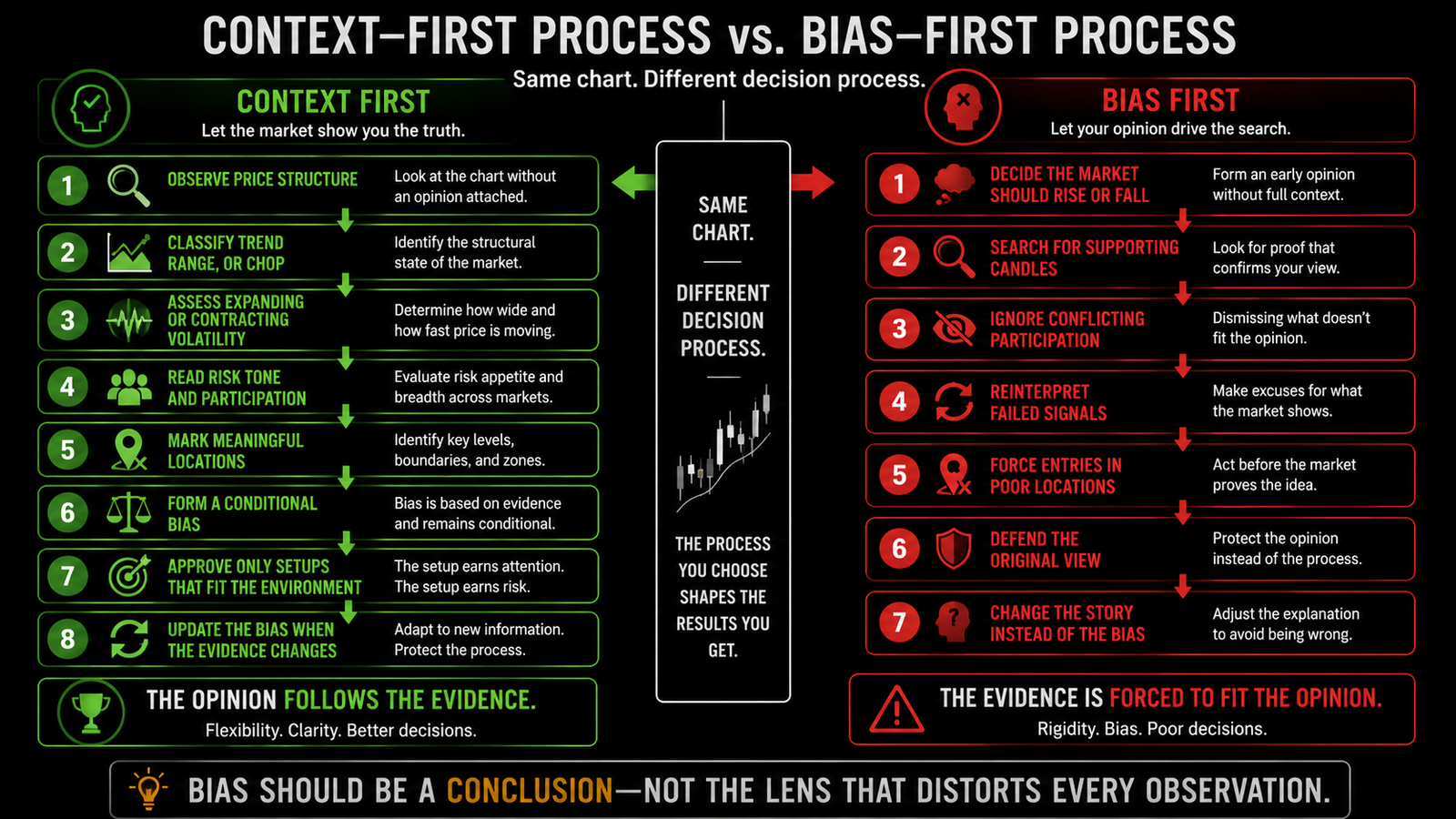
When bias comes first, the trader often explains away conflicting evidence. Weak participation becomes temporary, a failed breakout becomes a better entry, and a structural break becomes noise that should be ignored. The lesson that context comes before the candle is lost because each new candle is interpreted through the original opinion. The trader is defending a view instead of updating a description.
Build Bias From a Sequence
A cleaner process begins with observation. The trader identifies the structural state, volatility state, risk tone, key locations, and whether related markets are confirming or conflicting. Only then does the trader ask whether the evidence supports a directional preference. Bias becomes a working conclusion rather than a commitment that must be defended.
A bias can still be useful when it remains conditional. The trader may prefer longs while price holds above an important area and continues accepting higher, or prefer shorts while rallies fail beneath a defined boundary. If the condition changes, the bias must be reviewed rather than protected. Flexibility means responding to new evidence, not changing the story to preserve an old prediction.
Location remains important even when the context is clear. A bullish environment does not make every high price a good long entry, and a bearish environment does not make every low price a good short. The trader must still evaluate room, structure, invalidation, and the quality of the entry area. Context tells the trader what market is present; location helps determine whether a specific opportunity earns risk.
A Practical Context-First Filter
Before the session begins, the trader can describe the environment through a short sequence. The answers do not need to predict the entire day, but they should produce a clear working description that can be updated as new evidence appears. Each question should be answered from observable behavior rather than personal expectation. When the answers conflict, the trader should acknowledge the conflict instead of forcing a stronger conclusion:
- Is price making directional progress, respecting range boundaries, or overlapping without structure?
- Is volatility expanding, contracting, or remaining stable?
- Are breakouts receiving follow-through or failing quickly?
- Are pullbacks controlled, deep, or repeatedly reversing the prior move?
- Is participation broad, narrow, defensive, or rotational?
- Are major indexes and leading sectors confirming one another?
- Is the broader tone risk-on, risk-off, mixed, or unclear?
- Where are the meaningful boundaries, and is price near one or trapped in the middle?
- What evidence would justify a directional bias?
- What evidence would require that bias to be reduced, changed, or removed?
The answers should be summarized in one or two sentences. A useful description might be: “The market is ranging with contracting volatility, mixed sector leadership, and repeated breakout failures near the upper boundary.” That statement does not predict the next move, but it tells the trader what behavior is present. It also discourages trend-style entries until the market provides evidence that conditions have changed.
The better question is not, “Which direction do I want to trade?” It is, “What market am I trading inside, and what type of decision fits that environment?” Traders can include this question in a repeatable preparation routine such as the 2026 Trader’s Macro Playbook. The purpose is to make context a required step rather than an optional thought added after a bias has already formed.
Review Whether the Description Matched the Session
Trade review should evaluate the original market description separately from the result of any one trade. The trader may lose on a properly qualified trend setup or profit from an entry taken in poor context. Those outcomes do not automatically prove that the environmental read was correct or incorrect. The review should compare the description with the session’s actual structure, volatility, participation, and leadership.
The journal should also record when the environment changed. A contracting range may become an expanding trend, a risk-on open may become defensive, or an orderly move may deteriorate into chop. The trader should identify when that transition became visible and whether the bias was updated accordingly. This creates a more useful lesson than simply writing that the market was difficult or unpredictable.
Final Thought
Context should come before bias because the market deserves to be described before it is judged. Trend, range, chop, volatility, participation, and risk tone all affect what kind of behavior a trader should expect and what kind of setup may deserve attention. A directional opinion can be useful, but only when it grows from evidence and remains conditional. Bias becomes dangerous when it forces the market to fit a story that was formed too early.
The goal is not to eliminate opinions or wait for perfect certainty. It is to build a repeatable habit of asking what market is present before deciding what direction seems justified. Some environments support a clear bias, while others support caution, rotation, or no directional preference at all. The trader’s job is to evaluate the environment first and participate only when the decision fits the market being traded.
A focused comparison of participation quality appears in the difference between a breadth thrust and a weak market bounce.
The broader cross-market framework is developed in the guide to reading changing risk-on and risk-off conditions.
For a closer look at participation itself, market breadth shows what price alone can miss.
Educational content only. Trading involves substantial risk and is not suitable for everyone.