
Why Traders Ask One Observation to Answer Three Questions
A bullish trend does not answer whether this is a good place to buy. Support does not answer whether buyers are actually responding, and a momentum burst does not tell us whether the move is happening somewhere worth trading. The Market curriculum becomes much cleaner when those jobs are separated instead of treated as three versions of the same signal.
Traders naturally start with the most exciting thing on the screen. A large candle appears, momentum suddenly looks strong, and the mind begins searching backward for a trend and a level that justify the move. The order of analysis matters because the first thing you notice often becomes the story you try to prove.
Why the Order Matters
A cleaner process moves from broad to specific: what environment am I in, where is price relative to something meaningful, and what is price doing once it gets there? Only after those questions should the trader decide whether a coherent thesis exists. This is one reason the market comes first: the trade should emerge from the market read rather than force the market read to support the trade.
Starting with momentum reverses that hierarchy. The trader sees a burst, wants the trade, and then turns trend and location into evidence for a decision that has already been made emotionally. The Decision Stack puts environment first, location second, behavior third, and trade last.
Trend: The Environment
Trend describes the broader directional condition in which the trade is taking place. Price may be persistently moving higher, persistently moving lower, or behaving so unevenly that the honest trend read is unclear. Structure, moving averages, swing progression, or another tested method can organize that read, but no single tool owns the definition of trend.
Trend is context, not permission. An uptrend does not mean buy every candle, just as a downtrend does not mean short every low; the three market states exist partly because directional conditions can be strong, balanced, or unclear. Trend tells you which way the road has been running, but not that every point on the road is a good place to enter.
Location: Where the Idea Begins to Matter
Location is where the trading idea gains structural or contextual meaning. Prior highs and lows, range edges, support and resistance, VWAP, prior breakout areas, or another pre-defined reference can all matter when the strategy has a reason to care about them. That is why location is the first filter: it narrows the chart to places where a question is worth asking.
A location is not an entry signal. Price touching support does not mean buy, resistance does not mean short, and touching VWAP does not mean reversion. A location tells you where to ask the question; it does not answer the question for you.
Location also improves the geometry of risk because it helps define where the idea should fail. Entering near a meaningful reference can create clearer invalidation and better target room than chasing after price has already moved away. Better location does not guarantee a winner; it gives the trade a cleaner question and usually a clearer place to be wrong.
Momentum: What Price Is Doing There
Momentum describes the pressure behind price movement. It can be observed through pace, range expansion, directional follow-through, pullback quality, acceleration, deceleration, acceptance through levels, or failure to continue. RSI, MACD, and other indicators may quantify aspects of momentum, but momentum is market behavior before it is an indicator.
Direction and momentum are not the same thing. Price can still be moving higher while upside momentum weakens, just as price can still be falling while downside pressure contracts. Direction tells you where price is traveling; momentum tells you how much pressure is behind the trip.
Momentum becomes most useful at a location that already matters. If price reaches support and downside pressure accelerates straight through it, the level may not be holding; if selling pressure contracts and buyers begin reclaiming the area, the same location is behaving differently. Location tells you where the battle is happening, while momentum helps tell you how the battle is developing.
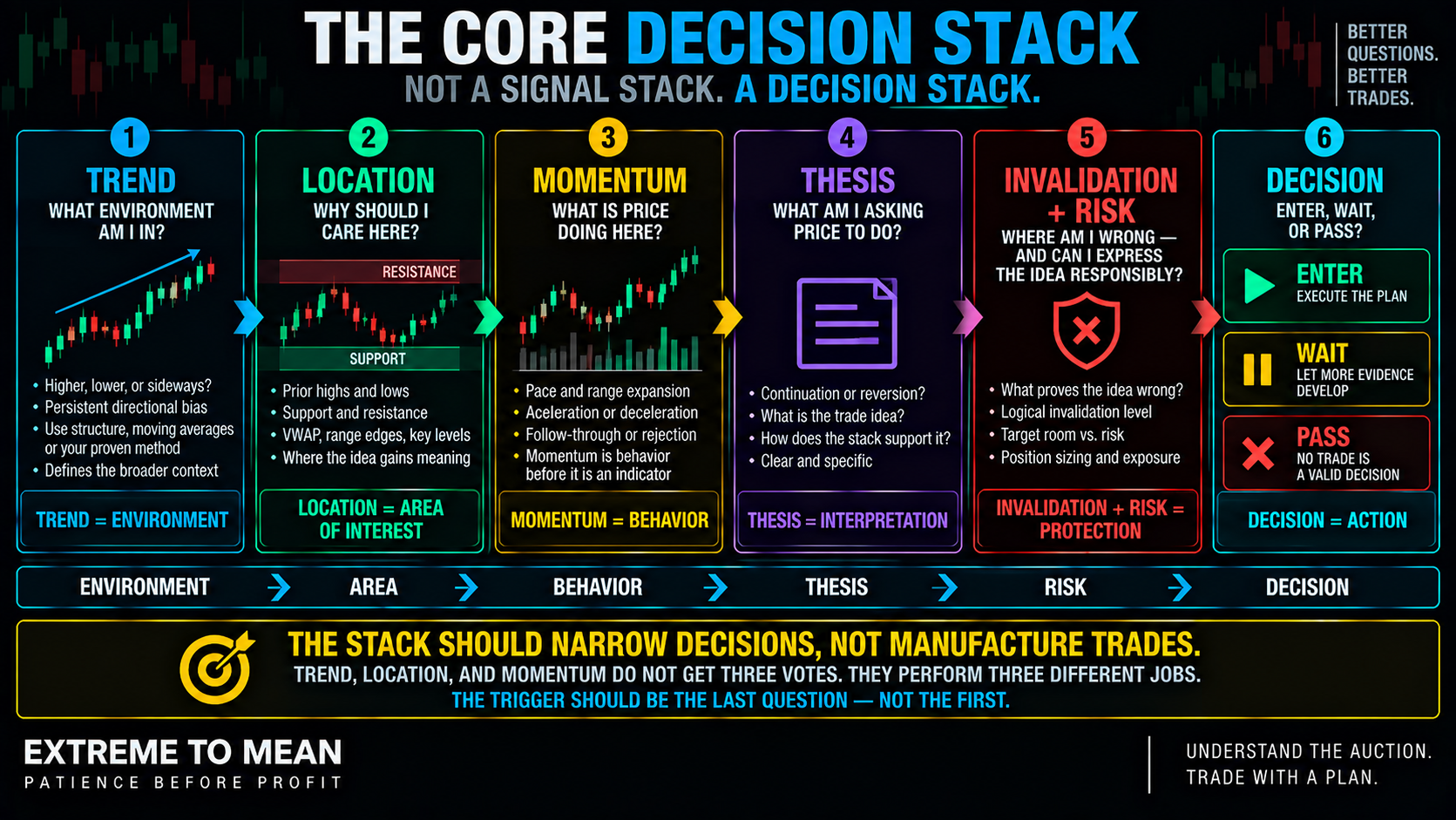
The Stack Is About Roles, Not Three Signals Agreeing
The Decision Stack is not asking for three bullish lights or three bearish lights. It asks whether three different pieces of information form one coherent trade thesis, which is why a setup is not a signal. Trend, location, and momentum can perform their jobs correctly even when they do not all point in the same direction.
A continuation trade might combine an uptrend, a pullback into prior structure, and renewed bullish pressure. A reversion trade could use the same stack differently: the uptrend establishes the environment, an extreme location defines the stretch, and contracting upside momentum supports a temporary reversion thesis. Different strategy, same decision architecture, and neither requires the three layers to vote in the same direction.
Trend therefore should not automatically veto mean reversion. A countertrend trade is asking price to do something different from a continuation trade, so the broader trend changes the context and expectations rather than simply turning the idea off. The stack organizes information inside the strategy; it does not choose the strategy for you.
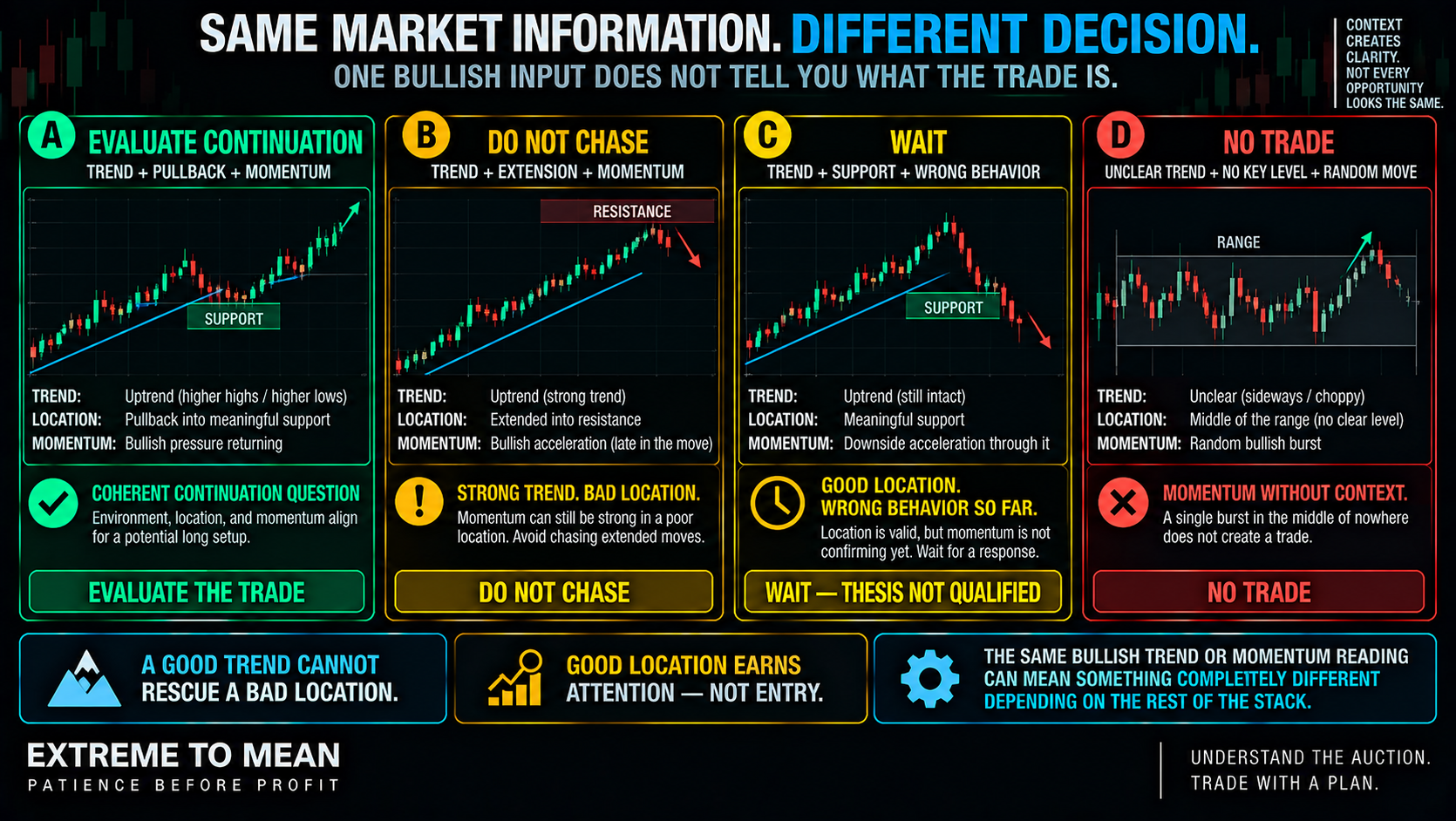
Same Information, Different Outcome
A strong uptrend plus strong bullish momentum can still be a poor trade when price is already extended into major resistance. The same uptrend can produce a cleaner continuation idea after a controlled pullback into a meaningful reference. A good trend cannot rescue a bad location.
Price can also arrive at excellent support while downside momentum expands through the level with no meaningful response. In that case, the location did its job by telling the trader where to watch, but the best decision may still be to wait. Good location earns attention—not entry.
A large bullish momentum burst in the middle of a range presents the opposite problem. Without meaningful location, a defined thesis, or sensible invalidation, fast movement may be nothing more than chasing pressure. Fast movement is not useful merely because it is fast.
From Observation to Thesis, Invalidation, and Risk
Trend, location, and momentum are still not the trade. They should lead to a thesis that states what the trader is asking price to do, such as resume a broader trend after a pullback or temporarily revert after an extreme extension. The chart gives us observations; the thesis is our interpretation of those observations.
A thesis then needs invalidation. If supposed support fails and price accepts below it with renewed downside pressure, the long idea may no longer make sense; if a reversion thesis depends on momentum stalling but price keeps accelerating away, the idea may be premature or wrong. If the stack gives you a story but no place where the story is wrong, you still do not have a complete trade.
Only after invalidation is clear should the trader evaluate target room and financial risk. A directionally reasonable trade can still be unattractive if resistance is too close, invalidation is too far away, or position size cannot make the risk acceptable. Market structure defines the idea; the account determines how much exposure can responsibly express it.
Wait and Pass Are Real Decisions
A useful framework should not force every analysis to end with a position. Trend may be favorable and location may be excellent while momentum has not yet responded, so the correct answer can simply be wait. A framework that cannot tell you to wait is not really filtering anything.
The stack can also say pass because trend is unclear, location is poor, behavior contradicts the thesis, invalidation is vague, or risk is unacceptable. That is not failed analysis; the goal is to improve the decision, including the decision not to trade. Patience becomes easier when you know exactly what information is still missing.
The ETM Core Decision Stack
Use the stack as a sequence of questions rather than a confluence score. Each layer should narrow the decision until the trader either has a coherent thesis or enough evidence to wait or walk away. The trigger should be the last question, not the first.
- Trend — What environment am I in?
- Location — Why should I care here?
- Momentum — What is price doing here?
- Thesis — What am I asking price to do?
- Invalidation — What proves the idea wrong?
- Room — Does the trade have somewhere logical to go?
- Risk — Can I express the idea responsibly?
- Decision — Enter, wait, or pass.
The condensed version is Trend → Location → Momentum → Thesis → Risk → Decision. The tool is not the layer; the market question is the layer, so the framework can work with structure, price references, indicators, or direct observation without becoming dependent on one setup. That keeps the trader focused on evaluate → qualify → define risk → decide.
The better question is not, “Are trend, location, and momentum all bullish?” Ask instead what job each piece of information is doing and whether those pieces form one coherent thesis with a clear place to be wrong. That is the difference between narrowing a decision and manufacturing a trade.
Final Thought
Trend, location, and momentum become far more useful when they stop competing to be the signal. Trend establishes the environment, location narrows the chart to a place worth watching, and momentum shows how price is behaving once it gets there. Together they can create a thesis, but that thesis still needs invalidation, room, and acceptable risk.
The stack will not make every trade win, and it should not. Its job is to make chasing harder, separate an interesting chart from a qualified opportunity, and make wait or pass legitimate outcomes when information is incomplete. Use it to make fewer, cleaner decisions in the right order, which is the process-first philosophy behind the broader Extreme to Mean system.
Educational content only. Trading involves substantial risk and is not suitable for everyone.