
“Triple witching” sounds like a warning label. Traders see the phrase on a quarterly Friday and often assume the market is about to become chaotic simply because several derivatives are expiring at once.
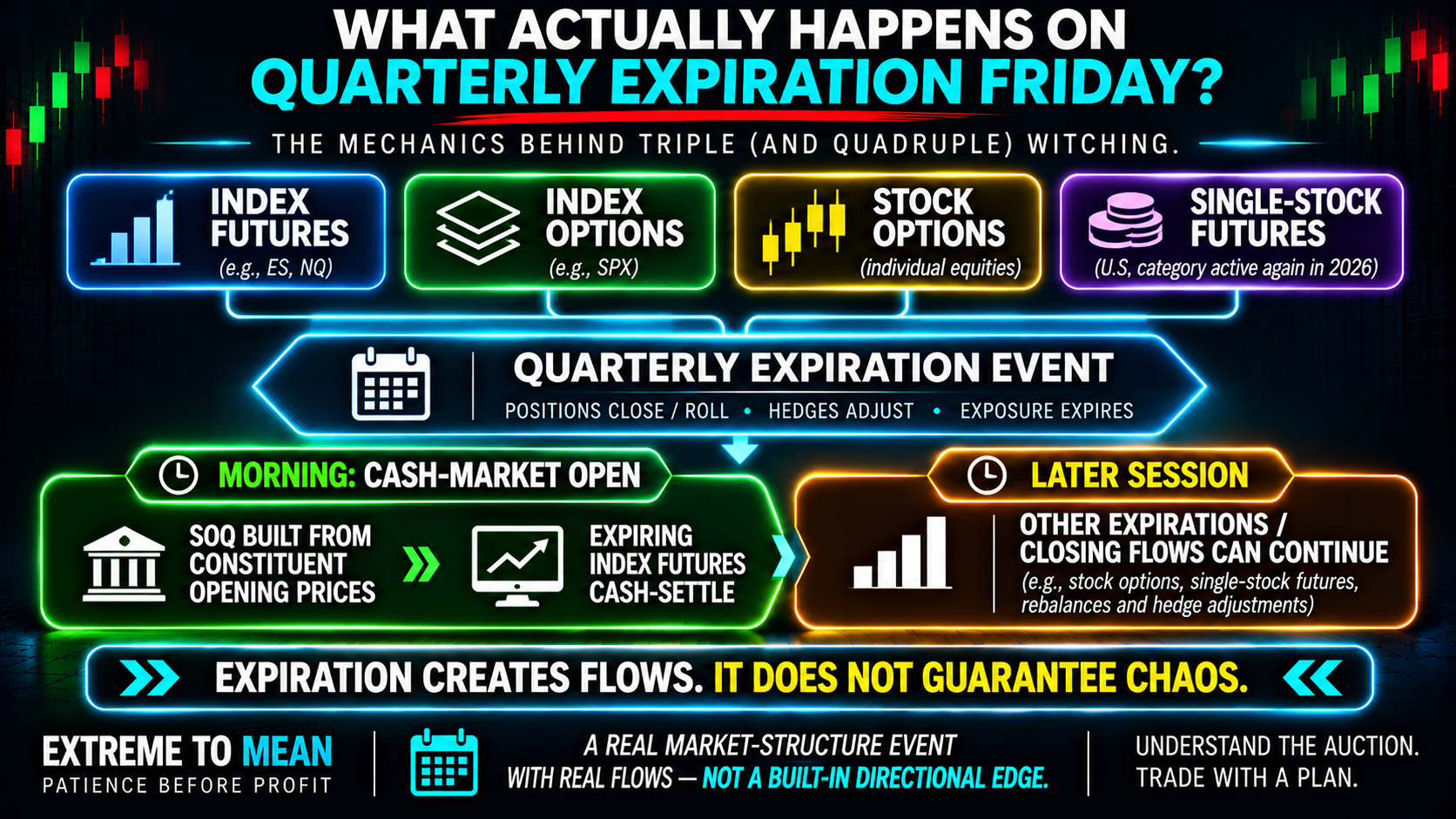
Expiration creates flows. It does not guarantee chaos.
Quarterly expiration is a real market-structure event. Index futures expire, index and stock options can expire around the same calendar event, positions are closed or rolled, hedges are adjusted, and unusual opening or closing volume can appear. The mistake is turning those mechanics into a directional forecast before price has done anything.
That is why this lesson belongs inside The Basics. The better question is not, “Is triple witching bullish, bearish, or dangerous?” It is: Which behavior comes from expiration mechanics—and which behavior are traders simply attributing to the calendar afterward?
What Is Triple Witching?
Traditionally, triple witching refers to the quarterly convergence of three derivative expirations: stock-index futures, stock-index options, and individual stock options. The familiar cycle is March, June, September, and December, generally around the third Friday, subject to exchange calendars and holiday adjustments. The “witches” are derivative expirations—not mysterious forces entering the market.
Triple vs. Quadruple Witching: What Changed Again in 2026
Historically, quadruple witching added a fourth category: single-stock futures. That fourth U.S. category disappeared after OneChicago shut down in 2020. The market structure changed again in 2026.
CME launched U.S. Single Stock futures in July 2026, with quarterly March, June, September, and December contracts that terminate on the third Friday. That makes “quadruple witching” technically meaningful again when those contracts expire alongside the traditional three categories. What matters is knowing which products are expiring and how each one settles.
The Quarterly Futures Cycle Comes Before Expiration Friday
Major U.S. equity-index futures such as ES and NQ use the familiar March, June, September, and December quarterly cycle. But activity usually begins shifting before the expiring contract reaches its final day. A contract can still exist after a later expiration becomes the one most traders use.
This is the distinction developed in Futures Rollover Explained. Rollover is the trader moving exposure from the old contract into a later one; expiration is the old contract reaching the end of its life. Roll week is the migration. Expiration is the destination.
CME publishes a customary equity-index roll date on the Monday before quarterly expiration, while also noting that traders can roll whenever they choose. After that date, the second-nearest expiration is commonly treated as the new lead month because the old contract is nearing termination and typically becomes less liquid. The busiest contract can change before the old contract is finished.
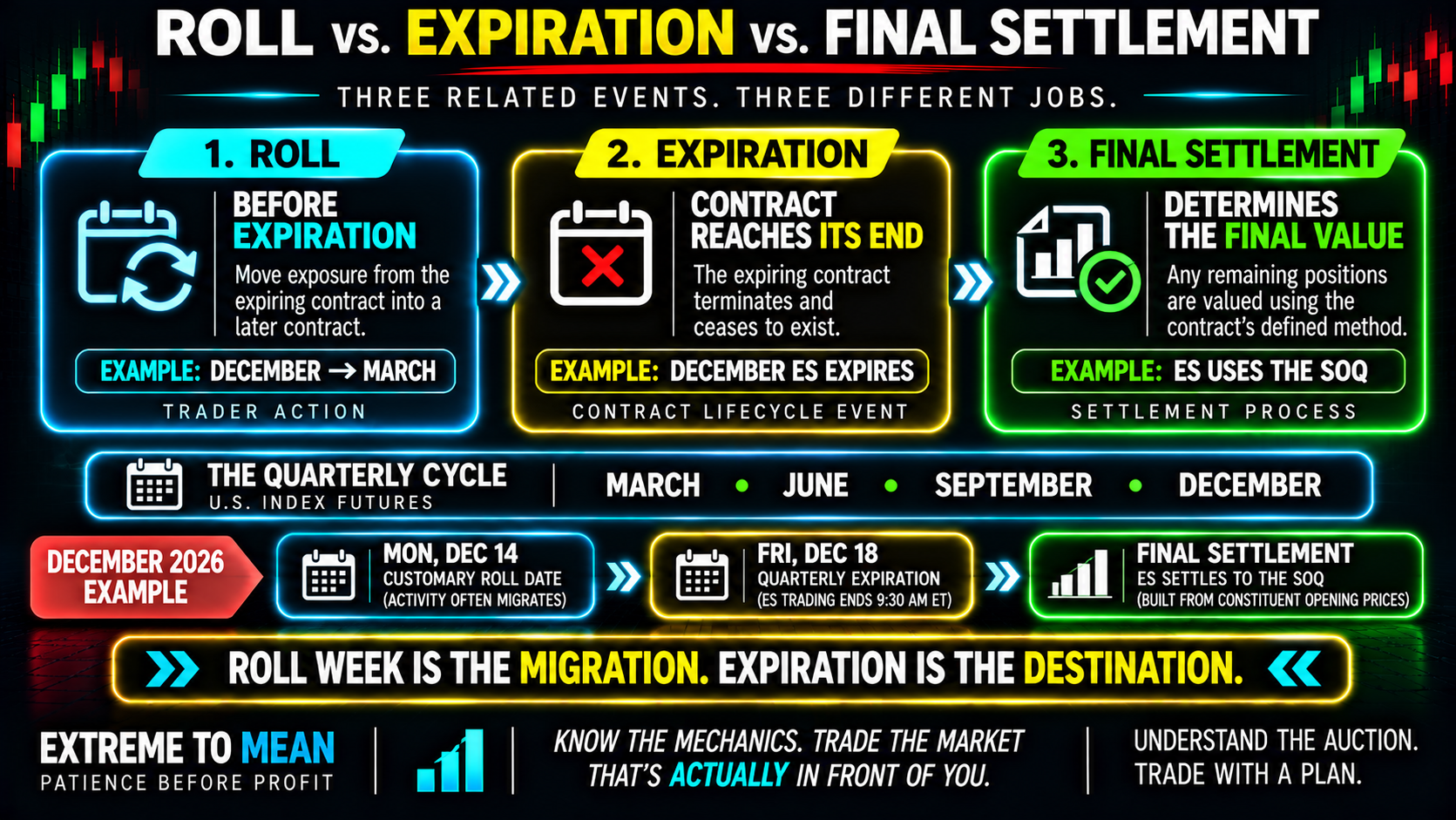
A flat day trader may simply switch to the new lead month once activity migrates. Around expiration, volume and open interest help show where trading is concentrating and how much exposure remains outstanding.
What Actually Happens to ES at Expiration?
Quarterly E-mini S&P 500 futures are cash settled. Holding an expiring ES contract does not result in delivery of 500 stocks; any remaining position is financially settled using the contract's defined final settlement methodology. Index futures expire into a calculation—not physical stock delivery.
For quarterly ES, trading can continue until 8:30 a.m. Chicago time, or 9:30 a.m. Eastern, on the third Friday of the contract month. That exact termination time belongs to this contract specification, not every futures product. Expiration mechanics are contract specifications—not market folklore.
The expiring ES contract's final value is determined through the Special Opening Quotation, or SOQ, of the S&P 500. The SOQ is built from the official opening prices of the constituent stocks in the index. It is not simply the first S&P 500 index value that flashes on the screen at 9:30.
Why the SOQ Is Not the 9:30 Index Print
Not every S&P 500 stock establishes its official opening trade at exactly 9:30:00 a.m. Eastern. Some stocks open quickly, while others take longer. The intraday index can therefore begin calculating while some constituents are already trading and others still reflect prior prices.
The SOQ works differently. It uses the official opening price for each constituent regardless of when that stock opens, so the calculation is assembled from opening prices rather than frozen at one clock second. The regular index asks, “Where are the stocks now?” The SOQ asks, “Where did each stock officially open?”
CME notes that the SOQ can differ from the ordinary opening index value and can even fall outside the cash index's reported high-low range for the session. A settlement value can be economically real without representing one moment when all 500 stocks traded at those prices together. The cash-market open therefore becomes part of the futures settlement machinery.
Daily Settlement and Final Settlement Are Different Jobs
The word settlement causes another common misunderstanding. Futures have a daily settlement process used for mark-to-market, P&L, and margin purposes, while final settlement closes the expiring contract at the end of its life. Daily settlement happens routinely; final settlement belongs to expiration.
Options and single-stock futures add another layer because not every derivative uses the same clock. Standard third-Friday SPX options are AM-settled, Cboe also lists SPXW expirations that use PM settlement, and CME's current Single Stock futures terminate at 4:00 p.m. Eastern on their third-Friday expiration. “Expiration Friday” is not one universal settlement moment.
That is why a morning-settled index futures contract can be finished while other expiration-related activity continues through the session. Stock options, single-stock futures, rebalances, and other flows can contribute later. Witching activity does not magically end at 9:30.
Why Expiration Can Create Heavy Volume
Quarterly expiration can generate real transactions. Participants may close positions, roll exposure, unwind hedges, rebalance portfolios, adjust options hedges, or execute opening and closing orders tied to settlement. Those flows can appear across futures, options, ETFs, stocks, and single-stock futures.
This is where volume and liquidity matter. High volume tells you that a great deal of trading occurred; it does not tell you that price must travel far or in one direction. Large expiration-related flows can be absorbed by deep liquidity and leave a surprisingly ordinary range.
Options hedging can also contribute as positions expire and hedge requirements change. But “dealer gamma” is not a universal directional signal, and unusual candles should not automatically be blamed on options dealers. Expiration can change hedging demand without creating a guaranteed trade.
Does Triple Witching Really Mean More Volatility?
Historically, the phrase became associated with abnormal activity near the market close. U.S. index-futures settlement was moved from the close to the open in 1987 in part to reduce that concentration. Research by Stoll and Whaley found that after the change, effects at the close became smaller while more activity and some price effects shifted toward the opening process.
Expiration is more reliably associated with unusual activity and elevated volume than with guaranteed abnormal volatility, trend, or reversal. More expiration-related trading does not automatically mean more directional chaos. A calendar event can change market mechanics without creating directional edge.
The better question is: What mechanical flows are plausible today, and what is price actually doing while those flows occur? That keeps the calendar in its proper role as context instead of turning it into a signal.
December 2026: A Useful Calendar Example
For the December 2026 U.S. equity-index quarterly cycle, CME lists Monday, December 14, 2026 as the customary roll date and Friday, December 18, 2026 as quarterly expiration. Actual activity can migrate earlier or later, so use the published date as a reference and actual volume to identify the active contract.
Imagine that Friday morning. December ES is approaching final settlement, March ES is already the newer lead contract, and the cash market is entering the SOQ process. Trader A says, “Witching day—everything is going to be crazy,” then starts chasing every large candle.
Trader B checks the active contract, knows what is expiring, understands the 9:30 a.m. Eastern termination and SOQ mechanics for quarterly ES, and checks for separate macro news. Trader B does not infer direction from the calendar. Trader A treats expiration as a prediction. Trader B treats expiration as context.
The Quarterly Expiration Checklist
Before trading a quarterly expiration session, ask:
- Which contract is actually expiring?
- Has volume migrated to the next contract?
- What is the current customary roll date?
- What time does this specific contract stop trading?
- How is its final settlement calculated?
- What other derivatives are expiring that day?
- Is there a separate macro event that could also move the market?
- Is volume unusual relative to normal conditions?
- Am I assuming high volume means high volatility?
- Am I using expiration as context—or as a directional prediction?
A practical place to check the broader schedule is the market calendar, but the calendar should begin the investigation rather than finish it. Better preparation combines the date, contract specifications, volume migration, settlement method, and actual behavior.
The ETM Calendar → Contract → Settlement → Flow → Behavior Framework
Use CALENDAR → CONTRACT → SETTLEMENT → FLOW → BEHAVIOR. Identify the expiration session, exact contract, active volume, settlement method, and likely rolls, hedges, or rebalances. Then evaluate what the market is actually doing.
The possible decisions remain TRADE / WAIT / PASS based on the setup in front of you—not WITCHING → PREDICT VOLATILITY. Know the mechanics before interpreting the movement. Expiration changes the plumbing; it does not dictate the direction of the water.
Final Thought
Triple witching sounds dramatic, but the underlying mechanics are understandable. Quarterly index futures, index options, stock options, and now single-stock futures can all reach expiration around the same quarterly event. Those mechanics can create unusual volume and flow without producing an extraordinary candle.
For major U.S. equity-index futures, final settlement can depend on a Special Opening Quotation built from constituent opening prices rather than the first index print at 9:30. Rollover, expiration, daily settlement, and final settlement are related events with different jobs. High volume is not guaranteed high volatility, and a calendar event is not directional edge.
Treat expiration as market context, verify the exact contract mechanics, and let actual price behavior decide whether there is a trade. The calendar tells you what may be happening mechanically; price tells you whether the setup deserves risk.
Educational content only. Trading involves substantial risk and is not suitable for everyone.