
Most beginners focus only on price. They look at whether price is going up, going down, moving fast, or sitting still. That makes sense because price is the most visible part of the chart.
But price does not move in a vacuum.
Behind every price move, there is trading activity. Buyers and sellers are interacting. Orders are being placed, filled, canceled, adjusted, or ignored. Some markets have heavy participation and tight execution. Others can move sharply because there are fewer buyers and sellers available at key prices.
That is why volume and liquidity matter. They do not tell a trader what will happen next. They help the trader understand the environment around the price movement. At Extreme to Mean, this belongs in The Basics lesson library because volume and liquidity prepare readers for later lessons on bid, ask, spread, slippage, execution quality, and market context.
Volume Means How Much Trading Happened
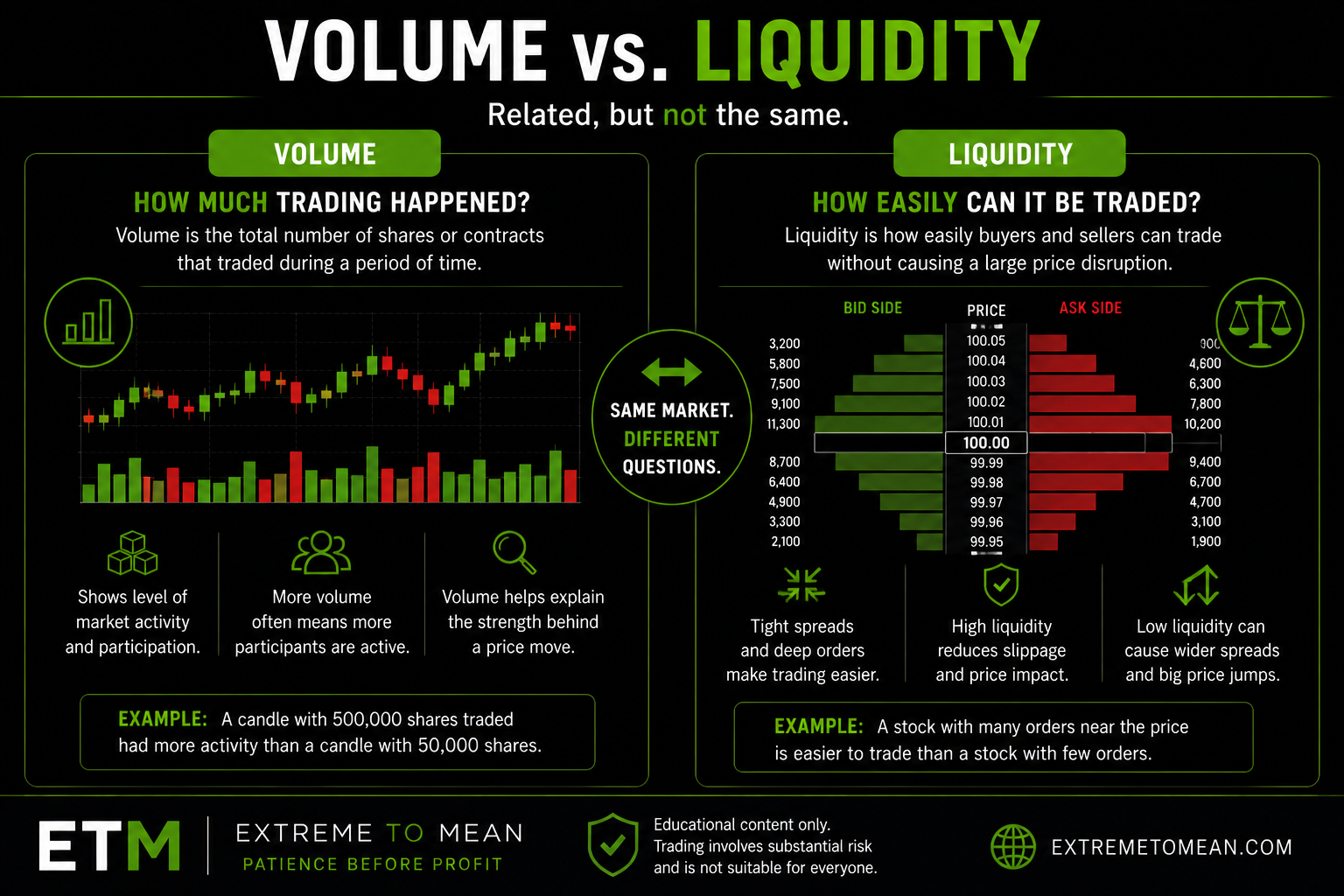
Volume is the amount of trading activity during a specific period.
In stocks and ETFs, volume usually refers to how many shares traded. In futures, it usually refers to how many contracts traded. The idea is simple: volume helps show how active the market was during a candle, a session, a day, or another measured period.
If a stock trades 10 million shares in a day, that is its daily volume. If a five-minute candle shows 50,000 shares traded, that is the volume for that five-minute period. If a futures contract trades heavily during the regular session, that volume shows active participation during that window.
Volume answers the question: “How much trading happened here?”
It does not automatically answer why the trading happened. A high-volume move may be caused by news, earnings, or economic data changing market behavior, institutional activity, forced selling, aggressive buying, or a major shift in expectations. A low-volume move may happen during a quiet session, during extended hours, or in a product with fewer participants.
Volume gives useful information, but it needs context.
A large volume bar can show that a lot of trading occurred, but it does not tell the trader by itself whether the move was a good trade, a bad trade, a trap, a breakout, a reversal, or noise. The trader still has to evaluate where volume occurred across price, what price did after it appeared, and whether the movement matters within the larger chart.
This connects directly to the earlier lesson on buyers, sellers, and price. Volume is one way to see that participation is happening, but price still moves based on how buyers and sellers interact at different levels.
Liquidity Means How Easy It Is to Trade
Liquidity describes how easily something can be bought or sold without causing a large price disruption.
A liquid market has enough buyers and sellers available that trades can usually happen near the current price. There is active participation. Orders can often be filled more smoothly. The difference between where buyers are willing to buy and sellers are willing to sell is often tighter.
A less liquid market can behave differently. There may be fewer buyers and sellers available. The difference between buying and selling prices may be wider. A larger order may push price more because there is not enough available interest at nearby prices.
Liquidity answers the question: “How easily can trading happen here?”
This is different from volume. Volume tells you what traded. Liquidity tells you how available trading is around the current price. Traders who need the next distinction can compare volume at price with time at price.
A market can show high volume during a sudden emotional move but still feel difficult to trade cleanly. A product can have decent average volume but poor liquidity at certain times of day. A stock may be liquid during the regular session but less liquid before the open or after the close.
That is why liquidity is not just a number on a screen. It is part of the trading environment.
For a beginner, the easiest way to understand liquidity is to imagine a busy doorway. If many people are moving through the doorway in an organized way, entry and exit may be smoother. If only a few people are available and the doorway is narrow, trying to move through quickly can create problems. Markets are not doorways, but the basic idea helps: participation affects how easily movement happens.
Volume and Liquidity Are Related, but Not the Same
Volume and liquidity often connect, but they are not identical.
High-volume markets are often more liquid because more participants are active. But that is not always enough. Liquidity depends on how many buyers and sellers are available near the current price, how deep the order book is, how wide the spread is, and how quickly conditions are changing.
A market can have high volume during a major news event and still move violently. Many trades may occur, but price may jump from level to level because orders are being consumed quickly. In that situation, volume is high, but execution may still be difficult.
A market can also have low volume but appear stable for a while. That does not always mean it is safe or easy to trade. If a large order arrives in a thin market, price may move quickly because there are not enough opposing orders nearby.
This is where beginners can get confused. They may see “high volume” and assume the market is clean. Or they may see a quiet chart and assume it is controlled. Neither assumption is reliable by itself.
The better question is not, “Is volume high?”
The better question is: “Is there enough participation and liquidity for this price movement to matter, and can the trade be evaluated cleanly?”
That question keeps the trader focused on decision quality instead of reacting to one piece of information.
Why Liquidity Changes Across the Trading Day
Liquidity can change depending on the session, the product, the news environment, and the time of day.
The regular session for U.S. stocks usually has broader participation than pre-market or after-hours trading. More participants are active, more orders are available, and price discovery may be more organized. Extended-hours periods can still matter, but they may have thinner participation and wider spreads.
That is why the earlier lesson on what a trading session actually is matters. A move during pre-market may not carry the same participation as a move during the main session. A level formed after-hours may be useful, but it should be evaluated with awareness of when it formed.
Liquidity can also change around news. Before a major economic report, some participants may step back. After the report, orders may rush in quickly. Spreads may widen. Price may jump. Volume may increase, but that does not automatically mean the environment is clean.
A beginner might see a fast move and think, “This is where the action is.” That reaction feels reasonable because active markets get attention. But fast movement can also create poor execution, emotional decisions, and unclear risk.
At Extreme to Mean, movement alone is not enough. A setup earns attention before it earns risk. Liquidity is part of that evaluation because a trader needs to understand not just where price is, but how the market is behaving around that price.
Why This Matters for Execution
Execution means the actual process of getting into or out of a trade.
Beginners often think of trading as simple: choose buy or sell, press the button, and get the price they expect. In very liquid markets under normal conditions, execution may feel close to that. But not every market or moment behaves that cleanly.
If liquidity is thin, the trader may not get filled exactly where expected. The price may move before the order is completed. The spread may be wide. A market order may fill at a less favorable price than the trader saw a moment earlier. This is how thin liquidity can create slippage: the difference between expected price and actual fill price.
This is why liquidity prepares traders for the next layer of market mechanics.
Volume helps show participation. Liquidity affects how easily orders can interact with that participation. Spread, bid, ask, and slippage are all connected to this. A trader does not need to master every execution detail immediately, but they should understand that the chart price and the trade fill are not always the same experience. This is also why order type matters in liquid and thin markets.
This matters for risk management. If a trader cannot reasonably understand how a trade may be entered and exited, the decision is incomplete. A chart may look interesting, but poor liquidity can make the trade harder to manage.
The lesson on long and short trade direction explains whether a trade benefits from price rising or falling. Volume and liquidity add another question: even if the direction idea is clear, can the trade be executed and managed in a reasonable environment?
Volume Does Not Automatically Confirm a Good Trade
One common mistake is treating volume like a green light.
A trader may see a large volume bar and assume the move must be important. Sometimes it is. But volume only says activity happened. It does not tell the trader whether the activity was clean, late, emotional, forced, or sustainable.
A high-volume candle after a long move may mean many traders are rushing in late. A high-volume flush may show panic, liquidation, or aggressive selling, but it may also occur near an area where buyers start responding. A low-volume pullback may be harmless in one market and weak in another.
The meaning depends on context.
This is why volume should be read with price, location, and structure. Where did the volume appear? Did price accept the new level or reject it? Did the move happen near an important area? Was the market already extended? Was liquidity normal, thin, or changing?
The trader’s job is not to worship volume. The trader’s job is to use volume as one piece of information inside a larger process.
That is the difference between reacting and evaluating.
A Simple Volume and Liquidity Filter
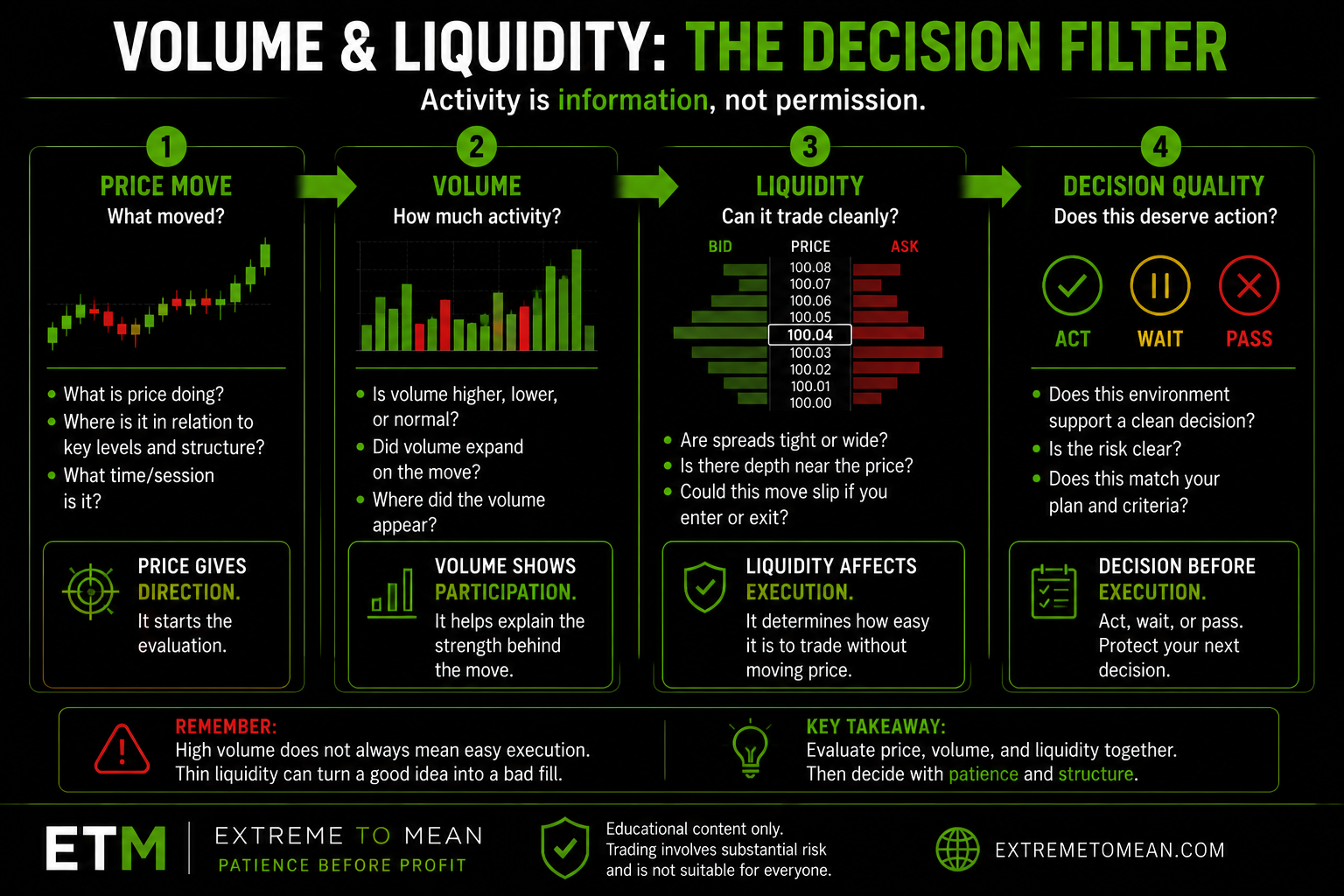
Before acting on a price move, a beginner can ask a few simple questions.
Start with these:
- Is this market actively trading right now?
- Is volume higher, lower, or normal compared with the surrounding candles?
- Is the move happening during the regular session or extended hours?
- Does the move look supported by broad participation, or does it look thin?
- Are spreads tight or wide?
- Could entering or exiting be harder than the chart makes it look?
- Am I treating volume as confirmation, or as information?
- Does this environment support a clean decision?
These questions do not predict the next move. They help the trader understand the conditions around the move.
The better question is not, “Is there volume?”
The better question is: “Is the activity meaningful, liquid enough, and clear enough to support the decision I am considering?”
That question is slower, but it is cleaner. It keeps the trader from chasing movement just because the market looks active. It also helps the trader avoid assuming that every product, session, or candle behaves the same way.
For newer readers, the best next step is to start with the beginner trading path.
From there, move into what bid, ask, and spread mean, slippage, and execution quality.
Final Thought
Volume and liquidity are basic market mechanics.
Volume tells you how much trading happened. Liquidity tells you how easily trading can happen near the current price without major disruption. They are related, but they are not the same.
A market can be active and still difficult to trade cleanly. A chart can move quickly and still offer poor information. A price level can matter more during one session than another because participation and liquidity can change.
The better trader does not ask only, “Is price moving?” The better trader asks, “How much trading is happening, how liquid is the environment, and does this support a clear decision?”
That is how volume and liquidity become part of a better process.
Educational content only. Trading involves substantial risk and is not suitable for everyone.