
Many traders assume that a series of difficult trades means the strategy must be broken. They begin searching for a different indicator, a faster entry, a tighter filter, or an entirely new market to trade. Sometimes the method does need work, but the strategy is often blamed before the trader reviews whether its rules were actually followed. A method cannot be evaluated clearly when the execution changes from one trade to the next.
The lessons in The Trader category focus on this gap between knowing the rules and applying them under pressure. A trader may understand the setup, recognize the location, and repeat the risk plan accurately while calm. The problem appears when price begins moving and the outcome becomes uncertain. At that point, impatience, fear, frustration, and urgency can quietly replace the process the trader intended to follow.
Strategy Is Only One Part of the Decision
A strategy should define the type of opportunity the trader is looking for. It may describe the appropriate market condition, meaningful location, required response, invalidation point, and available room. Those rules give the trader a framework for deciding when a setup deserves attention and when it may deserve risk. They do not place the trade, control the size, or prevent the trader from acting outside the plan.
A strategy may contain sound logic and still produce unreliable information when the execution is inconsistent. One trade may be entered at the intended location, while the next is chased after price has already moved. One position may use planned risk, while another is given extra room because the trader does not want to accept the loss. Understanding what an edge actually is requires recognizing that the repeatable idea and its repeatable execution must be evaluated together.
Why the Strategy Gets Blamed First
Blaming the strategy can feel reasonable because it moves the problem away from the trader’s decisions. Changing an indicator or setup rule feels more concrete than examining impatience, fear, or inconsistent risk. The trader can return to research with the belief that a technical improvement will solve the discomfort experienced during execution. This response creates action and hope, even when it does not address what actually changed during the trades.
The weaker explanation also protects the trader from admitting that the rules were clear but not followed. That admission can be uncomfortable because it means a new system may not solve the real problem. The previous lesson on why simple trading is not easy trading explains why clear rules can make the execution gap easier to see. When the process is simple, there are fewer technical details available to hide an early entry, a widened stop, or an unnecessary trade.
Impatience Changes the Setup
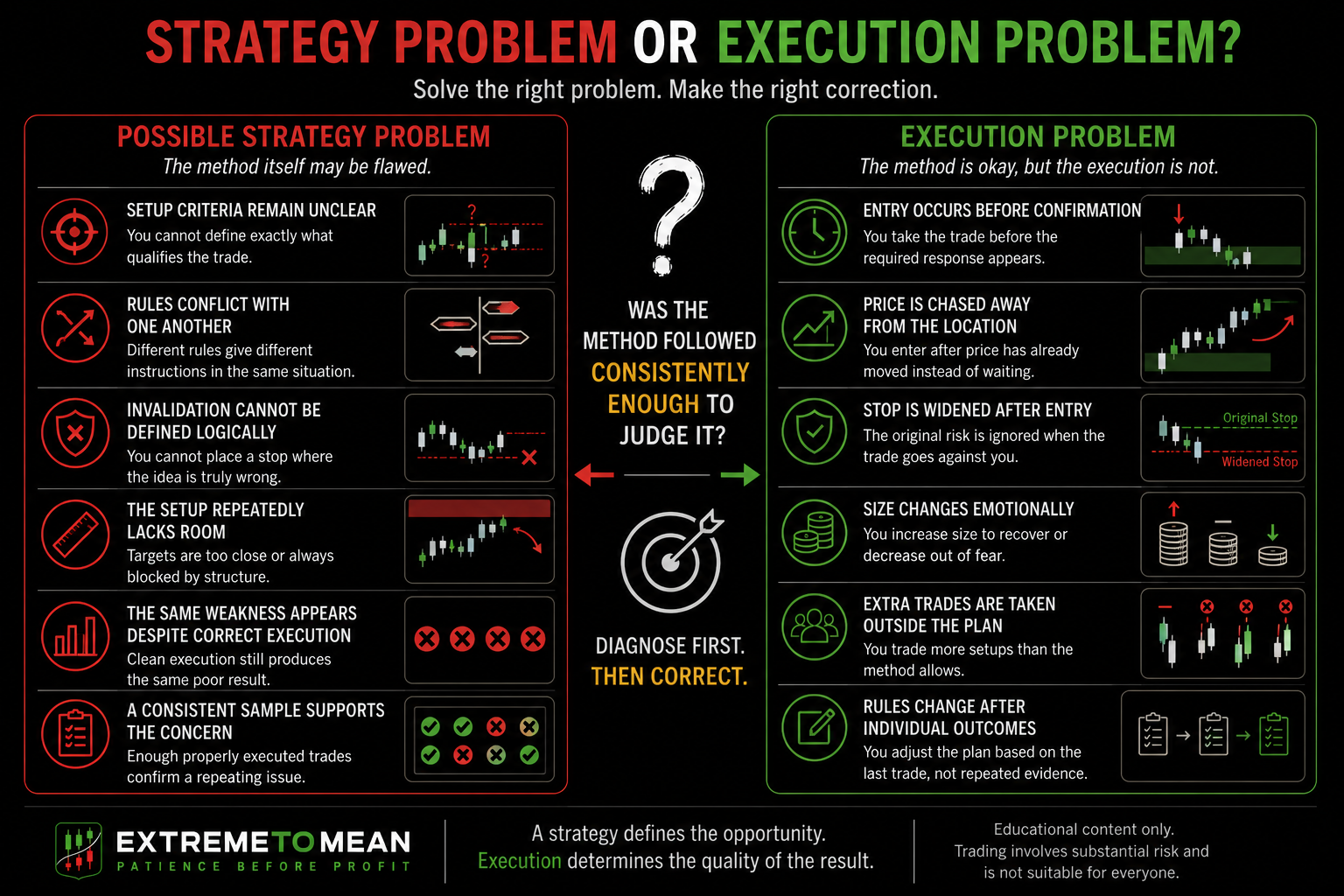
Impatience does more than cause a trader to enter a few seconds early. It can change the location, remove the required confirmation, reduce the available room, and turn a planned setup into a reaction to movement. The trader may still use the strategy’s name, but the trade no longer contains the conditions that originally defined it. A setup recognized on the chart has not necessarily been qualified for participation.
The impatient entry feels justified because waiting creates the possibility that the move will happen without the trader. As price accelerates, incomplete evidence begins to feel more persuasive and the original entry standard starts to feel overly cautious. The trader acts to avoid missing the opportunity, then evaluates the strategy based on a trade the strategy may never have authorized. The market outcome receives the blame even though the decision process changed before the order was placed.
Poor Risk Control Distorts the Evidence
Risk management is part of strategy execution, not a separate concern that begins after entry. A trader who changes position size emotionally, widens stops, or refuses the planned invalidation is no longer testing the original method. The outcome now reflects both the setup and the unplanned exposure attached to it. That makes it difficult to know whether the strategy, the risk decision, or both created the problem.
This is why protecting your next decision matters more than defending the current trade. A planned loss has a defined boundary, while an improvised loss can continue consuming attention and changing behavior. Once risk is no longer controlled, the trader may rush the next setup, increase size to recover, or avoid a valid trade out of fear.
One decision then affects the quality of several decisions that follow, which is exactly the pattern a trader has to interrupt when trying to restore confidence after a string of losses.
Overtrading Changes the Sample
A strategy designed for selective conditions cannot be judged from trades taken whenever the market moves. Overtrading adds lower-quality locations, incomplete setups, and market conditions the method may not have been designed to handle. The resulting group of trades no longer represents one consistent process. It becomes a mixture of planned opportunities and reactions that happen to use the same account.
The more often a trader participates, the easier it becomes to believe that every result contains useful information about the strategy. In reality, poor-quality trades can overwhelm the smaller sample of decisions that actually followed the rules. A trader struggling with this pattern should examine the process behind trading too much, not merely the total number of losses. Frequency becomes a strategy problem only when the planned method genuinely requires that level of participation.
Changing the Plan After Every Result
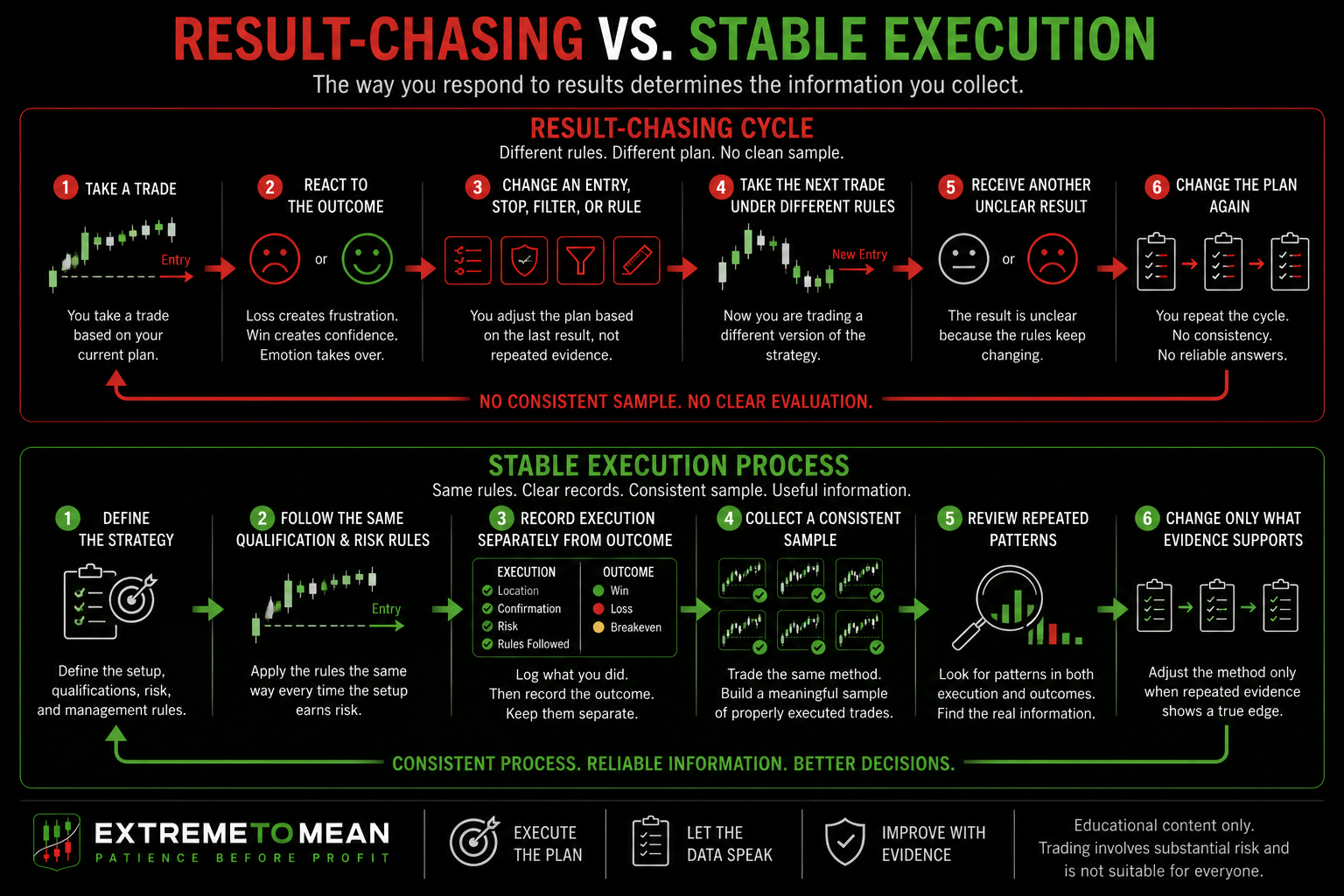
A single loss can make the entry appear too early, the stop too tight, or the setup filter too weak. A winning trade can create the opposite reaction by making loose execution look acceptable. When the method is changed after every result, the trader never collects enough consistent information to evaluate it. Each trade is taken under a slightly different version of the strategy.
This constant editing creates the feeling of improvement because the trader is always fixing something. The adjustments may be based on the most recent emotion rather than a repeated pattern across a meaningful sample. Losses create restriction, missed trades create looser rules, and favorable outcomes reinforce whatever happened to work that time. The strategy becomes a moving target that cannot be reviewed honestly.
A Cleaner Execution Process
A cleaner process begins by separating strategy rules from trader behavior. The strategy should explain what conditions qualify the trade, while the review should record whether those conditions were present and followed. This allows the trader to distinguish a valid setup that failed from an invalid trade that should not be counted as proper execution. The difference matters because those two outcomes teach different lessons.
The trader also needs a stable reference created before live pressure begins. A trading plan made before the open records the intended conditions, risk limits, and reasons to stand aside while thinking is clearer. It does not guarantee disciplined behavior, but it makes departures from the process easier to identify. The trader can then review what actually happened instead of reconstructing the rules around the final result.
A Better Question Before Replacing the Strategy
The question “Is this strategy working?” is too broad when execution has been inconsistent. A better question is, “Did I follow the same qualified process often enough to judge the strategy fairly?” That question does not excuse a weak method or prevent necessary changes. It simply requires the trader to separate technical evidence from behavioral noise before reaching a conclusion.
Before replacing or significantly changing a strategy, review the following:
- Were the trades taken in the market conditions the strategy was designed for?
- Did each trade begin at a meaningful location?
- Were setup recognition and trade qualification treated as separate steps?
- Was the required confirmation present before entry?
- Was risk defined and respected without being widened afterward?
- Were trades added because the setup qualified or because the trader wanted more action?
- Were the rules changed after individual results?
- Is there a consistent sample of properly executed trades to review?
These questions turn the review toward evidence rather than frustration. They may reveal a genuine weakness in the strategy, such as unclear qualification criteria or a condition that repeatedly fails to support the setup. They may also reveal that the method has not been followed consistently enough to evaluate. Both findings are useful because each points toward a different correction.
The review should record rule adherence separately from trade outcome. A losing trade can still reflect clean execution, while a favorable trade may have violated the plan in several important ways. When outcome and execution are graded separately, the trader becomes less likely to reward poor behavior merely because the trade worked. That creates a clearer record of whether the strategy or the decision process needs attention.
Final Thought
Strategy matters because a trader needs a logical and repeatable framework for evaluating opportunity and risk. Behavior matters because the framework cannot protect the trader when its rules are repeatedly ignored, changed, or applied selectively. A strategy should not be protected from honest criticism, but it should be tested under the conditions it was designed to use. Otherwise, the trader may discard a reasonable process without ever executing it consistently.
The goal is not perfect execution or the elimination of emotion. It is a decision process stable enough to reveal what actually happened and why. When qualification, risk, frequency, and review remain consistent, the trader can judge the strategy with better information. Until then, changing the method may only hide the same execution problem inside a new set of rules.
Educational content only. Trading involves substantial risk and is not suitable for everyone.