
New traders often speak about “the market,” “their broker,” and “their trading app” as though all three are the same thing. That confusion is understandable because one company may provide the account, platform, market data, order entry, and customer service inside a single website or application. From the trader’s perspective, everything appears to happen in one place.
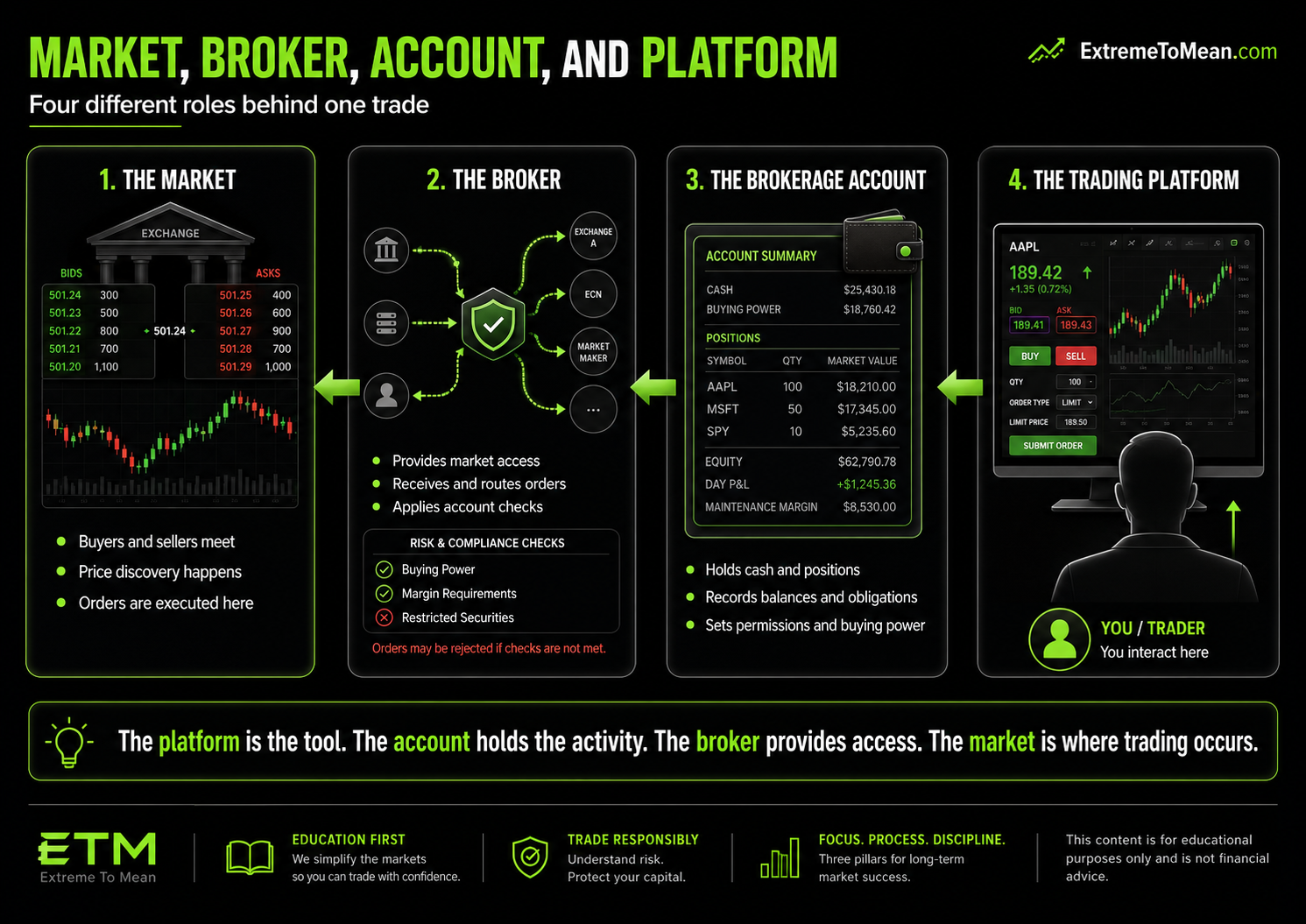
Behind that simple screen, however, several different functions are working together. The market is where trading interest meets, the broker provides access, the account records the customer’s money and positions, and the platform allows the trader to view information and submit instructions. Understanding those roles makes the entire trading process easier to follow.
A beginner does not need to become an expert in financial infrastructure before placing a trade. They should still know who is responsible for what, where their money is held, and what happens after they press Buy or Sell. This lesson belongs in the broader Basics learning path because choosing a broker and opening an account should come after understanding the purpose of a market—but before deciding what products to trade.
The Market Is Not the Broker
A market is the system in which buyers and sellers exchange financial instruments. Depending on what is being traded, that activity may occur on a formal exchange, through a network of dealers, or through another organized venue. Buyers communicate what they are willing to pay, sellers communicate what they are willing to accept, and transactions occur when compatible interest meets.
That interaction helps create the prices traders see on a chart. The market represents the broader system of participants, orders, liquidity, and transactions. It is not a single company controlling every price or deciding whether an individual trade succeeds.
A broker is different. A broker is a company that provides customers with access to financial markets. It receives the customer’s instructions, applies account and risk checks, and routes eligible orders toward a venue where they may be executed.
The broker does not create every market price, guarantee every fill, or determine whether a trade will be profitable. Its primary role is to connect the customer’s account and instructions with the infrastructure required to conduct the transaction. Readers who need the foundation behind that process should first understand how buyers, sellers, and price create a market.
What a Broker Actually Does
A broker may provide several services within one customer relationship. It can open and maintain accounts, verify identity, provide access to approved products, receive and route orders, apply buying-power or margin requirements, record positions, produce statements, and offer customer support. Some firms also provide research, live market data, educational tools, and trading technology.
The exact services depend on the broker, account type, and instruments being traded. The comparison of a personal account with a prop-firm account shows how access, risk, rules, and eligibility can differ even when the same futures market is traded. One broker may focus on stocks and options, while another may specialize in futures. Some firms provide their own platform, while others allow customers to connect approved third-party charting or order-entry software.
A futures trader, for example, may hold an account with one brokerage firm while using a separate platform connected to that account. The platform may look like the center of the experience, but the broker still maintains the customer relationship, applies account rules, and provides access to the supported market infrastructure.
This is why beginners should not evaluate a broker only by how attractive or easy the application looks. The visible interface is one part of the relationship. Product access, commissions, market-data costs, margin rules, order support, customer protections, outage procedures, and service quality also matter. The same custody question — who actually holds the asset, and under what protections — resurfaces outside brokerage accounts too, including in the article weighing Bitcoin against gold as monetary assets.
A clean interface can make trading easier to navigate, but it cannot replace an understanding of the rules underneath it. The trader should know not only what the app allows them to click, but what the broker permits the account to do.
What a Brokerage Account Is
A brokerage account is the financial account through which the customer holds cash, investments, open trading positions, and related obligations. It is not merely a username for a charting application. When the trader deposits money, enters or exits a position, pays commissions, receives proceeds, or carries an unrealized gain or loss, those changes are reflected in the account.
The account typically records available cash, buying power, open positions, average entry prices, realized and unrealized profit or loss, fees, margin requirements, deposits, withdrawals, and any applicable restrictions. It is the financial record of the customer’s activity with the broker.
Different accounts can have different permissions. One account may allow stock and ETF trading but not options, while another may be approved for only certain options strategies. Futures trading may require a separate account structure, additional approval, or a broker that specifically supports those products. Account access is not a given everywhere — banking and identification barriers are part of why Bitcoin adoption data in high-inflation economies is harder to interpret than it first appears.
The account therefore determines what the trader is actually permitted to do. A platform may display a market and provide a Buy button, but the order can still be rejected if the product is not approved, the position exceeds available buying power, the broker does not support that market, or an account requirement has not been satisfied.
This is why the brokerage account should be understood as the legal and financial container for the trading activity. The platform may provide the controls, but the account determines which instructions can be accepted and how the resulting activity is recorded.
The Trading Platform Is the Tool
The trading platform is the software the trader uses to view market information and interact with the brokerage account. It may provide charts, quotes, watchlists, order tickets, position data, profit-and-loss displays, alerts, news, technical indicators, risk controls, and account balances. The platform can be a desktop program, mobile application, browser-based service, or specialized professional interface.
The platform is where the trader sees and acts, but it is not necessarily where the money is held. It may simply be connected to the broker and account through an approved integration. Market data may also come from a separate provider, even though everything appears inside one screen.
This distinction becomes more important when multiple services are involved. A charting platform may provide advanced analysis while relying on another firm for brokerage access. The broker may maintain the account while using external technology for order routing, charts, or live quotes.
A useful way to separate the four roles is:
- The market: The system where buying and selling interest meets and transactions occur.
- The broker: The company that provides the customer with access and processes eligible instructions.
- The brokerage account: The financial record containing the customer’s money, positions, permissions, and obligations.
- The trading platform: The tool used to view information, monitor the account, and submit orders.
A trader may be able to change platforms without changing brokers, or change brokers while continuing to use similar charting software. The services can appear unified, but their responsibilities remain different.
What Happens When You Submit an Order
When a trader presses Buy or Sell, the transaction is not automatically complete. The platform first sends an instruction into the broker’s system. That instruction identifies the instrument, direction, quantity, order type, and any applicable limit price, stop price, time-in-force setting, or account condition.
The broker then checks whether the instruction is permitted. The system may evaluate account approval, available funds, buying power, margin requirements, product access, trading restrictions, and whether the order details are valid. An order that fails one of those checks may be rejected before it ever reaches the market.
If the order passes, the broker routes it toward an available execution venue. Depending on the product and market structure, that venue may be an exchange, dealer, market maker, or another source of liquidity. The order can then be filled completely, filled partially, left working, canceled, rejected, or triggered later if a specified condition is reached.
After execution, the brokerage account is updated. The position appears, the cash or buying-power figures change, and the trader receives confirmation showing what was bought or sold, the quantity, and the execution price or prices.
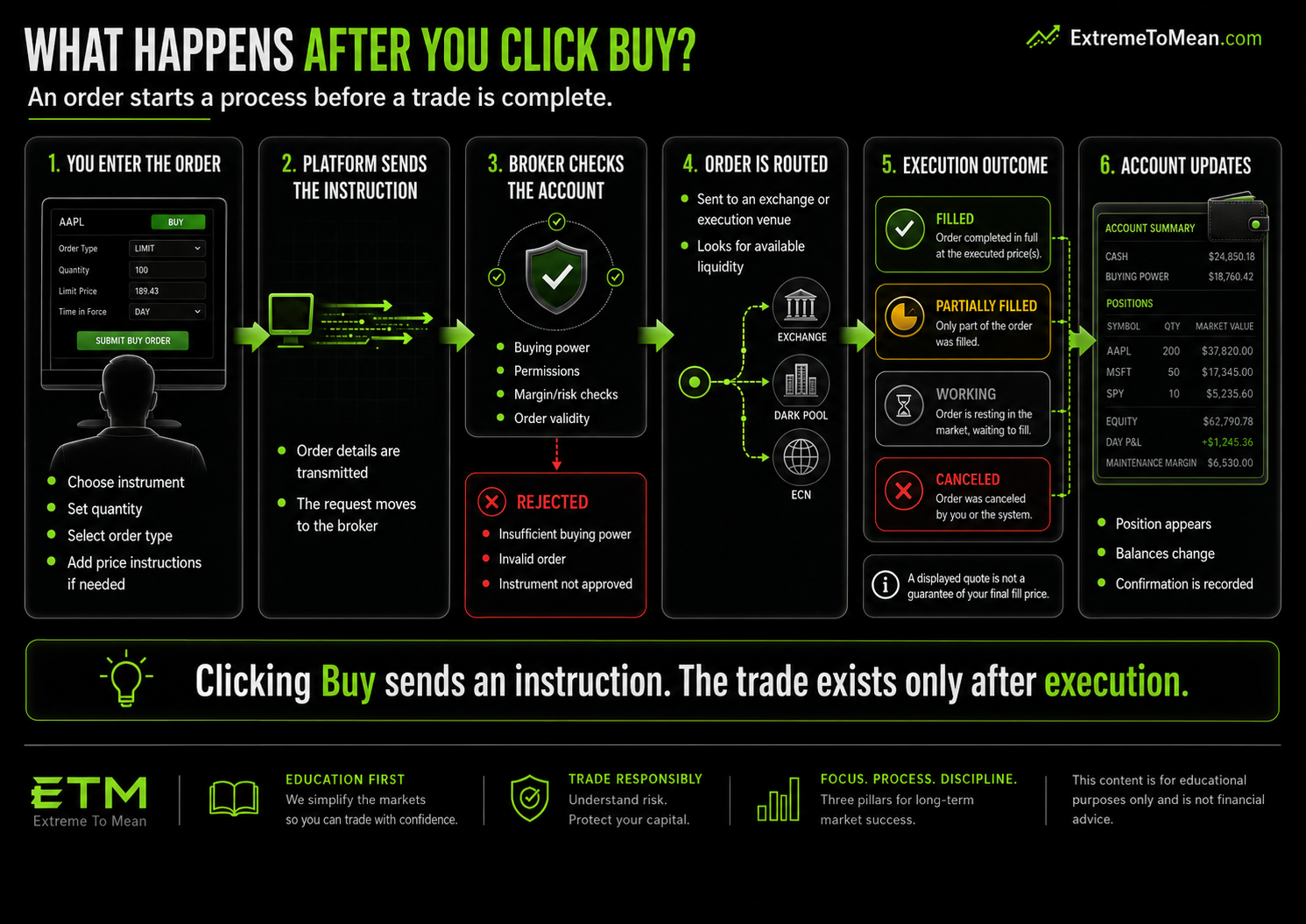
This process helps explain why the price visible on the screen is not always the exact price received. Quotes can change, liquidity can disappear, and different order types prioritize speed, price control, or a trigger condition. Understanding market, limit, and stop orders becomes easier once the trader recognizes that an order travels through a process rather than instantly becoming a completed trade.
Why Beginners Confuse the Pieces
Modern trading applications are intentionally designed to make the experience feel unified. The same screen may display charts, account equity, buying power, order buttons, open positions, news, and deposit controls. That convenience is useful, but it can hide the differences between the companies and systems involved.
A trader may assume the charting company holds the money, the broker controls the entire market, or the displayed quote guarantees execution. They may also assume that available buying power represents acceptable risk or that every feature visible on the platform is approved for their account.
Those assumptions can create avoidable mistakes. A trader may choose an account because they like the platform without confirming that the broker supports the desired instrument. They may begin trading without understanding commissions, market-data subscriptions, margin rules, or what happens when an order is rejected.
Technical access can also be mistaken for trade readiness. The platform may make buying or selling effortless, but the ease of submitting an order says nothing about whether the setup is qualified, the risk is defined, or the position size is appropriate.
Being able to place a trade does not mean the trade is well planned. The platform provides the ability to act; the trader’s process determines whether action is justified.
What to Evaluate Before Choosing a Broker
The best broker is not automatically the firm with the most features, the lowest advertised commission, or the most popular mobile application. The relationship should support the markets, costs, tools, protections, and risk process the trader actually intends to use.
A practical broker and account evaluation should include:
- Which instruments do I intend to trade? Stocks, ETFs, options, and futures have different structures and may require different account permissions or specialized support. Beginners still comparing products can review the basic differences between stocks, ETFs, futures, and options.
- What will trading actually cost? Look beyond the headline commission and review exchange, regulatory, routing, platform, data, financing, withdrawal, and service fees that may apply.
- What account and margin rules apply? Understand buying power, account minimums, approval requirements, and how broker margin requirements affect account access.
- Does the platform support my process? The software should provide the necessary information, order types, position monitoring, and risk controls without encouraging unnecessary activity.
- What happens when something goes wrong? Know how to contact support, verify an order’s status, manage a position during an outage, and determine whether an instruction was accepted, rejected, canceled, or filled.
- Does the broker provide the protections and procedures I expect? The trader should understand how cash, positions, statements, account security, and customer complaints are handled.
- Am I choosing based on a real need or on excitement? A promotion, attractive application, or immediate approval can create urgency before the trader understands the account.
More tools are not automatically better. A simpler platform that supports the trader’s actual process may be more useful than a feature-heavy system that creates distractions. Low advertised costs can also become less attractive if the broker does not support the required products, data, order types, or customer service.
The better question is:
Does this broker, account, and platform support the markets, risk controls, costs, and process I actually understand?
Opening an account should not be treated as permission to begin taking random trades. It creates access, but the trader still has to decide whether that access is appropriate and how it will be used.
Access Is Not Readiness
A funded account and working platform can make a beginner feel ready because all the visible pieces are present. The chart moves, the buttons work, and the broker has approved the account. From a technical perspective, the trader can participate.
Trading readiness requires more than technical access. The trader still needs to understand the instrument, how its orders work, how much the position can lose, where the idea becomes invalid, what size is appropriate, and which market conditions justify participation.
This is where Patience Before Profit becomes practical. The ability to enter immediately can create pressure to use the account immediately, but access should be treated as preparation rather than obligation. There is no requirement to trade simply because the infrastructure is ready.
The broker and platform can make action effortless, but they cannot supply the trader’s plan. They do not decide whether the location is strong, the risk is acceptable, or the setup has earned capital. Those responsibilities remain with the trader.
Final Thought
The market, broker, brokerage account, and trading platform are connected, but they are not interchangeable. The market brings together buyers and sellers, the broker provides access, the account records the customer’s money and obligations, and the platform allows the customer to view information and submit instructions.
Understanding those roles gives beginners a clearer picture of what happens between seeing a price and owning a position. It also helps them recognize why an order can be rejected, partially filled, delayed, or executed at a price different from the quote that appeared on the screen.
Opening an account does not create a trading process, and downloading a platform does not make a setup ready. These tools provide access, while the trader must still provide patience, risk control, preparation, and decision quality.
Readers building that foundation can start with the beginner trading path before choosing products or placing risk through a newly opened account.
Educational content only. Trading involves substantial risk and is not suitable for everyone.