
Many beginners think placing a trade is simple: choose buy or sell, press a button, and the trade happens. Sometimes it may feel that simple, but the order type being used can change where the trade fills, whether it fills at all, and what kind of execution risk the trader accepts. Bitcoin payments carry a related lesson: submitting a transaction is not the same as final settlement, as explained in how Bitcoin prevents a coin from being spent twice.
Order types do not need to be complicated, but they should be understood before they are used. A trader can have a clear chart idea, know whether they want to go long or short, and still choose an order that behaves differently than expected. Understanding how entry price and exit price determine the trade result is part of that foundation because every profit or loss begins with how the trade enters and exits.
At Extreme to Mean, this belongs in The Basics lesson library because later lessons refer to entries, exits, stops, fills, slippage, and execution quality. Before those ideas can make sense, a beginner needs to understand what the basic order types actually tell the market to do.
An Order Is an Instruction
An order is an instruction sent to the market through a broker or trading platform. It tells the system whether the trader wants to buy or sell, whether the action should happen immediately, whether a certain price is required, or whether the order should remain inactive until price reaches a trigger level. The order type defines the rules surrounding that instruction.
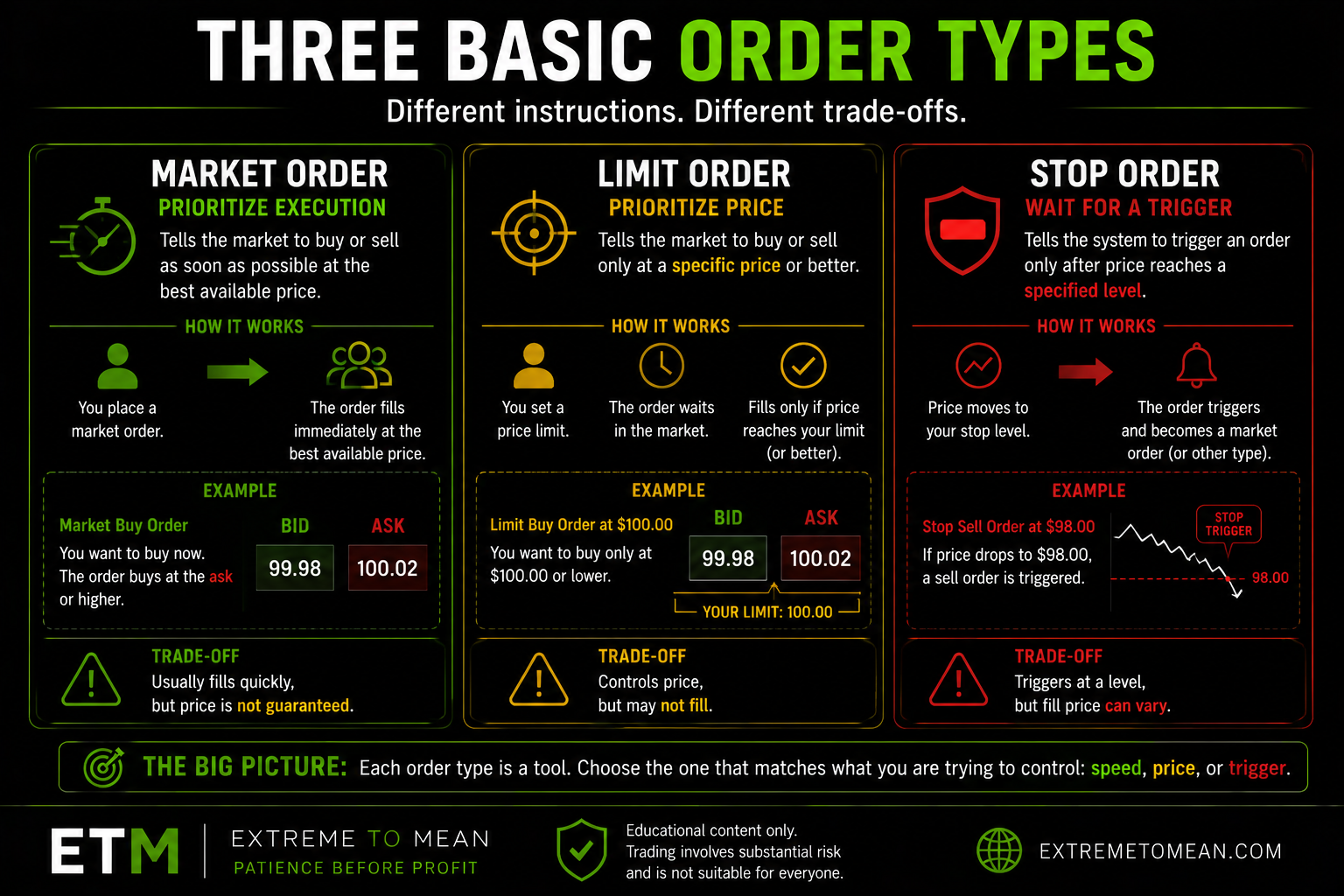
The three basic order types are market orders, limit orders, and stop orders. A market order says, “Get me in or out as soon as possible.” A limit order says, “Only trade at my price or better,” while a stop order says, “Take action only if price reaches this trigger.”
These are mechanical instructions rather than trading strategies. A market order is not automatically reckless, a limit order is not automatically disciplined, and a stop order is not protective simply because the word “stop” appears in its name. The quality of the decision depends on how the order is used, the market environment, and whether the trader understands the tradeoff.
The earlier lesson on what bid, ask, and spread mean matters here because every order interacts with the available quote. The chart may display where price has moved, but the order must still execute against actual buyers, sellers, and available prices.
Market Orders: Prioritizing Execution
A market order tells the broker to buy or sell as soon as possible at the best price currently available. Its main advantage is speed because the trader is prioritizing immediate execution rather than demanding one exact price. In simple terms, the instruction is not “Fill me here,” but “Fill me now.”
That tradeoff matters because a market order may execute quickly without guaranteeing the final fill price. In a liquid market with a tight spread, the fill may be close to the quote the trader sees. In a fast, thin, wide-spread, or news-driven market, the available price may change before the order is completed.
Suppose a stock displays an ask price of $100.02 and a trader submits a market buy order. If enough shares are available at $100.02, the order may fill there, but if there are not enough shares, part of the order may fill at a higher price. A rapidly changing quote can also cause the final fill to differ from the price that appeared on the screen when the button was pressed.
This is why traders need to understand what slippage is and why fill price can differ. Slippage is the difference between the price a trader expected and the price where the trade actually executed. Market orders simplify the timing decision, but they give the current market more control over the final price.
A market order can make sense when immediate execution matters more than exact pricing. A trader who needs to exit a position quickly may accept some price uncertainty to improve the likelihood of getting out. The important question is not simply whether the order will fill, but whether the trader accepts the price uncertainty required for immediate execution.
Limit Orders: Prioritizing Price
A limit order tells the broker to buy or sell only at a specified price or better. A buy limit at $100 means the trader is willing to buy at $100 or lower, but not higher. A sell limit at $101 means the trader is willing to sell at $101 or higher, but not lower.
The main advantage of a limit order is price control. The trader defines the least favorable price they are willing to accept, which can prevent them from paying more than planned when buying or receiving less than planned when selling. That control comes with an important tradeoff: the order may never fill.
If the market does not reach the limit price, the order may remain untouched. Even when the chart appears to touch the level, the trader may be behind other orders waiting at the same price, and there may not be enough available volume to reach them. The result can be a partial fill or no fill at all.
This is one of the first execution frustrations many beginners encounter. They see price trade at their limit level and assume their order should have been completed, but queue position, available liquidity, rapid movement, and differences between displayed chart prices and executable quotes can all affect the result. A visible touch does not guarantee that every waiting order at that price was filled.
A limit order works best when price discipline matters more than immediate participation. It allows the trader to decide in advance that the trade is acceptable only at a certain price or better. That mindset fits the Extreme to Mean process because the trader is defining what is acceptable instead of chasing whatever fill happens to be available.
Stop Orders: Triggering Action at a Price
A stop order remains inactive until price reaches a specified trigger level. Once that level is reached, the order becomes active and follows the execution instructions attached to it. The stop price therefore controls when action begins, not necessarily the exact price where the trade will finish executing.
Beginners can become confused because stop orders serve more than one purpose. They may be used to exit a losing position, enter a breakout, or trigger another order after price reaches a certain level. In every case, the essential feature is the same: nothing happens until the stop price is reached.
Suppose a trader owns a stock at $100 and places a sell stop at $98. If price reaches $98, the order is triggered and may become a market order or another order type, depending on how it was entered. A standard stop-market order therefore does not guarantee a $98 fill; it triggers at that level and then seeks the best available execution.
This means a stop order is an instruction, not a magic shield. If price moves quickly through the stop level, the fill may occur at a worse price than expected. Gaps, thin liquidity, wide spreads, and fast market conditions can all affect the result after the trigger has been activated.
Stop orders are commonly used for risk management, but they work properly only when the trader understands what a stop loss actually does. The stop price should connect to the trade idea, the market structure, and the point where the original reasoning is no longer valid. It should not be selected randomly because a certain dollar loss feels tolerable.
This connects directly to the lesson explaining why the trade is not ready until the risk is clear. A stop order may help carry out the risk plan, but the real decision is identifying where the setup becomes invalid before the order is placed.
Each Order Type Has a Tradeoff
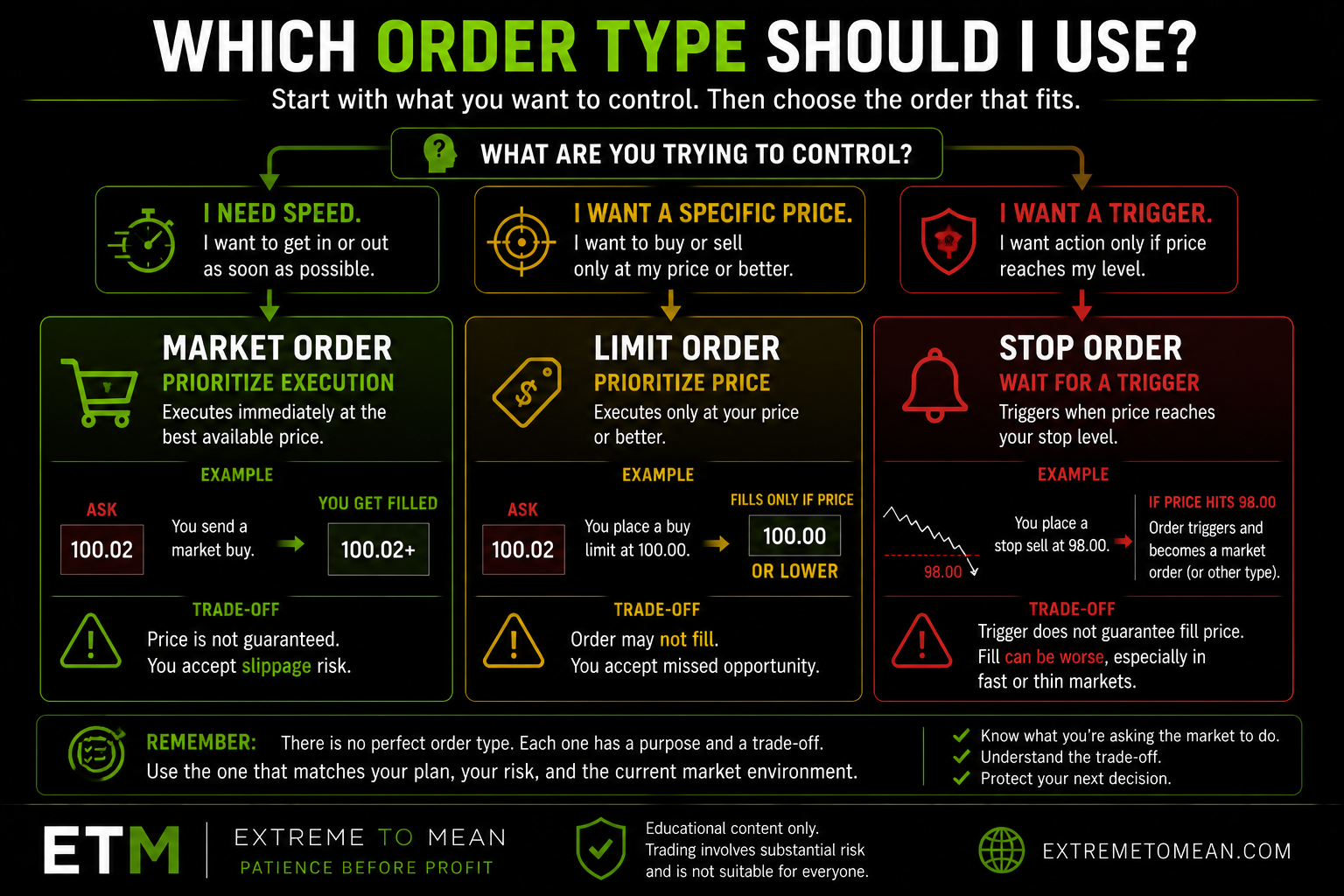
No order type provides complete control over every part of execution. A market order prioritizes getting filled but sacrifices price certainty. A limit order prioritizes price but sacrifices execution certainty, while a stop order waits for a trigger but still depends on available market prices after that trigger occurs.
This is the most important distinction for a beginner to understand. Order types are not good or bad by themselves; they are tools designed to control different parts of the process. Problems begin when a trader expects an order to provide a benefit that its design cannot guarantee.
A market order may be appropriate when immediate action is necessary and careless when price is moving violently through a wide spread. A limit order may reflect discipline when the trader has identified an acceptable entry, but it may become unrealistic if the trader continually places it at a price the market is unlikely to reach. A stop order can support a clear risk plan, but it can create confusion when the trader does not understand what happens after the trigger.
The order type should therefore match the decision the trader is making. Someone who needs immediate execution must accept price uncertainty, while someone who requires a specific price must accept the possibility of missing the trade. Someone waiting for a trigger must understand both the trigger condition and the order that becomes active afterward.
Instead of asking only, “Which order type should I use?” the trader should ask, “What am I trying to control: speed, price, or a trigger?” That question turns order selection from a platform setting into part of the trading decision.
Why Order Types Matter More in Fast or Thin Markets
Order behavior becomes especially important when the market is moving quickly or liquidity is limited. In a calm, active market with a tight spread, market orders may fill close to the visible quote, limit orders may behave more predictably, and stop orders may trigger with relatively little disruption. That smoother experience can make execution appear simpler than it really is.
In a fast or thin market, prices can jump, spreads can widen, and available liquidity can disappear. A market order may experience greater slippage, a limit order may remain unfilled, and a stop order may trigger before executing at a worse price than expected. Those outcomes do not automatically mean the broker or platform failed; they may simply reflect the conditions in which the order had to execute.
The earlier lesson on what volume and liquidity mean helps explain this environment. Volume shows how much trading is occurring, while liquidity reflects how easily orders can be completed near the current price. The behavior of an order cannot be understood completely without considering whether enough buyers and sellers are available.
A beginner may look at a clean chart and assume the trade should execute just as cleanly. The chart, however, is not the order book. It displays price movement, while the order interacts with live supply, demand, bid, ask, spread, queue position, and available liquidity.
This is why the trader’s job is to evaluate rather than react. A chart idea is incomplete when the trader has not considered how the order will behave in the conditions surrounding the trade. Execution is not separate from the setup; it is how the setup becomes an actual position.
A Simple Order Type Filter
Before placing an order, the trader should pause long enough to identify what they are asking the market to do. The goal is not to make every order complicated, but to prevent a mechanical button press from replacing a clear execution decision.
A useful pre-order filter includes the following questions:
- Am I entering or exiting, and am I buying or selling? The trader should understand the basic action being requested before selecting the order.
- Do I need immediate execution? If speed matters most, the trader must accept that the final price may differ from the quote.
- Do I require a specific price or better? If price control matters most, the trader must accept that the order may not fill.
- Am I waiting for a trigger level? The trader should know what activates the order and what type of order becomes active afterward.
- What happens if the order does not fill? Missing the trade should be part of the plan rather than a surprise that causes chasing.
- What happens if the fill is worse than expected? The trader should know how slippage would affect risk and position size.
- What are the current market conditions? Spread, liquidity, volatility, speed, and news risk can all change how the order behaves.
- Does this order match the decision I am trying to make? The instruction should reflect whether the trader is prioritizing execution, price, or a trigger.
These questions are not meant to slow the trader down without purpose. They create a short pause between the chart idea and the order ticket, which helps prevent execution mistakes made under urgency. The trader should know not only why they want the trade, but what instruction they are sending to obtain it.
The better question is not, “How do I place the trade fastest?” It is, “What exactly am I telling the market to do, and do I understand the tradeoff?” That is part of Patience Before Profit because the trader waits not only for a setup, but also for a clear execution plan.
A setup earns attention before it earns risk, and an order should not be placed until the trader understands how that order can behave. Newer readers can start with the beginner trading path before moving deeper into execution, stops, slippage, and trade management.
Final Thought
Market orders, limit orders, and stop orders are basic instructions with different priorities. A market order prioritizes immediate execution, a limit order prioritizes a specified price or better, and a stop order waits for a trigger before action begins. None guarantees a perfect result because every order type carries a tradeoff.
A market order can slip, a limit order may not fill, and a stop order may trigger during fast movement before executing at a different price than expected. The better trader does not treat the order ticket like a simple button. They treat it as a clear instruction: this is what I want the market to do, and this is the tradeoff I am willing to accept.
That is how order selection becomes part of a cleaner trading process. The account infrastructure behind those instructions explains how orders travel from the platform through the broker.
The choice between instructions also affects how order selection can influence execution cost.
Educational content only. Trading involves substantial risk and is not suitable for everyone.