
ETFs are everywhere in modern markets. Beginners hear symbols like SPY, QQQ, DIA, IWM, XLF, XLK, and countless others before they fully understand what those symbols represent. They see a price chart, a ticker, and a buy or sell button, so it feels natural to think of an ETF like any other stock.
That is where confusion starts.
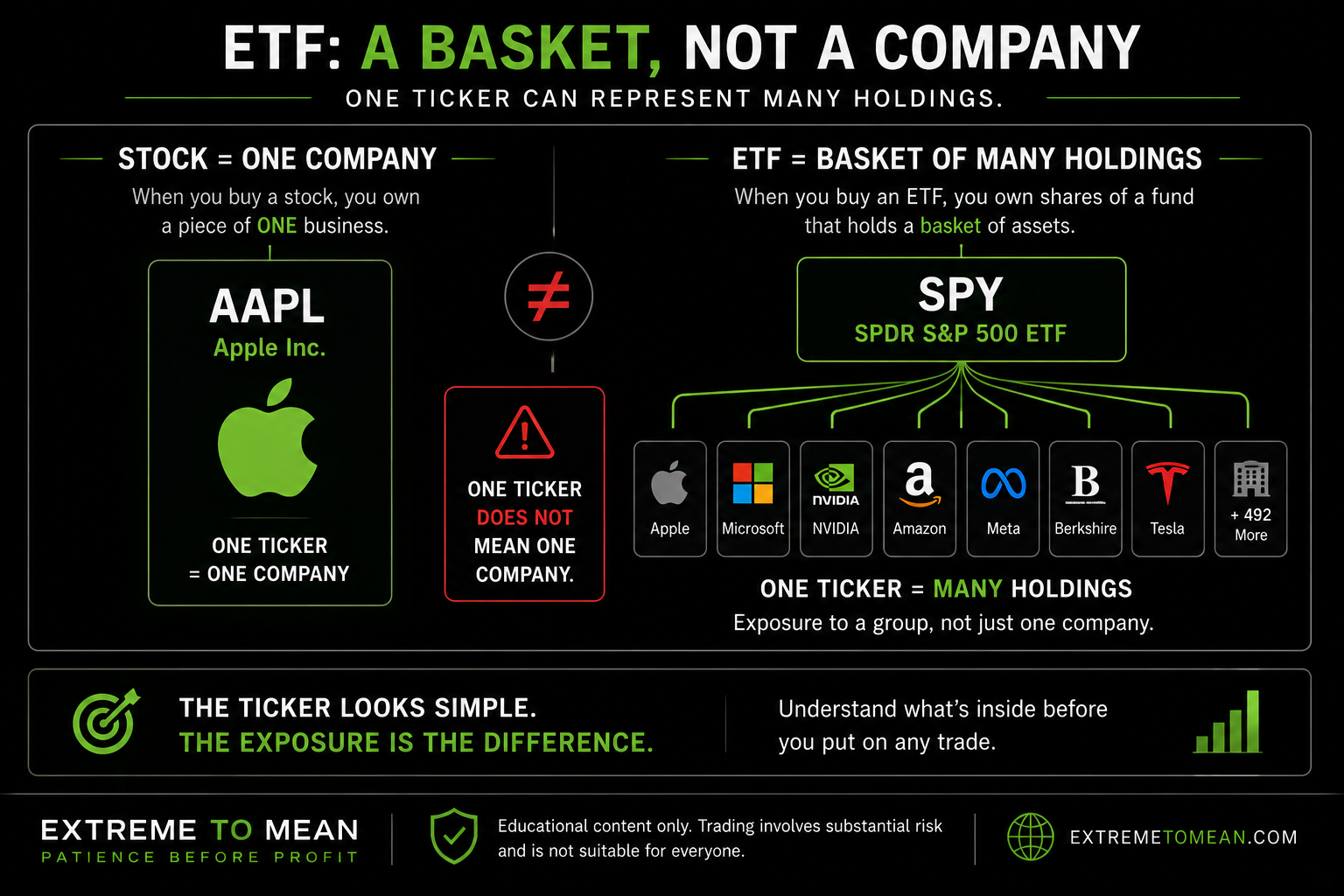
An ETF may trade like a stock, but it does not usually represent one business. Most ETFs are built to give exposure to a group of assets. That group may be an index, a sector, an industry, a bond category, a commodity theme, or another basket of holdings.
The purpose of this lesson is simple: understand what an ETF is before you use one for trading or investing decisions. This is a foundational concept inside the Basics trading education path, because ETFs often become the bridge between individual stocks, indexes, market context, and broader trading products.
An ETF Trades Like One Symbol, But Holds Many Things
ETF stands for exchange-traded fund. “Exchange-traded” means it trades on an exchange during the trading day, similar to a stock. “Fund” means it is a pooled investment vehicle that can hold multiple assets inside it.
That combination is what makes ETFs so useful and so easy to misunderstand.
If you look up an ETF on a chart, it appears as one ticker symbol. You may see SPY moving up or QQQ moving down. The chart looks clean and simple. The price changes throughout the day, and traders can buy or sell shares of the ETF through a brokerage account.
But underneath that one ticker, there may be dozens, hundreds, or even thousands of holdings.
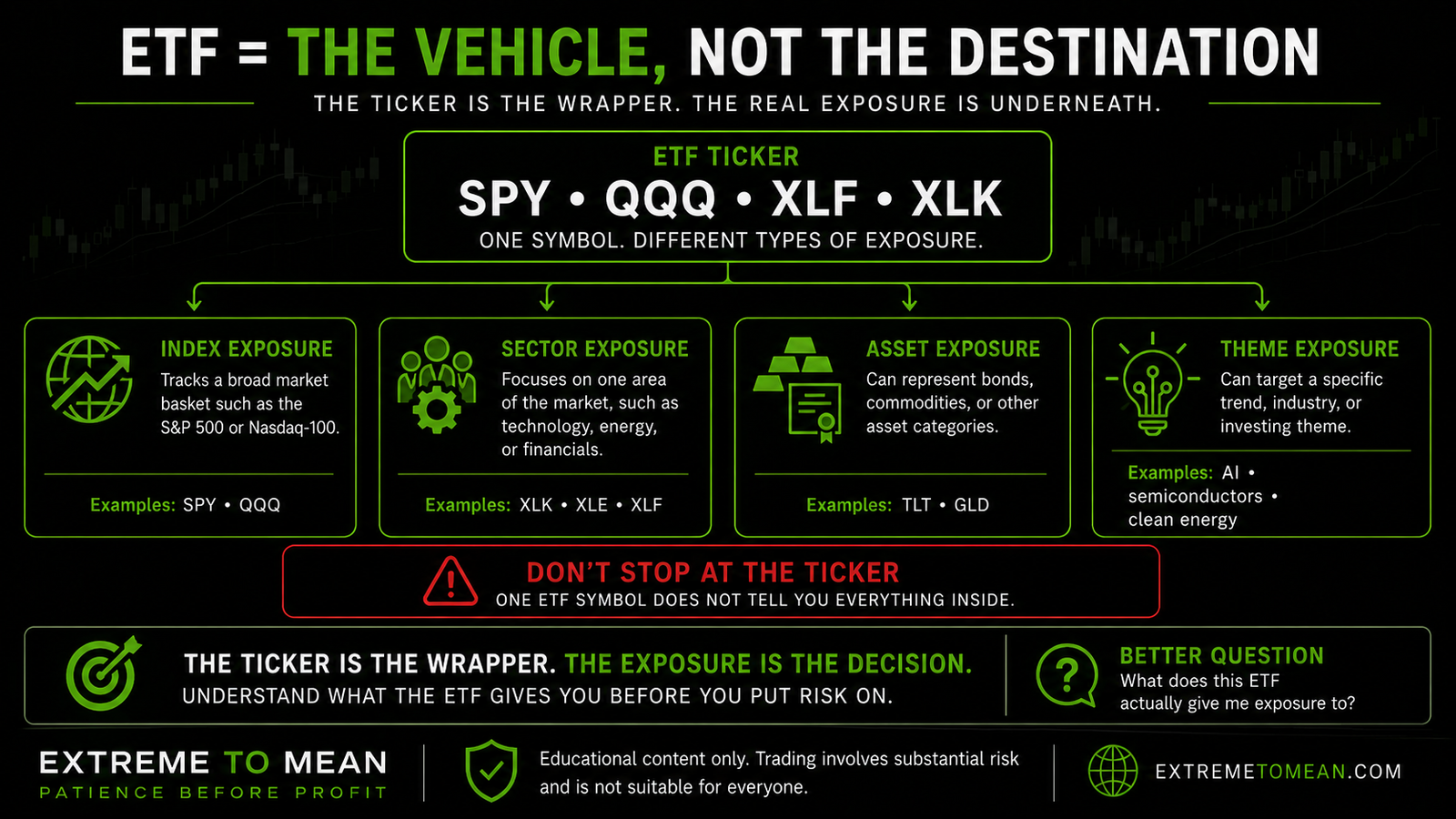
For example, an index ETF may be designed to track a major index. A sector ETF may hold companies from one part of the market, such as technology, financials, energy, or healthcare. A bond ETF may hold a basket of bonds. A commodity-related ETF may be tied to exposure in a commodity or commodity-linked structure.
The key beginner distinction is this: a stock is usually one company, while an ETF is usually a basket.
That is why understanding what a stock really is matters first. A stock represents ownership in a specific business. An ETF represents shares of a fund that holds or tracks a group of assets.
The ticker may look just as simple, but the thing behind the ticker is different.
Why ETFs Exist
ETFs exist because market participants often want exposure to a group instead of only one company. Instead of buying many individual stocks separately, a person can buy one ETF designed to represent that basket.
That does not make an ETF automatically better or safer. It simply makes the exposure different.
If a trader wants broad exposure to the S&P 500, an ETF tied to that index may be one way to access that exposure. If someone wants exposure to a specific sector, a sector ETF may provide a basket of companies from that area. If someone wants to follow a theme, there may be ETFs built around that theme. A spot Bitcoin ETF works on the same wrapper concept, though as explained in Bitcoin self-custody vs. a Bitcoin ETF, the shareholder ends up owning something different from the underlying asset itself.
This is why ETFs are often used by both investors and traders.
An investor may use ETFs to build long-term exposure to broad markets. A trader may use ETFs to trade shorter-term movement in an index, sector, or theme. The product can be the same, but the purpose, timeframe, and risk process may be completely different.
That connects directly to the difference between trading and investing. Buying an ETF for a long-term plan is not the same decision as trading the ETF intraday because price is moving. The symbol may be identical, but the decision is not.
This distinction matters because beginners often focus only on the ticker. A better trader focuses on the purpose of the decision.
Are you trying to invest in broad exposure over time? Are you trying to trade a short-term setup? Are you using the ETF to understand market context? Are you reacting because the chart is moving?
The ETF does not answer those questions for you. Your process does.
ETFs Are Often Connected to Indexes
Many of the most popular ETFs are connected to indexes. This is one reason the previous Basics lesson on what an index is matters.
An index is a measurement. It tracks the behavior of a group of assets, usually a group of stocks. An ETF can be built to track that index, giving traders and investors a tradable product connected to the index’s movement.
For example, SPY is commonly used as an ETF tied to the S&P 500. QQQ is commonly associated with the Nasdaq-100. DIA is commonly associated with the Dow Jones Industrial Average. These ETFs are not the indexes themselves. They are products designed to give exposure to those index-related baskets.
That distinction may sound technical, but it is important.
The index is the scoreboard. The ETF is a tradable vehicle connected to that scoreboard.
Beginners often say things like “I bought the S&P” or “I traded the Nasdaq.” In most cases, they did not literally buy the index. They bought or traded a product tied to it. That could be an ETF, a futures contract, an option, or something else.
Clear language leads to clearer decisions. When you know whether you are looking at the measurement or trading the vehicle, you are less likely to misunderstand the risk.
The Basket Can Move Differently Than You Expect
One mistake beginners make is assuming that because an ETF holds many things, its movement is automatically simple. It is not always simple.
An ETF’s price depends on what is inside the basket and how those holdings behave. Some ETFs are broad and diversified. Others are concentrated in a smaller group of companies or assets. Some are heavily influenced by a few large holdings. Some are built around sectors that can move sharply when news, rates, commodities, earnings, or economic expectations change.
This means two ETFs can behave very differently even though they both look like single ticker symbols.
A broad market ETF may move more smoothly than a single highly volatile stock at times, but that does not mean it cannot move quickly. A sector ETF may look diversified, but if that sector is under pressure, many holdings inside the ETF may move together. A thematic ETF may sound broad, but it may still be concentrated around one story, one industry, or one market mood.
This is where traders can get into trouble. They see a familiar ETF symbol and assume they understand it because it is popular. Popular does not mean simple. Familiar does not mean low-risk. A clean-looking chart does not remove the need to understand the product.
A better trader asks, “What is inside this ETF, and what is driving it today?”
That question slows down the decision. It moves the trader from symbol recognition to actual evaluation.
ETF Context Still Does Not Replace Trade Quality
Because ETFs often represent broader baskets, they can be useful context tools. Traders may watch index ETFs to understand the general market. They may watch sector ETFs to see where strength or weakness is concentrated. They may compare an individual stock to a related ETF to see whether the stock is moving with or against its group.
That can be useful, but it is not permission to trade.
A green ETF does not mean every long trade is clean. A red ETF does not mean every short trade is clean. A sector ETF breaking higher does not mean a late entry has good risk. An index ETF selling off does not mean every bounce attempt is automatically bad.
This is where the Extreme to Mean process matters. Context helps frame the decision, but the setup still needs location. The trade still needs structure. The risk still has to be clear.
A beginner may look at a strong ETF and feel pressure to chase. That reaction feels reasonable because the ETF seems to be confirming that the group is strong. But if price has already moved far from a clean location, the trade may still be poorly structured.
The market can be right and the trade can still be wrong.
That is why ETF context should support the decision, not replace the decision. This is the same principle behind many of the market context lessons: the broader environment matters, but the trader still has to evaluate the specific opportunity.
A Simple ETF Decision Filter
Before trading or investing in an ETF, a beginner should slow down and ask better questions. The goal is not to make the market predictable. The goal is to understand what you are dealing with before taking risk.
A simple ETF filter can help:
- What does this ETF actually hold or track?
- Is it broad, sector-specific, thematic, commodity-related, bond-related, or something else?
- Is the ETF connected to an index, and if so, which one?
- Are a few large holdings driving most of the movement?
- Am I using this ETF for long-term exposure or a short-term trade?
- Is the current price location clean, or am I reacting late?
- Where is the trade invalidated if I am wrong?
- Is my risk clear before I act?
The better question is not, “Is this ETF going up or down?”
The better question is, “What exposure does this ETF give me, and does this decision have a clear purpose, location, and risk plan?”
That question changes the process. It forces the trader to look underneath the ticker, separate the product from the decision, and avoid treating every moving symbol as an opportunity.
ETFs can be useful tools, but they are still tools. A tool does not create discipline by itself. The process around the tool is what matters.
For beginners, the clean next step is to keep building the foundation before jumping into more complex products or strategies. You can start with the beginner trading path and work through the concepts in order before treating any ticker as a trade idea.
Final Thought
An ETF is a basket, not a company. It trades like one symbol, but it often represents exposure to many holdings underneath the surface.
That makes ETFs useful, but it also makes them easy to misunderstand. The ticker is simple. The exposure may not be.
The trader’s job is not to react because an ETF is moving. The trader’s job is to understand what the ETF represents, why it is moving, whether the location is clean, and whether the risk is clear before making a decision.
Educational content only. Trading involves substantial risk and is not suitable for everyone.