
The word margin appears throughout trading platforms, account dashboards, and brokerage agreements. Traders may see initial margin, maintenance margin, available margin, excess margin, and margin buying power displayed beside the same controls they use to enter positions.
Because those numbers appear so close to the order ticket, it is easy to treat them as risk limits. A platform may show enough buying power for several contracts, making the position appear affordable. That conclusion can be dangerously incomplete because the broker and the trader are answering different questions.
The broker is asking, “Does this account meet the requirement to hold the position?” The trader should be asking, “What happens to my account if this position moves against me?” Meeting the first requirement does not automatically produce an acceptable answer to the second.
Before studying margin, a trader should understand how ticks, points, and contract value turn price movement into dollars. Margin controls access to that financial exposure. It does not replace the need to calculate it.
Margin Is a Requirement, Not the Purchase Price
When traders buy shares in a cash account, they generally pay the full purchase price. Buying 100 shares at $20 would require approximately $2,000 before trading costs. Leveraged products operate differently because the capital required to open the position can be much smaller than the total market exposure being controlled.
That required capital is called margin. In futures, margin is often described as a performance bond because it supports the trader’s financial obligations while the position remains open. The trader is not purchasing the underlying index, commodity, currency, or interest-rate instrument for its full value.
This creates three separate measurements. Position value describes the total market exposure being controlled. Margin requirement describes the qualifying capital needed to open or maintain that exposure. Planned trade risk describes the amount the trader expects to lose if price reaches the intended invalidation level.
Those amounts can be very different. One futures contract might represent $25,000 of notional market exposure while requiring only a portion of that amount as margin. The smaller deposit does not make the position small; it means the trader is controlling larger exposure with less capital committed upfront.
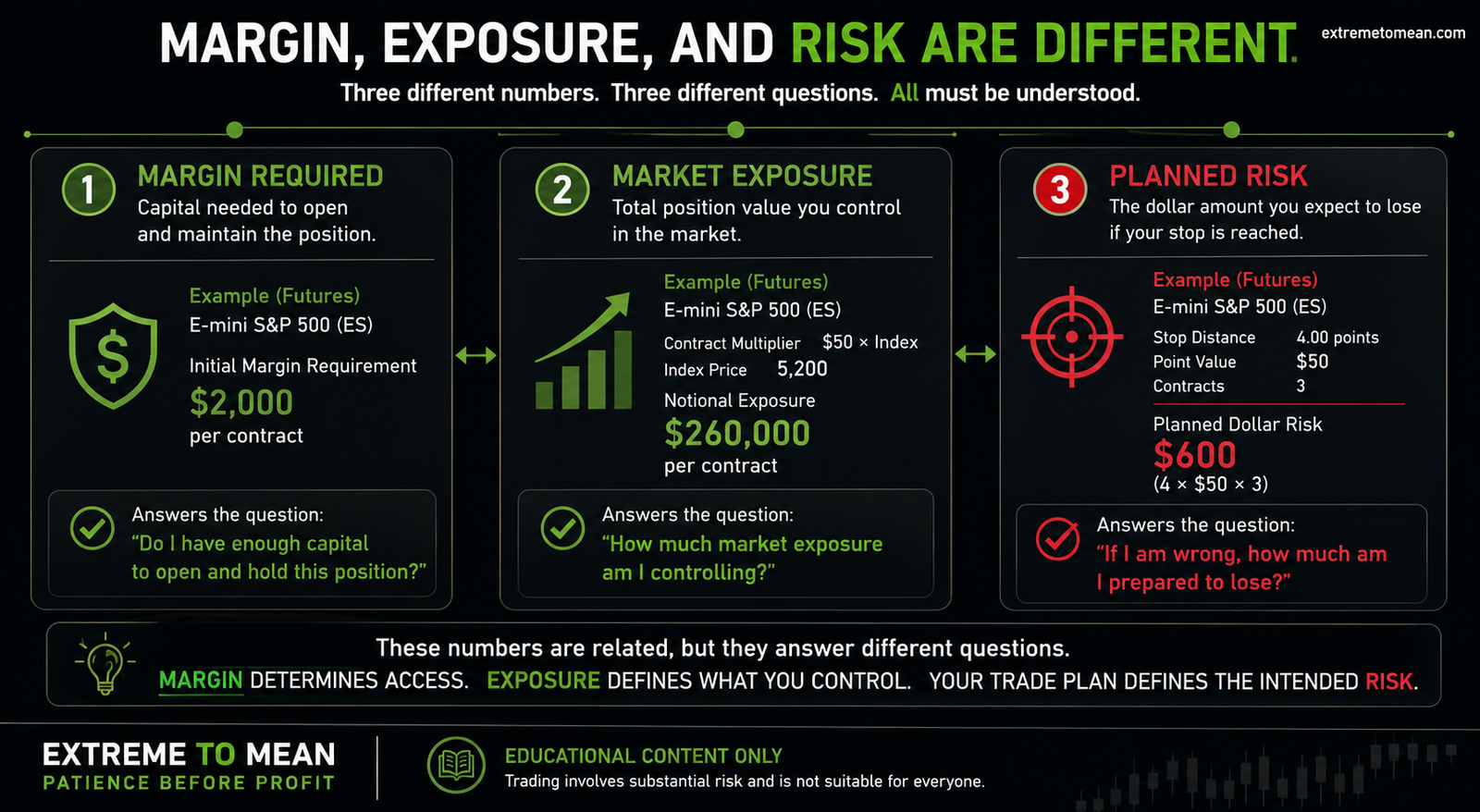
Margin makes leveraged exposure possible, but it does not make the underlying exposure disappear. The account still responds to the movement of the entire position rather than only to the amount posted as margin.
Initial Margin Opens the Position
Initial margin is the amount generally required to establish a leveraged position. The exact terminology and calculation can vary by market, broker, clearing firm, account type, and regulatory structure. In futures, an exchange or clearing system may establish risk-based requirements while the broker applies the same requirement or imposes a higher one.
Suppose the initial margin requirement is $2,000 per contract. An account may need at least $2,000 of qualifying capital to open one contract and approximately $4,000 to open two, subject to the broker’s rules and any permitted adjustments or offsets.
That number answers a narrow question:
How much qualifying capital is required to establish the position?
It does not determine where the stop belongs, how much the trade may lose, whether the setup is valid, or whether the quantity is appropriate for the account. It also does not account for a possible gap, slippage, or a fill beyond the trader’s intended exit.
A trader can satisfy the initial margin requirement while still taking a poorly constructed trade. The platform may accept the order, but technical acceptance does not mean the decision has earned risk.
Maintenance Margin Keeps the Position Open
Maintenance margin is the minimum account equity generally required to continue holding a leveraged position. Once the trade is open, gains and losses change the account equity. If losses reduce that equity below the applicable maintenance requirement, the broker may demand additional capital, restrict the account, reduce the position, or liquidate it.
The exact response depends on the market, broker agreement, and current conditions. Traders should not assume that every firm will provide a traditional margin-call warning or allow enough time for a new decision. During a fast market, the broker may act quickly to protect itself from additional exposure.
This is why the maintenance threshold should never become the trader’s stop-loss plan. Waiting until the broker forces a reduction means the trader has surrendered control of the exit process and allowed account mechanics to replace the original trade plan.
A planned exit is based on market structure, invalidation, and acceptable dollar risk. A maintenance requirement is based on the financial conditions for continuing to carry the position. They serve different purposes.
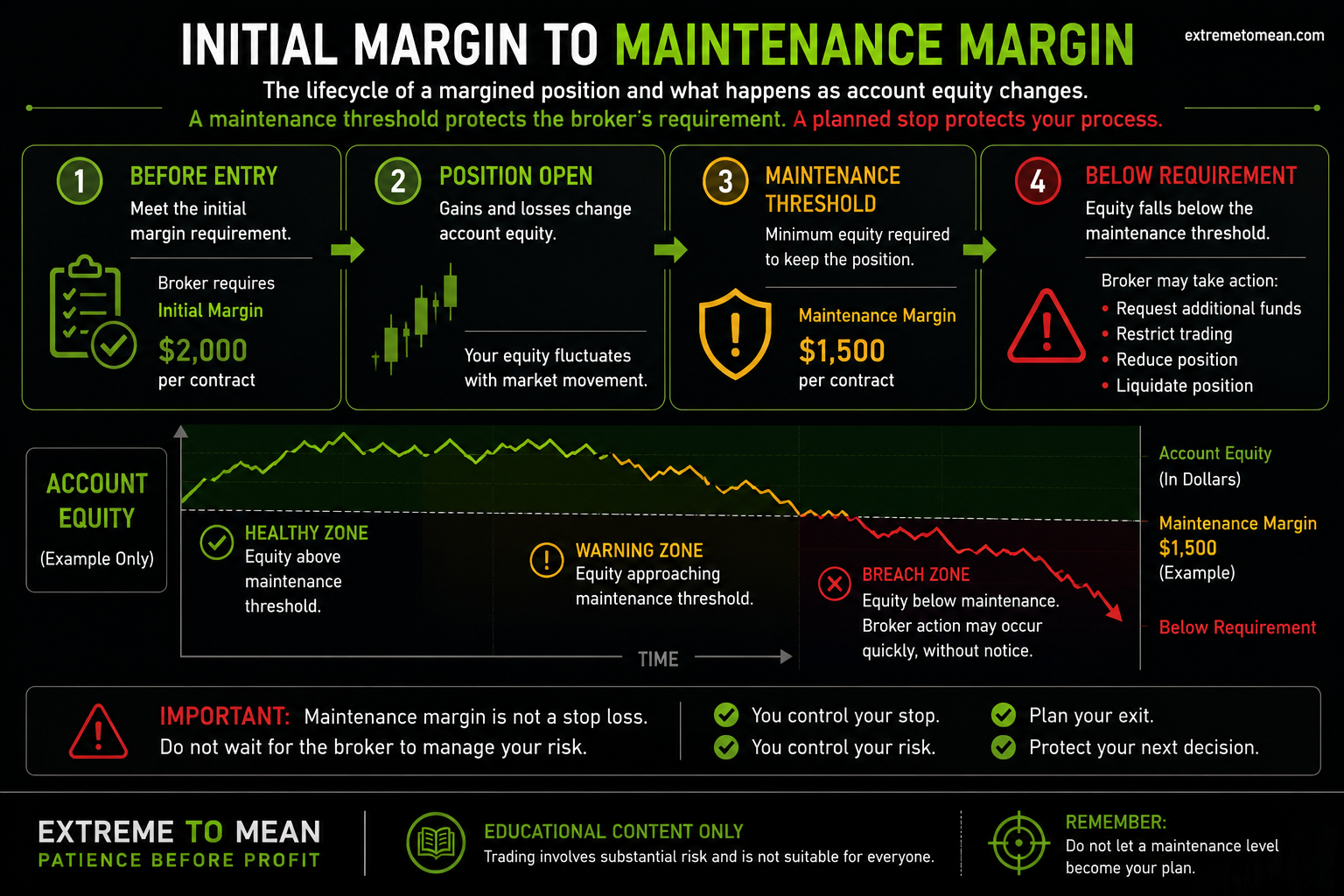
The trader should act long before the account approaches a forced-liquidation condition. Risk planning should determine the exit before the broker’s financial safeguards become involved.
Futures Margin Can Change
Futures margin is not always a fixed number. Requirements can increase when volatility rises, important events approach, liquidity becomes less reliable, or the exchange and broker determine that the product carries greater short-term risk. A broker may also require more capital than the exchange minimum.
Some futures brokers offer reduced intraday margin during designated trading hours. That amount may be significantly lower than the requirement for holding the same contract beyond the broker’s intraday cutoff. The smaller number can make the contract appear more accessible than its true exposure suggests.
A trader may be permitted to open a futures position using a relatively small intraday requirement. If the position remains open near the cutoff, a larger overnight or full-margin requirement may take effect. An account that cannot satisfy the new requirement may be forced to close the position.
Reduced intraday margin does not change the contract’s tick value, point value, volatility, or speed of movement. It does not reduce the financial exposure represented by the position or slow the rate at which losses can accumulate. It changes only the capital the broker requires for access during a particular period.
A small margin requirement can therefore sit underneath a large amount of market exposure. The required deposit may change while the economic behavior of the contract remains the same.
Buying Power Is Not a Position-Sizing Recommendation
One of the most common margin mistakes is allowing available buying power to determine position size. A platform may show enough buying power for five contracts, but that does not mean five contracts are appropriate. It means only that the account currently satisfies the broker’s access requirement for that quantity.
The broker is not evaluating the quality of the setup. It does not know whether the trader is entering in the middle of a range, chasing an extended move, using a structurally valid stop, or reacting emotionally after several losses. It is performing an account calculation rather than approving the trade idea.
Suppose an account has enough buying power to open ten micro futures contracts, and each contract is worth $5 per point. The combined position changes by:
10 contracts × $5 per point = $50 per point
A ten-point adverse move would therefore represent:
10 points × $50 per point = $500
The word micro does not make the combined position small. By increasing the contract quantity, the trader has rebuilt the exposure of a larger contract. The platform’s willingness to accept the order does not change what the market movement means for the account.
Buying power feels like permission because the order ticket is available and the account satisfies the broker’s requirement. But technical permission is not risk approval. The cleaner question is, “How many contracts fit the planned stop and acceptable dollar risk?”
That calculation should determine quantity—not the maximum amount the broker permits.
Margin and Trade Risk Must Be Calculated Separately
Margin and planned risk belong in the same trade evaluation, but they perform different jobs. Margin determines whether the account can open and maintain the position. Planned risk determines whether the financial consequence of being wrong is acceptable.
Suppose a trader is considering three futures contracts with a four-point distance between entry and invalidation. If each contract is worth $5 per point, the planned price risk is:
4 points × $5 per point × 3 contracts = $60
That $60 represents the calculated price risk if the stop fills at the intended level. Commissions, fees, bid-ask spread, and slippage can increase the final loss, as explained in the real cost of a trade.
The broker’s margin requirement may be higher or lower than $60, but that does not change the stop-based calculation. The trader therefore needs two separate approvals: the account must support the position under the broker’s rules, and the planned loss must be appropriate for the account and setup.
A trade should pass both checks. Passing the margin requirement alone is not enough because access and acceptable risk are not the same measurement.
Margin Does Not Cap the Loss
Another dangerous misunderstanding is treating the required margin as the maximum amount that can be lost. Margin is not a prepaid loss limit or an amount beyond which the market can no longer affect the account.
A leveraged position can lose more than the margin originally required to open it. Under severe market conditions, the loss may also exceed the capital currently held in the account, depending on the product, market movement, available liquidity, and brokerage agreement.
A stop order can help manage the position, but it cannot guarantee an exact exit price. A gap, fast move, thin order book, or trading interruption can cause the actual fill to occur beyond the requested stop level. This is why position size remains important even when a stop is used.
The wrong sequence is to find the maximum quantity the broker allows, open that quantity, and then search for a stop that makes the loss appear acceptable. That approach allows buying power to define the trade before market structure and account risk have been considered.
The cleaner sequence begins with the setup and invalidation level. The trader measures the distance from entry to that level, converts the distance into dollars per contract, and selects a quantity that fits the account’s risk limit. Only then should the trader confirm that the account also satisfies the applicable margin requirement.
The market structure should define the stop, while acceptable dollar risk should define the quantity. Margin is the final access check rather than the starting point for constructing the trade.
Available Margin Can Shrink Quickly
Available margin is the remaining account capacity after current positions and account equity are considered. It is not static because open profits and losses continually affect the amount of capital available to support additional exposure.
When an open position loses value, account equity may decline. At the same time, the account’s remaining capacity to hold other positions may shrink. A trader who uses nearly all available margin can therefore lose flexibility at the exact moment additional room is most important.
The account may have little capacity to absorb normal adverse movement, increased volatility, higher margin requirements, slippage, an overnight requirement, or several correlated positions moving against it at the same time. A broker’s risk adjustment can tighten that capacity further.
Using less than the maximum available buying power is not wasted capacity. It creates room for uncertainty and allows the trader to respond according to the market rather than according to an approaching account restriction.
That room protects decision quality. A trader with excess capacity can evaluate the next decision more calmly, while a trader operating near the margin limit may be forced to react to account mechanics instead of market structure.
A Better Margin Checklist
Before entering a leveraged position, the trader should be able to explain both the exposure and the account requirements. A practical margin review includes:
- What total market exposure does the position represent? Identify the contract’s notional value or the full value controlled by the position.
- What are the tick size, tick value, and point value? These specifications determine how price movement becomes dollars.
- What are the current initial and maintenance requirements? Confirm the capital needed to open and continue holding the position.
- Do intraday and overnight requirements differ? A position that qualifies during the session may require substantially more capital later.
- What is the broker’s liquidation policy? Understand when the broker may restrict, reduce, or close the position.
- Where is the planned invalidation level? The trade should have a meaningful structural point where the original idea is no longer valid.
- What is the dollar risk per contract? Convert the distance from entry to the stop into a financial amount.
- What is the total risk for the full position? Multiply the per-contract exposure by the intended quantity.
- How much account capacity remains after entry? The position should leave room for normal movement, execution uncertainty, and changing requirements.
- Is the quantity based on the trade plan or on available buying power? The position should come from acceptable risk rather than from the broker’s maximum allowance.
These values should be confirmed through the broker, exchange, and trading platform because margin requirements and account policies can change. The purpose is not to memorize every number permanently; it is to verify the current information before using it.
A useful final question is:
Am I choosing this position because the trade structure supports it, or because the broker gives me enough buying power to open it?
That question separates risk management from access. Traders can continue through The Basics curriculum, learn what leverage is and why it cuts both ways, or start with the beginner trading path when building the foundation from the beginning.
Final Thought
Margin is the deposit behind leveraged exposure. It allows the trader to control a position without paying its full value upfront, but that convenience can make a large position appear smaller than it actually is.
Initial margin determines what is required to open the position, while maintenance margin helps determine whether the position can remain open. Neither number identifies where the setup becomes invalid, how much should be risked, or whether the position fits the account.
Buying power is not a recommendation. The better process is to define the trade, calculate the stop-based dollar risk, choose an appropriate position size, and then confirm that the account satisfies the margin requirement.
Margin determines access. Risk management determines whether that access should be used.
The regulatory distinction is explained further in the comparison between PDT rules and futures margin.
For the practical distinction between buying power and trade risk, read why futures margin is not the same as trading risk.
Educational content only. Trading involves substantial risk and is not suitable for everyone.