
Many beginners hear the word leverage and think first about opportunity. They learn that a trader can control a larger position with a smaller amount of capital, and that sounds powerful. The statement is true, but it explains only half of what leverage does.
Leverage does not magnify only favorable movement. It also increases the account impact when price moves against the position. The same mechanism that can make a winning trade more meaningful can make a losing trade more damaging, which is why leverage must be understood mechanically before it is used emotionally.
At Extreme to Mean, this belongs in The Basics lesson library because leverage affects risk, position size, stop distance, drawdown, and decision quality from the beginning. A trader who does not understand leverage may believe they are taking a small trade while actually controlling exposure much larger than the account balance suggests.
Leverage Means Controlling More Exposure Than Cash Alone
Leverage allows a trader to control a position larger than the amount of cash that would normally be required to purchase that exposure outright. The account balance and the market value being controlled are therefore not always the same number.
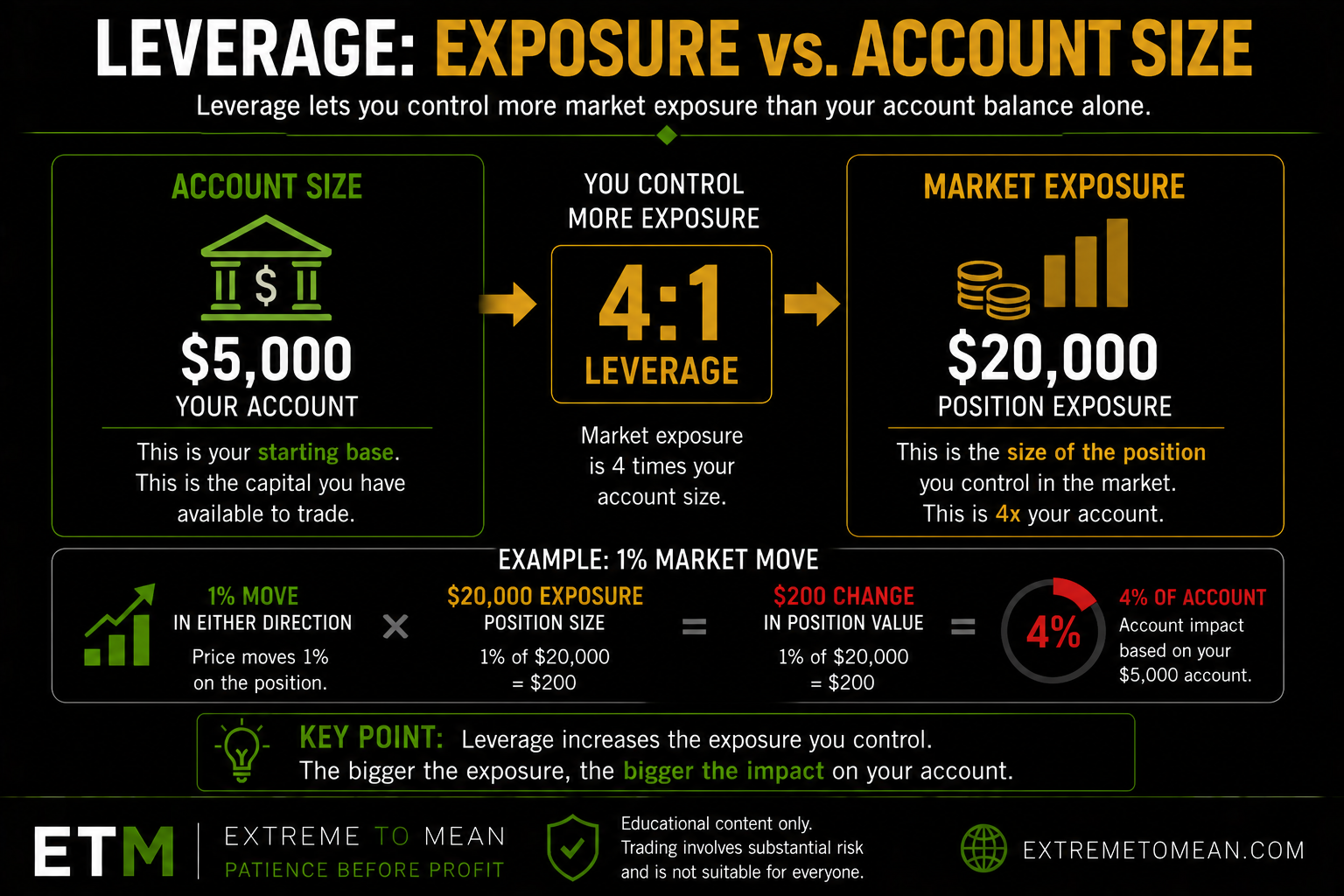
Suppose a trader has a $5,000 account and controls a $20,000 position. The market exposure is four times the account size, which is a simple example of 4-to-1 leverage. The trader is not exposed only to the movement of the $5,000 deposited in the account; the account responds to the movement of the entire $20,000 position.
This relationship can appear in different forms depending on the product. Stocks may involve borrowed buying power through margin, while futures naturally provide notional exposure larger than the margin deposit behind that leveraged exposure. Options can also create significant market exposure relative to the amount paid for the contract, although their mechanics differ.
The common principle is that the trader controls more market exposure than the cash balance alone suggests. That is why leverage must be connected to the earlier lesson on position size versus account size. Account size establishes the trader’s capital base, while position size determines how strongly market movement affects that base.
The useful question is not merely, “How much money is required to enter?” It is, “How much market exposure am I actually controlling, and what does that exposure mean for my account?”
Leverage Amplifies Both Directions
Leverage cuts both ways because price can move either for or against the position. When the trader controls more exposure, a favorable move can produce a larger gain relative to the account. An unfavorable move can produce an equally magnified loss.
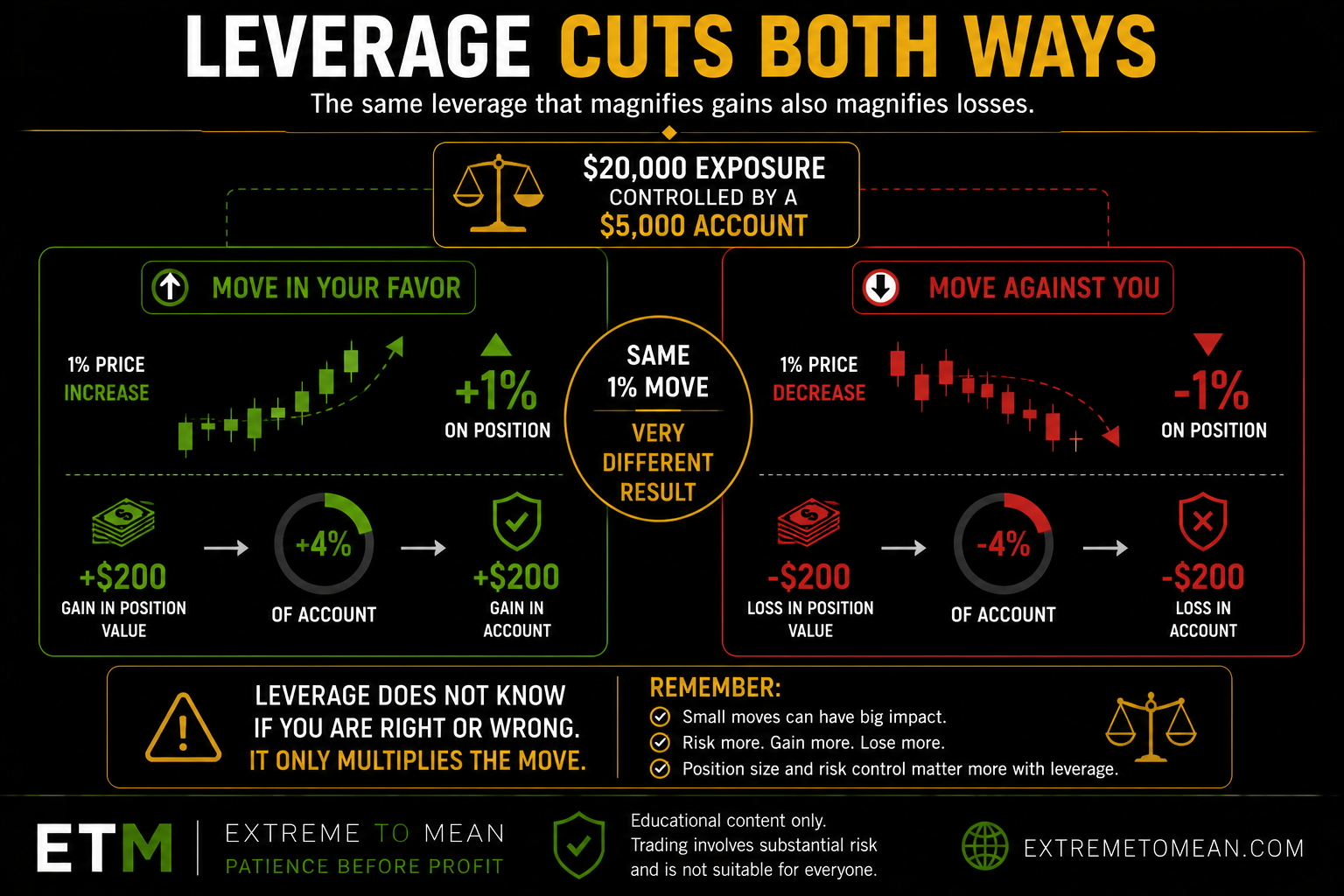
Imagine a trader with a $5,000 account controlling a $20,000 position. If the position gains 1%, its value increases by $200. That $200 gain represents 4% of the $5,000 account.
The relationship works the same way in the opposite direction. A 1% decline in the $20,000 position creates a $200 loss, which also equals 4% of the account. The market moved only 1%, but the account changed by 4% because the position was four times larger than the account balance.
That is the central leverage lesson. Leverage does not care whether the trader is right or wrong; it simply increases how strongly the account responds to the movement of the position. The amplification applies in both directions.
This is why leveraged trading can feel intense even when the chart does not appear dramatic. A relatively small market move can create a meaningful account change when the controlled exposure is large. Leverage does not make the chart more predictable; it changes how much the chart matters financially.
Leverage Is Not the Same as Skill
One of the most important beginner distinctions is that leverage is not an edge. It can make the result of a winning trade larger, but it does not improve the quality of the entry, market context, setup, or risk plan. It increases exposure without improving the probability that the trade will work.
Beginners may be tempted to use leverage to make a small account feel larger. The desire for faster growth, larger profits, or more noticeable results is understandable. However, increasing exposure does not solve unclear analysis, poor entries, weak discipline, or inconsistent risk control.
Leverage can expose those weaknesses more quickly. If a trader is impatient, the financial cost of impatience may become larger. If the trader chases price, moves stops emotionally, or takes unqualified setups, leverage can magnify the consequences of those decisions.
The leverage itself did not create the behavioral mistake. It increased the amount of account capital affected by the mistake. That distinction matters because the solution is not greater confidence; it is better preparation and more appropriate exposure.
Extreme to Mean treats the setup as something that must earn attention before it earns risk. Leverage should never be used as a substitute for a clean decision or as a way to force an ordinary setup to produce an extraordinary result.
Leverage Makes Position Size More Important
Leverage and position size are closely connected because position size determines the amount of exposure being controlled. A trader may think of the decision as only one trade, one contract, or one order, but those labels do not reveal how large the position is relative to the account.
With leveraged products, even a small quantity can represent substantial market exposure. The trader needs to know what a normal price move means for the position and what that same movement would mean for the account. Without that translation, the position may be larger than the trader realizes.
The earlier lesson on entry price, exit price, profit, and loss explains that trade results depend on direction, price movement, and position size. Leverage adds another layer because the position being controlled may be considerably larger than the cash required to open it.
A trader can therefore focus on the entry while missing the larger problem: the position may be too large for the account. A technically reasonable setup can still become an inappropriate trade when the exposure makes the planned loss too significant.
Decision quality begins before the order is submitted. The trader should understand the account size, total exposure, position quantity, planned exit, possible execution differences, and account impact before entering. When those pieces are unclear, leverage makes the uncertainty more expensive.
Leverage Can Shrink the Room for Mistakes
Every trader makes mistakes, but leverage can make those mistakes affect the account more quickly. A minor execution or judgment error in a small position may still require review, but its financial impact may be limited. The same mistake in a highly leveraged position can produce a larger loss before the trader has time to respond clearly.
This becomes especially important during fast market conditions. Price can move rapidly, spreads can widen, available liquidity can change, and orders can fill at prices different from what the trader expected. Stops can also experience slippage when the market moves through the trigger level faster than available orders can be matched.
A small difference between the expected and actual fill may appear insignificant on the chart. When the position is large relative to the account, however, that difference can produce a more meaningful account impact. Leverage magnifies not only the planned price movement but also the cost of imperfect execution.
Leverage can also reduce the trader’s emotional room for error. When the account moves too quickly, the trader may stop following the plan, exit prematurely, widen a stop, hold a losing position too long, or take another trade in an attempt to recover.
At that point, the position is no longer being managed according to the original setup. It is being managed according to pressure. More exposure therefore requires more preparation, not more confidence.
Leverage and Stops Still Require Risk Planning
A stop loss can help define where the trader intends to exit if the position moves against the original idea. Leverage makes that stop distance even more important because the same number of points or dollars can represent a larger percentage of the account when the position is oversized.
A stop may look close on the chart and still create substantial account risk. The distance from entry to invalidation must be combined with the position size and value of the market movement. Looking at the stop distance without calculating the total exposure provides an incomplete picture.
This is why understanding what a stop loss is matters before using leverage. A stop is a risk tool rather than a guarantee. It can define the planned exit, but it cannot eliminate gaps, slippage, liquidity problems, or the consequences of excessive size.
Before entering a leveraged position, the trader should know where the idea becomes invalid, what action will occur at that level, and how much the account could lose if the planned exit is reached. The trader should also consider what would happen if the actual fill were worse than expected.
Those questions are not intended to create fear. They make the exposure visible before it becomes emotional. Trading always involves risk, but the trader should understand the risk being accepted rather than discovering it after the market begins moving.
A Simple Leverage Filter
Before using leverage, the trader should be able to explain the exposure in plain English. The goal is not to avoid every leveraged product, but to confirm that the position fits the account, the setup, and the trader’s ability to follow the plan.
A useful leverage filter includes the following questions:
- What is my current account size? The account balance provides the base against which the position’s gains and losses will be measured.
- How much total market exposure am I controlling? The trader should understand the full value represented by the shares, contracts, or position.
- How large is that exposure relative to my account? Comparing exposure with capital helps reveal the amount of leverage being used.
- What happens if the position moves 1% against me? A simple adverse-move calculation can show how strongly the account may respond.
- What happens if price reaches the planned stop? The stop distance must be converted into dollars and then evaluated as a percentage of the account.
- Could slippage or fast conditions increase the loss? The risk plan should recognize that the actual execution may differ from the clean calculation.
- Am I using leverage because the setup is planned or because I want a larger result? Exposure should come from the process rather than from impatience.
- Would I still take the trade after explaining the downside clearly? A trade that loses its appeal once the risk is understood may not deserve capital.
- Does this exposure support disciplined execution or create pressure? Position size should make following the plan possible rather than emotionally difficult.
These questions help separate planned exposure from emotional exposure. They do not make the trade safe or predictable, but they make the account impact easier to evaluate before the order is placed.
The better question is not, “How much leverage can I use?” It is, “How much exposure can I responsibly manage if the trade does not work?” That shift puts risk before excitement and keeps leverage connected to the quality of the decision.
For newer readers, the best next step is to start with the beginner trading path before moving deeper into risk per trade, drawdown, and trade management.
Final Thought
Leverage allows a trader to control more market exposure than the account balance alone would normally permit. That can make favorable moves more meaningful, but it also makes unfavorable moves more damaging. The amplification applies whether the trade is well planned or poorly executed.
Leverage does not improve the trade idea, make the market more predictable, or remove the need for patience. It increases the importance of position sizing, stop planning, execution awareness, and account-level risk control.
The better trader does not ask only, “How much can I control?” They ask, “If this moves against me, what will the exposure mean for my account, my risk, and my ability to make the next decision?” That is why leverage cuts both ways.
To see why margin and risk should be kept separate, review futures margin requirements explained.
Educational content only. Trading involves substantial risk and is not suitable for everyone.