
Trend trading sounds simple when reduced to "buy what is going up and sell what is going down." In practice, the challenge is deciding whether price is actually trending, whether the structure supporting that trend remains healthy, and whether enough of the move remains to justify a new entry. A market can be directional without offering a good trade, just as an extended market can continue much farther before meaningfully reverting. The trader's job is to evaluate the structure rather than react to the direction.
That distinction makes trend trading an important foundation inside The Market curriculum. Mean reversion asks when price may move back toward balance, while trend trading starts from the opposite possibility: directional movement may continue because the market is still accepting progressively higher or lower prices. Neither approach is inherently superior, and neither should be applied to every environment. The cleaner decision begins by identifying which behavior the market is actually showing.
Trend Trading Is About Persistence, Not One Directional Candle
A trend is not created because several candles happen to share the same color. Directional persistence becomes more meaningful when price repeatedly makes structural progress, pullbacks remain contained, broken areas continue to hold, and attempts to reverse the move fail to reclaim important structure. In an uptrend, the market keeps finding acceptance at higher prices; in a downtrend, it keeps finding acceptance lower. Trend trading attempts to participate while that process remains functional.
This is why understanding the three market states matters before applying a trend approach. A directional market behaves differently from rotation, and a market transitioning out of a trend can still look directional for a while even though continuation is becoming less efficient. The relevant question is not simply whether price has been moving higher or lower. Ask whether directional attempts are still accomplishing more than the countertrend responses against them.
Structure Matters More Than the Visual Slope
A rising chart can look convincingly bullish even when the structure underneath it is becoming fragile. Price may still print new highs while pullbacks deepen, breakout attempts fail faster, or previously defended levels begin to disappear. The visual slope has not necessarily changed yet, but the behavior supporting the trend has. A trend trader therefore needs a structural reason for remaining interested rather than relying on the appearance of momentum alone.
Healthy directional structure does not require every pullback to stop at an exact price or every breakout to accelerate immediately. Markets breathe, consolidate, test prior levels, and temporarily slow without automatically abandoning the larger move. The useful distinction is whether those countertrend moves are being absorbed or whether they are beginning to reclaim the structure that supported continuation. That keeps the trader focused on evidence rather than demanding a textbook staircase.
Why Fading a Strong Trend Feels So Reasonable
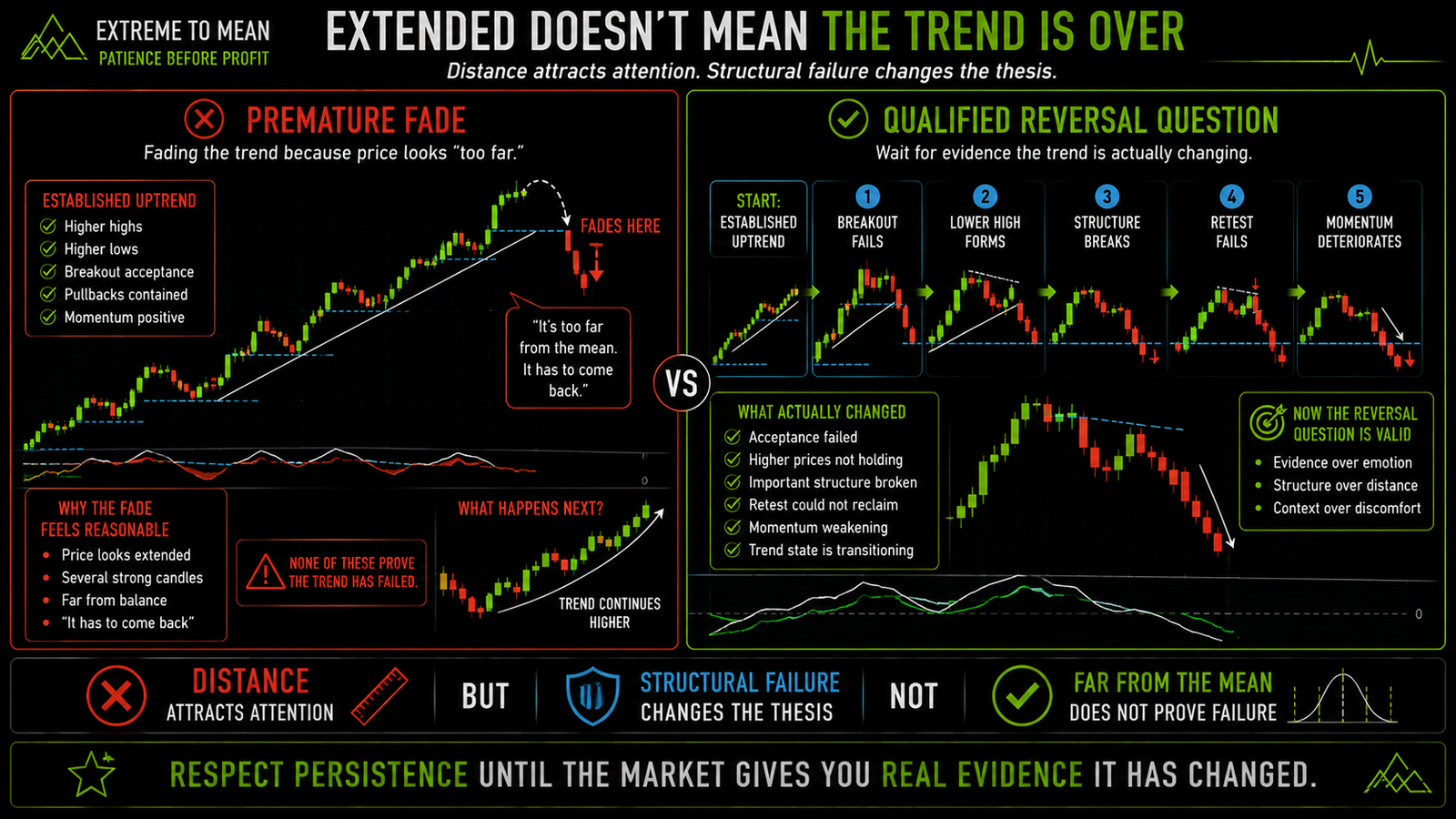
Strong trends often create exactly the conditions that tempt traders to fight them. Price becomes far from a mean, candles expand, the move looks obvious, and the potential entry in the opposite direction appears to offer an attractive return toward balance. The intuition is understandable because markets do eventually pause, pull back, or reverse. The mistake is turning eventual reversion into evidence that reversion must begin now.
This is where Reversion Is Not Reversal becomes especially important. A healthy trend can experience repeated countertrend moves without surrendering its directional structure, and a temporary return toward a mean may simply create another continuation opportunity. Distance can make a reversal question worth asking, but distance alone does not prove that directional control has changed. Fading persistence because the move feels extreme replaces market evidence with personal discomfort.
Pullbacks Are Where Trend Quality Becomes Easier to Evaluate
A trend pullback gives the trader information that the impulse itself cannot provide. During an advance, the trader can observe whether selling pressure remains contained, whether prior breakout areas continue to hold, and whether buyers regain control before meaningful bullish structure is lost. During a decline, the same logic works in reverse as rallies test whether sellers can continue defending lower prices. The pullback is therefore not automatically the entry; it is a test of whether the directional thesis remains intact.
Good pullbacks can take different forms depending on volatility and timeframe. Some are shallow and brief, while others retrace more deeply but still preserve the structure that matters to the directional move. The cleaner question is not whether price touched a preferred moving average or retraced an exact percentage. Ask whether the pullback behaved like temporary countertrend pressure or whether it began changing the market state itself.
Momentum Supports the Trend but Does Not Qualify the Entry
Momentum helps describe the pressure behind directional movement. Strong trends often show efficient progress, expanding impulses, limited hesitation, and relatively weak countertrend responses, while deteriorating momentum can appear as shorter extensions, more overlap, or repeated failure to make progress. Those changes can help a trader judge whether the trend is fresh, mature, or transitioning. Momentum should support the structural read rather than replace it.
This matters because chasing strong momentum is one of the easiest ways to turn a correct directional observation into a weak trade. The market may unquestionably be trending higher, but buying after a large expansion directly beneath resistance can still create poor location and awkward invalidation. Direction and entry quality are separate decisions. A trend deserves respect without making every point along that trend equally attractive.
The Biggest Trend-Trading Mistake Can Be Entering Too Late
Trend trading contains an uncomfortable tension: the trader needs enough evidence to establish persistence, but waiting for certainty can leave the entry far behind the developing structure. Early in a trend, confirmation is incomplete; late in a trend, confirmation can look overwhelming precisely because so much movement has already occurred. This makes trend maturity part of the qualification process. The strongest-looking chart can sometimes offer the weakest location for a new commitment.
Entering late often feels safer because the market has already demonstrated direction. The problem is that a late entry can place the trader far from logical invalidation, close to the next obstacle, or inside the most emotionally charged part of the move. If this becomes a recurring behavior, the problem is less about recognizing trend and more about chasing the trade. Patience in trend trading means waiting for useful structure, not waiting until continuation feels undeniable.
A Trend Ends Through Evidence, Not Distance
No trend continues forever, but the end should be evaluated through changing behavior rather than a predetermined amount of movement. An uptrend becomes more questionable when higher prices stop holding, pullbacks begin breaking important structure, failed breakouts increase, and attempts to resume the advance become less effective. A downtrend weakens through the inverse process as lower prices lose acceptance and bullish structure begins rebuilding. Distinguishing continuation from reversal requires naming which thesis that evidence still supports. The change often develops gradually before the chart looks like an obvious reversal.
That is why market conditions change the quality of a setup. A continuation pullback inside fresh directional acceptance is different from an identical-looking pullback after several exhausted extensions and repeated structural failures. The setup name has not changed, but the environment surrounding it has. Trend trading works best as an evaluation of persistence, maturity, and structure rather than a permanent directional bias.
A Cleaner Trend-Trading Evaluation Process
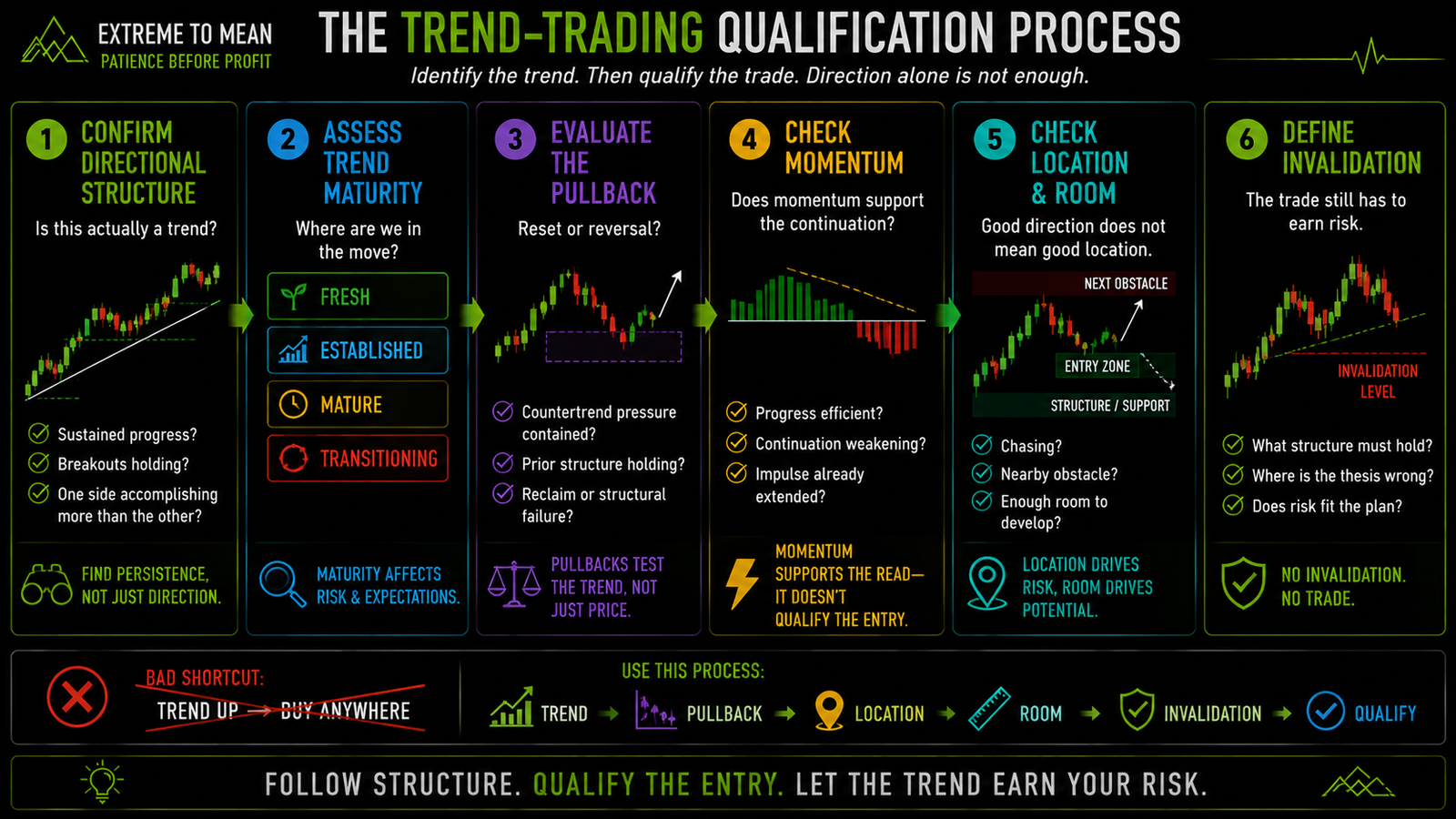
Start by establishing whether the market is actually directional. Look for sustained structural progress, acceptance beyond previous boundaries, contained countertrend moves, and evidence that one side continues accomplishing more than the other. Then evaluate where the trend sits in its development: freshly emerging, established, mature, or beginning to transition. That keeps the trader from confusing a historical trend with a current opportunity.
Next, evaluate the specific trade rather than the trend in isolation. Ask whether the pullback preserves structure, whether momentum still supports continuation, whether useful room remains before the next obstacle, and whether invalidation can be defined without forcing excessive distance. A good trend does not rescue a poor entry. The setup still has to earn risk through location and qualification.
Better Questions Before Following the Trend
A good trend-trading review should make it possible to separate three different judgments: whether a trend exists, whether it remains healthy, and whether the current location offers a qualified trade. Those questions are easy to collapse when price is moving quickly because strong direction creates urgency. The purpose of the review is to prevent "the market is trending" from becoming the entire trade thesis. Directional context should narrow the decision, not complete it.
- Is price making sustained structural progress or merely moving directionally for a few candles?
- Are pullbacks contained, or are they reclaiming important structure?
- Are breakout attempts holding outside prior boundaries?
- Is momentum strengthening, stable, or deteriorating?
- Is the trend fresh, established, mature, or transitioning?
- Am I evaluating a pullback, or chasing an already extended impulse?
- Is there useful room before the next meaningful obstacle?
- Where is the logical invalidation point?
- Has anything actually changed enough to justify fading the trend?
- Does this entry fit the trend, or am I using the trend to justify poor location?
These questions also improve post-trade review because they separate a losing trend trade from a badly qualified trend trade. A valid continuation thesis can still produce a losing outcome, while a profitable late chase can still reflect a weak process that should not be reinforced. Recording structure, trend maturity, pullback quality, and entry location creates a more useful decision record than simply labeling the trade "trend." The goal is to evaluate whether the process matched the environment.
Final Thought
Trend trading begins with a simple idea: directional movement can persist, and the trader does not need to fade every move away from balance. The difficult part is distinguishing healthy continuation from late-stage extension and separating a valid trend from a valid entry. Structure, pullback behavior, momentum, location, and remaining room provide the evidence needed to make that distinction. The trend earns attention, but the individual trade still has to earn risk.
Following structure does not mean blindly following price. It means respecting directional persistence until the market provides evidence that persistence is changing, while remaining disciplined enough not to chase after the useful entry has passed. Trend trading and mean reversion therefore begin with different questions but share the same underlying responsibility: evaluate the environment before choosing the approach. The market decides whether persistence or reversion is currently doing the better analytical work.
Educational content only. Trading involves substantial risk and is not suitable for everyone.