
The difference between a good setup and a good trade shows how a valid pattern can still fail the complete decision.
Many newer traders learn to recognize patterns before they learn to qualify trades. They see a rejection candle, a pullback, a breakout, a moving average touch, or an extreme move away from the mean, and they think, “That is my setup.”
But a familiar-looking chart is not enough.
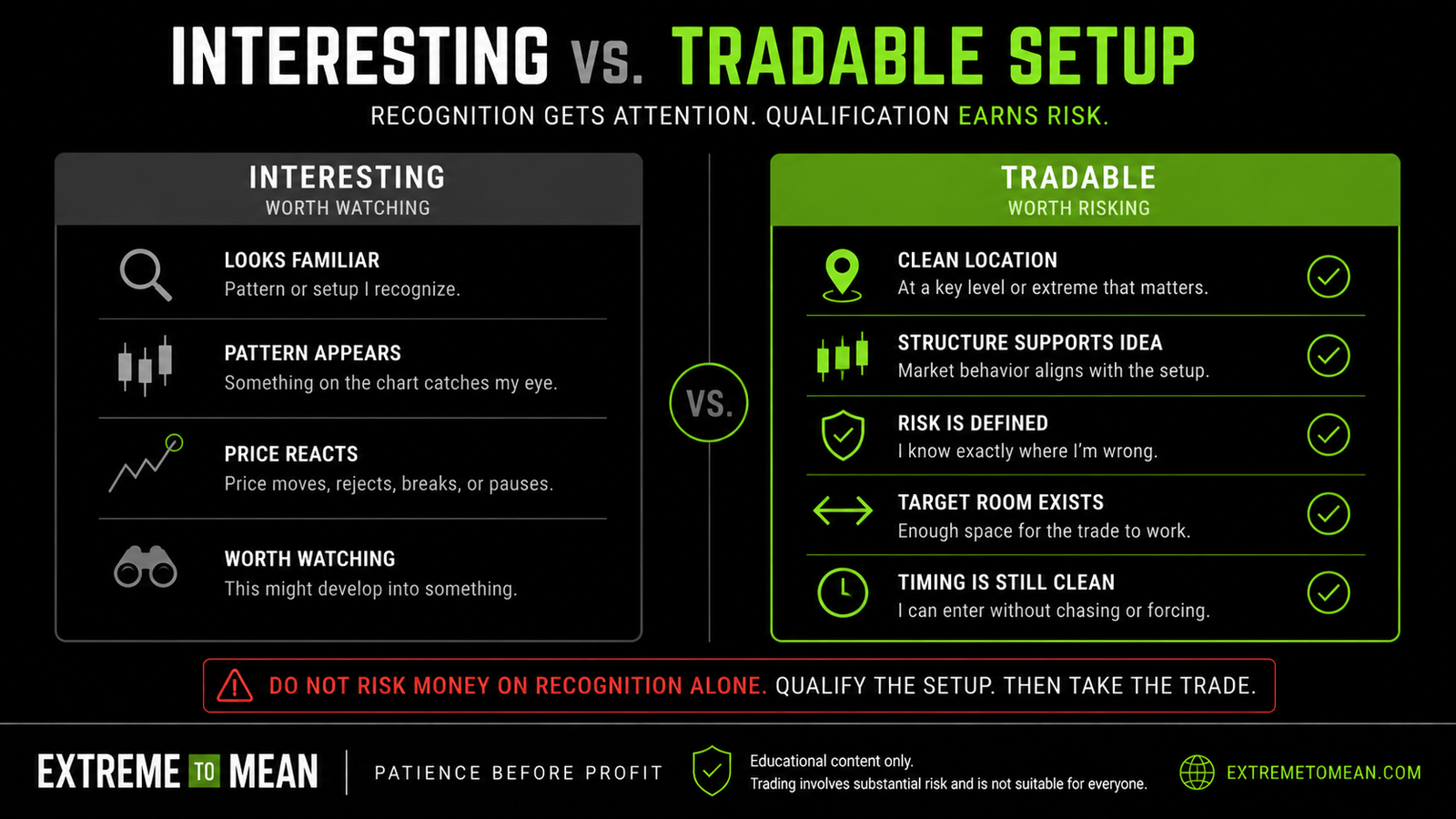
A setup can be interesting without being tradable. It can be worth watching without being worth risking money on. It can match the basic idea of a strategy while still missing the conditions that make a setup clean enough to explain simply. This is where many traders get into trouble. They confuse recognition with qualification.
The goal is not to take every chart that reminds you of a setup. The goal is to wait until the setup earns attention, then earns risk. That is why this lesson belongs with the broader setup and risk lessons. A setup is not just something you see. It is something you can define, manage, and evaluate before entry.
A Setup Is More Than a Pattern
A pattern is visual. A setup is structural.
That distinction matters. A pattern might be a wick, a candle shape, a pullback, a breakout, or a move into an indicator area. It catches the eye. It tells the trader that something may be happening. But it does not automatically answer the questions that matter before a trade.
A tradable setup needs more than recognition. It needs context. It needs location. It needs a reason the trade idea makes sense in the current market environment. It needs a clear place where the idea is wrong. It needs enough room for the target to make sense. It needs timing that does not force the trader to chase.
For Extreme to Mean, this is especially important because reversion-to-mean trading can make almost every stretched move look tempting. Price moves away from the mean, the trader notices distance, and the mind starts looking for a turn. But distance alone is not enough. An extreme may create interest, but interest is not the same as qualification.
This is why not every extreme is a trade. A move can be stretched and still keep stretching. A candle can reject and still fail. A level can hold once and break the next time. The setup is not tradable because it looks like something you have seen before. It is tradable only if the whole decision structure supports the idea.
The better question is not, “Do I recognize this?”
The better question is, “Can I define this trade clearly enough to take responsibility for it?”
Why Familiar Setups Feel So Convincing
Familiarity creates confidence. That can be helpful when the trader has a clear process, but it can be dangerous when the trader is only reacting to appearance.
A trader may see a chart that looks similar to a past winning trade. The mind remembers the result, not the full context. It remembers the move that worked, the clean reversal, or the perfect target touch. It forgets the market conditions, the location, the timing, the risk, and the failed versions that looked almost the same.
That is why familiar setups can feel more reliable than they really are. The trader is not only reading the current chart. They are comparing it to a memory. If that memory is incomplete, the trade idea may feel cleaner than it actually is.
This happens often around common setups. A trader sees price stretch into an outer area and expects reversion. They see a pullback into a moving average and expect continuation. They see a breakout and expect follow-through, without checking whether the first pullback actually confirms it. They see rejection and expect reversal. None of these ideas are automatically wrong, but none of them are complete by themselves.
A setup becomes more trustworthy only when the current evidence supports it. What is the market state? Where is price located? Is the move happening near an area that matters? Is the reaction strong enough to notice? Is the risk clear? Is there room for the trade to work before it runs into trouble?
This is where traders need to slow down. A familiar pattern can earn attention, but it has not earned risk yet. The space between those two decisions is where discipline lives.
The Missing Piece Is Usually Risk Clarity
Most traders do not get into trouble because they saw nothing. They get into trouble because they saw something but did not define it well enough.
Risk clarity is often the missing piece. A trader may know why they like the trade, but they may not know exactly where the idea is wrong. They may enter because price is moving, but the stop is too wide, too random, too emotional, or decided after the entry. That is not a tradable setup. That is a reaction with a trade attached to it.
A tradable setup needs a clear invalidation point. Invalidation means the area or condition where the trade idea no longer makes sense. It is not just the place where the trader is tired of losing. It is the place where the reason for the trade has failed.
For example, if the trade idea depends on price rejecting a key area, then the trader needs to know what would show that rejection has failed. If the trade idea depends on a pullback holding structure, then the trader needs to know where that structure is broken. If the trade idea depends on price reverting toward a mean, then the trader needs to know what would show that the market is not ready to rotate back.
This is why the trade is not ready until the risk is clear. A trader can have a good idea and still have a bad trade if the risk cannot be defined cleanly.
The mistake feels reasonable because the market may be moving quickly. The trader sees the entry area, feels the setup forming, and worries that waiting will cause them to miss it. But a trade that must be taken before the risk is clear is usually not a clean trade. It may work sometimes, but the process is weak.
A better trader does not ask only, “Where can I get in?”
They also ask, “Where am I wrong, and is that risk acceptable before I enter?”
A Tradable Setup Needs Room to Work
Even when location and risk are clear, the setup still needs room. This is another place where newer traders often skip a step.
A trade may have a good entry idea but a poor target path. Price may be too close to the mean, too close to resistance, too close to support, or trapped in the middle of a range. If the trade has to fight through immediate obstacles before reaching a reasonable target, the setup may not be worth taking.
In reversion-to-mean trading, room matters because the target is often tied to a return toward a more balanced area. If price is already near that area, the trade may not offer enough space to justify the risk. If price is stretched but there is a strong level directly in the way, the trader needs to account for that. The presence of an extreme does not automatically create a clean path.
A setup should have a logical target before entry. That does not mean the target is guaranteed. It means the trader knows where the trade is supposed to go if the idea works. Without that, the trader may enter first and figure out the exit later, which often leads to hesitation, greed, or panic.
This is why room to revert matters. A setup is not only about where price is now. It is also about whether there is enough space between the entry area and the target area to make the trade structure reasonable.
A clean setup has a defined entry idea, a defined risk area, and a defined target area. If one of those pieces is missing, the trader is not looking at a complete setup yet. They may be looking at a chart worth watching, but watching is not the same as entering.
Timing Decides Whether the Setup Is Still Clean
Timing does not mean predicting the perfect candle. It means evaluating whether the setup is still in a condition where the trade can be taken without chasing, forcing, or accepting sloppy risk.
Sometimes the setup idea is good, but the timing is poor. Price may have already moved too far from the clean entry area. The stop may now need to be wider. The target may be closer. The trader may be late. In that case, the setup may have been tradable earlier, but it may no longer be tradable now.
That is one of the hardest lessons for newer traders. A good idea can expire.
The market does not owe the trader a second chance at the clean entry. If the trade has already moved, the trader has to decide whether the structure still makes sense. Many bad trades come from trying to force an entry after the clean opportunity has passed.
This is where patience protects decision quality. The trader who missed the clean entry may feel frustrated, but frustration is not a setup. The trader who waits may feel like they are doing nothing, but waiting can protect the next decision.
A setup is actually tradable only if the timing still allows the trader to define the trade properly. If entering now creates unclear risk, poor target room, or emotional pressure, the better decision may be to let it go.
A Simple Filter for Tradable Setups
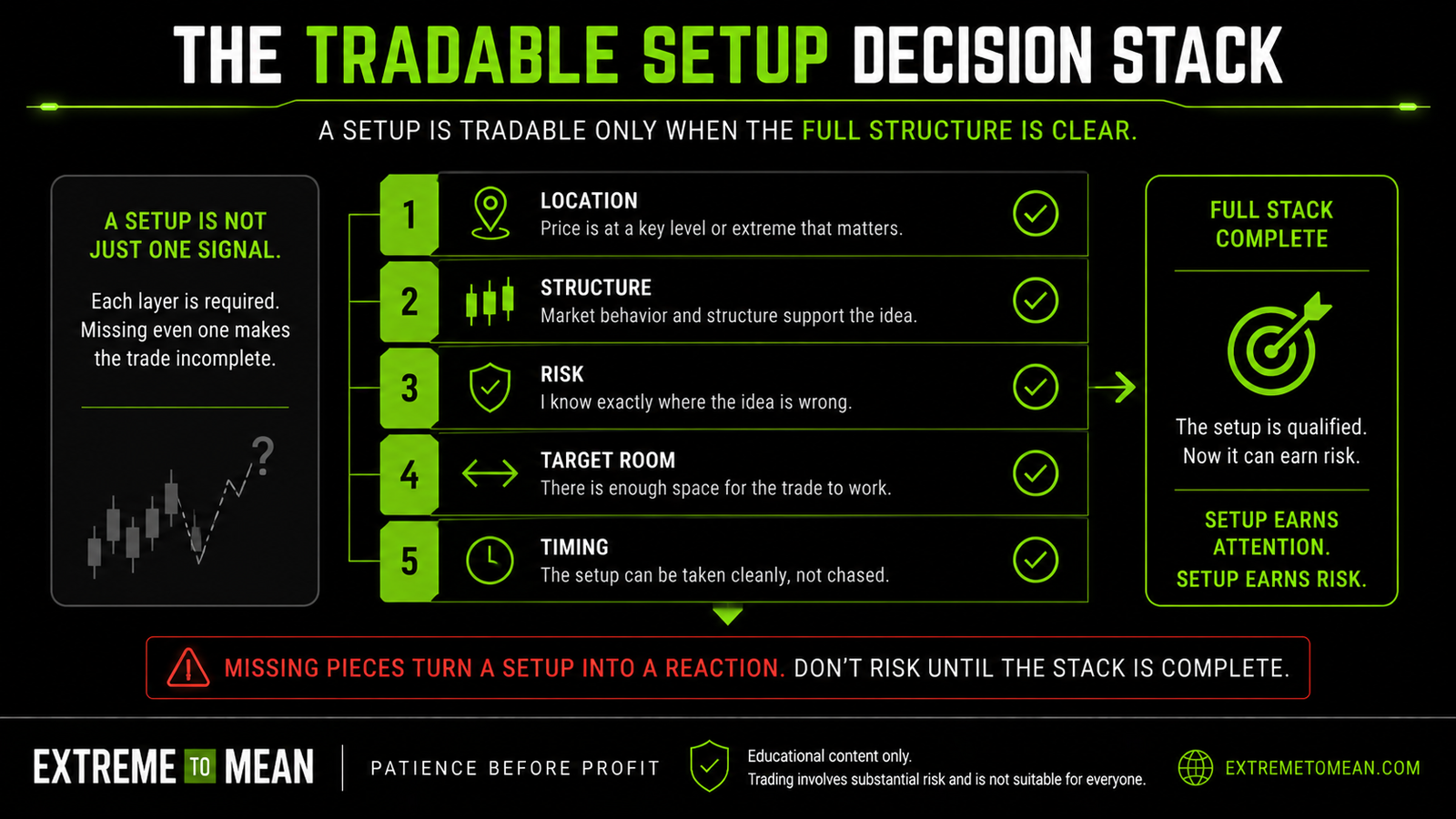
A setup does not need to be complicated to be qualified. A simple decision filter can help a trader slow down and separate interest from action.
Before taking a setup, ask:
- Context: What kind of market am I trading inside?
- Location: Is price at an area where this idea makes sense?
- Structure: Is the market behavior supporting the idea?
- Risk: Do I know exactly where the trade is wrong?
- Target: Is there enough room for the trade to develop?
- Timing: Am I entering cleanly, or am I late and chasing?
- Decision: Does this setup deserve risk, or only attention?
The most important question may be this: If I could not enter for the next candle, would the trade still make sense?
That question helps expose urgency. If the only reason to enter is fear of missing the move, the setup may not be as clean as it feels. A quality setup should not depend entirely on panic speed. It should have a structure the trader can explain before the entry is taken.
This is also where broader market reading matters. A setup that looks clean in isolation may be weak inside poor conditions. Chop, low-quality movement, news risk, exhaustion, or unclear structure can all change whether a setup deserves risk. Traders who want a stronger foundation can study how market conditions change the quality of a setup before focusing too heavily on entries.
A tradable setup should answer the basic trade questions before the order is placed. What is the idea? Why here? Where is it wrong? Where can it go? What would make me stand aside? Writing those answers as a scenario-based if-then plan before the session starts turns this checklist into a prepared response instead of a live improvisation.
If those answers are not clear, the trade is not ready.
For traders building a rules-based process, the next practical step is to download the free RTM trade checklist and use it as a way to slow down before acting on a chart that only looks familiar.
Final Thought
A setup is not tradable because it looks good. It is tradable because it is defined.
The difference matters. An interesting chart situation can grab attention, but attention is not risk. A candle, level, pattern, or extreme only becomes useful when the trader can place it inside context, define the risk, identify the target path, and decide whether the timing is still clean.
The trader’s job is not to react to every familiar pattern. The trader’s job is to qualify the opportunity before capital is involved.
A setup earns attention first. It earns risk only after the full decision structure is clear.
Educational content only. Trading involves substantial risk and is not suitable for everyone.