
Before a trader studies setups, entries, exits, or advanced market structure, they need to understand the two basic directions a trade can take. A trader can buy first and hope to sell later at a higher price. Or a trader can sell first and hope to buy back later at a lower price.
That sounds simple, but many beginners confuse direction with prediction. They hear “long” and think bullish. They hear “short” and think bearish. That part is true, but it is not enough. Direction only tells you which way the trade benefits if price moves in your favor.
At Extreme to Mean, this belongs in The Basics lesson library because direction is one of the first pieces of market language a trader needs to understand. If a later lesson says “go long,” “avoid shorting into support,” or “fade an extended move,” the reader should know what those words mean mechanically before thinking about strategy.
What It Means to Go Long
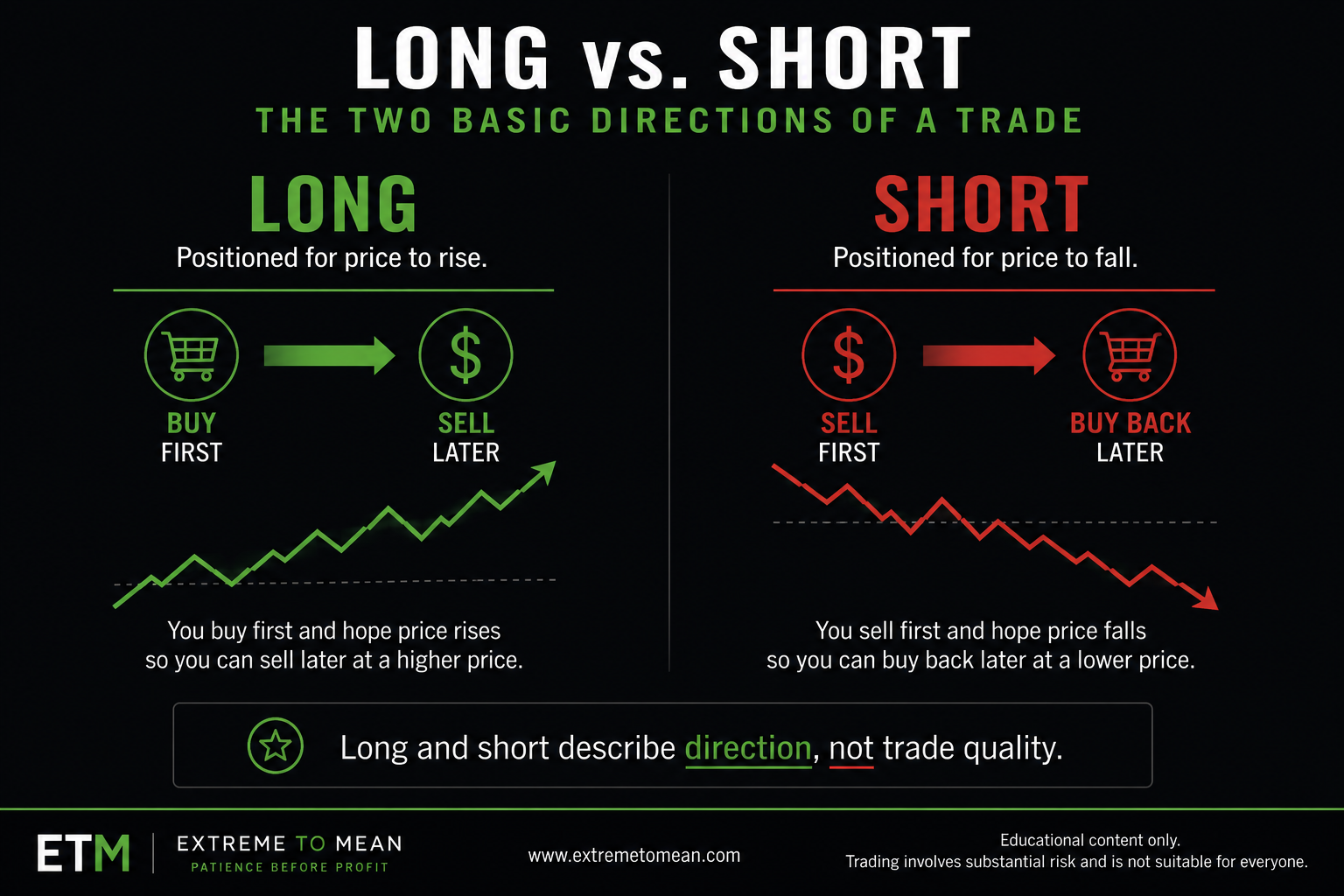
To go long means you buy first.
The basic idea is simple: you enter a position because you believe price may rise from where you bought it. If price rises and you later sell at a higher price, the trade has moved in the direction you wanted. If price falls after you buy, the trade moves against you.
For example, if a stock is trading at $50 and a trader buys it, that trader is long. If the price later moves to $55 and the trader sells, the long trade benefited from the rise. If the price drops to $45 instead, the long trade is under pressure because the trader bought before the decline.
Going long is usually the easier direction for beginners to understand because it matches how people think about buying most things. You buy something, then you want it to become worth more. That same basic logic applies across stocks, ETFs, futures, and other tradable markets, though the exact rules and risks can differ by instrument.
A long trade does not mean the trader is correct. It only means the trader is positioned for a move higher. Price can rise, fall, chop sideways, reverse suddenly, or move too slowly to make the trade worthwhile.
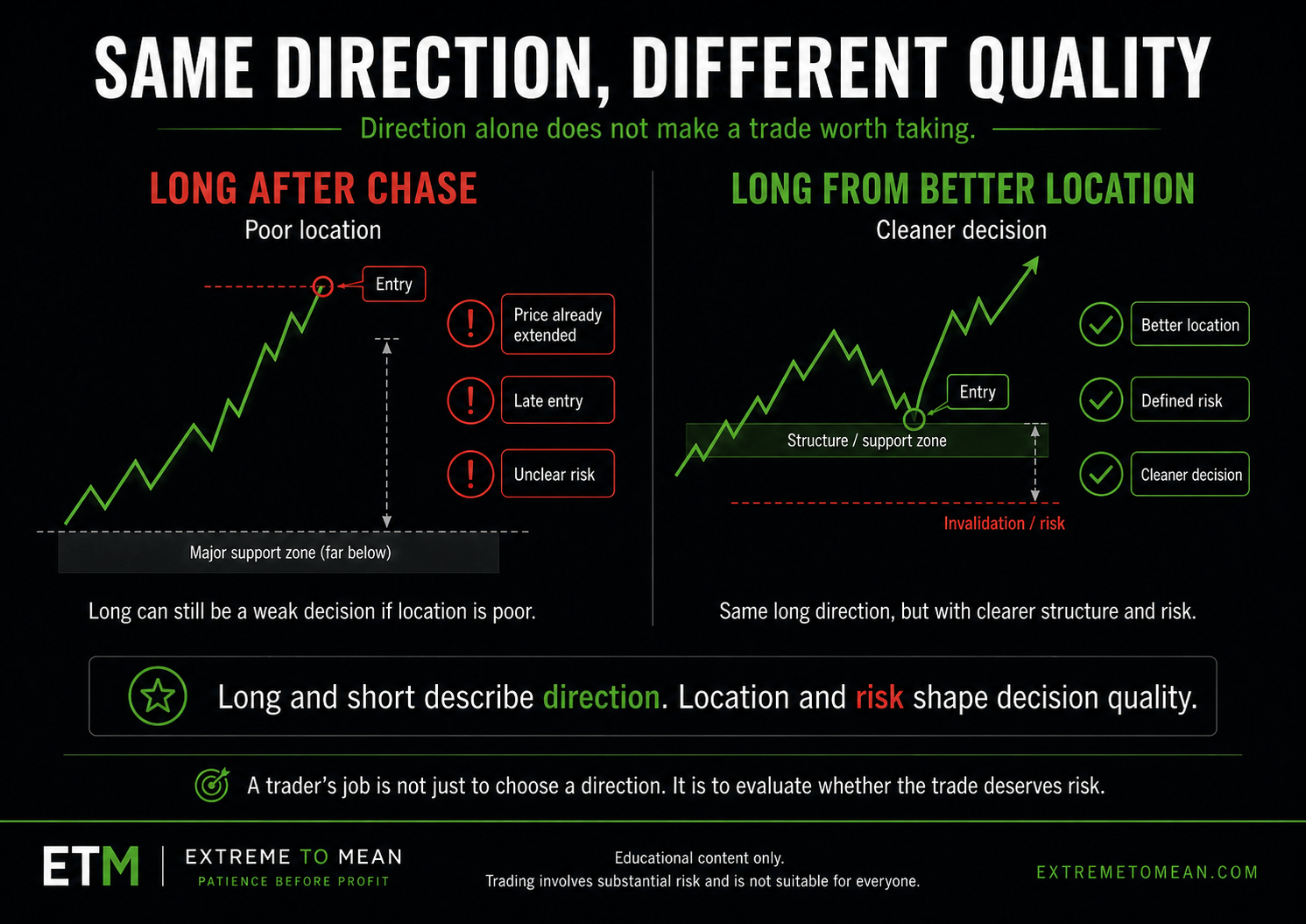
This is why direction is only the first layer. A trader still has to evaluate context, location, risk, and whether the trade has a clear reason to exist. A long trade taken in a poor location can still be a poor decision, even if the trader likes the market.
What It Means to Go Short
To go short means you sell first.
The basic idea is the opposite of going long: you enter a position because you believe price may fall from where you sold it. If price falls and you later buy back at a lower price, the trade has moved in the direction you wanted. If price rises after you sell short, the trade moves against you.
For a beginner, this can feel strange. How can you sell something before you own it?
The answer depends on the market. In stocks, short selling usually involves borrowing shares, selling them, and later buying them back to return them. If the buyback price is lower than the original sale price, the short trade benefited from the decline. If the buyback price is higher, the short trade moved against the trader.
In futures markets, the mechanics are different because traders are buying or selling contracts rather than shares of a company. A trader can sell a futures contract first if they want exposure to a potential move lower. That does not make the trade safer or better. It only means the trade is positioned to benefit if price falls.
Shorting is not automatically aggressive, negative, or advanced. It is simply the other direction a trade can take. But because the mechanics can be less familiar, beginners should be careful not to treat short trades casually. Different products, brokers, and account types can have different rules, margin requirements, borrowing costs, and risk considerations.
A short trade is not a prediction that price must fall. It is a position that benefits if price falls. That distinction matters because markets do not owe the trader follow-through.
Direction Is Not the Same as Trade Quality
One of the most important lessons for a beginner is that long and short only answer the direction question.
They do not answer whether the trade is well-located. They do not answer whether the risk is clear. They do not answer whether the market is trending, ranging, or reversing. They do not answer whether the trader is reacting emotionally or following a process.
A trader can be long in a market that looks strong and still enter too late. A trader can be short in a market that looks weak and still sell directly into a level where buyers are waiting. Direction can make sense, while the actual trade still lacks quality.
This is where many new traders get trapped. They look at a chart, decide price “should” go up or down, and then assume that opinion is enough to justify a trade. But an opinion about direction is not the same as a complete trade decision.
A better trader separates the questions:
- What direction would this trade need price to move?
- Where would the trade idea be wrong?
- Is there enough room for the trade to develop?
- Is the risk clear before entry?
- Am I acting because the setup is ready, or because price is moving?
Those questions slow the trader down. That matters because many trading mistakes happen when a trader confuses movement with opportunity. Price moving up does not automatically mean a long is clean. Price moving down does not automatically mean a short is clean. Even how candle color shows price movement inside one period is descriptive, not a complete reason to take a long or short trade.
If you are still building the foundation, it helps to understand what trading really is: a decision made under uncertainty, not a guarantee that the next move will cooperate.
Why Long and Short Feel Emotional
Long and short are mechanical terms, but they often create emotional reactions.
Going long can feel easier because rising prices are usually associated with strength, optimism, and opportunity. A beginner may feel more comfortable buying because it seems natural to participate in something moving higher. The danger is that comfort can turn into chasing.
Going short can feel uncomfortable because falling prices are often associated with fear, weakness, or negativity. Some beginners avoid shorting completely because it feels backwards. Others become too aggressive with shorts because they see a market dropping and assume the decline must continue.
Both reactions can create problems.
The long trader may buy too high after the move has already stretched. The short trader may sell too low after the market has already flushed. In both cases, the issue is not simply direction. The issue is location, timing, and risk.
This is especially important in reversion-to-mean thinking. A move can be strong and still extended. A move can be weak and still near an area where selling becomes less attractive. Extreme to Mean does not teach traders to react to every move. It teaches traders to evaluate whether the location, context, and risk make the decision worth attention.
That is why the better question is not, “Is price going up or down?”
The better question is: “If I take this direction, where exactly is the trade wrong, and is this location worth the risk?”
Long, Short, and the Role of the Market
A trade direction only makes sense inside a market.
Markets move because buyers and sellers are constantly negotiating price. When buyers are more aggressive, price may rise. When sellers are more aggressive, price may fall. When neither side has clear control, price may chop back and forth.
That is why a long or short trade should not be viewed in isolation. The trader needs to consider what the market is doing around the trade idea. Is price breaking out of balance, pulling back into structure, rejecting an extreme, or moving in the middle of a messy range? That process starts with reading price movement on a chart before judging whether the direction is worth risk.
A long trade near the top of an extended move is different from a long trade near an area where buyers have previously defended price. A short trade after a clean rejection is different from a short trade placed randomly because a red candle appeared.
The direction may be the same, but the decision quality is different.
If a trader does not understand how price forms through buying and selling pressure, direction can become a guess. That is why the earlier lesson on buyers, sellers, and price matters. Long and short trades are not floating opinions. They are decisions made inside an auction.
Before that direction becomes an order, the trader also needs to understand where a buy or sell order actually executes.
They also need to understand how orders are used to enter or exit a trade.
This does not mean the market becomes predictable. It means the trader has more structure for evaluating the decision before acting.
Different Products, Same Direction Logic
The long-versus-short idea appears across many markets, but the details are not identical.
In stocks, going long means buying shares. Shorting stock usually involves borrowing shares and later buying them back. In ETFs, traders may go long or short depending on broker rules, available shares, and account permissions. In futures, traders can buy or sell contracts depending on the direction they want exposure to. In options, direction can become more complex because contracts involve rights, obligations, expiration, strike prices, and changing option values.
The important beginner lesson is this: the direction logic stays simple, even when the product mechanics become more complex.
Long means the position generally benefits from price moving higher. Short means the position generally benefits from price moving lower. The product determines the rules, costs, leverage, expiration details, and risk mechanics around that position.
That is why beginners should not rush from knowing the words into using every product available. Understanding direction is only one piece. Understanding the instrument is another. A trader who knows the difference between direction and product structure is less likely to assume that all trades behave the same way.
The earlier comparison of stocks, ETFs, futures, and options is useful here because the trade direction may sound similar, but the mechanics behind the instrument can be very different.
A Simple Direction Filter Before You Act
Before entering any trade, a beginner should be able to answer a few basic questions without hesitation.
Start with direction:
- Am I going long or short?
- Does this trade need price to rise or fall?
- What would price have to do to prove this idea wrong?
- Where would I exit if the trade moves against me?
- Is the trade based on a planned setup, or am I reacting to movement?
- Is this location clean enough to justify attention?
These questions are not meant to predict the outcome. They are meant to clarify the decision.
A trader who cannot clearly explain the direction of the trade usually cannot clearly explain the risk of the trade. And if the risk is unclear, the trade is not ready. That does not mean the trade will fail. It means the decision process is incomplete.
This is one of the core Extreme to Mean ideas: the setup earns attention before it earns risk. Direction alone does not earn risk. A fast move does not earn risk. A feeling does not earn risk.
A cleaner decision starts with patience. The trader identifies the direction, checks the location, defines the risk, and decides whether the trade still deserves action. If that process is missing, doing nothing may be the better decision.
For a deeper next step, the lesson on why the trade is not ready until the risk is clear builds on this same idea: direction is not enough without a defined invalidation point.
Final Thought
Long and short are the two basic directions of a trade.
Going long means buying first because the trade benefits if price rises. Going short means selling first because the trade benefits if price falls. Neither direction is automatically smart, safe, aggressive, or wrong. The next step is understanding how entry and exit create profit or loss.
The better trader does not ask only, “Which way do I think price will go?” The better trader asks, “Is this the right direction, in the right location, with clear risk, under conditions that justify a decision?”
That is where Patience Before Profit begins.
Educational content only. Trading involves substantial risk and is not suitable for everyone.