
A good month can make larger size feel like the obvious next step. That is exactly why the decision deserves more evidence than confidence.
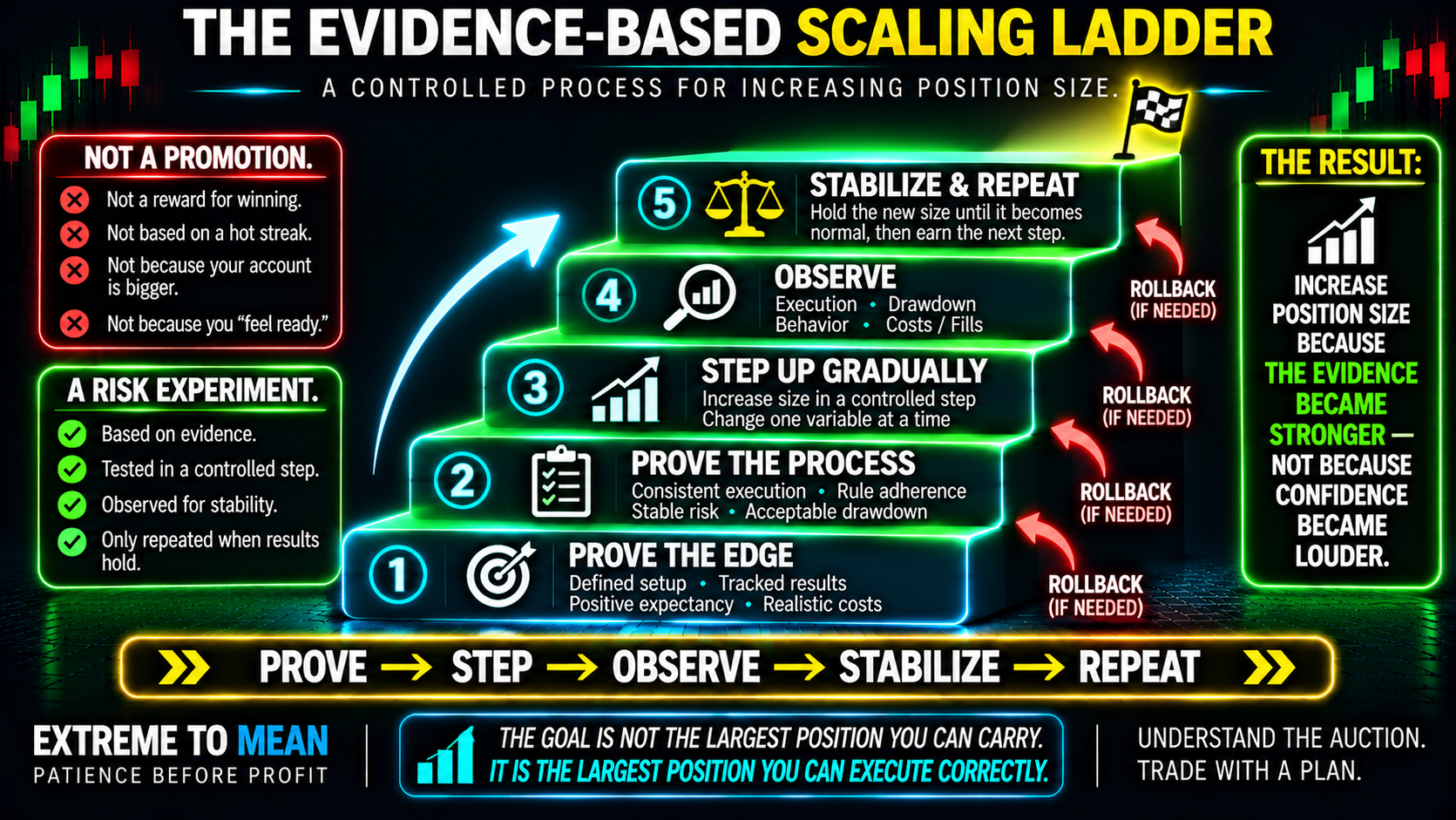
Size should increase because the evidence became stronger—not because confidence became louder.
Increasing position size should not be treated as a reward for winning. It should be treated as a new risk experiment: the trader has demonstrated performance at the current size and now has to test whether the same process survives when the dollars become larger. Has my edge earned more size—or has recent success merely made me feel ready for it?
That question belongs inside The Setup because scaling changes more than account exposure. Larger dollars can change execution, rule adherence, drawdown tolerance, and eventually fill quality. Scaling does not improve an edge; it magnifies whatever edge—or lack of edge—already exists.
Position Sizing and Position Scaling Are Different Decisions
Position sizing answers how large a specific trade should be given the stop, contract value, account, and risk plan. That is the job covered in Futures Position Sizing. Position scaling asks a different question: when should the trader's normal operating size become larger across future trades?
Scaling up is also different from scaling into an open position. Adding contracts to one existing trade is a trade-management decision; increasing normal size across future setups is an account-level progression decision. Position sizing chooses today's risk. Position scaling decides whether tomorrow's normal risk should become larger.
Confidence Is Not a Scaling Metric
Confidence can rise after a winning streak, one unusually large winner, account growth, or a market regime that fits the strategy especially well. None of those facts alone proves that the underlying edge has strengthened or that the trader can execute the same process under greater pressure. Confidence describes how the trader feels about the evidence; it is not the evidence itself.
The easiest time to believe you are ready for more size can be immediately after the market has been unusually kind to your strategy. Six winners in eight trades may feel like proof, but the regime may have been unusually favorable, several winners may have been outsized, and the sample may still be too small to separate repeatable performance from a hot stretch. Recent success can justify investigation; it does not automatically justify extrapolation.
The First Gate: Has the Current Size Actually Proven Anything?
Before scaling, the process needs credible evidence of positive expectancy rather than recent profitability alone. The setup should be clearly defined, results tracked, costs included, and performance evaluated across enough comparable opportunities to say something useful about the distribution. If the edge itself is still vague, what an edge actually is needs to be settled before more exposure is added.
There is no responsible universal answer such as “scale after 50 trades” or “add a contract after three profitable months.” A strategy that trades three times a month and one that trades thirty times a day cannot use the same calendar threshold meaningfully. The gate should be evidence density—not an arbitrary number of days.
The current-size process should also look stable beyond P&L. Qualified setups, risk rules, execution, and post-loss decision-making should remain consistent. Scale the process only after the process has become boringly repeatable.
The Behavioral Test: Does More Money Change Your Decisions?
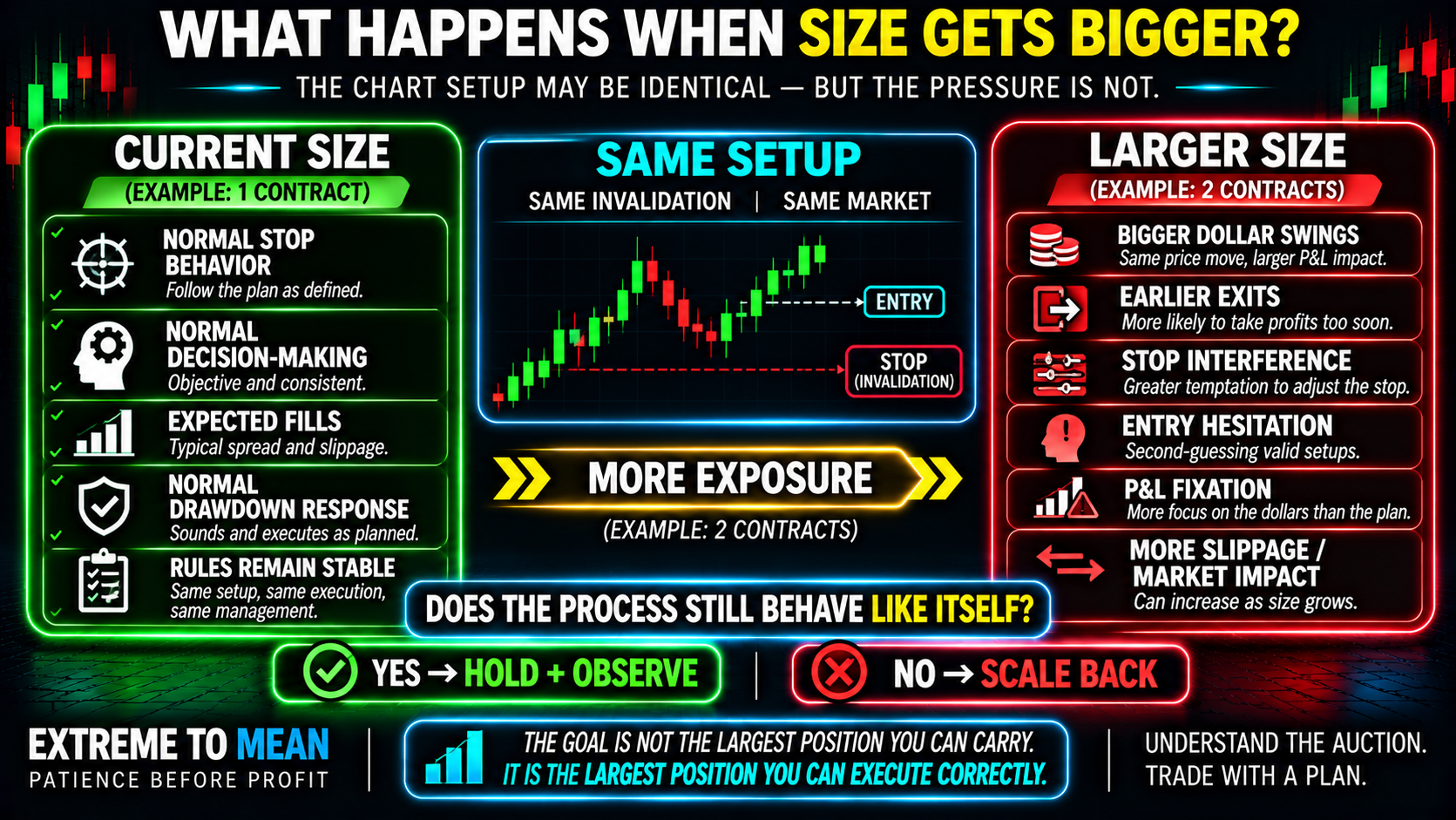
Imagine a trader who comfortably risks $50 on a setup and then doubles the position so the same stop represents $100. Nothing changed on the chart, the setup definition, or the invalidation. Yet the trader may start staring at P&L, cutting winners early, hesitating on valid entries, or moving the stop emotionally.
That is why a size increase needs its own observation period. Risk can remain mathematically proportional while becoming emotionally larger, and the setup can remain identical while the trade becomes psychologically different. The purpose of the first increase is not to maximize profit; it is to test whether the process survives the new pressure.
One Contract to Two Is a Bigger Jump Than It Sounds
For futures traders, one additional contract can look trivial because the integer changes by one. Moving from one contract to two is still a 100% increase in position size, which can double planned dollar swings before considering any change in stop distance, costs, or slippage. One additional contract can be a small integer and a very large percentage.
Smaller contracts can make progression more granular because exposure can be adjusted in finer steps. That does not make Micro futures automatically safe; it simply gives the trader more sizing precision.
Scale in Steps—and Change One Variable at a Time
A planned increase should function as a test rather than a leap to the maximum the account can support. There is no universal percentage or contract increment because strategies, instruments, accounts, and current operating sizes differ. The principle is staged exposure, not a magic step size.
Once size changes, freeze the other major variables. Do not simultaneously change the strategy, add instruments, trade more sessions, loosen setup criteria, and increase size. If several things change together, you lose the ability to diagnose why results or behavior changed.
The new size is a new operating condition. Stay there long enough to observe execution, drawdown, costs, and behavior before considering another increase. Every increase in size must earn the next increase.
Every Scaling Plan Needs a Rollback Rule
Most traders ask when they can increase size. The better risk question is: What would make me reduce it again? A scaling plan without a rollback rule is only an escalation plan.
Possible rollback evidence includes deteriorating rule adherence, earlier exits, stop interference, hesitation on valid trades, drawdown reaching a planned review area, or the new size no longer fitting the account's risk policy. The goal is not to prescribe one universal trigger. The goal is to define deterioration before the trader becomes emotionally invested in proving the larger size was deserved.
Scaling down is not failure when the larger size has changed the process. It is data-driven risk management. The goal is to discover the largest size at which the process still behaves like itself.
Eventually Scaling Becomes an Execution Problem
For small retail futures positions, account risk and behavior will often become constraints before true market impact does. But as size grows, execution capacity matters more because larger orders may fill across multiple prices or experience more slippage under thinner conditions. At some point, scaling becomes a liquidity question as well as a risk question.
CME's liquidity materials evaluate more than displayed book depth; they also examine spread, cost to trade, order size, and market impact. “This market is liquid” is incomplete without asking: liquid for how much size, at what time, and under what conditions? A strategy's edge has to survive the cost of executing the larger version of itself.
A Worked Scaling Example
Suppose a trader currently uses one Micro contract and has a meaningful sample with positive net expectancy, stable rule adherence, and tolerable drawdown. The scaling plan says that when predetermined review criteria are met, exposure increases one step rather than jumping to the maximum allowed by buying power. The trader tests two Micros.
That move is illustrative, not a recommendation—and it is a 100% increase in contract count. The trader does not increase again immediately; the new size is held while expectancy, drawdown, execution, costs, and behavior are reviewed.
If those dimensions remain stable, the new size can become the operating baseline and another increase can be considered later. If the trader begins cutting winners, moving stops, or hesitating on qualified entries, the correct response is to step back down rather than force adaptation. The maximum useful size is the largest position at which the trader can still execute the proven process correctly.
The Evidence-Based Scaling Check
Before increasing normal operating size, ask:
- Is the edge clearly defined?
- Do I have a meaningful sample at the current size?
- Is expectancy positive after realistic costs?
- Have I followed my rules consistently?
- Is current drawdown understood and acceptable under the plan?
- Would the new size still fit the account's risk policy?
- Is my desire to scale coming from data—or from a winning streak?
- Can the market absorb the new size without materially changing execution?
- What evidence would make me step back down?
- Will I hold the new size long enough to evaluate it before increasing again?
A trading plan made before the session should define scaling and rollback logic before a winning streak creates pressure to move faster. The decision to scale should be designed when the trader does not currently want to scale.
The ETM Prove → Step → Observe → Stabilize → Repeat Framework
Use PROVE → STEP → OBSERVE → STABILIZE → REPEAT. Prove that current-size performance is credible, step exposure upward gradually, observe behavior, execution, drawdown, and costs, and hold the new size until it becomes operationally normal. Only then consider repeating the process.
At every stage, ROLL BACK if process quality deteriorates. The first increase is a test—not a promotion. Every increase in size must earn the next increase.
The ETM free tools can support that review. The better question is not “How quickly can I reach the next size?” It is “Has this operating level earned the right to become normal?”
Final Thought
Increasing position size should not be a reward for confidence, a good month, account growth, or access to more buying power. Larger size exposes the same strategy to larger dollar swings, more behavioral pressure, and eventually different execution conditions. Profitability can justify a review; it does not by itself prove readiness to scale.
Prove the current process first. Increase exposure gradually, freeze further scaling while the new level is observed, and decide in advance what would make you step back down. If larger size changes the stops, exits, entries, rule adherence, drawdown tolerance, or net execution quality, the evidence has answered the question.
The goal is not to reach the largest position the broker or account will allow. It is to find the largest size at which the proven process still behaves like the process that earned the increase in the first place. Scaling is a staircase, not an elevator.
Educational content only. Trading involves substantial risk and is not suitable for everyone.