
Why the Stop Often Gets Blamed for the Entry
Stops are easy to blame because they make risk visible. A trader can see twenty or thirty points between entry and invalidation and immediately conclude that the trade requires too much room. What is less obvious is that part of that distance may have been created by entering at a poor location rather than by the market demanding an unreasonable stop.
The Setup curriculum treats location, structure, and risk as connected decisions rather than separate boxes. If price has already traveled a meaningful distance away from the location that originally made the setup attractive, the invalidation point may not have changed at all. What changed is the amount of distance the trader created between the entry and that same valid point.
That is why the question “How can I make this stop tighter?” can send the trader in the wrong direction. Moving the stop inward may make the number smaller, but it does not improve the original thesis or the entry location. It simply changes where the trade will be forced to exit.
Where Is the Trade Actually Wrong?
A stop should follow the trade’s invalidation, not the trader’s comfort level. If the thesis remains valid until price reaches a particular structural point, then that is the level the risk plan has to evaluate. The cleaner process is to define where the idea is wrong first and only then decide whether the proposed entry creates an acceptable trade around that level.
This is why the trade is not ready until the risk is clear. A ten-point stop placed inside valid structure is not automatically better risk management than a thirty-point stop beyond genuine invalidation. If normal market movement can reach the tighter stop without disproving the trade, the trader has reduced the distance but may also have damaged the logic of the setup.
The right question is therefore not whether the stop feels wide in isolation. It is whether the distance from entry to valid invalidation creates a trade whose total geometry still makes sense. If it does not, the solution may be to change the entry decision rather than change where the thesis becomes wrong.
How Entry Location Changes Stop Distance
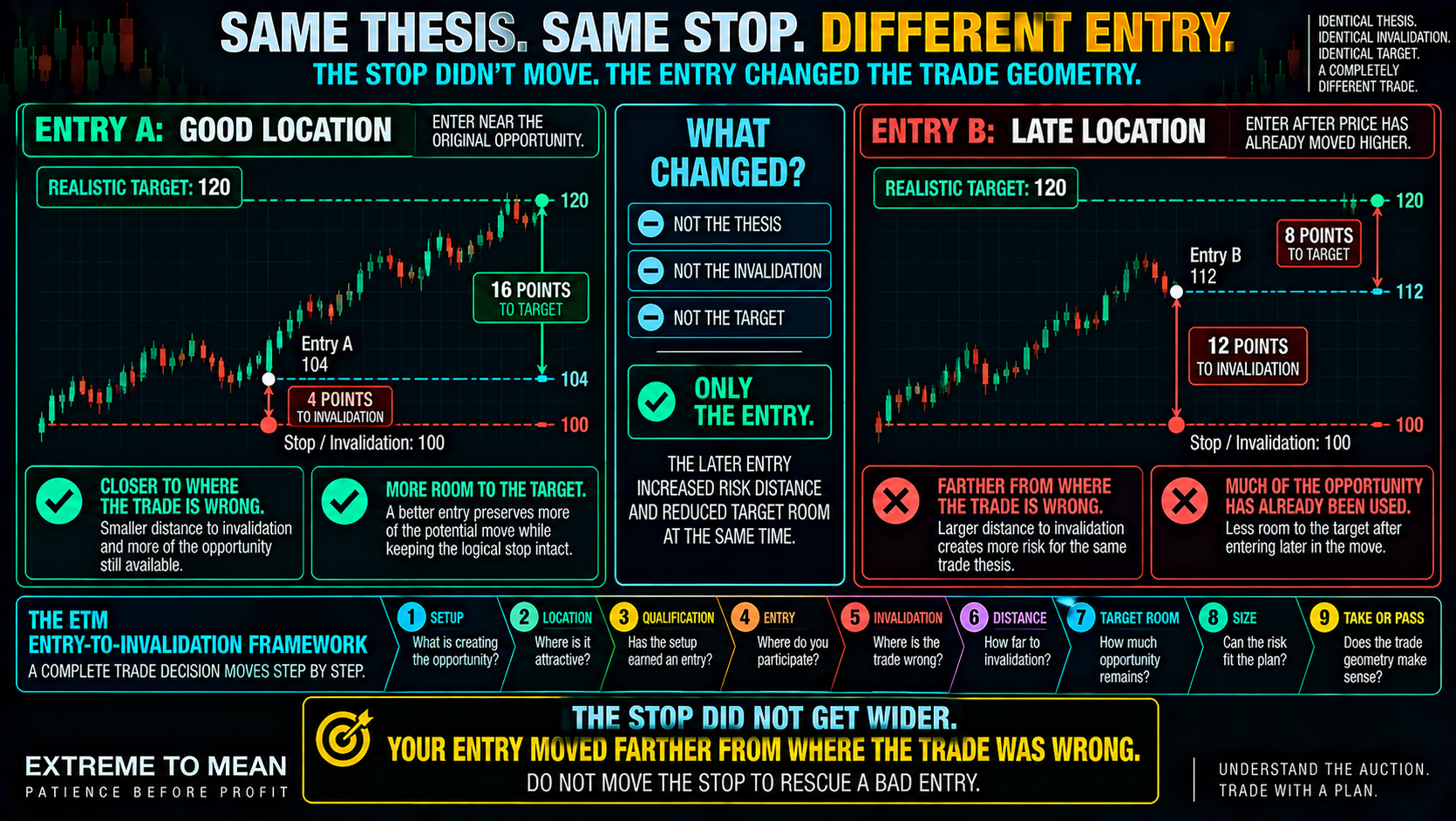
Imagine one long setup with a fixed invalidation at 100 and a realistic target at 120. Trader A enters at 104 near the location that created the opportunity, while Trader B waits until price has already moved to 112 before entering. Both traders can have the same market thesis, the same invalidation, and the same destination while facing completely different trades.
Trader A has four points between entry and invalidation and sixteen points of room to the target. Trader B has twelve points between entry and invalidation and only eight points of remaining room. Nothing about the stop or target changed; the later entry transformed both sides of the trade geometry.
This is one practical consequence of why location is the first filter. Good location can reduce the distance to logical invalidation while preserving more of the movement the setup is trying to capture. Poor location can do the opposite at the same time, increasing risk distance while consuming potential room.
The Goal Is Not the Earliest Possible Entry
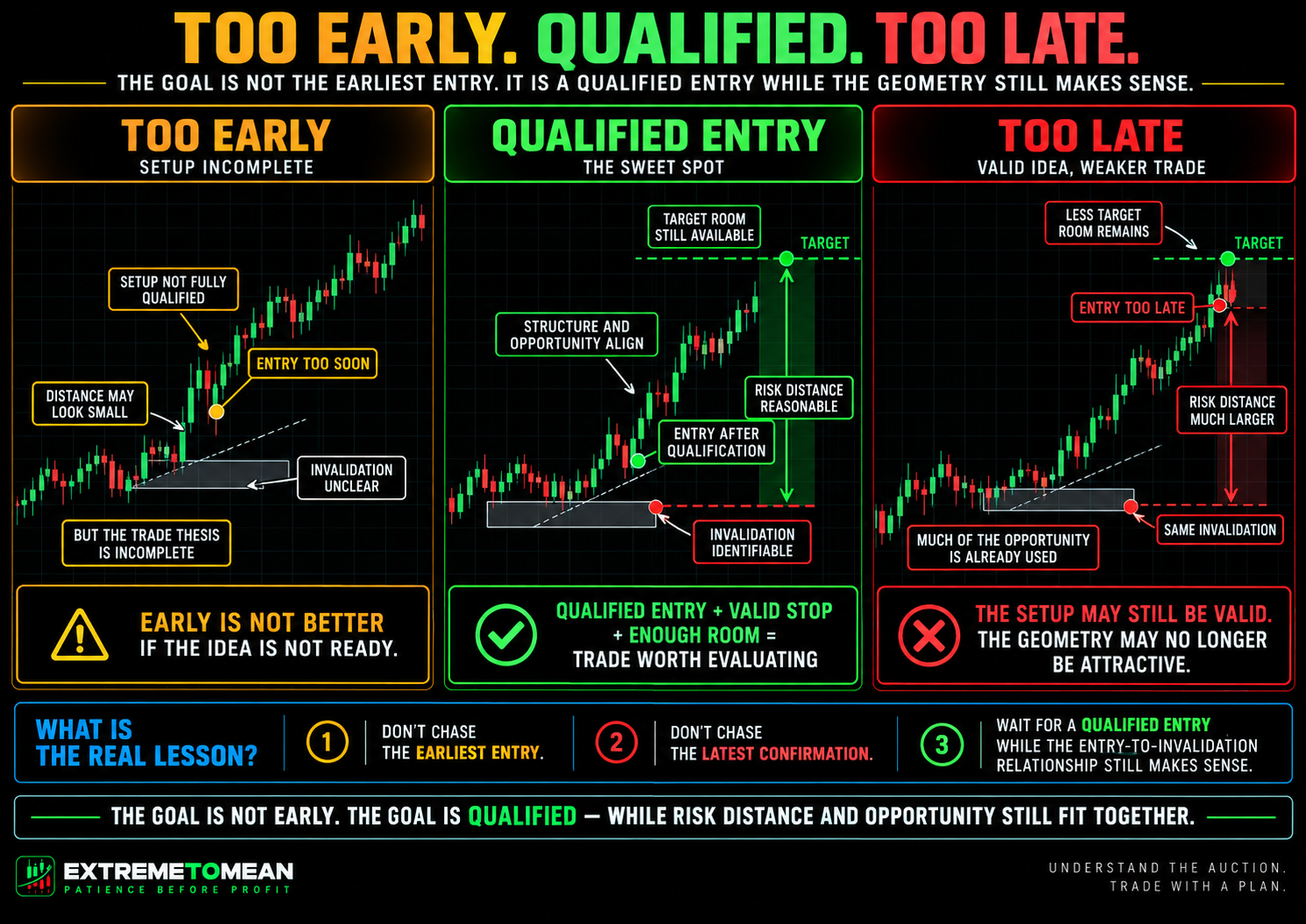
It would be easy to draw the wrong lesson and conclude that earlier is always better. Entering before the setup has actually qualified can create the opposite problem: the market has not yet provided enough structure to define what would make the idea wrong. A small distance to an imaginary invalidation point is not an improvement if the thesis itself is incomplete.
That creates two different location errors. An early trader may have attractive-looking distance but unclear qualification and invalidation, while a late trader may have a completed setup but arrive after too much of the opportunity has already been consumed. The useful middle is a qualified entry while the relationship among location, invalidation, and available room still makes sense.
This distinction matters because where you enter matters more than what you predict. A trader can correctly anticipate the next direction and still create a poor trade by entering too soon or too late. Directional correctness does not repair bad geometry.
More Confirmation Has a Cost
Waiting for more evidence can be rational because confirmation may reduce uncertainty about whether the setup is actually developing. The problem is that evidence often arrives only after price has moved farther from the location that first made the trade attractive. Every additional confirmation step therefore has a possible cost in entry quality.
That creates a trade-off rather than a universal rule. Too little confirmation can mean entering an unfinished idea, while too much confirmation can leave the trader chasing a move whose valid invalidation remains far behind. The goal is not maximum certainty because markets do not offer certainty; the goal is enough evidence to qualify the setup while the trade is still structurally attractive.
A trader who waits until nearly every doubt has disappeared can end up with the strongest-looking story and the weakest-looking trade geometry. By then, price may have already traveled most of the distance toward the realistic target. The setup can still be valid while the entry is no longer worth taking.
When the Correct Stop Means You Should Pass
Sometimes the proper invalidation really is farther away than the trader can responsibly accommodate. That does not automatically mean the stop needs fixing. It may simply mean that the available entry does not produce a trade that fits the trader’s risk constraints.
The legitimate responses are limited. The trader can reduce size if that is practical, wait for a better entry if the setup allows another opportunity, or pass completely. Moving the stop inside valid structure merely to force the trade to fit the account solves the spreadsheet problem by creating a different trading problem.
The useful principle is straightforward: if the correct stop makes the trade unattractive, the trade may simply be unattractive. Patience is not finding a way to enter every idea anyway; sometimes it is accepting that a valid market thesis does not currently offer acceptable trade structure. The trader’s job is to evaluate the opportunity, not rescue it.
Entry, Stop, Target, and Size Work Together
P061 established that stop distance cannot be separated from position size when evaluating financial exposure, while P062 established that the target should come from a realistic destination rather than a desired ratio. P063 connects those ideas through entry location: the entry determines how far the trader is from valid invalidation and how much room remains to the realistic target. One price decision can therefore affect both the risk side and the opportunity side of the plan.
This is where the idea of room to revert becomes useful even outside a pure mean-reversion example. If a later entry leaves very little meaningful room before the destination, reducing size may solve the dollar-risk problem without fixing the deteriorated reward side. A smaller position can make the loss affordable, but it cannot recreate opportunity that price has already traveled through.
Better location can improve several parts of the trade simultaneously, but it does not guarantee success. A well-located entry can still fail because the market remains uncertain and any valid setup can lose. Its advantage is structural clarity: the trader is risking from a more coherent relationship among entry, invalidation, destination, and size.
The ETM Entry-to-Invalidation Framework
The cleanest process is to work outward from the setup rather than inward from the stop size the trader wishes they could use. Determine whether the setup is qualified, identify the location that makes it interesting, define invalidation, and then judge the proposed entry against that structure. Only after those pieces are clear should distance, target room, and position size determine whether the trade is worth taking.
Setup — What market behavior is creating the opportunity?
Location — Where does that opportunity become meaningfully attractive?
Qualification — Has the setup actually earned an entry yet?
Entry — Where would the trader realistically participate?
Invalidation — Where is the trade thesis genuinely wrong?
Distance — How far is the proposed entry from that valid invalidation?
Target room — How much realistic opportunity remains from the entry to the destination?
Size — Can appropriate position size fit the valid stop without distorting the trade?
Take or pass — Does the completed geometry justify taking risk?
The condensed framework is Setup → Location → Qualification → Entry → Invalidation → Distance → Target Room → Size → Take or Pass. The central discipline is not to change the stop to rescue the entry. Judge the entry by whether it creates a trade worth taking around the stop the thesis actually requires.
Final Thought
A wide stop is sometimes exactly what it appears to be: a trade whose valid invalidation requires substantial room. But sometimes the stop only feels wide because the trader waited until price had moved too far from the place where the opportunity originally made sense. In that situation, tightening the stop does not restore the lost location.
The same problem can occur in reverse when the trader enters before the setup is complete. The goal is not to get in as early as possible or to wait until every uncertainty is gone. It is to participate after the setup qualifies while the relationship among entry, invalidation, and realistic target still creates a trade worth considering.
The better question is no longer, “How can I make this stop tighter?” Ask, “Why am I entering this far from the place where the trade is actually wrong—and is this still a trade worth taking?” That question turns stop frustration back into the location and decision-quality problem the broader Extreme to Mean system is designed to solve.
Educational content only. Trading involves substantial risk and is not suitable for everyone.