
How a Good Idea Becomes a Bad Trade
The problem with chasing is not simply that the entry price looks worse. A late entry changes the entire relationship among entry, invalidation, and target, even when the original thesis has not changed. The trader can therefore be correct about the market direction and still make a poor trading decision.
That distinction belongs at the center of the Setup curriculum. A setup creates an opportunity only while the location, risk, and remaining room still fit together well enough to justify participation. Once price has already traveled a meaningful portion of the expected move, the trader has to evaluate the opportunity that exists now rather than mentally trading the setup that existed earlier.
This is where traders get trapped by being right. The original analysis may have been excellent, and price moving in the expected direction seems to confirm it. But confirmation of the idea does not preserve the original entry geometry.
The Entry Window Has a Shelf Life
Every setup has an entry window in which the trade makes sense relative to its invalidation and destination. That window does not have to be one exact price, but it cannot be treated as permanently open. As price travels, the same thesis can produce a progressively weaker trade.
This is one reason where you enter matters more than what you predict. Direction tells you what you think the market may do, while entry determines the price from which your risk and available opportunity are actually measured. A correct prediction entered from poor location can still create an unattractive trade.
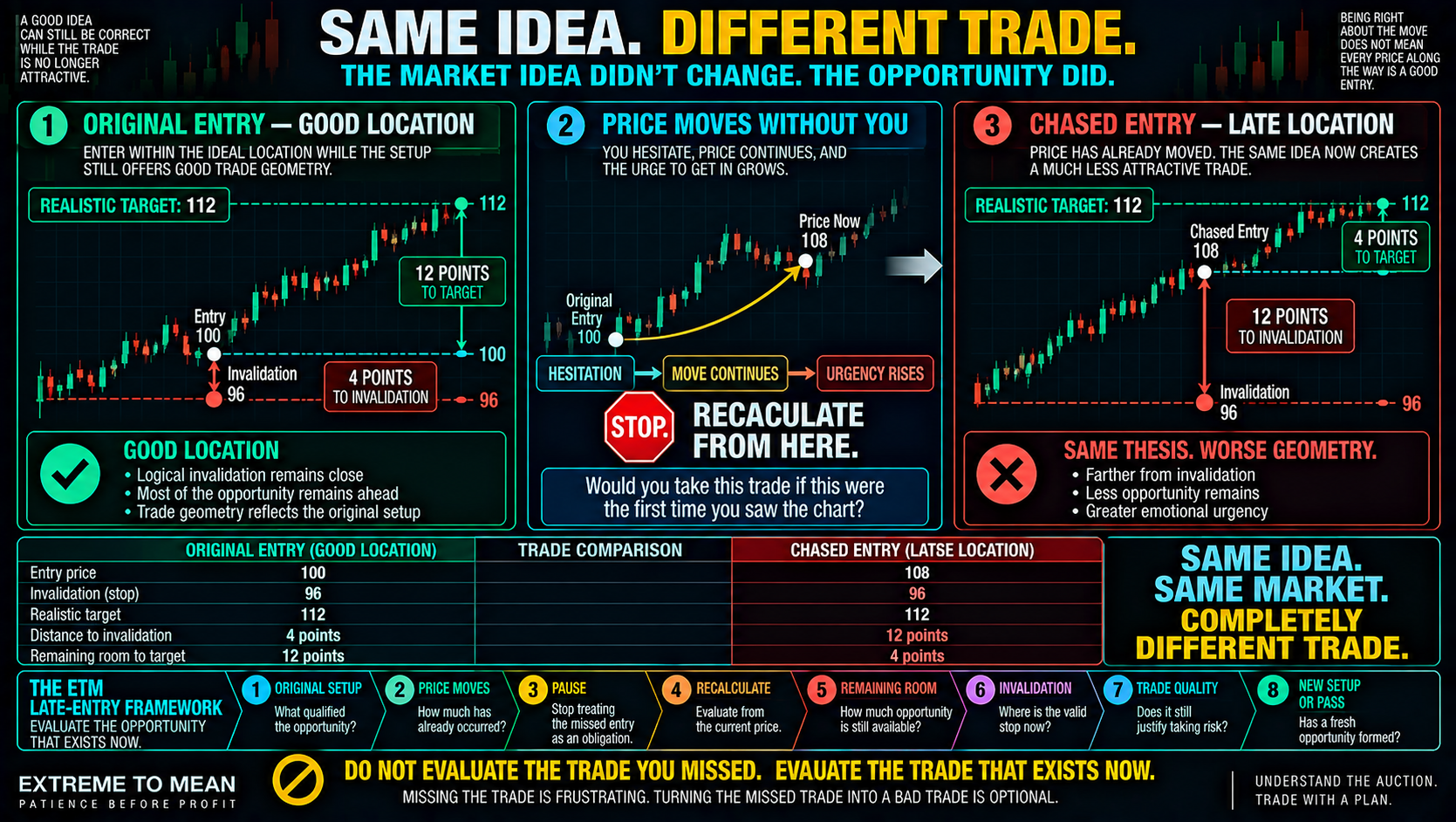
The useful question is not, “Was my original idea right?” It is, “If I had never seen the original setup and this were the first moment I looked at the chart, would I still take this trade from here?” That question forces the trader to evaluate the present trade instead of defending a missed past opportunity.
What Chasing Does to Entry, Stop, and Target
Consider a simple hypothetical long setup with an intended entry at 100, valid invalidation at 96, and realistic target at 112. At the intended entry, the trade has four points between entry and invalidation and twelve points of potential room to the destination. The trader hesitates, price runs higher, and the urge to participate grows as the move becomes more obvious.
Suppose the trader finally enters at 108. The original invalidation remains at 96 and the original destination remains 112, so the new trade now has twelve points of distance to invalidation and only four points of remaining room to the target. Same idea, same market, same structural references—completely different trade.
Nothing new happened to make the stop inherently worse. As P063 teaches through the broader location problem, the trader simply entered farther from the place where the trade was wrong. At the same time, the trader consumed most of the original opportunity before participating.
The Reward That Already Traveled Is Gone
One of the most subtle chasing mistakes is continuing to evaluate a late entry using the reward that existed at the beginning of the setup. If the original move offered forty points of potential travel and price has already delivered twenty-five of them, those twenty-five points are no longer available to the new entry. The trader can only plan around the distance that remains from the current price.
This sounds obvious on paper but becomes surprisingly difficult during a live move. The trader remembers seeing the setup earlier and mentally anchors to the entire move, treating the unentered portion almost as though it still belongs to the trade. That is how a late entry can feel more attractive than the current geometry actually supports.
A cleaner process is to recalculate everything from the new entry. Where is valid invalidation now relative to the current price, and how much realistic room remains before the original destination or next meaningful obstacle? You cannot enter halfway through the move and still claim the reward that existed at the beginning.
Confirmation and Hesitation Can Create the Late Entry
Waiting for confirmation can be reasonable. Additional evidence may help determine whether the setup has genuinely qualified, but every extra piece of evidence can also allow price to move farther from the location that made the trade attractive. The challenge is getting enough confirmation to justify the trade without waiting so long that the trade no longer offers acceptable geometry.
This is where location is the first filter remains important even after the thesis looks stronger. More evidence does not automatically improve the price at which the trader can participate. A setup can become more convincing at exactly the same time that its entry becomes less attractive.
The answer is not to enter earlier merely to avoid missing a move. Premature entries create their own problems because the setup may not yet be complete and invalidation may still be unclear. The goal is a qualified opportunity, not the earliest possible participation or the latest possible confirmation.
Why FOMO Makes the Remaining Trade Look Better Than It Is
Once price begins moving without the trader, the emotional problem often becomes more visible than the structural one. Hesitation turns into urgency, and urgency can make the trader stop asking about remaining room, valid invalidation, current volatility, or whether the setup still qualifies. The immediate objective quietly changes from “take a good trade” to “do not miss this move.”
That is why FOMO feels like opportunity but usually becomes regret. The feeling of urgency does not create additional room or improve the late entry; it merely increases the pressure to ignore what changed. The market does not restore the original opportunity because the trader is frustrated about missing it.
A useful behavioral check is therefore structural rather than emotional. Recalculate the trade from the current price before doing anything else. If the entry-to-invalidation distance has expanded and the remaining destination has shrunk, urgency should not be allowed to hide those facts.
Missing the Trade Is Not the Same as Making a Mistake
A trader can correctly identify a move, refuse to chase it after the entry deteriorates, and then watch price continue all the way to the original target. That outcome can feel like proof that the trader made the wrong decision, but it proves only that the market continued. It does not prove that the late entry offered acceptable risk at the moment the trader declined it.
This distinction is essential because process and outcome are not the same thing. A disciplined pass can remain a good decision even when price later moves exactly where the trader expected. The quality of the decision depends on the opportunity available when the choice was made, not on whether hindsight eventually rewards the original directional thesis.
Missing the trade is frustrating. Turning the missed trade into a bad trade is optional. The trader is not obligated to manufacture a second chance simply because the first entry was missed.
A Pullback Can Create a New Opportunity
Refusing to chase does not mean the market can never be traded again after the first move. Price may later pull back, retest structure, consolidate, or form an entirely new setup that creates a fresh entry with its own qualification, invalidation, and realistic destination. That is a new trade decision, not permission to revive the old one.
The distinction matters because traders often rename a late chase after the fact. A move that has already extended substantially is suddenly described as a “pullback entry” even though no actual pullback or new structure formed. Calling the entry something different does not improve the geometry.
The correct process is to wait and see whether a genuinely new opportunity develops. If it does, evaluate it from scratch using the current structure and make sure the trade’s risk is actually clear. A new entry requires a new reason—not just regret about the old one.
The ETM Late-Entry Framework
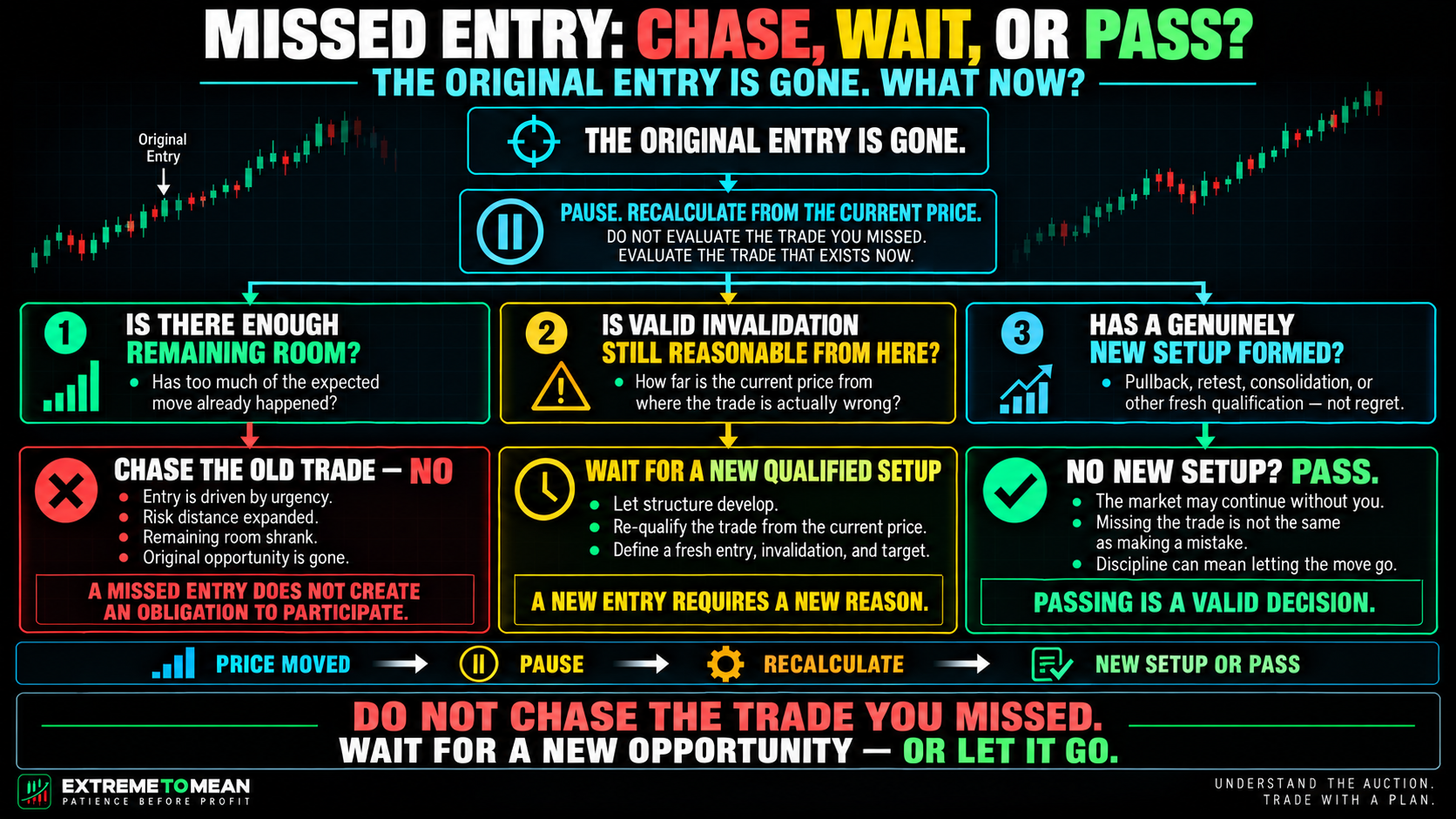
Once the intended entry is gone, the trader should stop evaluating the original trade and perform a fresh assessment. The purpose of the framework is to interrupt the emotional sequence from missed entry to urgent chase and replace it with a structural review. The trader may discover that the opportunity remains acceptable, that a new setup is developing, or that the correct decision is simply to let the move go.
Original setup — What opportunity originally qualified?
Price moved — How much of the expected move has already occurred?
Pause — Stop treating the missed entry as an obligation to participate.
Recalculate — Evaluate the trade from the current price.
Remaining room — How much realistic opportunity is actually still available?
Invalidation distance — Where is the valid stop relative to the new entry?
Current trade quality — Does the new geometry still justify taking risk?
New setup or pass — Has a fresh opportunity formed, or is the original trade simply gone?
The condensed framework is Original Setup → Price Moves → Pause → Recalculate → Remaining Room → Invalidation Distance → Current Trade Quality → New Setup or Pass. The key discipline is simple: do not evaluate the trade you missed. Evaluate the trade that exists now.
Final Thought
A good market idea can remain completely valid after the best opportunity to trade it has passed. Price may continue exactly toward the destination the trader originally expected, but that does not preserve the original entry, stop distance, or available reward. Every new entry has to be evaluated from the price where the trader can actually participate.
This is why chasing is more than a psychological problem. It changes the structure of the trade by increasing distance to valid invalidation, reducing remaining room, and often adding emotional urgency at the exact moment decision quality needs to improve. The trader who missed the first entry does not owe the market a replacement trade.
The better question is: “If I had never seen the original setup and this were the first time I looked at the chart, would I still take this trade from here?” If the answer is no, then the move can continue without you and the decision can still be sound. That is the kind of patience built into the broader chasing-the-trade problem: evaluate the opportunity that exists now, not the opportunity you wish you had taken earlier.
Educational content only. Trading involves substantial risk and is not suitable for everyone.