
A sudden futures move can feel mysterious because the trader experiences the price change before understanding the context around it. The natural response is to reach for a story immediately: news, manipulation, stops, algorithms, a liquidation, or “somebody knows something.” The better response is to slow the explanation down and investigate the easiest facts first.
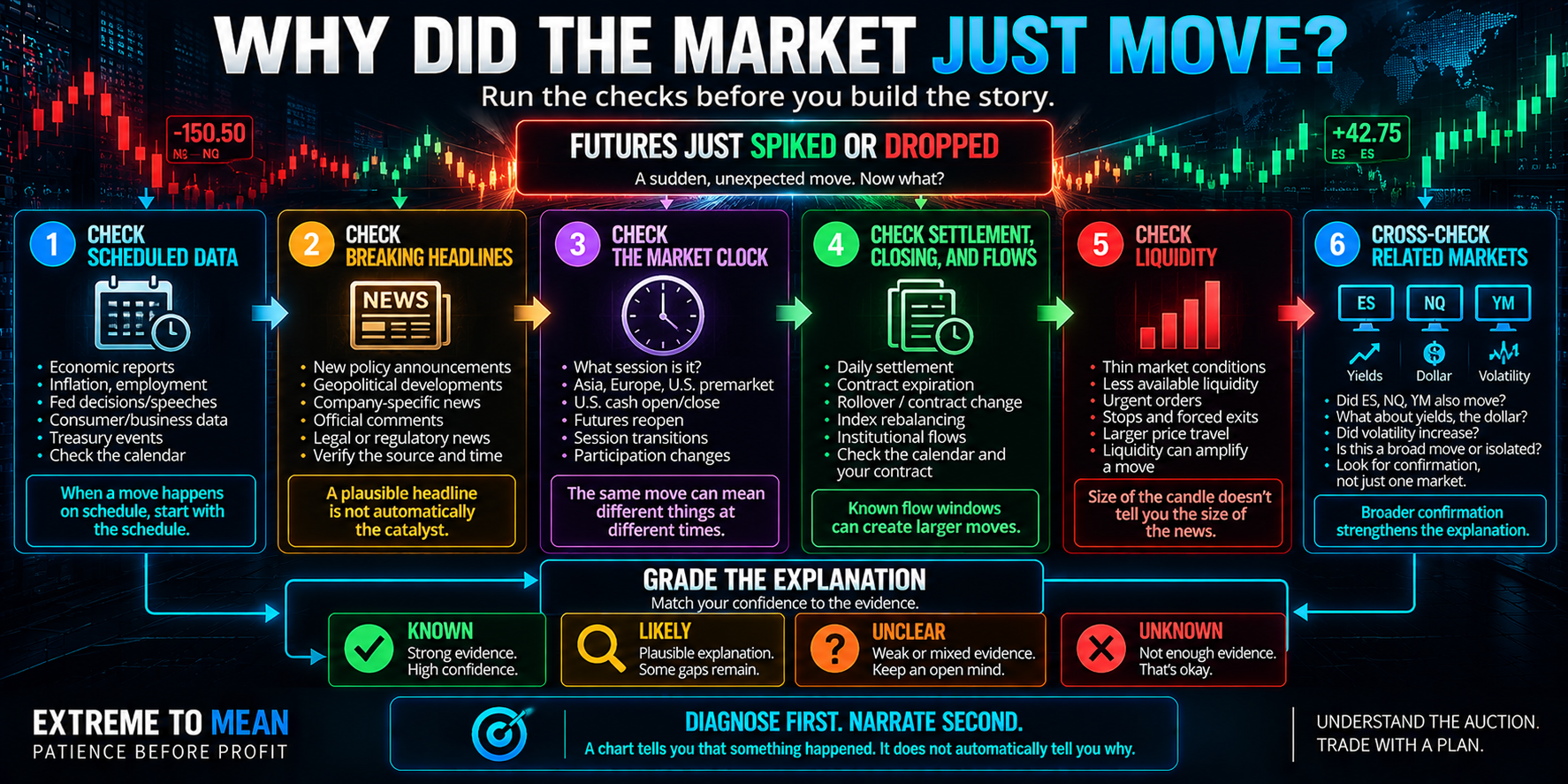
That is why this lesson belongs inside The Market. A chart tells you that something happened; it does not automatically tell you why. The practical job is to move from TIME → EVENT → CONTEXT → FLOW → CONFIRM, then match the confidence of the explanation to the quality of the evidence.
The Candle Happened. The Explanation Comes Second.
Unexpected movement is not mysterious simply because you did not expect it. A sharp move may coincide with scheduled data, a breaking headline, a session transition, closing or settlement activity, thin liquidity, positioning pressure, or several forces interacting. The mistake is going directly from MOVE → STORY before checking what was actually happening at that time.
Fast explanations feel useful because uncertainty is uncomfortable. A story creates the feeling that the market makes sense again, even when the story is only plausible rather than proven. The better first question is: What do I know about the exact minute this started?
Step 1: Check Scheduled Economic Data
Start with the economic calendar. Did the move begin at the exact time of a scheduled inflation release, employment report, central-bank decision, speech, survey, Treasury event, or another known macro release? When a move happens on schedule, start with the schedule.
Finding an event does not finish the investigation. Markets can react to the reported number, expectations, revisions, underlying components, prior positioning, and reactions in related markets. Finding the event tells you where to investigate; it does not automatically explain the reaction.
This is where context comes before the candle. The same 80-point NQ candle means something different if it begins exactly when important data hits than if it appears during a quiet period with no scheduled event. Timing does not prove causation, but it gives you the first evidence worth checking.
Step 2: Check Verified Breaking Information
If nothing important was scheduled, look for verified breaking information. Policy announcements, geopolitical developments, unexpected official comments, legal or regulatory news, or company-specific developments affecting major index weights can matter to equity-index futures. The important word is verified.
The faster the market moves, the faster rumors spread with it. A plausible headline posted seconds after a spike is not automatically the catalyst, and the first story that fits the timestamp is not necessarily the correct one. Verify the source, publication time, and whether the information was genuinely new.
Do not assume “there was no news” simply because the explanation reached your screen after price moved. Related markets can move first, positioning can respond immediately, and mainstream reporting can lag the first reaction. The explanation reaching you after the move does not mean the market waited for that explanation before moving.
Step 3: Check the Market Clock
Next ask what part of the trading day you were actually in. Equity-index futures trade through most of the week, but participation is not uniform across every hour; a move at the U.S. cash open does not exist in the same context as the same move during a quieter overnight period. Before asking what happened, ask when it happened.
Consider overseas session transitions, the U.S. premarket, the 9:30 a.m. ET cash open, the U.S. close, and futures maintenance or reopen windows. Different participants become active, accumulated orders meet fresh liquidity, and related cash markets may open or close. None of those moments guarantees a spike, but they change the environment in which orders are interacting.
Overnight does not mean nothing is happening. International developments, overseas markets, economic events, and shifting liquidity can move ES and NQ while a U.S. trader is asleep. Your trading day may have ended; the global market’s day did not.
Step 4: Check Settlement, Closing, Expiration, and Flow Windows
The market clock contains more than an open and a close. Depending on the instrument and date, daily settlement procedures, the cash-market close, contract expiration, rollover, index rebalancing, or another institutional execution window may be relevant. The key is to check whether the timing and calendar actually support that explanation.
If the contract is near expiration or the lead month is changing, make sure you are studying the correct contract and where participation has migrated. A known flow window is evidence to investigate, not a universal explanation for whatever price just did. This is another reason the market comes first: your personal expectation is not the mechanism driving the broader auction.
Step 5: Check Liquidity
Sometimes the move is large because the catalyst is large. Other times price travels unusually far because there is less liquidity available to absorb urgent trading. The size of the candle does not tell you the size of the news.
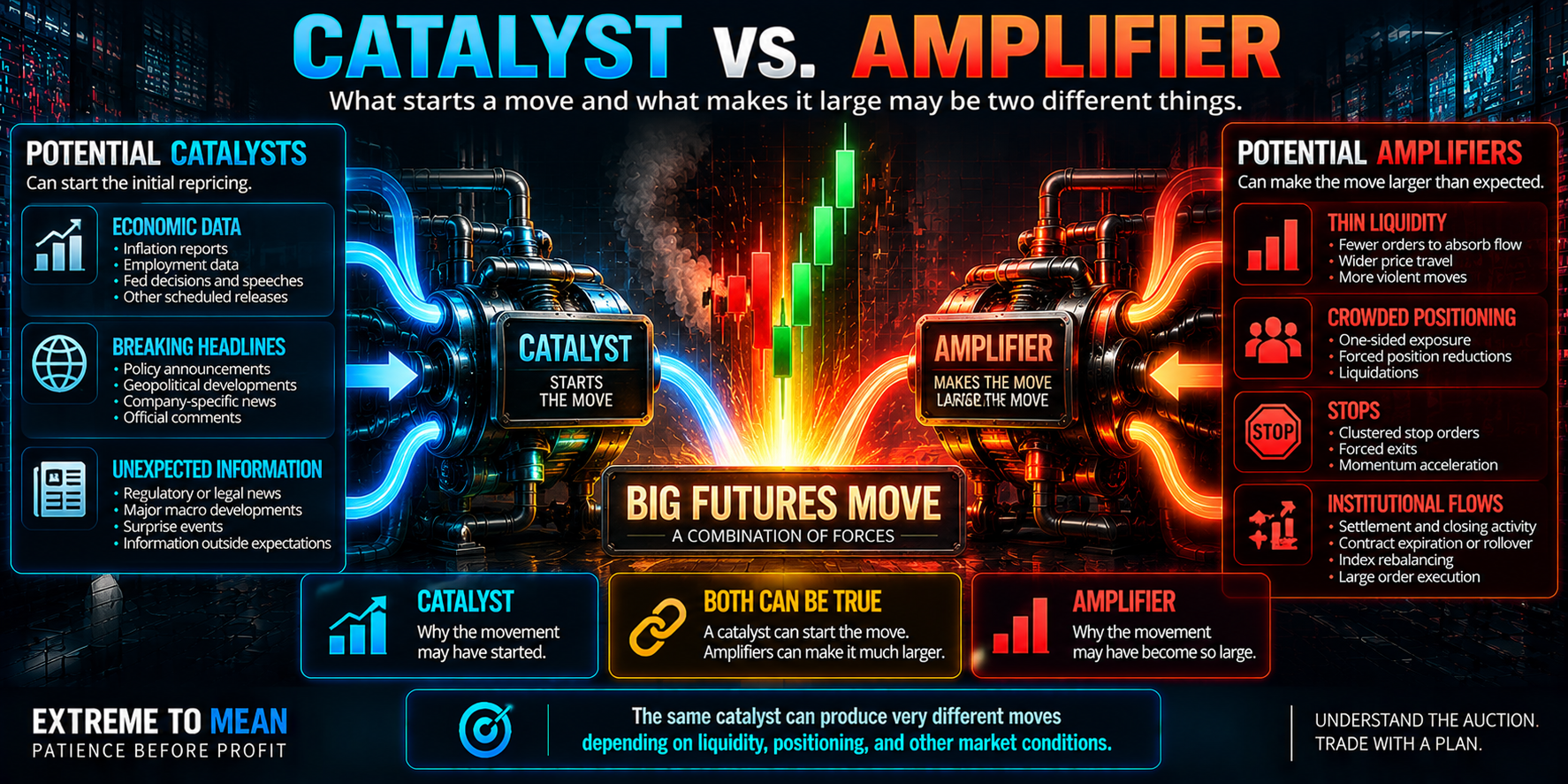
Urgent orders can have different effects in different environments. In deeper liquidity, more trading may be absorbed with less price travel; in thinner conditions, price may need to move farther to find counterparties. Thin liquidity may therefore amplify a move without being the original cause.
This is where auction, liquidity, and emotion become useful context. Stops, forced exits, and position reductions can add trading once a move is already underway. Stops can accelerate a move without being the reason it began.
Catalyst and Amplifier Are Different Jobs
One of the most useful distinctions is catalyst versus amplifier. A scheduled report or unexpected headline may start repricing, while thin liquidity, crowded positioning, stops, or forced deleveraging make the resulting candle much larger. What starts a move and what makes it large are not necessarily the same thing.
That prevents lazy explanations. Saying “it was the jobs report” may identify the catalyst while missing why the reaction became unusually violent, just as saying “it was stop hunting” may describe part of the acceleration while ignoring what initiated it. Markets are auctions, not detective novels; every candle does not need one villain.
Cross-Check Related Markets and Grade the Explanation
Before settling on an explanation, ask whether related markets moved too. If NQ suddenly drops, did ES react, did yields or the dollar move, did volatility change, or did other equity markets respond? You are not building a giant macro dashboard; you are asking whether the move looks isolated or part of a broader repricing.
Broad confirmation can strengthen the case for a macro catalyst, while an isolated move may point toward instrument-specific news, contract mechanics, or localized order flow. Correlation still does not prove causation, so grade the explanation instead of forcing certainty. Known, likely, unclear, and unknown are all legitimate outcomes.
One NQ Spike, Two Very Different Responses
Imagine NQ suddenly falls hard at 10:00 a.m. ET and ES moves with it. Trader A sees the candle, decides that “market makers ran the stops,” and shorts after the move because the story feels obvious. Trader B starts with the timestamp, finds a scheduled release at 10:00, sees broad confirmation, and treats that release as the strongest identifiable catalyst while allowing that liquidity or positioning may have affected the magnitude.
The important part is what Trader B does next: nothing automatically. Knowing why the move likely happened does not tell the trader whether the next move continues, reverses, or becomes a qualified setup. Trader A turned the candle into a story; Trader B turned the timestamp into an investigation.
The ETM Unexplained-Move Checklist
When futures suddenly spike or drop, work through this sequence:
- TIME: Exactly when did the move begin?
- CALENDAR: Was scheduled data or another known event due?
- HEADLINE: Was genuinely new information released from a reliable source?
- SESSION: What market or session transition was occurring?
- FLOW: Was this near settlement, the cash close, expiration, rollover, rebalancing, or another known flow window?
- LIQUIDITY: Were conditions thin, urgent, or disorderly?
- CONFIRMATION: Did related markets move too?
- CONFIDENCE: Is the explanation known, likely, unclear, or unknown?
The purpose is not to manufacture a story for every candle. It is to separate facts from inference quickly enough that uncertainty does not become an excuse for invented certainty. Match the confidence of the explanation to the quality of the evidence.
A useful next step is the market calendar, especially when the first question is whether something scheduled coincided with the move. Use it as an investigative tool rather than proof that the event caused every part of the reaction. A better question is: What evidence would make this explanation more credible—or less credible?
Diagnosis Is Not Prediction
Even a high-confidence explanation remains retrospective. “That move followed the economic release” and “price will continue lower from here” are different claims requiring different evidence. Explanation and prediction are different jobs.
The trader does not need to explain every candle in order to trade responsibly. Sometimes the investigation ends with, “I cannot verify what caused this,” and that is better than inventing certainty and putting capital behind it. Unknown does not mean failure; it means the evidence did not earn a stronger conclusion.
Final Thought
When futures suddenly spike or collapse, start with the timestamp, check the calendar, look for verified information, identify the session, consider settlement or other flow mechanics, assess liquidity, and cross-check related markets. Sometimes the answer will be clear; sometimes the catalyst will be identifiable but the size of the move will require additional explanation; sometimes several forces will be interacting.
Your job is not to invent a story for every candle. Separate what you know from what you suspect, and never confuse explaining the last move with qualifying the next trade. Diagnose first. Narrate second.
Educational content only. Trading involves substantial risk and is not suitable for everyone.