
Mean reversion becomes attractive for a simple reason: markets repeatedly demonstrate that extreme movement can be followed by movement back toward balance. After seeing that pattern enough times, a trader can begin treating the return as inevitable rather than conditional. Each additional point away from the mean then seems to improve the opportunity because the eventual snapback appears larger. The problem is that distance can increase while the probability that the old reference still describes the market is decreasing.
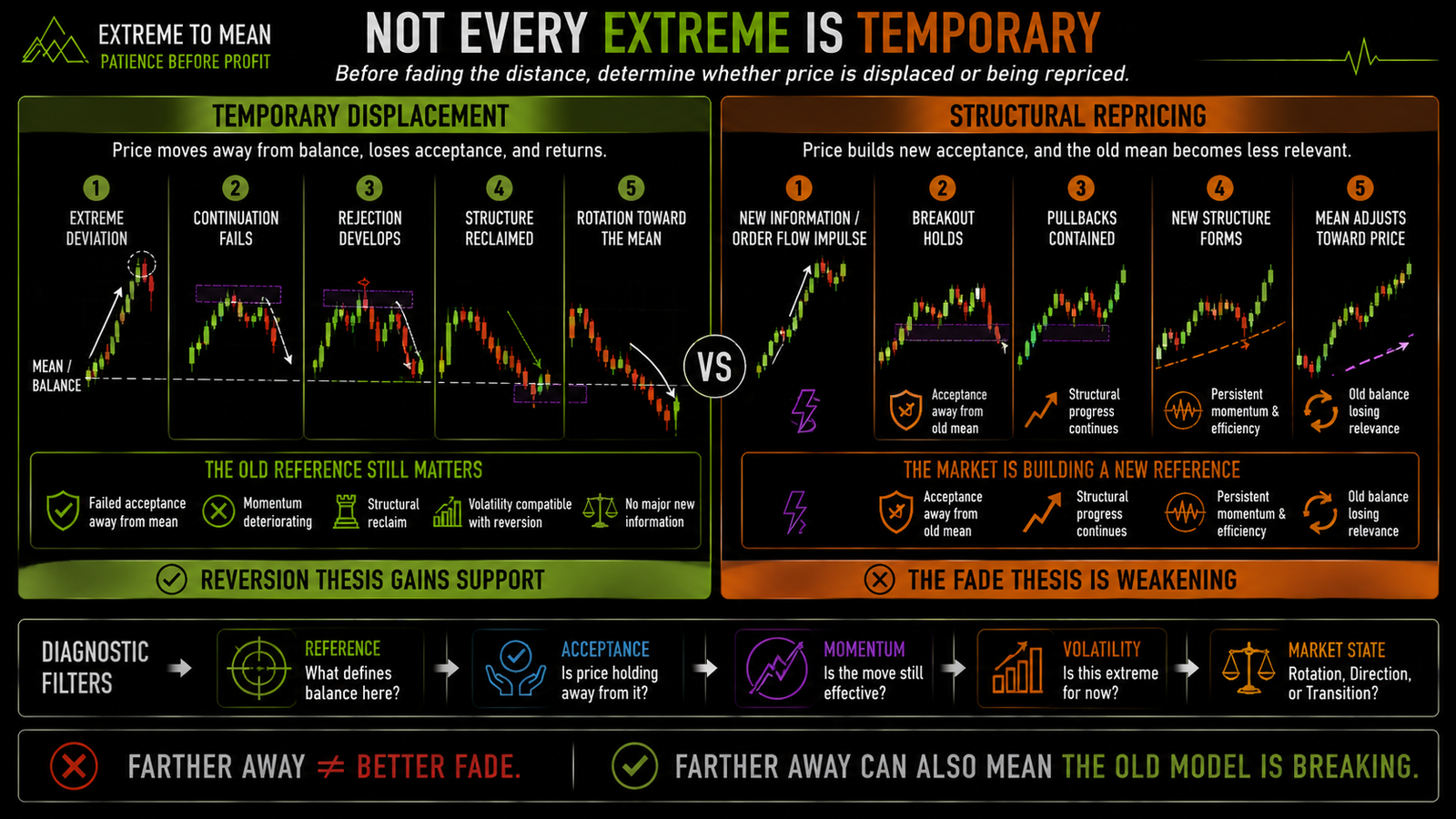
A cleaner way to study The Market begins by separating temporary displacement from sustained repricing. In one environment, price stretches away from accepted value, loses momentum, fails to maintain the extension, and rotates back toward balance. In another, new information or persistent order flow causes the market to accept progressively different prices while the old mean slowly becomes irrelevant. Both can initially look "too far," but they require very different decisions.
Mean Reversion Fails When the Market Is Repricing
A mean-reversion thesis assumes that the current deviation is temporary enough for the reference to remain useful. Repricing challenges that assumption because the market is not merely wandering away from balance; it is establishing balance somewhere else. Breakouts hold, pullbacks remain contained, directional structure continues to progress, and attempts to return toward the old area repeatedly fail. Under those conditions, the distance from the original mean may reflect new information rather than an increasingly attractive fade.
This is why understanding what the mean really is matters before judging the size of an extreme. A moving average, VWAP, prior balance area, spread relationship, or other reference is useful only while the relationship supporting it remains relevant. If price is building new acceptance elsewhere, the reference can continue moving or eventually become stale. Treating an outdated mean as a fixed destination turns a descriptive tool into a prediction.
Persistent Momentum Can Overwhelm the Fade
One reason mean-reversion traders get trapped is that momentum can persist longer than intuition expects. Research on time-series momentum has documented return persistence across multiple futures markets, including equity indexes, currencies, commodities, and bonds, demonstrating that directional behavior and subsequent reversion can operate on different horizons. (papers.ssrn.com) A market can therefore look statistically or visually extended while directional pressure remains effective. The extension alone does not tell the trader when persistence will end.
Strong trends make this especially uncomfortable because every additional push appears to improve the theoretical price of the fade. The trader sells an extreme, price continues, and the next level looks even more attractive because it is farther from balance. What looks like a better bargain can actually be evidence that the original thesis is failing. Averaging into persistent momentum without new confirmation converts a mean-reversion idea into a growing bet against the market's current structure.
News Can Change the Price the Market Is Willing to Accept
A major information event can make yesterday's equilibrium a poor guide to today's market. Monetary-policy surprises, economic data, earnings information, geopolitical developments, or other meaningful news can change expectations rapidly enough that price needs to discover a new area of acceptance. Federal Reserve research on macroeconomic news shows that equity prices react meaningfully to new information and that those reactions are connected with changes in expected real economic outcomes. (federalreserve.gov) In that situation, the move away from the old mean may represent information being incorporated rather than temporary emotional excess.
The practical mistake is assuming that every post-news expansion must close because it looks unusually large. A gap, impulse, or rapid breakout can eventually retrace, but the market may first need to travel much farther while participants reprice the new information. The trader should therefore ask whether the old structure is being reclaimed or whether new structure is forming away from it. Mean reversion becomes less compelling while the market continues accepting the very prices that supposedly represent the extreme.
Volatility Expansion Changes What "Too Far" Means
Distance is meaningful only relative to the environment in which it occurs. A 100-point deviation might be extraordinary during compressed conditions and routine during an expansion in range and volatility. When volatility rises, normal intraday movement can widen enough that fixed-distance definitions of extreme begin triggering far earlier than the market's current behavior justifies. The trader may believe price has reached an exceptional location when the scale of the market has simply changed.
This is one reason the three market states matter to a mean-reversion approach. Rotation, sustained direction, and transition produce different expectations for how price interacts with a reference. An extreme inside stable rotation is not the same condition as an identical measured extreme during expanding directional repricing. Using the same fade logic across both environments ignores the information contained in the state itself.
Liquidity Stress Can Push Price Beyond a Reasonable Model
Mean-reversion models often assume that enough opposing liquidity will eventually absorb a temporary imbalance. During stress, that assumption can become unreliable because liquidity demand can increase precisely when liquidity providers are becoming less willing to hold risk. Federal Reserve research on stressed Treasury markets has documented how one-sided order-flow demand can amplify price movements when liquidity supply deteriorates. (federalreserve.gov) The resulting move can travel much farther than a normal-condition model would suggest.
This matters because a trader can be conceptually correct that the dislocation is temporary and still be unable to survive it. The reference may eventually regain relevance after forced flows end, liquidity returns, or positioning normalizes, but none of that determines the maximum distance traveled first. A mean-reversion thesis that requires unlimited time or unlimited risk is not a qualified trade. Timing and survivability are part of the thesis because the market does not owe the trader a tolerable path back to balance.
Crowding Can Break the Trade Before the Relationship Recovers
Crowded relative-value trades provide an extreme example of this problem. During the August 2007 quant dislocation, Khandani and Lo found evidence consistent with coordinated deleveraging of similarly constructed portfolios and a temporary withdrawal of market-making risk capital, producing severe short-run losses in strategies built around historically reasonable relationships. (nber.org) The fact that some relationships later normalized did not prevent significant damage during the unwind. Mean reversion can therefore fail operationally even when eventual convergence occurs.
Crowding also changes the mechanism behind the move. If many participants hold similar positions and are forced to reduce them together, price can move because of balance-sheet pressure rather than because the underlying relationship suddenly became economically sensible at the new level. Pedersen's analysis of crowded exits highlights how trading congestion itself can become a source of market risk. (nber.org) The trader needs to distinguish "this should eventually normalize" from "I can safely assume normalization begins here."
Poor Location Can Ruin a Valid Reversion Idea
Not every mean-reversion failure requires a regime change or liquidity crisis. Sometimes the trader is simply early, entering in open space before price reaches meaningful structural location. The market may eventually turn exactly as expected but only after traveling through another support, resistance, liquidity, or higher-timeframe area that should have been considered first. Being directionally correct about an eventual reversion does not make every preceding price a good entry.
Available space on the path back matters as much as distance from the mean. A trader can identify a genuine extreme and still have poor opportunity if major structure sits between the entry and the intended destination. This is why room to revert belongs inside qualification rather than being checked after commitment. The question is not merely whether price might return toward balance, but whether the proposed trade has a coherent path, useful location, and definable risk.
Weak Confirmation Turns "Extreme" Into the Entire Thesis
A stretched market earns attention because unusual location can create a useful question. It does not earn commitment until behavior begins supporting the idea that continued movement is failing. Rejection, failed acceptance, structural reclaim, momentum deterioration, or other relevant confirmation can show that the displacement is losing effectiveness. Without that evidence, the trader may simply be standing in front of persistent order flow because the chart looks uncomfortable.
This distinction helps explain why Reversion Is Not Reversal is more than a terminology lesson. Even when price finally begins moving toward a mean, the move can remain a temporary countertrend response inside a larger directional structure. The trader needs to know which claim the evidence actually supports. Expecting a modest reversion requires less structural change than declaring the entire move reversed.
Eventually Right Can Still Be a Failed Trade
The familiar warning that markets can remain unreasonable longer than a trader can remain financially capable of holding the position captures an important risk principle without requiring the market to be literally irrational. A trader can correctly identify an unsustainable condition but be wrong about the timing, path, volatility, or amount of risk required before the condition resolves. Markets do not settle conceptual arguments on the trader's preferred schedule. A thesis that cannot survive its invalidation boundary is not improved by being proven right later.
This is why risk definition must come before the comforting idea that price will "eventually" return. If the trade requires moving the stop repeatedly, adding because the deviation grew, or redefining the mean every time price moves farther away, the original setup has stopped controlling the decision. The trader is now defending a destination rather than evaluating current evidence. Patience means waiting for better conditions, not waiting indefinitely inside a thesis that the market has stopped supporting.
A Cleaner Failure Filter
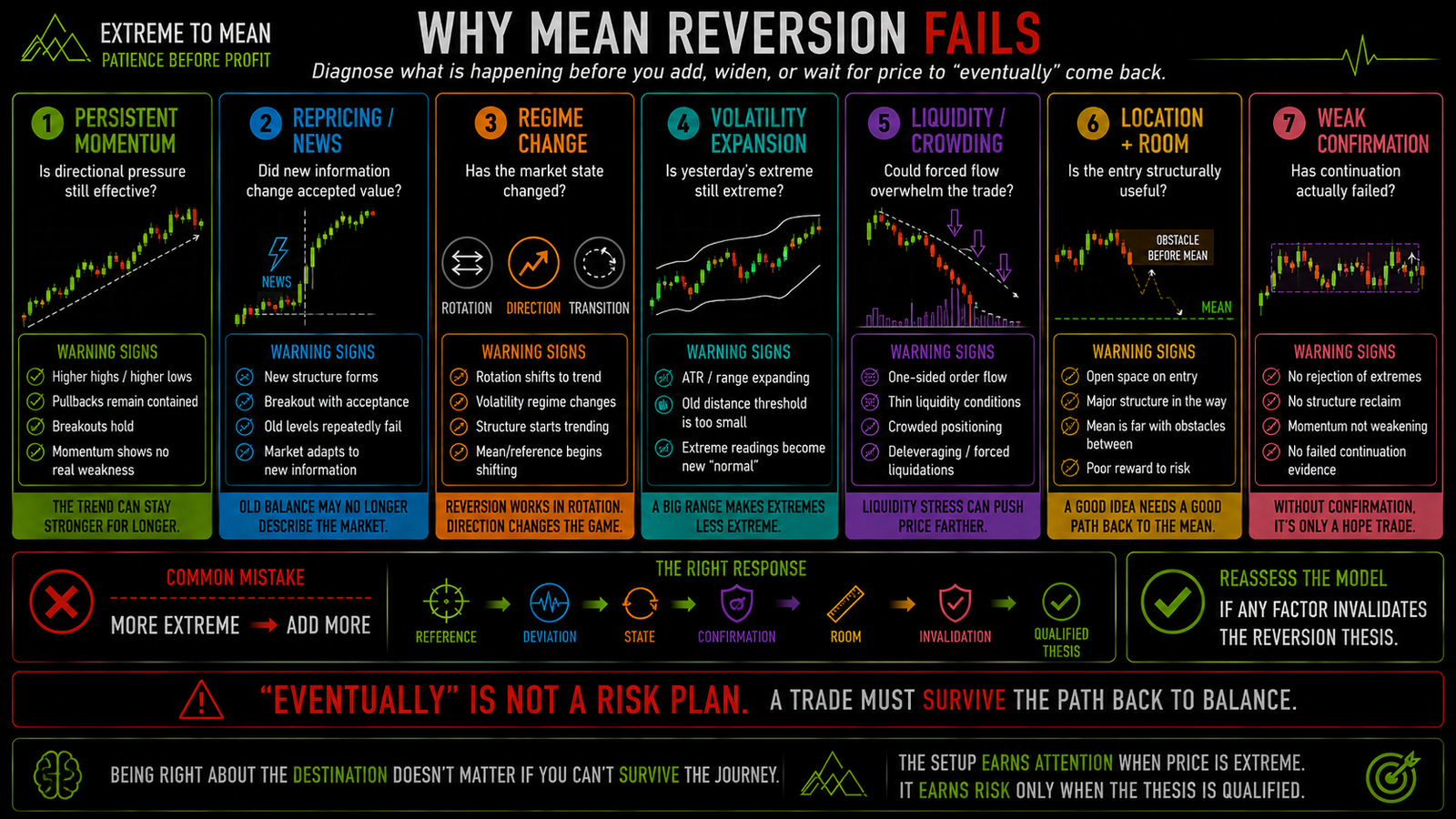
Before fading an extreme, first ask what evidence would prove that the market is doing something other than temporarily deviating. Persistent breakout acceptance, accelerating momentum, a new information shock, expanding volatility, deteriorating liquidity, or a shift in market state should all force the trader to reassess whether the original reference remains appropriate. The goal is not to predict that reversion cannot happen later. The goal is to avoid using an eventual possibility as permission for a poorly timed trade now.
Then evaluate the trade itself. Location should be meaningful, continuation should show some evidence of weakening, the path toward balance should offer usable room, and invalidation should remain clear if the market resumes repricing. This is the practical meaning behind the idea that an extreme is not automatically a trade. The setup earns risk only when market behavior begins supporting the specific reversion thesis being proposed.
Better Questions Before Fading the Move
A useful failure check asks whether the assumptions behind mean reversion are still intact. It should challenge the reference, the market state, the reason for the displacement, and the trader's ability to survive being wrong. These questions are especially important when the move looks so extreme that taking the other side feels obvious. The stronger the emotional certainty, the more useful it becomes to ask what the market is actually confirming.
- Is the market temporarily displaced, or is it repricing?
- Is my reference still relevant, or has new acceptance formed elsewhere?
- Is directional momentum persistent or clearly deteriorating?
- Did news materially change expectations?
- Has volatility expanded enough to make my definition of "extreme" stale?
- Is liquidity normal, or could stressed order flow be amplifying the move?
- Could crowding or forced positioning push the market farther?
- Am I entering at meaningful location or simply because price is far away?
- What confirmation shows that continuation is actually failing?
- Is there usable room back toward the mean?
- Where is the thesis clearly invalidated?
- Can the trade survive that invalidation without changing the plan?
- Am I relying on "eventually" instead of evidence available now?
These questions also create a better review process after the trade. Instead of writing that mean reversion "didn't work," the trader can identify whether the failure came from trend persistence, structural repricing, volatility, liquidity, timing, weak confirmation, poor location, or an invalid reference. That distinction is useful because different failure mechanisms require different process corrections. The objective is not to remove losing outcomes but to make the assumptions behind each decision visible enough to evaluate.
Final Thought
Mean reversion fails when a trader treats a conditional tendency as an obligation the market must fulfill. A stretched move can keep trending, a news shock can establish a new equilibrium, volatility can make yesterday's extreme ordinary, liquidity stress can magnify displacement, and crowded positioning can push a reasonable relationship much farther apart before it converges. Even when price eventually returns, timing and risk can make the original trade unusable. Being eventually right about balance is not the same thing as having a qualified trade.
The better process begins by asking whether the mean still matters and whether the market has actually started losing acceptance away from it. Define location, confirmation, room, timing, and invalidation before commitment, and be willing to classify sustained repricing as evidence against the fade. That discipline is part of the broader Extreme to Mean approach: extremes create questions, but context determines which ones deserve risk. The trader's job is not to prove that price must return; it is to evaluate whether the current market has earned a reversion thesis.
Educational content only. Trading involves substantial risk and is not suitable for everyone.