
If you trade a prop account, the chart is not the only environment you operate inside. You are also operating inside a rulebook, which is why understanding the prop-firm structure matters before judging individual trades. Account limits can affect what you are able to do.
That creates a distinction traders often miss. A good setup answers, “Is there a trade here?” The account answers, “Can I take this trade this way?” The trade can be technically right and operationally wrong at the same time.
The Perfect Setup Problem
Imagine NQ reaches a location you have been waiting for all morning. Conditions fit the strategy, the setup is clean, invalidation is clear, and there appears to be enough target room. From the chart alone, it may be one of the better opportunities all week.
Now add the account information. Your normal size may risk too much of the remaining cushion, you may have reached a personal daily-loss limit, or the exact account may have a restriction that applies at that time. None of that makes the technical setup worse; it changes whether the account can express it.
This is where the trader starts negotiating. Reducing size feels wasteful, while passing feels ridiculous. But the quality of the setup does not create an exception to the rulebook. A rule that disappears whenever you really want a trade is not governing much.
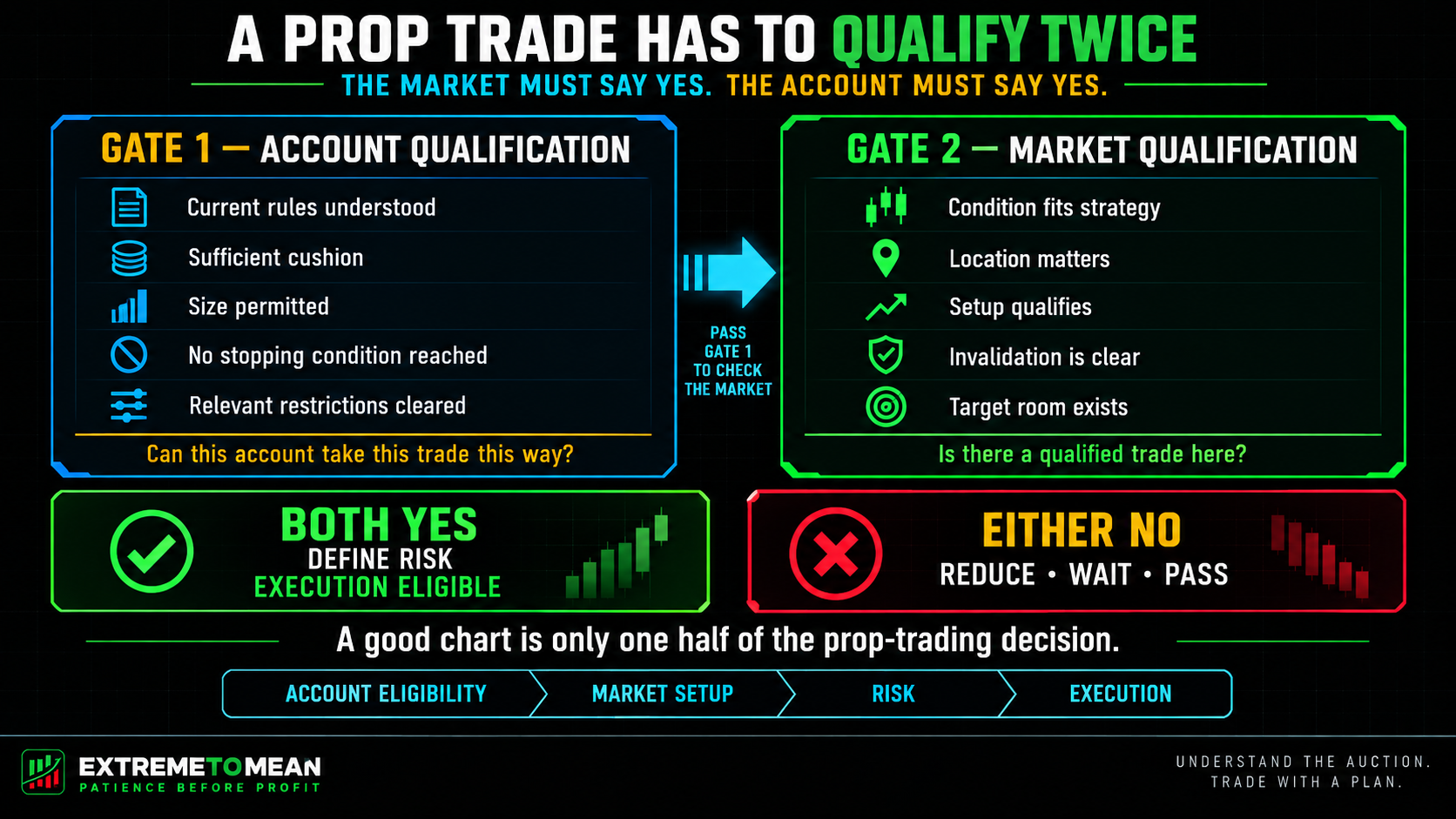
A Prop Trade Has to Qualify Twice
The first test is market qualification. Are conditions appropriate, is location meaningful, has the setup completed, and is invalidation clear? Those questions decide whether the opportunity deserves attention.
The second test is account qualification. Is the trade permitted, does size fit the remaining cushion, and have you hit a stopping condition? Those questions do not create edge; they decide whether this account can express it responsibly.
| Qualification | What It Tests | Better Question |
|---|---|---|
| Market | Whether the opportunity deserves risk | Is there a qualified trade here? |
| Account | Whether this account can express that risk | Can I take this trade this way and preserve the process? |
Neither test can replace the other. Passing every account rule does not make a weak setup good, while an excellent setup does not grant permission to ignore the account. The hierarchy is account eligibility → market condition → setup → invalidation → size → execution. A prop trade is not qualified until both the chart and the account say yes.
An A+ Setup Does Not Mean A+ Size
One of the easiest mistakes is turning confidence into size. The trader sees an unusually clean setup and thinks, “This is the one I should size up on.” If a tested risk plan already contains predefined size tiers, that is different from increasing exposure because the trade feels special.
A better-looking setup does not move the account’s loss boundary farther away. A firm’s maximum contract allowance, where one exists, is a ceiling rather than a recommendation. The account tells you what may be permitted; your risk plan decides what is appropriate.
If the technically correct stop creates too much risk at the size you wanted, do not squeeze the stop closer to make the arithmetic fit. The trade is not ready until the risk is clear, and invalidation should still come from the market. Reduce exposure, use a smaller contract when appropriate, or pass. When the account cannot afford the trade, change the exposure—not the market logic.
Do Not Let the Account Dashboard Manufacture the Trade
Prop traders can quietly turn account information into another market indicator. Near a profit target, a B-quality setup can suddenly look like an A; near a drawdown boundary, normal size can feel too small. In both cases, account urgency begins changing the trade.
The market does not know that you are $500 from a milestone or low on cushion. Those numbers matter for account management, but they do not create a setup. Account information determines whether you can take risk; market information determines whether there is a reason to take it.
The same principle applies after a stopping condition has been reached. A later setup can look perfect, work perfectly, and still be a correct pass if your rules say the session is over. Hindsight does not turn a process-breaking trade into a good decision. A trade working after you were supposed to stand aside does not make standing aside wrong.
One Extra Trade Is Not Free
A constrained account gives trade frequency an additional cost. Suppose you take two planned trades, conditions weaken, and you take a third because it looks “close enough.” That trade also spends account capacity that may be needed for a better opportunity later.
This is how overtrading can hurt an account without one spectacular mistake. A planned loss becomes a marginal trade, then another attempt, then boredom, frustration, or size creep enters the picture. The cost of trading too much is often cumulative rather than dramatic.
The better question is not only, “Can I survive this trade?” Ask, “If this trade loses normally, can I still execute the next qualified opportunity?” That shifts the goal from surviving one click to preserving decision capacity. Your best setup today should not consume the account’s ability to take tomorrow’s best setup.
A Losing Trade and a Rule Violation Are Different
A losing trade can still be a correct process decision. The setup qualified, risk was appropriate, rules were followed, and the market produced a loss. Setup quality changes the reason for taking risk; it never removes the possibility of loss.
A rule violation is different because the process broke before the outcome arrived. The trader used too much size, ignored a stopping condition, took a prohibited trade, or changed risk because this setup supposedly deserved an exception. A planned loss belongs to trading variance; a rule violation belongs in the decision review.
The most dangerous version can be a winning violation. Profit feels like proof, so the trader concludes that the larger size, extra attempt, or broken rule was justified. It was not. A positive outcome can reward a bad decision and teach the trader to repeat the exception.
The Rulebook and Your Trading Plan Have Different Jobs
The prop-firm rulebook defines the account’s outer boundary. Your trading plan defines how you operate inside it, which is why the broader Trader curriculum still matters. A program may permit more than your process should use.
Personal limits can therefore be stricter than firm limits. Your session may be finished even though the platform would allow another trade, and your normal size may be smaller than the account maximum. The firm tells you how far you may go; your process should usually stop you before the outer boundary begins making decisions for you.
The reverse is equally important: following every prop rule does not create an edge. An account can be fully eligible while the market setup is poor, and the correct decision is still no trade. Rules can keep you eligible; they cannot make a bad strategy good. The setup still has to come from the market.
Build the Account Gate Before the Trade Gate
The cleanest process is to check account eligibility before price reaches the setup. Know the current rules, remaining cushion, personal stopping conditions, and allowed size range. Rules can vary by provider, product, and stage, so current official documentation matters more than memory. Do not research account eligibility while the candle you want is already moving.
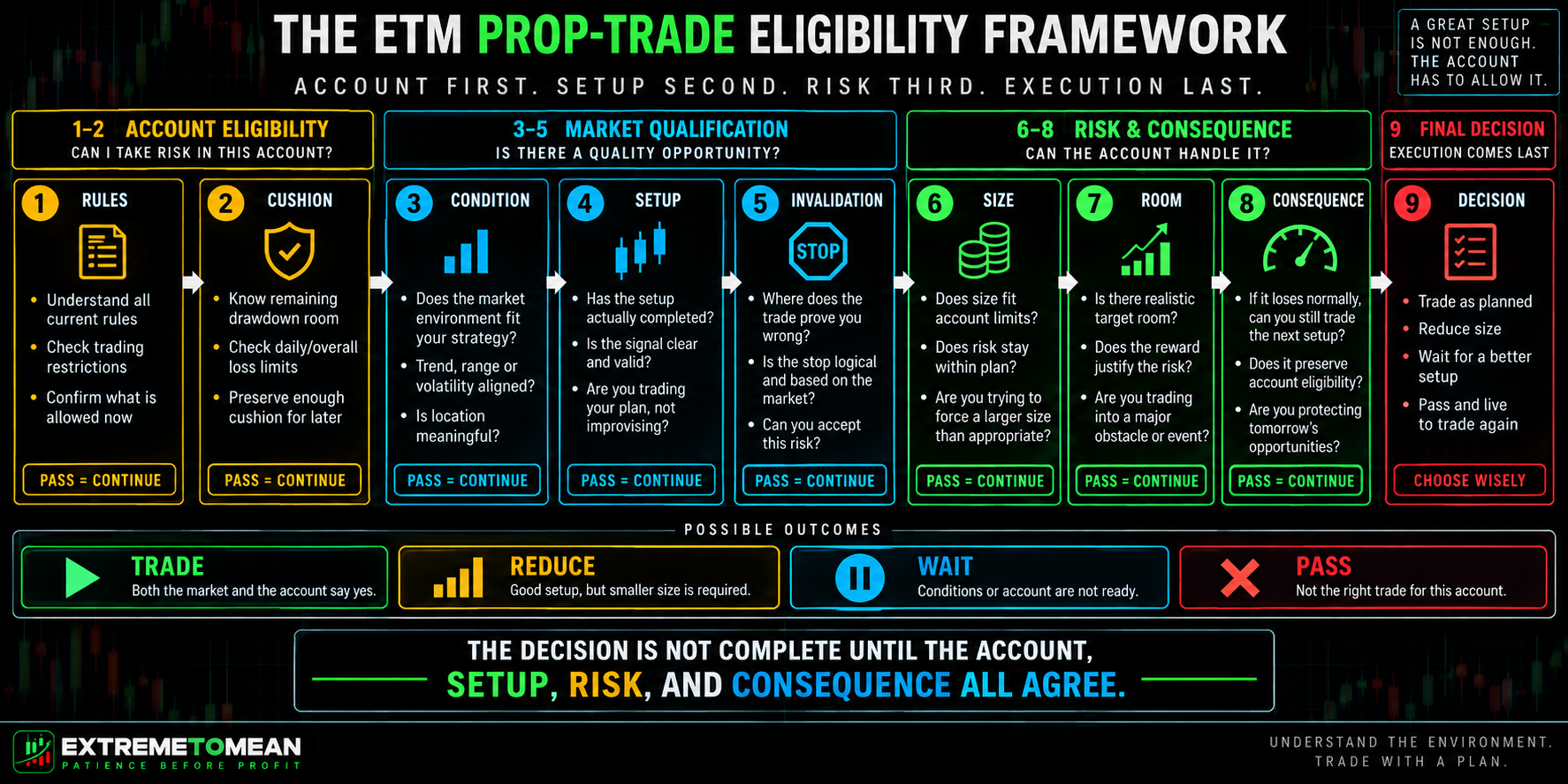
Once that is known, run the opportunity through one sequence. The goal is not to find a reason to trade. It is to find where the decision fails before execution.
- Rules: Is the trade permitted under the exact current account rules?
- Cushion: What is the distance to the nearest relevant loss boundary?
- Condition: Does the market environment fit the strategy?
- Setup: Has the opportunity actually qualified?
- Invalidation: Where does the market prove the idea wrong?
- Size: Can that stop be expressed at a size that fits the account?
- Room: Is there enough realistic target room?
- Consequence: If it loses normally, can the account still take the next qualified opportunity?
- Decision: Trade, reduce, wait, or pass.
The order prevents the account from manufacturing the setup and prevents the setup from overruling the account. Confirm eligibility, evaluate the market, define invalidation, fit size to risk, and then decide. That is evaluate → qualify → define risk → decide, not predict → react.
Preserve the Next Decision
A prop account creates pressure to think in milestones: pass, reach a target, recover drawdown, or reach the next stage. The danger is letting the milestone become responsible for the next trade. Progress should come from qualified opportunities, not forced trades.
This is why protecting your next decision is more useful than asking one trade to carry the whole account. Preserve eligibility, execute qualified opportunities, and let milestones remain consequences rather than instructions. Sometimes the market says yes but the account says reduce; sometimes the account says yes but the market says no. Both are legitimate reasons not to take the trade as originally planned.
Final Thought
A prop firm’s rules do not make a trade good, and a great setup does not make the rules optional. The market still has to provide a valid reason to take risk, while the account needs enough room and permission to express that risk properly. When those two sides disagree, the answer is not to bend whichever side is inconvenient. The answer may be to reduce, wait, or pass.
The better question is not, “How good does this setup look?” Ask, “Does this opportunity qualify for the market and for this account, and can I take it without damaging the next decision?” That is the difference between seeing a trade and being eligible to take it. For a broader framework that organizes those decisions before the session begins, the Extreme to Mean system is the logical next step.
That perspective matters when an evaluation starts feeling like a test of identity instead of a process to execute. The difference between trading to pass and trading to prove something explains how that shift can damage decision quality.
Why passing a challenge starts with skipping bad trades extends this point: a rule-compliant pass can protect the account better than a forced setup.
Why consistency rules expose impatience examines the pressure that can turn a good process into an avoidable rule violation near the finish line.
Educational content only. Trading involves substantial risk and is not suitable for everyone.