
The Maximum Contract Limit Is Not Your Starting Size
Prop firms often publish a maximum number of contracts that an account may hold. That number is a rule boundary, not a recommendation for how large every trade should be. Just because an account allows several contracts does not mean the trader’s setup, stop distance, risk tolerance, or remaining drawdown supports using them.
That distinction belongs at the center of the Trader curriculum. A prop account adds external rules to the same basic trading problem: the market still determines where the idea is wrong, while the account determines how much room the trader has to absorb that risk. The correct size has to respect both.
This is especially easy to forget when the account looks large on the dashboard. The maximum position can create the impression that the firm is telling you what the account was designed to trade. It is better understood as a ceiling you are not allowed to exceed, not a target you are expected to reach.
The Account Number Is Bigger Than Your Actual Risk Room
A trader may be enrolled in a $50,000 evaluation without having anything close to $50,000 of usable loss capacity. The account tier describes the product, while the actual room for error may be defined by a much smaller maximum or daily drawdown boundary. That gap between the headline number and the real cushion changes how position size should be understood.
This is one reason it helps to understand what a prop firm actually is. You are operating inside a provider-defined structure with specific eligibility, drawdown, contract, and risk rules rather than trading an unrestricted personal account whose full balance is available on your terms. The large number on the screen can therefore be psychologically misleading if it encourages you to size risk from the headline balance instead of the actual constraint.
A simple way to frame it is: the big number tells you the account tier; the drawdown tells you how little room you may actually have to be wrong. That does not make prop accounts bad or unfair. It means the trader has to size around the account that actually exists instead of the number that sounds impressive.
Small Size Gives Beginners Room to Learn
A beginner in a prop environment is usually learning more than strategy at once. They may still be getting comfortable with the platform, order entry, contract value, firm rules, drawdown behavior, trade management, and their own emotional response to a live position. Every one of those areas can produce mistakes even when the underlying setup is legitimate.
Small size does not make those mistakes harmless. It makes each individual mistake less capable of ending the entire learning process immediately. If the trader clicks the wrong order type, hesitates on an exit, misreads a normal pullback, or simply takes a properly planned losing trade, smaller exposure can leave enough room to review what happened and continue.
That learning window has value. The new trader needs repetitions under real pressure in order to discover where execution breaks down, which rules are confusing, and which emotional reactions appear once money and eligibility are involved. Oversizing compresses that learning window because ordinary errors become disproportionately expensive.
A Normal Loss Should Not Become an Account Emergency
A legitimate trading strategy will have losing trades. That is not a defect that position size can eliminate, and the goal should never be to size the position as though the next qualified setup is supposed to win. A normal loss should remain a normal part of the process.
The problem begins when one routine losing trade consumes so much of the remaining cushion that the next decision suddenly feels like rescue. The trader stops thinking, “Does this next setup deserve risk?” and starts thinking, “I need this next one to get me back.” Nothing about the market changed, but the account pressure changed the trader’s relationship with the next opportunity.
That is why ETM places so much emphasis on protecting your next decision. Position size affects more than the current trade; it affects how much emotional and financial room remains after the current trade is finished. A useful risk decision should consider the trader who still has to make decisions afterward.
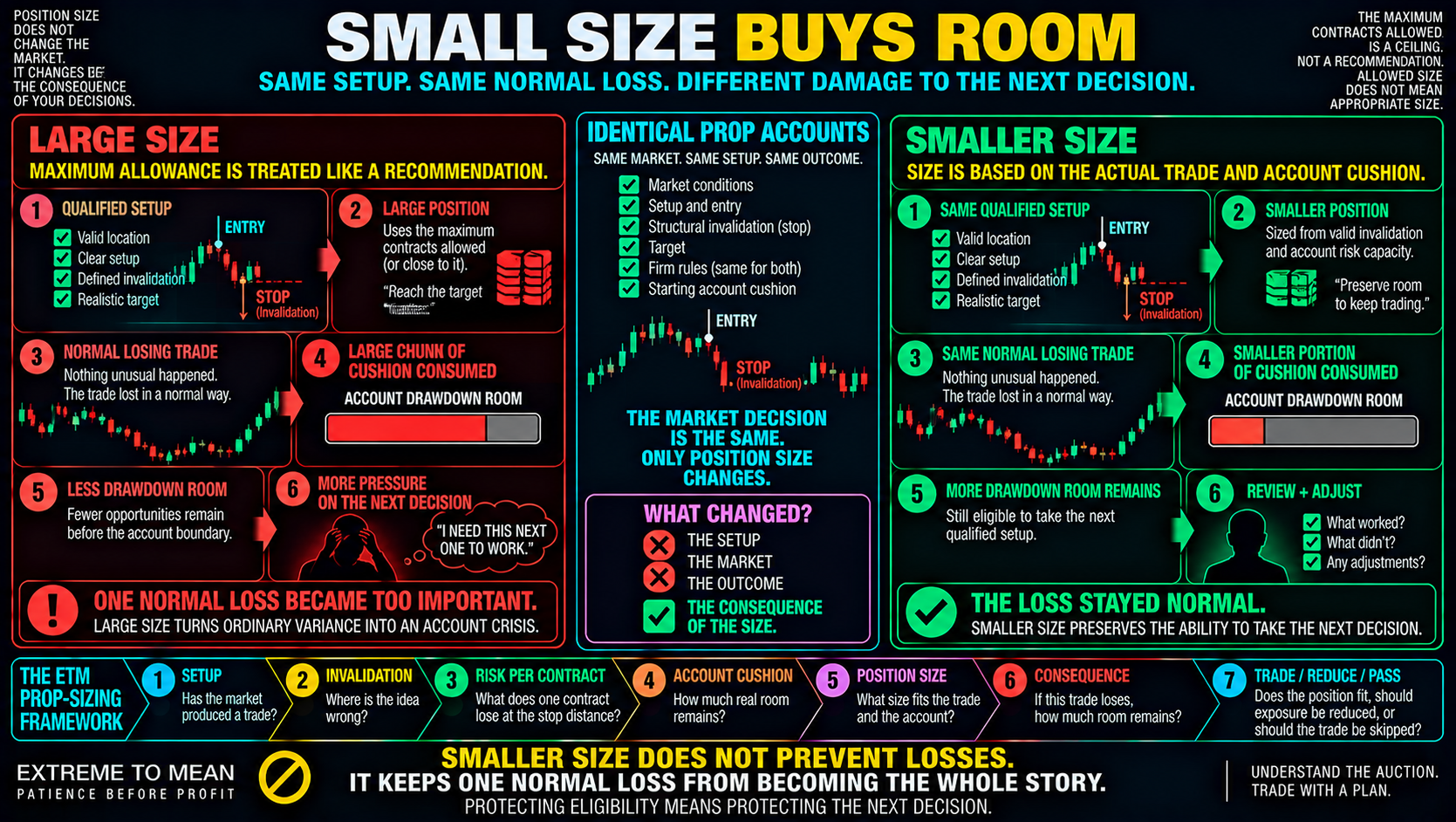
Same Trade. Same Loss. Different Damage.
Imagine two new prop traders with identical accounts and the same qualified futures setup. Both identify the same entry, the same structural invalidation, and the same realistic target, and the firm’s rules allow both traders to hold several contracts. The only difference is the amount of exposure they choose.
Trader A looks at the maximum contract allowance and takes a large position because reaching the profit target faster sounds attractive. The setup loses normally—no platform malfunction, no extraordinary market shock, and no bizarre event. Yet because the position was large, a substantial portion of the available drawdown disappears in one otherwise ordinary losing trade.
Trader B takes the same setup with smaller size based on the actual stop distance and the risk that the account can reasonably absorb. The exact same losing trade occurs, but much more of the cushion remains. Trader B can review the trade and consider the next qualified setup without requiring that next decision to rescue the account.
The lesson does not depend on Trader B winning the next trade. We do not even need to know what happens next. Same analysis. Same losing trade. Different damage to the next decision.
Size the Trade From Invalidation, Not From the Profit Target
The order of the decision matters. First comes the qualified setup, then the point where the market proves the idea wrong, then the amount one contract would lose across that distance, and only after that should contract count enter the conversation. Starting with “How many contracts can I trade?” puts the sequence backward.
This is consistent with the broader ETM principle that the trade is not ready until the risk is clear. The stop should come from the trade thesis and market structure, not from whatever stop distance would make the trader’s preferred contract count fit inside the account. If valid invalidation is farther away than the account can responsibly support at the current size, the answer is to reduce exposure, use a smaller suitable contract where appropriate, or pass.
The profit target should not determine size either. A trader who still needs $2,000 to complete an evaluation does not suddenly have a stronger reason to risk more on the next setup. The amount left to make is an account objective; it is not evidence that the market has offered a better trade.
Sometimes One Contract Is Still Too Much
“Trade small” should not be translated into “always trade one standard contract.” Depending on the instrument, stop distance, provider rules, and account cushion, even one contract may create more risk than the trade should carry. In futures markets, a Micro contract may sometimes allow the same setup to be expressed with a smaller unit of exposure.
That does not make Micros automatically safe. A poor setup taken with one Micro is still a poor setup, and revenge trading ten small positions does not become disciplined merely because each individual position is modest. Size controls the consequence of the decision; it does not improve the quality of the decision itself.
The goal is not to trade as small as humanly possible forever. The goal is to use a position size that allows normal uncertainty to remain survivable while the trader’s process, account cushion, and execution skill are still developing. Size should increase because the risk framework justifies it, not because the trader is impatient with the profit target.
Small Size Is Not Permission to Trade Carelessly
Smaller exposure can create another trap if the trader begins treating low-dollar risk as unimportant. “It is only one Micro” can become an excuse to enter in poor location, skip qualification, take revenge trades, or ignore the plan. That undermines the very learning process small size is supposed to protect.
A bad decision does not become good because the financial damage is limited. What smaller size does is allow the trader to study mistakes without every mistake becoming catastrophic. The purpose is to give a good process enough time to become repeatable, not to subsidize an undisciplined one.
This is where size and selectivity have to work together. The trader still needs a setup that belongs to the strategy, clear invalidation, acceptable room, and a reason to take the trade. Small position size is the risk container around that process, not a replacement for it.
The ETM Prop-Sizing Framework
A prop trader should work from the market outward rather than from the firm’s maximum allowance inward. The sequence should begin with a qualified trade and end with a size that protects both the account and the trader’s ability to continue making clean decisions. Maximum buying power should never be the first input.
- Setup — Has the market actually produced a trade that belongs to the strategy?
- Invalidation — Where does the market prove the idea wrong?
- Risk per contract — What does one contract lose if price reaches that valid invalidation?
- Account cushion — How much real room remains before the relevant account boundary?
- Position size — What size fits both the trade and the account constraint?
- Consequence — If this trade loses normally, how much decision room remains afterward?
- Trade / reduce / pass — Does the position fit as planned, should exposure be reduced, or should the trade be skipped?
The condensed framework is Setup → Invalidation → Risk Per Contract → Account Cushion → Position Size → Consequence → Trade / Reduce / Pass. The defining question is not, “How many contracts will the firm let me trade?” It is, “Can I take this trade at a size that protects both the account and my next decision?”
That framing keeps the trade connected to reality. The setup determines where risk belongs, the account constraint determines how much of that risk can reasonably be carried, and position size connects the two. If those pieces do not fit, the correct solution is not to distort the setup until they do.
Final Thought
A beginner’s first prop-trading advantage is not the firm’s buying power. It is the ability to choose how little of that buying power they actually use.
Small size buys room: room to learn the platform, take an ordinary loss, review a mistake, understand the firm’s rules, experience normal variance, and remain eligible to make the next decision. It does not guarantee survival, better psychology, or profitability, but it reduces the chance that one ordinary event becomes the entire story.
The maximum contract limit is a ceiling, not a recommendation. Build the trade from qualification and invalidation first, then choose the amount of exposure the account can actually carry. That is how the broader Extreme to Mean system keeps leverage in its proper place: as a tool for expressing a defined trade, not as a shortcut to the profit target.
Educational content only. Trading involves substantial risk and is not suitable for everyone.