
The Snapback Is Evidence, Not an Entry
A snapback tells the trader something useful about market behavior. Price moved far enough in one direction to reach an extreme, then encountered enough opposing activity to create a meaningful counter-move. Inside the Setup curriculum, that change deserves attention because the one-way auction may no longer be behaving the same way.
What the snapback does not tell you is whether the move will continue all the way toward the mean, whether the best part of the opportunity has already happened, or whether the current price offers a defensible entry. A sharp counter-move can occur inside a larger trend, during volatility expansion, or as a temporary reaction before the original direction resumes. The behavior has changed, but the complete trade still has to be evaluated.
This is closely related to why reversion is not reversal. Price can move back toward balance without establishing a complete directional reversal, and the trader does not need to predict which larger story will eventually win. The cleaner question is whether the reversion behavior now visible has created a trade worth taking from the price available now.
Why Mean-Reversion Moves Can Start Too Fast
Mean-reversion moves do not always wait politely for the trader to qualify them. A stretched market can reverse sharply and cover a large portion of the distance back toward balance in only a few bars. By the time the trader feels confident that the snapback is real, much of the original opportunity may already be gone.
That creates a frustrating situation because the analysis can be correct while the trade is poor. The trader identified the extreme, expected a return toward the mean, and then watched that exact behavior unfold. But the market is not obligated to provide both correct analysis and a clean entry.
This is where traders are tempted to chase because the move feels like proof. The more clearly the snapback validates the original idea, the stronger the emotional pressure to participate before the rest of the move disappears. Yet the right response is not “I was right, so I have to get in”; it is “What trade exists from this price now?”
How Much of the Trade Is Still Left?
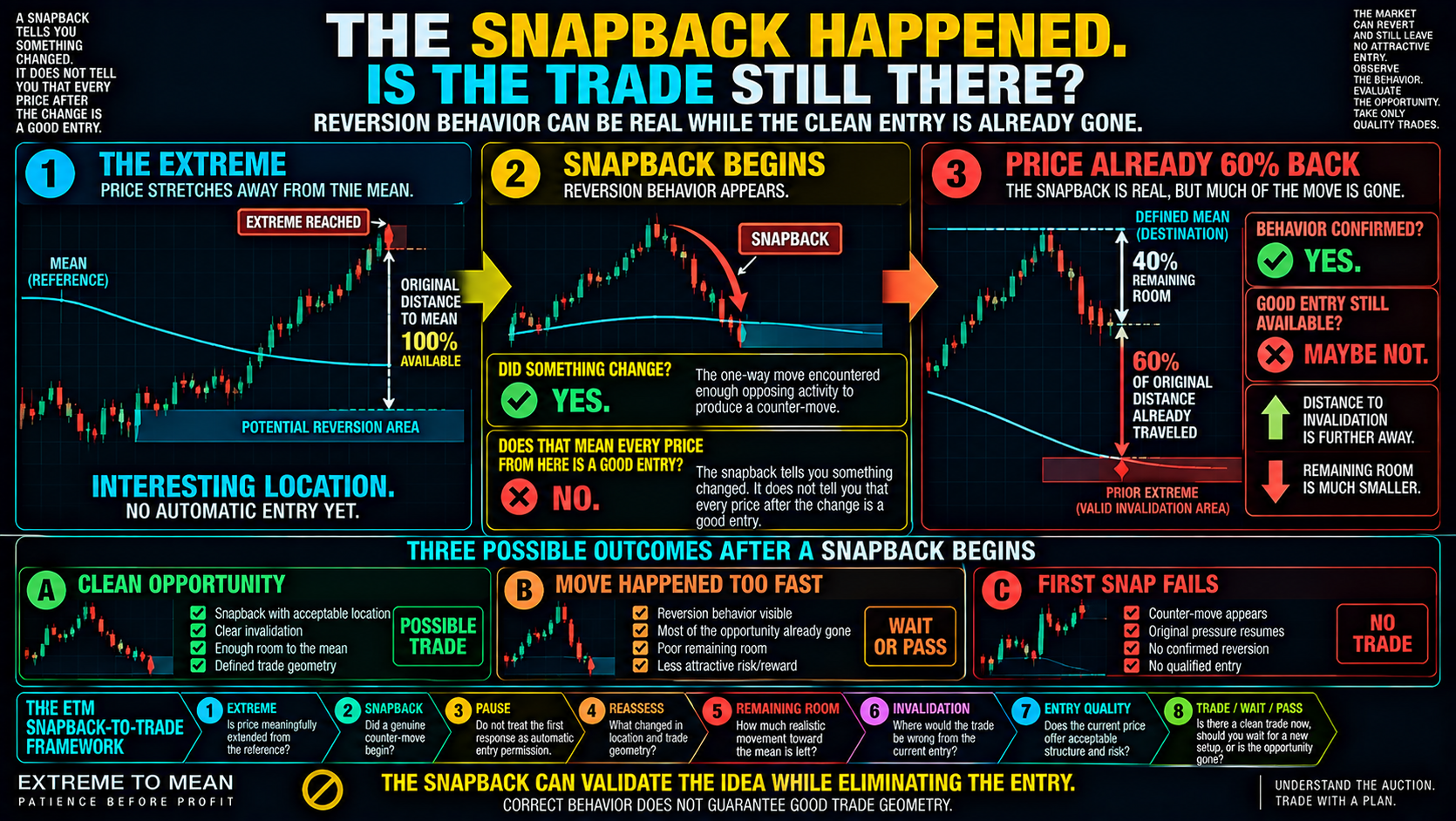
Imagine price is significantly extended from a defined mean, and the trader is watching for a reversion. The move finally begins, but price snaps roughly 60% of the distance back toward the reference in only a few bars. The trader now has two facts: the expected reversion behavior appeared, and most of the available distance has already been consumed.
That second fact matters because room to revert is part of the opportunity. The trade is not simply “price is reversing”; the trade is the remaining movement from the price where the trader can actually enter toward a realistic destination. If the mean is now close while valid invalidation remains near the prior extreme, the geometry can deteriorate very quickly.
This is one of the easiest ways to confuse a correct observation with an attractive trade. The trader mentally gives themselves credit for the whole move from the extreme even though they were not positioned for that part of it. Reward that already happened before entry is no longer available to the trade being considered now.
The First Counter-Move Can Still Fail
A fast opposite move can be meaningful without proving that the larger pressure has ended. In a strong trend or volatile environment, price may snap sharply away from an extreme, pause, and then resume the original direction. One force was strong enough to create a counter-move, but that alone does not establish the final destination.
This is why one large opposite candle should not become a universal confirmation signal. A counter-move proves that price moved the other way; it does not prove that the larger directional pressure has finished or that full reversion to the mean is now inevitable. The trader still needs to judge the behavior in context.
The useful distinction is between evidence of response and evidence of a tradable opportunity. Sometimes the first response is enough to change the hypothesis, but not enough to define an entry with clear risk and sufficient remaining room. The trader’s job is to evaluate what changed without automatically converting every response into a position.
A Real Reversion Can Still Be a Bad Trade
Suppose the snapback is genuine and price ultimately continues all the way toward the mean. That still does not prove that every entry taken after the first snap was a good trade. A real market move and a good entry into that move are separate questions.
The trader still needs to know where the trade is actually wrong. If the current entry is far from a rational invalidation point, the distance required to prove the new thesis wrong may be much larger than it was near the original extreme. At the same time, the mean or realistic target may now be much closer.
That combination can produce one of three outcomes. The snapback may leave good location, clear invalidation, and enough room for a possible trade; it may happen so quickly that the behavior is confirmed while the entry is gone; or it may begin and then fail to develop. The correct job is not to force all three into the same “snapback equals entry” rule.
Correct Analysis Does Not Create an Obligation to Trade
Missing a snapback can feel like failure because the trader saw the setup and the market did exactly what they expected. That emotional reaction is understandable, especially when price later reaches the mean and makes the missed move look obvious in hindsight. But a correct read does not create an obligation to participate after the opportunity deteriorates.
This is where where you enter matters more than what you predict becomes especially important. The trader can be right about the direction of the reversion and still be wrong to enter from a price that leaves poor geometry. Prediction quality and entry quality are not interchangeable.
A missed snapback therefore does not erase the value of the analysis. The trader may have correctly identified the extreme, correctly anticipated the response, and still made the right decision by not chasing after most of the movement was already gone. Good analysis can sometimes end with no trade.
Sometimes the Better Opportunity Comes After the First Snap
The first snapback does not have to be the final opportunity. Price may pause, pull back again, retest part of the extreme area, consolidate, or form another structure that creates a fresh entry with its own invalidation and target room. That later opportunity should be evaluated as a new setup rather than treated as permission to revive the missed one.
This distinction protects the trader from turning every continuation of the thesis into a chase. If a later structure provides better location and a clearly defined risk point, it may become tradable on its own merits. If nothing new develops, the original move can simply continue without participation.
The practical advantage of waiting is not that the market will always offer another chance. Sometimes it will not, and that has to be acceptable. Patience means being willing to miss the movement rather than distort the trade just to avoid watching it happen without you.
The ETM Snapback-to-Trade Framework
Once the snapback begins, the decision process should restart rather than end. The trader needs to separate the evidence that reversion behavior appeared from the separate question of whether the current price still offers a qualified entry. This is where evaluation has to replace reaction.
- Extreme — Was price meaningfully extended from the reference?
- Snapback — Did a genuine counter-move begin?
- Pause — Do not treat the first response as automatic entry permission.
- Reassess — What changed in location and trade geometry?
- Remaining room — How much realistic movement toward the mean or target is still available?
- Invalidation — Where would the trade be wrong from the current entry?
- Entry quality — Does the available price still create acceptable structure and risk?
- Trade / wait / pass — Is there a clean trade now, should the trader wait for a new setup, or is the opportunity gone?
The condensed framework is Extreme → Snapback → Pause → Reassess → Remaining Room → Invalidation → Entry Quality → Trade / Wait / Pass. The important shift is that the snapback does not complete the decision; it gives the trader new information that must be evaluated from the new price. The snapback can validate the idea while simultaneously eliminating the entry.
The better question is not, “Did the market start reverting?” Ask, “How much of the reversion is still available from here, where am I wrong from here, and does this current price still offer a clean trade?” Those questions keep the focus on the opportunity that exists rather than the move the trader already watched happen.
Final Thought
The snapback matters because it shows that the one-way move encountered a meaningful response. It can strengthen the case that reversion behavior has begun, but it does not guarantee that price will reach the mean and it does not automatically make the current price an attractive entry. The observation and the trade must remain separate.
Sometimes the snapback appears slowly enough that a clean setup develops around it. Sometimes it moves so quickly that by the time the behavior is obvious, the best part of the opportunity has already passed. And sometimes the first counter-move fails altogether.
The snapback can be real while the trade is gone. Correct analysis does not require participation, and seeing the move begin does not mean the move is still available to you. That is the kind of distinction the broader Extreme to Mean system is designed to reinforce: observe the behavior, reassess the opportunity, and take risk only when the trade from here still makes sense.
Educational content only. Trading involves substantial risk and is not suitable for everyone.