
Fast markets can make decisions feel obvious. Price accelerates, the entry appears to be disappearing, and suddenly a trade that felt uncertain thirty seconds ago feels as though it requires immediate action. The danger is assuming that the pressure to decide means the decision itself has become clear.
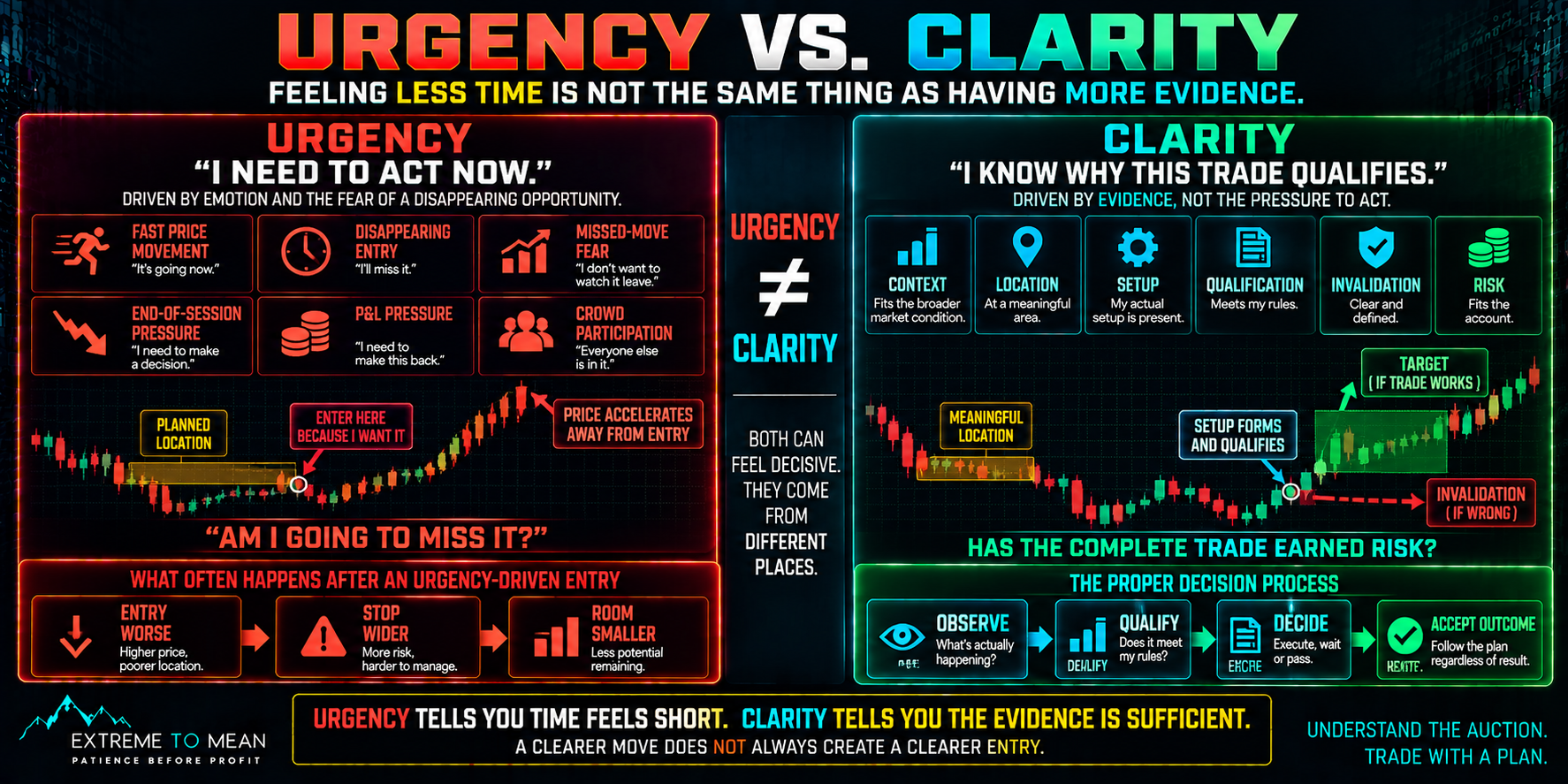
Clarity comes from enough relevant evidence. Urgency comes from fear that there will not be enough time.
Both states can feel surprisingly similar. They can sharpen attention, reduce hesitation, increase conviction, and produce quick decisions, which is why traders can mistake one for the other. The better question is simple: Am I seeing more evidence—or merely feeling less time?
This distinction belongs inside the broader Trader curriculum because good decision-making is not the same thing as slow decision-making. Some valid strategies genuinely require prompt execution, and rapid market movement can contain useful information. The goal is to keep the qualification standard intact even when the market speeds up.
Urgency and Clarity Can Feel Almost Identical
Real clarity comes from the relevant pieces of the trade aligning. The trader can explain the market condition, location, setup, invalidation, risk, and what information would change the thesis. The decision may still need to happen quickly, but the reason for acting is understandable before the outcome is known.
Urgency feels different internally but can produce the same outward behavior. The trader becomes focused, decisive, and unwilling to hesitate because the opportunity appears to be disappearing. Instead of “Does this trade qualify?”, the dominant question becomes “Am I going to miss it?”
That shift is easy to overlook because urgency can feel like conviction. The trader is no longer uncertain about whether they should act; they feel certain that they must decide. But certainty about the need to make a decision is not the same thing as certainty that the trade has met its requirements.
A Fast Market Is Information—but Speed Is Not a Setup
If NQ suddenly accelerates sixty points, the speed matters. It may reveal stronger momentum, changing volatility, imbalance, a breakout attempt, or a meaningful change in the market's current behavior. Ignoring that information simply because it happened quickly would be as unhelpful as blindly chasing it.
What speed does not automatically answer is whether the entry is still good, the setup is complete, invalidation is clear, or the risk still fits. Price can become more directionally obvious while simultaneously becoming more extended and harder to enter responsibly. Speed can change the context without completing the trade.
This is where the trade not being ready until risk is clear remains important. A rapidly moving market does not suspend the need to understand where the idea is wrong. If acceleration makes that answer less clear rather than more clear, the trader has gained directional information while losing part of the trade's structural quality.
Urgency Shrinks a Multi-Question Decision Into One Question
Under normal conditions, a trader might ask several questions before acting. Where is price, what condition is the market in, has the setup formed, where is invalidation, and does the available risk make sense? Those questions keep the decision distributed across several pieces of evidence.
During a fast move, that process can collapse into a binary choice: get in or miss it. Questions about location, setup quality, stop placement, and remaining room begin feeling secondary because the opportunity appears temporary. Urgency turns a multi-question decision into a one-question decision: “Am I going to miss it?”
That is one reason FOMO can feel like opportunity. Movement makes the cost of waiting visible because every new candle shows where the trader could have entered seconds earlier. The chart begins measuring imagined lost opportunity faster than the trader measures whether the current entry still makes sense.
A Clearer Move Does Not Always Create a Clearer Entry
Imagine price sitting just beneath a breakout area. The trader is uncertain because the break has not occurred, but then price suddenly surges through the level and accelerates. Something genuinely became clearer: the market did, in fact, break the boundary with directional force.
At the same time, other parts of the trade may have deteriorated. The entry may now be significantly worse, the logical stop may be farther away, the remaining room may be smaller, and volatility may have expanded. The market becoming more obvious directionally can make the trade worse structurally.
This matters because one clearer component can make the entire trade feel clearer. The trader sees the breakout and mentally upgrades everything else along with it, even though location and risk may have moved in the opposite direction. A clearer move does not always create a clearer entry.
The same problem appears when the original plan required a pullback. Price breaks higher without ever producing that pullback, and the trader's urgency rises as the move gets farther away. Nothing about the planned entry improved; in fact, the planned trade may simply be gone.
Urgency Can Rise While Trade Quality Falls
A rapidly moving market creates a strange contradiction. The farther price moves in the expected direction, the more certain the trader can feel, yet the actual trade may be becoming more difficult to structure. Urgency can make certainty feel higher while trade quality is getting lower.
As price runs, the entry can deteriorate, stop distance can widen, remaining reward can shrink, slippage can increase, and volatility can expand. Those are not arguments that the directional read is wrong. They are reminders that directional correctness and trade quality are different questions.
A useful diagnostic is: “What new evidence did I receive—and what part of the trade became worse while I received it?” If the answer is that momentum improved while entry and risk deteriorated, the trader should evaluate both sides of that change. More confirmation does not automatically mean better execution.
Real Clarity Should Survive Being Explained
Clarity does not require a long pause or waiting for several more candles. It means the trader can explain why the trade qualifies: market condition, location, setup, invalidation, risk, and why immediate execution is required. Real clarity can usually be explained; urgency often can only be felt.
A fast trader may only need a few seconds to run that explanation because the important work was done beforehand. If taking five seconds to verbalize the case causes the entire trade logic to disappear, that is useful information. The point is not to force hesitation; it is to expose whether there was a prepared trade thesis beneath the pressure.
This is why a trading plan made before the open becomes especially valuable when volatility increases. The faster the market moves, the less useful it is to invent entry rules, chase limits, stop logic, and position size in real time. Preparation allows execution to remain fast without allowing qualification to become smaller.
External Urgency and Internal Urgency Are Different
Some trading decisions genuinely have deadlines. A breakout method, very short-term strategy, stop-management decision, event-driven approach, or order-cancellation rule may require prompt action. In those situations, speed belongs to the strategy rather than being evidence that the trader has lost discipline.
That is external urgency: the process itself requires a timely response. Internal urgency is different; the trader feels compelled because they fear that the opportunity will disappear before they can participate. The distinction can be summarized with one question: Does my strategy require speed here—or does my emotion require speed here?
Urgency can also come from sources that have nothing to do with market acceleration. A trader may feel rushed because the session is ending, they missed the previous move, they want to recover a loss, they have a daily P&L target in mind, or they see other traders already participating. A deadline in your head does not create evidence on the chart.
The Market Got Faster. Do Not Make the Decision Smaller.
Suppose NQ has been trading beneath an important area and the trader's plan requires a clean break, acceptable location, clear invalidation, and risk that fits. Price suddenly surges through the area, and Trader A immediately thinks, “There it is. Go.” Within seconds, price is far above the original location, stop placement is less obvious, and volatility is expanding.
Trader A feels more certain because one important piece of evidence improved: the directional break occurred. But entry quality, risk clarity, and extension simultaneously became worse. Trader A treats one clearer component as though the entire trade became clearer and buys because the move feels too urgent to miss.
Trader B recognizes the same breakout as meaningful new information but asks whether the actual entry conditions survived the acceleration. If they still qualify, Trader B can act quickly; if they do not, the decision becomes WAIT / PASS even if the move continues without them. The market got faster. Trader B made sure the decision did not get smaller.
Missing the move would not prove Trader B's process was wrong. The disappearance of one opportunity does not require the trader to lower the standard before it disappears. When that standard gets abandoned simply because price is escaping, chasing the trade has replaced evaluation.
The Urgency vs. Clarity Test
Before acting in a fast market, ask:
- WHAT ACTUALLY CHANGED? — What specific new evidence appeared?
- WHAT DID NOT CHANGE? — Which trade requirements are still unresolved?
- WHAT GOT WORSE? — Did entry, location, invalidation, or available reward deteriorate?
- WHY MUST I ACT NOW? — Is there a process reason or fear of missing?
- CAN I STATE INVALIDATION? — If not, the trade may not be fully clear.
- WOULD I TAKE THIS EXACT TRADE IF PRICE WERE MOVING MORE SLOWLY?
- IF I MISS IT, WILL I STILL CONSIDER MY PROCESS CORRECT?
These questions are not designed to slow every decision. They are designed to prevent one dramatic piece of information from replacing the rest of the trade. Fast execution is completely compatible with disciplined qualification when the requirements were defined before urgency arrived.
A useful way to classify the moment is:
| State | What It Means | Appropriate Response |
|---|---|---|
| Clear, Not Urgent | Setup qualifies and normal execution time exists | Execute normally |
| Clear and Urgent | Setup qualifies and strategy requires prompt action | Follow prepared rules |
| Urgent, Not Clear | Opportunity feels temporary but setup/risk is incomplete | Wait or pass |
| Neither | No complete setup and no time-sensitive requirement | Do nothing |
The dangerous state is URGENT, NOT CLEAR because pressure can impersonate confidence. Clear and urgent is different: the trade already qualified, and the trader simply needs to execute the prepared decision efficiently.
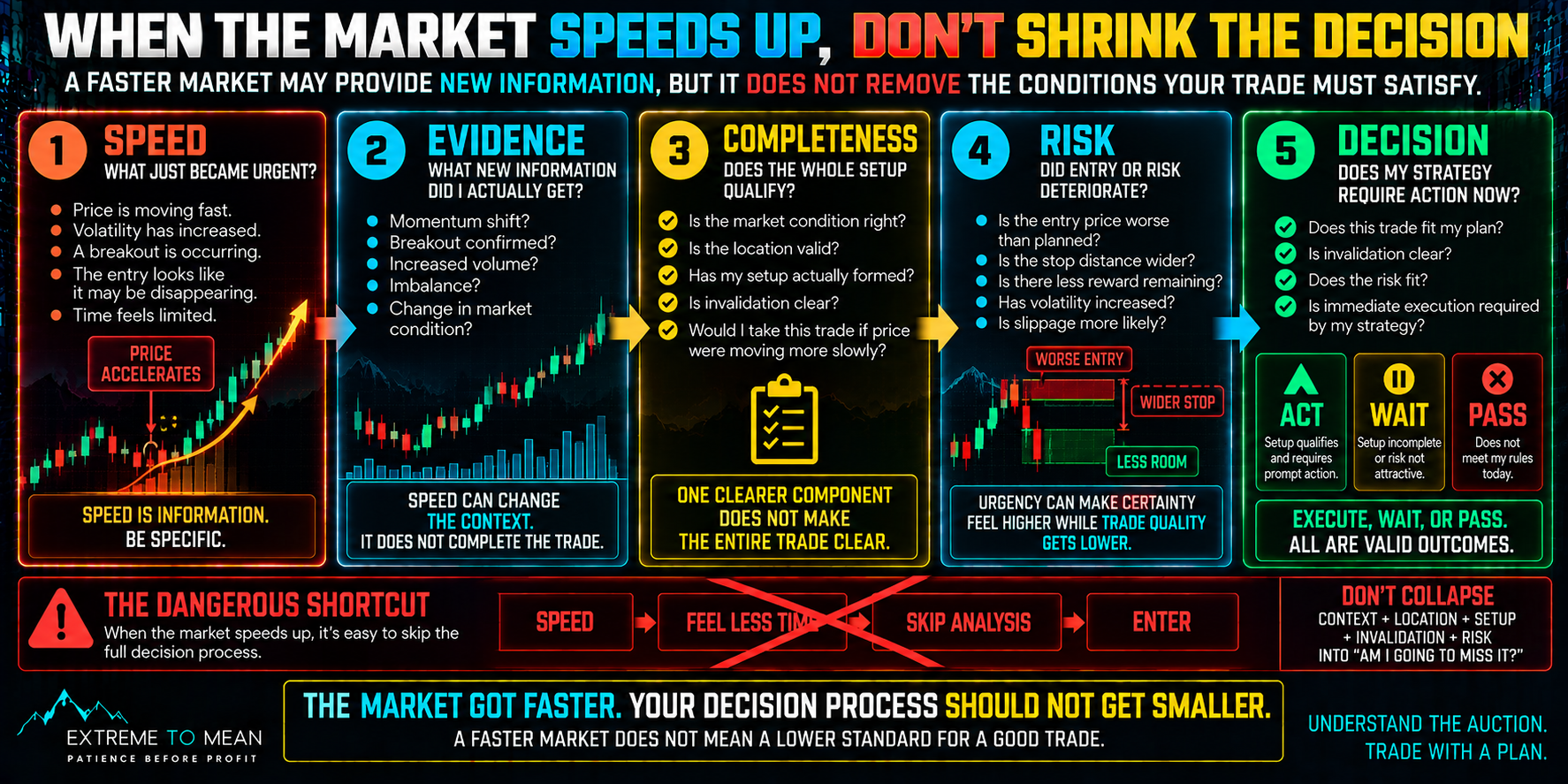
The ETM Speed → Evidence → Completeness Framework
Use this sequence:
- SPEED — What just became urgent?
- EVIDENCE — What new information did the movement actually provide?
- COMPLETENESS — Does the whole setup qualify, or did only one component improve?
- RISK — Did acceleration improve or degrade location, invalidation, and position risk?
- DECISION — ACT / WAIT / PASS
The advanced review question is: Did the evidence improve faster than the trade deteriorated? That does not have a universal answer because different strategies tolerate different kinds of movement and require different execution speeds. It simply forces the trader to evaluate the entire trade rather than rewarding acceleration with automatic permission.
Final Thought
Fast markets can make decisions feel obvious because the cost of waiting suddenly becomes visible. Price is moving, the entry is disappearing, and the trader feels they must act before there is time to think, but urgency and clarity answer different questions. Urgency asks, “How long do I have?” Clarity asks, “Do I have enough evidence?”
A strong process keeps those questions separate. Let speed change the context when it genuinely matters, and act quickly when a qualified strategy requires it, but do not let the fear of missing the move erase the conditions the trade was supposed to satisfy. The market can get faster without your decision process getting smaller.
Educational content only. Trading involves substantial risk and is not suitable for everyone.